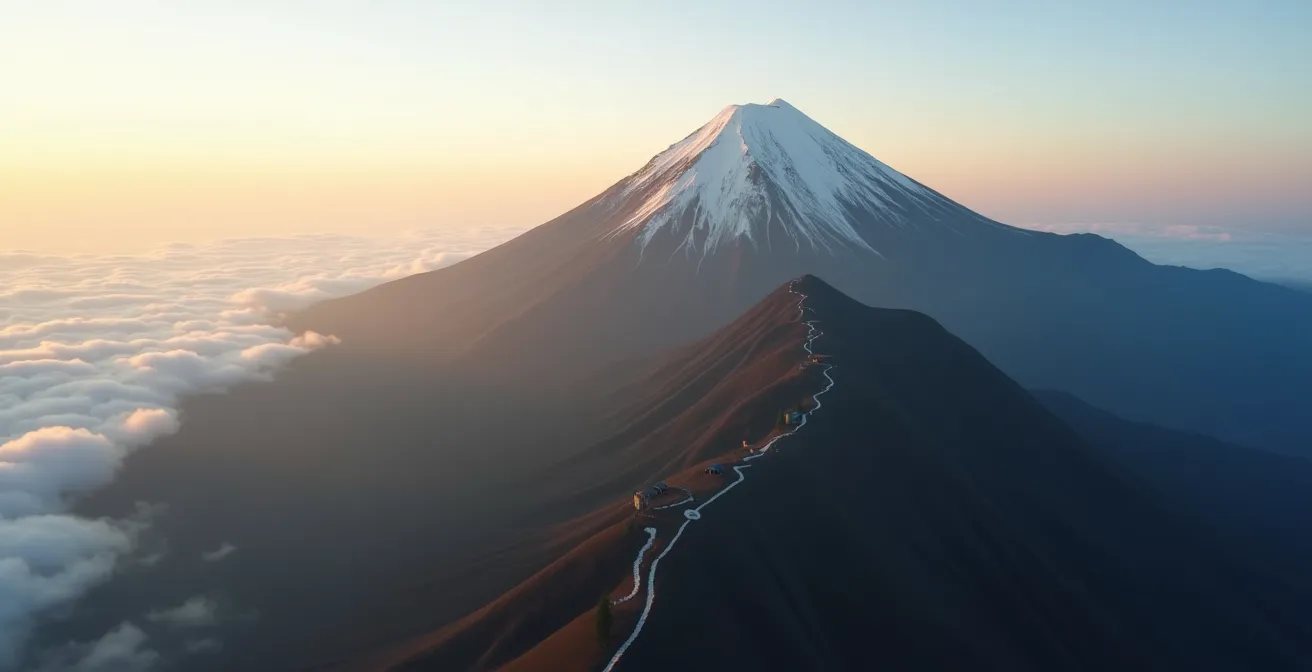
Choosing the “safest” trail for Mt. Fuji is a dangerous misconception; success hinges on mastering the mountain’s non-negotiable rules, not the path you take.
- Altitude sickness is a physiological trap, not a sign of weakness, and requires strict hydration and pacing protocols.
- Logistical failure is the most common reason for disaster; hut reservations and proper gear are mandatory, not optional.
Recommendation: Treat the climb as a serious expedition, not a casual hike. Your safety depends on discipline, not luck.
Many aspiring climbers ask which trail is “safer” for a beginner. The question itself, while logical, is flawed. It presupposes that the primary danger lies in the trail’s gradient or length. As a guide on this mountain, I can tell you unequivocally: the greatest danger is not the trail you choose, but the respect you fail to give the mountain. Both the Yoshida and Fujinomiya trails have their challenges, but hikers fail for the same reasons on both: underestimating the altitude, poor logistical planning, and a lack of discipline. The Yoshida trail, often labeled the “easiest,” is paradoxically where I see the most preventable failures because its popularity encourages a dangerously casual mindset.
Generic advice to “acclimatize” and “dress in layers” is insufficient. It doesn’t prepare you for the specific physiological traps that await above 3,000 meters or the logistical warfare required to secure a safe night’s sleep. This guide will not debate the merits of one trail over another. Instead, it will provide a safety-first briefing on the non-negotiable rules for climbing Mount Fuji, focusing on the common failure points on the popular Yoshida route. We will dissect the reality of altitude sickness, the absolute necessity of hut reservations, the science of layering for the summit freeze, and the critical importance of planned rest. Forget choosing the easy path; focus on making the smart one.
This article provides a structured briefing on the critical factors that determine a safe and successful climb. Follow these sections to understand the real challenges and how to overcome them with disciplined preparation.
Summary: Yoshida or Fujinomiya: Which Trail Is Safer for Beginners?
- Why Do So Many Tourists Get Sick at the 8th Station?
- Hut Reservation Wars: When Must You Book to Secure a Sleeping Spot?
- Shorts or Thermals: What Clothes Do You Need for the Summit Freeze?
- Why Is Climbing Overnight Without Sleep Dangerous and Disrespectful?
- The Subashiri Sand Run: How to Protect Your Knees on the Way Down?
- Rent or Bring: Is It Worth Hauling Camping Gear to Japan?
- Net Cafe Refugees: Is Sleeping in a Manga Cafe Safe for Tourists?
- Snow Monkeys or Sea Views: Choosing the Best Rotenburo Experience
Why Do So Many Tourists Get Sick at the 8th Station?
The climb from the 7th to the 8th Station is what I call the “Great Filter.” This is where enthusiasm meets physiology, and physiology always wins. The air thins, the path steepens, and the body begins to protest the rapid gain in elevation. The primary reason so many hikers become ill here is Acute Mountain Sickness (AMS), or altitude sickness. It’s not a sign of physical weakness; it is a predictable response to ascending too quickly. A pilot study confirmed that on Mt. Fuji, nearly 29.5% of climbers suffer from AMS, with symptoms ranging from headaches and nausea to debilitating fatigue.
The mistake is thinking you can “push through it.” AMS is a serious condition that impairs judgment and physical coordination. The only effective countermeasure is discipline: a slow, deliberate pace and aggressive hydration. Your body needs time to create more red blood cells to transport the scarce oxygen. By pacing yourself to arrive at your 8th station hut in the late afternoon, you allow for several hours of acclimatization before attempting to sleep. Ignoring the early signs of a headache or dizziness is a direct path to a failed, and potentially dangerous, summit attempt. This is not a race; it is a controlled ascent.
Treating hydration and breathing as a core part of your strategy is non-negotiable. It’s the most powerful tool you have to combat the effects of altitude before they sideline your climb.
Hut Reservation Wars: When Must You Book to Secure a Sleeping Spot?
Securing a spot in a mountain hut, particularly on the Yoshida trail from the 8th station onwards, is not a casual booking—it is a logistical battle. The climbing season is short (early July to early September), and demand is immense. Waiting until the last minute is a guarantee of failure. Reservations typically open in April or May, and for weekend climbs, the most desirable huts sell out within hours or days, not weeks. This is the second major filter that stops climbers: logistical failure.
Many climbers are surprised to find that a large number of huts operate on a phone-only, Japanese-language-only reservation system. This can be a significant barrier. As a practical workaround, many foreign climbers find success by asking their hotel concierge or a Japanese-speaking friend to make the call on their behalf. Hotels are often accustomed to this request and are happy to assist. Attempting the climb without a confirmed hut reservation is not only irresponsible but, with new regulations, increasingly impossible.
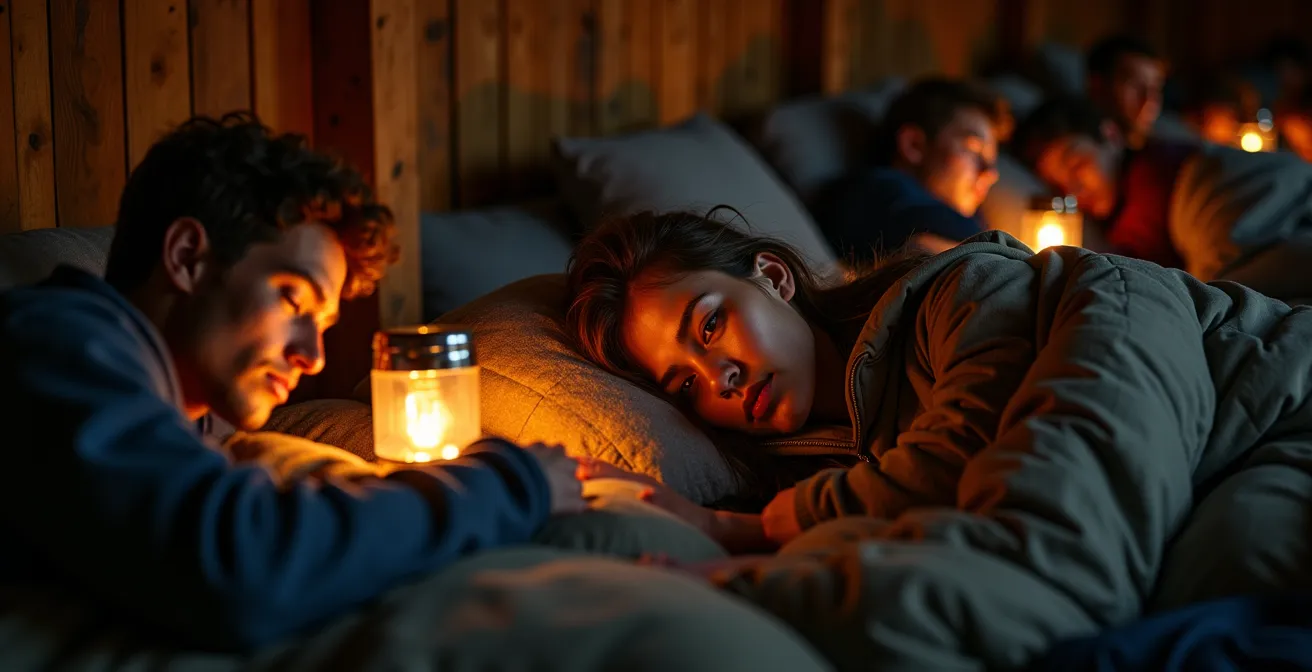
The image above gives a clear sense of the conditions. You are booking a small, shared space for essential rest, not a private room. Arriving without a booking and hoping for a cancellation is a high-risk gamble that disrespects the system and puts both yourself and the hut staff in a difficult position. Book early and confirm your spot; it is a foundational element of a safe climb.
Your reservation is your permit to rest and acclimatize safely. Treat it with the seriousness it deserves and secure it the moment your travel dates are fixed.
Shorts or Thermals: What Clothes Do You Need for the Summit Freeze?
One of the most dangerous underestimations is the dramatic temperature change. You may start your climb at the 5th Station in a t-shirt and shorts, enjoying warm, sunny weather. However, the summit of Mount Fuji is a completely different climate zone. Temperatures at the top regularly drop below freezing (0°C or 32°F), even in August, and when combined with strong winds, the wind chill can be severe and life-threatening. The mistake is packing for a summer hike, not a high-altitude alpine ascent. Hypothermia is a real and present danger.
The only correct approach is a four-zone layering system. This is not a suggestion; it is a mandatory safety protocol. Each layer has a specific function: a base layer to wick sweat, a mid-layer (like fleece) for insulation, and an outer shell to block wind and rain. You add these layers as you ascend through the “zones” of the mountain. Packing shorts is a mistake. Lightweight convertible hiking pants are acceptable for the lower sections, but full thermal underwear is essential for the 8th station and above. Your gear must be prepared for the worst-case scenario at the summit, not the best-case scenario at the base.
Your Four-Zone Layering Protocol for Mount Fuji
- 5th Station (2300m): Start with lightweight, breathable summer clothes. Ensure you have sun protection, including a hat and sunglasses.
- 7th Station (2700-2900m): As the temperature drops, add a fleece or other insulating mid-layer. This is the time to switch to long pants if you started in shorts.
- 8th Station (3000-3400m): Put on your full thermal underwear (top and bottom). Add a down jacket for significant insulation, along with gloves and a warm hat (beanie).
- Summit (3776m): Wear all layers, including a waterproof and windproof outer shell. Use windproof gloves and consider a balaclava or face mask for protection against windburn. A head torch with spare batteries is essential for the pre-dawn ascent.
Remember, there is no such thing as bad weather on a mountain, only bad gear. Being cold is not just uncomfortable; it is the first step toward clouded judgment and a serious safety incident.
Why Is Climbing Overnight Without Sleep Dangerous and Disrespectful?
The practice of “bullet climbing” (dangan tozan in Japanese) involves attempting to ascend and descend Mount Fuji in a single push, typically overnight, without resting in a mountain hut. For years, guides and authorities have warned against this, but now, the rules are formalizing. This practice is not a display of endurance; it is a display of recklessness. The primary danger is severe sleep deprivation, which has been shown to impair cognitive function and judgment as much as alcohol intoxication.
When you are exhausted, your ability to recognize the early symptoms of altitude sickness or hypothermia is dangerously compromised. Your reaction time slows, and your risk of making a critical error—like a misstep on a rocky path in the dark—increases exponentially. The authorities have taken this so seriously that, starting in 2025, new regulations include gate closures from late afternoon to early morning for climbers without hut reservations, specifically to prevent bullet climbing. This, combined with a mandatory entrance fee, effectively makes a planned overnight stay a requirement. The official position is clear, as stated by the Council for the Promotion of the Proper Use of Mt. Fuji:
Bullet climbing involves climbing all night without resting in a mountain hut, and since you are climbing in the dark, there is a high risk of injury, accidents, distress, and altitude sickness.
– Official Mt. Fuji Climbing Website, Council for the Promotion of the Proper Use of Mt. Fuji
Furthermore, attempting a bullet climb is deeply disrespectful. It places an avoidable strain on rescue services and goes against the cultural and spiritual significance of the mountain, which is seen as a place for pilgrimage and reflection, not a 24-hour gym challenge. Respect the mountain, respect the rules, and respect your own physical limits.
The Subashiri Sand Run: How to Protect Your Knees on the Way Down?
The ascent is only half the battle. The descent from Mount Fuji can be just as, if not more, grueling. The long, steep, and repetitive impact is brutal on the knees and quadriceps. The Subashiri trail is famous for its “sand run” (osunabashiri), a wide, straight path of loose volcanic gravel that allows for a rapid descent. While this sounds fun, and can be, executing it incorrectly is a fast track to a knee injury or a painful fall. A similar, though less extensive, sandy section exists on the Yoshida descent trail as well.
The key is not to fight gravity but to control your fall. Many hikers make the mistake of trying to brake with short, choppy steps, which puts immense strain on their joints. The correct technique involves leaning back slightly, taking long, sliding strides, and landing on your heels. You let the soft gravel absorb the impact as you glide downwards. Trekking poles are invaluable here, not for support, but for balance, used like outriggers on a canoe. The single most important piece of gear for this section is a pair of high gaiters. Without them, your boots will fill with sharp volcanic gravel within minutes, leading to blisters and extreme discomfort.
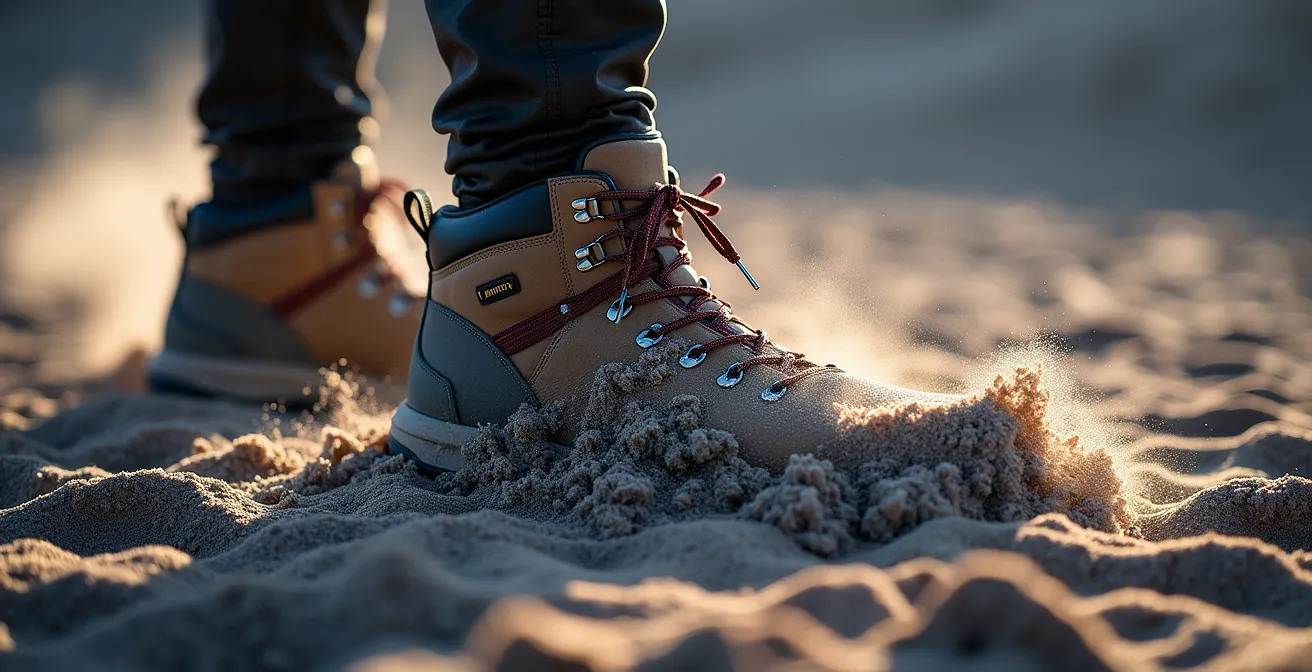
This is a specific skill that must be learned. Practice it in the upper, less steep sections of the sand run before committing to the full gradient. A controlled, joyful slide down the mountain is the reward for a well-executed climb; an uncontrolled tumble is the penalty for carelessness.
Do not underestimate the descent. Conserve enough energy during your climb to ensure you can descend safely and with proper technique, protecting your joints for future adventures.
Rent or Bring: Is It Worth Hauling Camping Gear to Japan?
The question of whether to bring your own climbing gear or rent it in Japan is a matter of balancing cost, convenience, and comfort. Hauling bulky items like a backpack, waterproof jacket, pants, and trekking poles can add significant baggage fees and logistical hassle to your trip. Conversely, you are familiar with your own equipment. Rental services, however, have become an extremely efficient and popular option for Fuji climbers, and for good reason.
Companies like Yamarent and Sora no Shita offer complete, high-quality gear sets that can be reserved online in English and either shipped to your hotel or picked up in Tokyo or near the mountain. The quality is generally excellent. The one piece of equipment you should always bring is your own pair of well-broken-in hiking boots and quality wool socks. Renting boots is a major gamble that can lead to debilitating blisters. The best approach for most international climbers is a hybrid strategy: bring your own boots, socks, and any personal comfort items, but rent the major bulky gear. This offers the best balance of cost, convenience, and safety.
A cost analysis shows that renting can be highly competitive when airline baggage fees are considered. The convenience of having clean, well-maintained gear waiting for you is a significant advantage. The following table provides a general overview of the options.
| Option | Cost | Pros | Cons |
|---|---|---|---|
| Bring Own Gear | $100-200 baggage fees | Familiar equipment, already broken in | Heavy luggage, takes space |
| Rent in Tokyo | ¥10,000 ($100) full set | High quality, can reserve online | Need to pick up/return |
| Rent at 5th Station | ¥12,000-15,000 | Most convenient | Limited sizes, higher cost |
| Hybrid Strategy | ¥5,000-7,000 | Bring boots/socks, rent jacket/poles | Best value option |
Ultimately, having the right gear is non-negotiable. Whether you bring it or rent it, ensure every item on your checklist is accounted for before you set foot on the trail.
Net Cafe Refugees: Is Sleeping in a Manga Cafe Safe for Tourists?
In the context of climbing Mount Fuji, considering a manga or net cafe as a sleeping option is a sign of critical planning failure. These establishments, found in most Japanese cities, offer private cubicles with a computer, internet access, and often a reclining chair or flat mat for a very low hourly rate. For budget travelers, they can seem like a viable, last-minute alternative to a hotel. However, using one as your base for a Fuji climb is an exceptionally poor decision.
While generally safe for locals and experienced travelers, they present several problems for a prospective climber. First, the “bed” is rarely a true bed, and the environment is not designed for deep, restorative sleep. You will be surrounded by the low hum of computers and the quiet movements of other patrons. This is not the quality of rest your body needs before a major physical undertaking. Second, security for your luggage can be a concern. While some offer small lockers, leaving a large backpack full of expensive climbing gear unattended is a risk. You are a “refugee” from proper planning, and it shows.
The only reason a climber would find themselves in this situation is by failing to book a mountain hut and being turned away from the trail, or by arriving in the Fuji area without any accommodation. It should be viewed as an emergency shelter, not a plan. Your performance on the mountain is directly tied to the quality of your rest. Sacrificing sleep in a noisy, semi-public space to save money is a false economy that will cost you your summit attempt. This is not a viable strategy; it is a consequence of logistical failure.
The message is simple and absolute: your Fuji plan must include a reservation for a proper bed, either in a mountain hut for the climb itself or a hotel before and after. There is no other safe option.
Key Takeaways
- Respect the Altitude: Altitude sickness is the primary danger. A slow pace and disciplined hydration are your most critical tools for prevention.
- Logistics are Mandatory: A confirmed mountain hut reservation is not optional. It is a core component of a safe climb, and “bullet climbing” is now actively prevented.
- Gear is Non-Negotiable: The summit is an alpine environment. A complete layering system, including thermals and a waterproof shell, is essential to prevent life-threatening hypothermia.
Snow Monkeys or Sea Views: Choosing the Best Rotenburo Experience
After the rigors of the climb and the jarring descent, there is no greater reward in Japan than soaking your exhausted muscles in an onsen (hot spring). A rotenburo, or outdoor bath, offers a particularly special experience, allowing you to connect with nature. The question of whether to choose one with a view of snow monkeys or the sea is a wonderful dilemma to have, but it’s a choice you only earn the right to make after a successful and safe expedition.
This choice is a metaphor for the entire climb. On the mountain, you are not choosing between pleasant options. You are making a series of critical decisions where the wrong choice has real consequences. The choice is not between shorts or thermals, but between comfort and hypothermia. The choice is not between climbing fast or slow, but between a summit selfie and a medical evacuation. The choice is not between booking a hut or trying a bullet climb, but between disciplined rest and dangerous exhaustion.
The true “rotenburo experience” of climbing Mount Fuji is not the hot spring you visit afterward. It is the deep satisfaction of standing on the summit, knowing you got there not by luck, but by discipline, respect, and meticulous preparation. You made the right choices when it mattered. You respected the mountain’s rules, and in return, it granted you safe passage.
Your journey to the summit begins not at the 5th Station, but with the disciplined preparation you undertake today. Plan meticulously, respect the mountain, and climb safely. That is the only choice that matters.