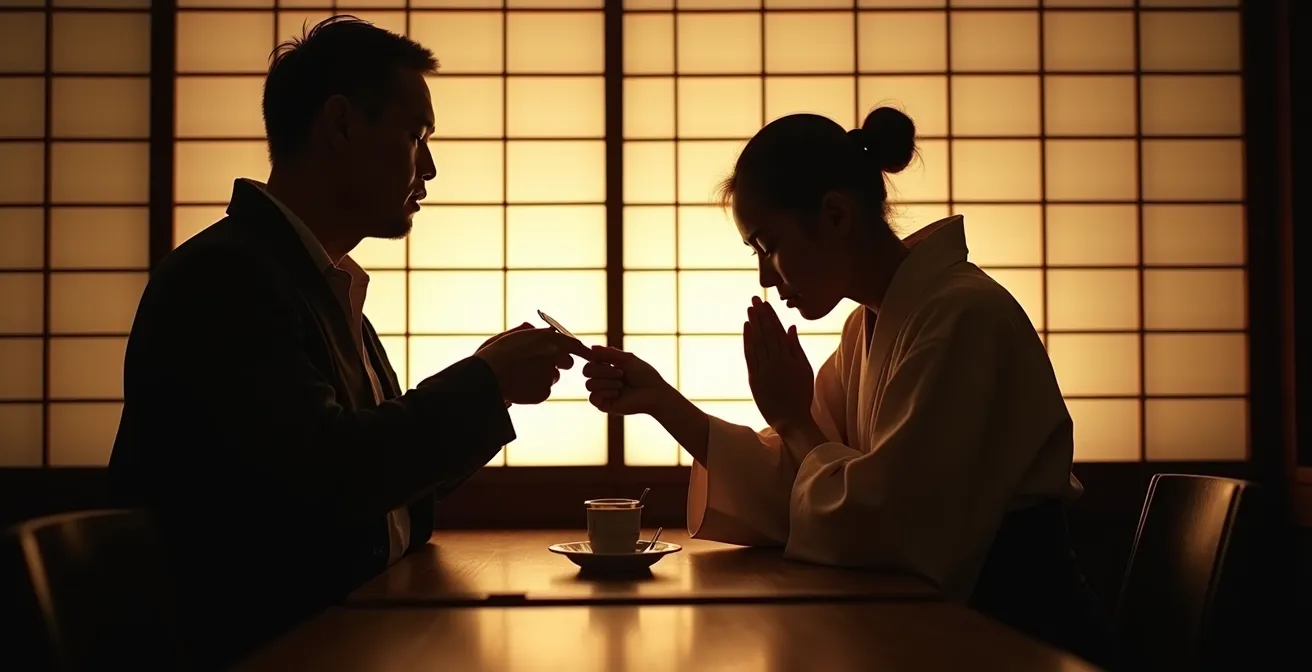
Leaving a tip in Japan doesn’t signal appreciation; it signals a misunderstanding of a service culture built on professional pride, not financial incentives.
- Service quality is driven by a cultural philosophy of anticipatory hospitality (omotenashi), where excellent work is the standard, not a bonus.
- Attempting to tip can cause embarrassment by implying staff are underpaid, and may even lead to them chasing you to return the money.
Recommendation: Express gratitude with polite language and respectful gestures, and understand that all costs, including service, are already built into the price you pay.
For Americans and Western travelers, the act of tipping is almost muscle memory—a deeply ingrained ritual of showing gratitude and ensuring good service. We calculate percentages, worry if it’s enough, and feel a sense of obligation. But in Japan, this well-intentioned gesture can create awkwardness, confusion, and even offense. The issue isn’t about being generous; it’s about a fundamental clash between two different economic and cultural systems for valuing labor. In the West, we often practice transactional gratitude, where a cash bonus is exchanged for superior effort. In Japan, service is rooted in a concept of professional pride, where excellence is the baseline expectation, fully compensated by a salary.
This guide moves beyond the simple rule of “don’t tip” to explain the financial and cultural logic behind it. Understanding this framework is crucial for any money-smart traveler. We’ll decode the philosophy of omotenashi, explain what to do if your tip is refused, and clarify confusing charges like otoshi. By the end, you won’t just know the rules; you’ll understand the system, allowing you to navigate Japan’s service landscape with confidence and respect, ensuring your gratitude is received as intended—not as a monetary misstep.
Summary: A Westerner’s Guide to Japanese Tipping Culture
- Why Japanese Service Is High Quality Without Cash Incentives?
- How to React When a Waiter Chases You to Return Your Tip?
- Ryokan or Guide: Are There Rare Situations Where Gifts Are Okay?
- The ‘Charity’ Misunderstanding: Why Money Is Seen as Rude?
- When to Use ‘Arigato Gozaimasu’ Instead of Cash?
- Why Is There a Cover Charge on My Bill for Food I didn’t Order?
- To Tip or Not: Should You Leave Money for Your Nakai-san?
- Anticipating Needs: How Omotenashi Redefines Luxury Service
Why Japanese Service Is High Quality Without Cash Incentives?
The exceptional quality of service in Japan isn’t a happy accident; it’s the product of a deep-seated cultural philosophy known as omotenashi. This concept goes far beyond simple hospitality. It’s a form of wholehearted, anticipatory service where a host strives to understand and meet a guest’s needs before they are even expressed. This is not driven by the hope of a financial reward. Instead, it’s a matter of professional pride and a reflection of the establishment’s honor. The (generally accurate) assumption is that workers will give a 100-percent effort as the standard, not a lesser amount that needs a bonus to reach its maximum.
As writer Oliver Strand noted when analyzing the culture, “The service culture of Japan, which always over-delivers, directly contradicts the tipping culture of the United States, which supposedly incentivizes superior service but can have exactly the inverse effect.” This is because the motivation is intrinsic, not extrinsic. The core principles of this philosophy include:
- Sakiyomi: The act of anticipating guest needs before they have to ask.
- Ichi-go ichi-e: Treating every single encounter as a unique, once-in-a-lifetime event that deserves full attention and care.
- Dignity through excellence: Viewing impeccable service as a standard that upholds one’s professional dignity.
- Collective honor: Understanding that service reflects on the entire company or team, not just the individual.
In this framework, a tip is not just unnecessary; it’s disruptive. It introduces an external, transactional element into a relationship built on mutual respect and the pursuit of excellence for its own sake.
How to React When a Waiter Chases You to Return Your Tip?
It’s a scenario many first-time visitors dread: you leave a few extra yen on the table, thinking you’re being polite, only to have a staff member urgently chase you down the street to return it. This is not a rebuke, but a correction based on a system where all transactions must be precise. The employee is not trying to embarrass you; they are fulfilling their duty to ensure the bill is paid exactly and no money is misplaced. The key is to handle the moment with grace and understanding, not protest.
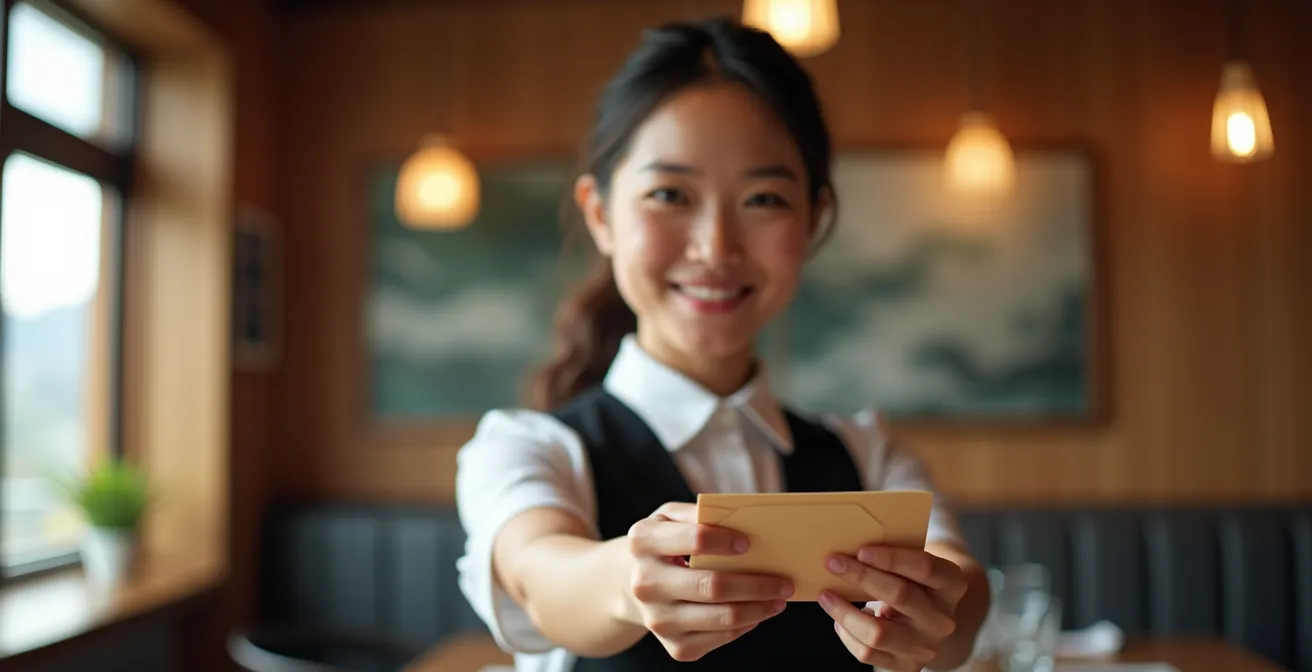
Reacting correctly can turn an awkward encounter into a moment of cultural understanding. Panicking or arguing will only escalate the confusion. Instead, follow a simple de-escalation script to resolve the situation smoothly and politely.
- Stop immediately and turn to face the staff member with a calm, friendly expression.
- Offer a slight bow and say, “Ah, gomen nasai!” (Oh, I’m sorry!). This acknowledges your mistake.
- Accept the money back gracefully without any argument. Do not try to insist they keep it.
- Immediately follow up by expressing your genuine appreciation for the service. Say, “Gochisousama deshita” (Thank you for the meal).
- If you can, add a specific compliment like, “Oishikatta desu” (It was delicious), to make it clear your intention was to show gratitude for a positive experience.
By following these steps, you show that you understand and respect their custom, even if you made an initial mistake. The goal is to defuse the awkwardness and end the interaction on a positive, respectful note.
Ryokan or Guide: Are There Rare Situations Where Gifts Are Okay?
While the rule is “no tipping,” there are rare, specific situations where a token of appreciation, known as kokorozuke (literally, “a piece of the heart”), may be given. This is fundamentally different from a Western tip. It’s not a percentage-based payment for service but a pre-planned, ritualized gift to express gratitude for extraordinary personal care. This practice is most common in high-end ryokans (traditional inns) for your personal attendant (nakai-san) or for a private guide who has been with you for several days.
The key differences are in presentation and intent. Unlike a tip left on a table, a kokorozuke is presented discreetly in a special envelope (pochibukuro) at the beginning of a service. However, even in these cases, it is often politely refused. As one analysis notes, private guides in Japan are paid quite well and do not depend on tips, though the influx of global travelers is making the practice slightly more common. It is crucial never to press the matter if the gift is declined.
This table highlights the stark contrast between the two customs:
| Aspect | Western Tip | Japanese Kokorozuke |
|---|---|---|
| Presentation | Cash left on table | In a pochibukuro envelope, given with both hands |
| Timing | After service | At check-in or start of a multi-day tour |
| Amount | 15-20% of bill | A set, modest amount (e.g., ¥1,000-3,000) |
| Phrase Used | (Often none) | “Tsumaranai mono desu ga…” (It’s an insignificant thing, but…) |
| Acceptance | Expected | Sometimes accepted, often politely refused |
Ultimately, kokorozuke remains a nuanced and largely optional custom. For most travelers, sticking to verbal gratitude is the safest and most respectful path. If you do choose to offer it, be prepared for it to be refused and accept the refusal gracefully.
The ‘Charity’ Misunderstanding: Why Money Is Seen as Rude?
The primary reason tipping is considered rude in Japan is that it subverts the established financial structure and can be interpreted as a form of pity or charity. The system is built on the principle that employees receive a fair, full wage for their work. With Japan’s national average minimum wage set around 1,121 JPY per hour (and higher in major cities like Tokyo), service roles are considered professional jobs with proper compensation. Handing someone extra cash can therefore carry an insulting subtext.
As the Radical Storage Travel Guide points out, when you offer a tip, you may unintentionally imply a financial need, suggesting the worker requires extra money and potentially causing them deep embarrassment. This is the core of the cultural misunderstanding.
When you offer a tip to Japanese service staff, you may unintentionally: Imply financial need: Suggesting the worker needs extra money, potentially causing embarrassment.
– Radical Storage Travel Guide, 2025 Guide to Japanese Tipping Culture
The cultural resistance to tipping is so strong that even organized business efforts to introduce it have failed spectacularly, demonstrating the system’s structural integrity.
Case Study: The Failure of the ‘Tip Project’
In 2021, a business venture called “Tip Project” was launched to introduce American-style gratuity practices into Japanese culture. The project was a categorical failure and shut down within two years. The Financial Times celebrated its demise, with columnist Leo Lewis writing that it was a rare case where one should “relish the failure of a business venture.” According to a report on the initiative, its failure was seen as Japan’s culture being spared from a social “tyranny,” highlighting the deep-seated view that tipping culture is a negative influence, not a positive one.
This strong rejection shows that the no-tipping rule isn’t just a quaint custom; it’s a deliberate defense of a work culture built on professional respect and fair, transparent wages.
When to Use ‘Arigato Gozaimasu’ Instead of Cash?
In a culture where cash tips are off the table, gratitude is expressed through words, respect, and non-verbal cues. A sincere “thank you” holds far more value than a handful of coins. The Japanese language has a rich vocabulary for expressing gratitude, and using the right phrase at the right time is the proper way to show your appreciation for excellent service. A simple “Arigatou gozaimasu” (thank you very much) accompanied by a slight bow is the universal and most effective method.
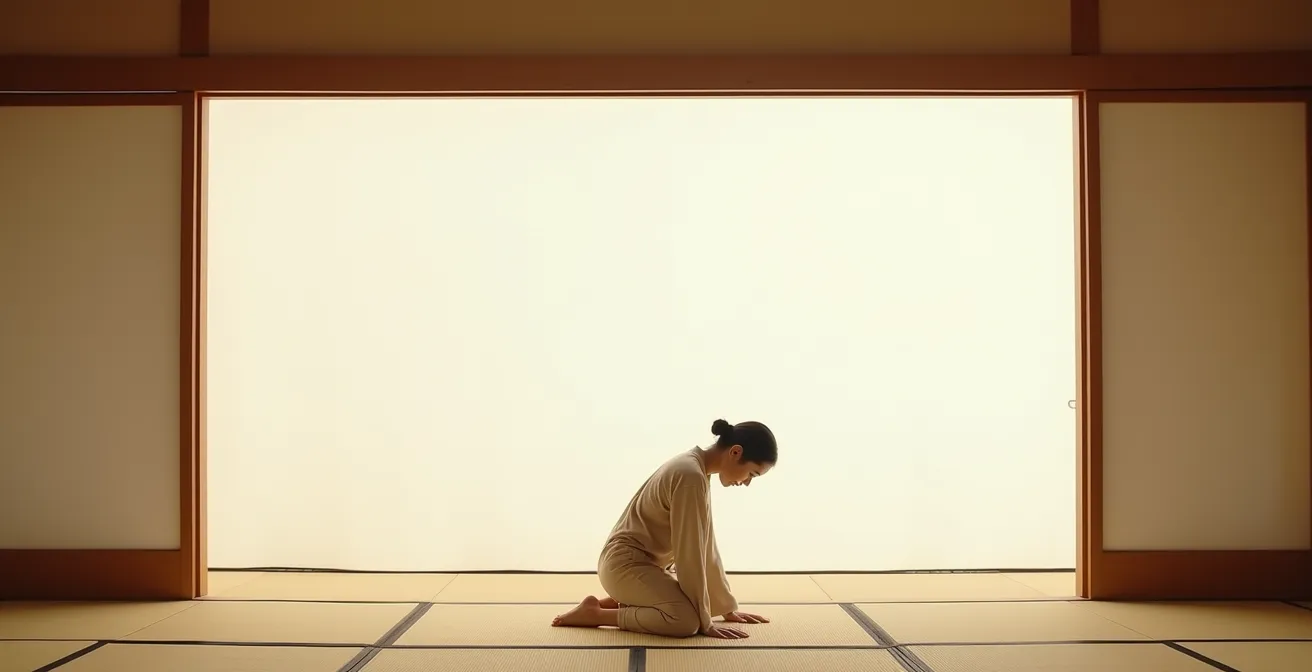
Beyond the standard “thank you,” using more specific phrases demonstrates a deeper level of appreciation and cultural awareness. Your tone and body language are just as important as the words themselves. A warm smile and direct eye contact (while speaking, followed by a bow) convey sincerity. Here are a few key phrases to use instead of cash:
- After a meal: Instead of leaving money, say “Gochisousama deshita” to your server or the chef as you leave. It means “Thank you for the meal” and acknowledges the effort that went into it.
- For help over time: If a hotel concierge or staff member has assisted you repeatedly, use “Osewa ni narimashita” (Thank you for your great help/care).
- For something wonderful: To express admiration for a beautifully presented dish or a wonderful experience, you can say “Subarashii desu ne!” (That’s wonderful!).
- When leaving: A polite “Shitsurei shimasu” (Excuse me for leaving/intruding) as you depart from a shop or restaurant acknowledges their service and your departure.
Mastering these simple expressions of gratitude is the key to being a respectful and appreciative guest in Japan. Your effort to communicate in their language will be recognized and valued far more than any monetary tip.
Why Is There a Cover Charge on My Bill for Food I didn’t Order?
One of the most common sources of financial confusion for Western tourists in Japan is the appearance of a mysterious charge on the bill, often accompanied by a small appetizer you didn’t ask for. This is not a scam or a mistake; it’s a standard cultural practice known as otoshi or tsukidashi. This is a compulsory, non-negotiable table charge, particularly common in izakaya (Japanese pubs) and some other traditional restaurants. It functions as both a seating fee and includes the cost of the small appetizer served.
Think of it as the Japanese equivalent of a cover charge or a bread service fee, but with a small dish included. The fee is charged per person, and refusing it is generally not an option as it’s an integral part of the izakaya experience. The confusion often arises because this custom is so ingrained in local culture that establishments may not bother to list it on English-language menus, assuming patrons already understand it. This leads tourists to believe they’ve been charged for something they didn’t order.
While this might feel strange, it’s important to see it through a different financial lens. It replaces the ambiguity of a tipping system with a fixed, transparent cost. You know exactly what you are paying for service and seating upfront. It’s also worth noting that in some more formal settings, a different fee might appear. For example, some high-end restaurants and luxury hotels may explicitly list a 10-15% service charge on the bill. This, again, is not a tip—it is a mandatory fee that covers the cost of service, and no additional gratuity is expected on top of it.
To Tip or Not: Should You Leave Money for Your Nakai-san?
The most nuanced exception to the no-tipping rule involves the nakai-san at a traditional ryokan. This is your personal attendant who provides an extremely high level of dedicated service—serving your multi-course kaiseki dinner in your room, preparing your futons, and attending to your needs throughout your stay. In this specific context, offering a kokorozuke (a token of thanks) is a recognized, though still optional, custom.
As the experts at All Japan Tours explain, the level of personal care is exceptional.
Your nakai-san will serve your dinner, arrange your futons, and be with you every step of the way. It’s customary to prepare an envelope with 1,000 JPY per person and to give it during check-in.
– All Japan Tours, Tipping Guidelines for Traditional Inns
However, this act must be performed with precise etiquette. It’s not a casual cash hand-off. If you decide to offer a kokorozuke, following the correct protocol is non-negotiable to ensure it is received as a sign of respect, not a rude tip.
Action Plan: Proper Kokorozuke Protocol for a Ryokan Stay
- Prepare the Right Currency: Use crisp, new bills. A common amount is ¥1,000 per guest in your party. Avoid using old or crumpled notes.
- Use the Correct Envelope: Place the money inside a special small envelope called a pochibukuro before you even arrive at the ryokan. These can be found at any stationery store.
- Timing Is Everything: Present the gift at the very beginning of your stay, typically when your nakai-san first greets you in your room during check-in. Never give it at the end like a tip.
- Present It Respectfully: Hold the envelope with both hands and present it with a slight bow.
- Use the Right Phrase: As you hand it over, say “Kore wa honno kimochi desu” (This is just a small token of my feelings) or “Tsumaranai mono desu ga…” (It is an insignificant thing, but…). This humility is a key part of the ritual.
Key Takeaways
- Tipping is generally considered rude in Japan because service is seen as a matter of professional pride, not something requiring a cash incentive.
- Express gratitude with polite Japanese phrases like “Arigatou gozaimasu” and “Gochisousama deshita,” accompanied by a bow.
- In rare cases, like at a high-end ryokan, a pre-packaged gift of money (kokorozuke) may be given at the start of service, but it must follow strict etiquette and may be refused.
Anticipating Needs: How Omotenashi Redefines Luxury Service
Ultimately, the reason tipping feels so out of place in Japan is because the entire philosophy of service, omotenashi, is designed to make it obsolete. It’s a system that redefines luxury not through opulence, but through profound, selfless attention to a guest’s unspoken needs. It’s a quiet, background process that aims for seamless comfort and delight. When service is this intuitive and all-encompassing, the idea of a transactional “thank you” in the form of cash feels clumsy and inadequate.
This philosophy manifests in countless small gestures that, together, create an atmosphere of being perfectly cared for. These are not “extras” performed in hopes of a tip; they are the very fabric of standard service.
Practical Examples of Omotenashi in Action
The magic of omotenashi is in its subtlety. For a foreigner, it might be the fork and spoon that appear silently beside your chopsticks, just in case you need them. It could be the deep, respectful bow you receive when leaving a simple convenience store. One traveler shared their amazement when an airport desk worker tagged their bags and, upon arrival at their home country, they discovered a handwritten note on the tag: “Thank you always – have a nice flight!” This gesture expected no reward and was discovered long after the interaction was over—the purest form of selfless hospitality.
This culture of anticipatory care is the true reward for the consumer. It replaces the anxiety and obligation of tipping with a serene confidence that you are in good hands. By understanding and respecting this system, you are not just avoiding a faux pas; you are participating in a beautiful and efficient cultural exchange, where gratitude is shown with respect, not with money.
Now that you understand the financial and cultural etiquette, you can confidently navigate Japan, appreciating its remarkable service culture the way it’s meant to be: with sincere words and respectful admiration.