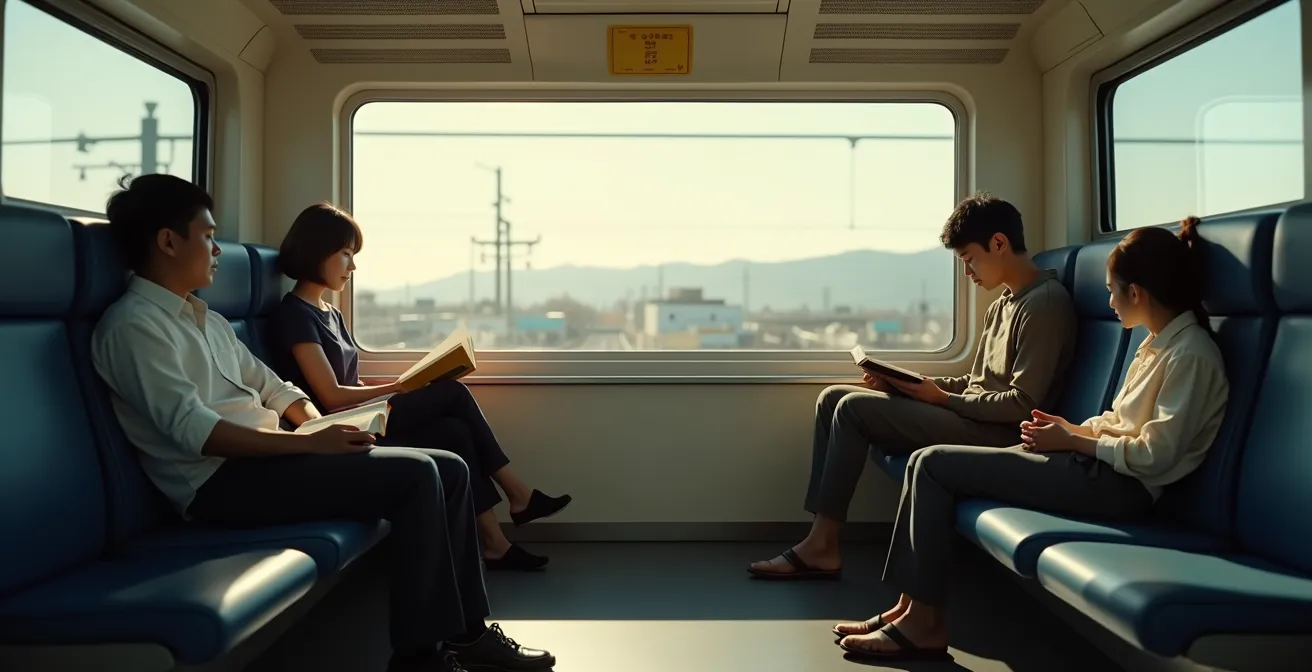
The pervasive quiet on Japanese trains is not a passive cultural habit; it is an active, non-negotiable system for managing personal space in hyper-dense environments.
- Making a phone call is considered a direct intrusion into the shared, public “auditory space.”
- Even sound leaking from headphones is a serious breach of etiquette, known as ‘meiwaku’ (a disruptive annoyance).
Recommendation: Treat silence as the default rule. Your phone must be in ‘Manner Mode’ before you even reach the platform, and any necessary calls must be handled off the train or in designated vestibule areas.
For many travelers, the first ride on a Japanese commuter train is a culture shock. It’s not the speed or the punctuality that’s most striking, but the profound, almost library-like quiet. While you may be accustomed to fellow passengers chatting on their phones or listening to music, in Japan, such behavior is a significant social faux pas. This isn’t just a quaint custom; it’s a strict and deeply ingrained component of public life that tourists and foreign residents are expected to understand and respect immediately.
The common advice is simply “don’t talk on your phone.” While correct, this instruction misses the crucial ‘why’. The silence on Japanese trains is not a sign of shyness or a lack of things to say. It is an active, collectively-enforced system designed to manage the immense social friction of millions of people sharing a confined space. It’s about respecting the integrity of each individual’s personal bubble, which, in Japan, extends to the auditory space around them. Your voice, your notification ping, or the tinny beat from your headphones is not just sound; it’s an unwelcome physical intrusion.
This guide goes beyond the simple rules. It decodes the social mechanics behind the silence. We will explore the core concept of ‘meiwaku’ (disruptive annoyance), outline the precise protocols for handling emergencies, clarify what digital activities are permissible, and provide actionable steps to ensure you are never the cause of a silent, collective sigh from your fellow passengers. Mastering this etiquette is fundamental to a respectful journey through Japan.
Summary: Understanding and Navigating Japan’s Train Silence Etiquette
- Why Is Phone Talking Considered ‘Meiwaku’ on Commuter Trains?
- How to Handle an Emergency Call While on the Shinkansen?
- Texting vs. Calling: What Is Acceptable Usage in Green Cars?
- The Sound Leakage Error That Annoys Your Neighbors Instantly
- When to Switch to ‘Manner Mode’ Before Boarding?
- Why Being Loud in Public Is the Ultimate Taboo in Japan?
- Nozomi, Hikari, or Kodama: Which Train Saves You Time vs Money?
- How to Reserve Oversized Luggage Seats on the Shinkansen?
Why Is Phone Talking Considered ‘Meiwaku’ on Commuter Trains?
The core reason phone conversations are forbidden lies in the concept of 迷惑 (meiwaku). This Japanese term is often translated as “annoyance” or “trouble,” but its meaning is much deeper. Meiwaku refers to any action that disrupts social harmony and imposes on others. In the hyper-dense, shared environment of a commuter train, your private phone call becomes a public broadcast, forcing dozens of strangers to unwillingly participate in your conversation. This is considered a major act of meiwaku, a selfish claim on the shared auditory space.
Case Study: The Tokyo Commuter Train Silence Culture
An analysis of behavior on Tokyo’s notoriously packed train lines during rush hour reveals the power of this social contract. A crowded train is viewed as the ultimate shared public space where personal bubbles shrink to a minimum. In this context, making noise is considered a major act of meiwaku. This shared understanding creates an incredibly peaceful, if compressed, travel experience. The principle is even more pronounced in the premium “Green Car” (first class) of the Shinkansen, which offers a library-like atmosphere for a truly zen-like journey, demonstrating that quiet is a valued commodity.
Unlike background chatter between two people sitting next to each other, a one-sided phone conversation is particularly jarring. The brain of a bystander is forced to try and fill in the other half of the dialogue, making it uniquely distracting and impossible to ignore. Therefore, abstaining from calls is not just polite; it is a fundamental act of civic duty, acknowledging that the collective peace and comfort of the group outweighs an individual’s desire to chat.
How to Handle an Emergency Call While on the Shinkansen?
The rule against phone calls is strict, but Japanese society is also pragmatic. It recognizes that genuine emergencies can occur. However, the definition of an “emergency” is extremely narrow. According to Japanese cultural context, ’emergencies’ are typically restricted to genuine crises like family health issues or accidents, not logistical problems like running late or changing dinner plans. If you must take or make such a call, there is a rigid protocol to follow that minimizes disruption to other passengers.
The primary directive is to remove yourself from the main cabin immediately. Every Shinkansen and most limited express trains are equipped with deck areas (デッキ, dekki) between the cars. This is the only acceptable place to conduct a brief, quiet conversation. Attempting to whisper into your phone from your seat is not an acceptable alternative; the act of speaking itself, regardless of volume, is the source of the disruption. The goal is to make your auditory intrusion as minimal and short-lived as possible.
Action Plan: Emergency Call Protocol on Japanese Trains
- Acknowledge nearby passengers with a silent, apologetic bow as you get up.
- Move swiftly and quietly to the deck area between cars (the ‘dekki’).
- Cover your mouth with your hand to muffle your voice and speak at the absolute minimum volume necessary.
- Keep the call as brief as possible. The ideal exchange is simply, “I’m on the train, I’ll call you back.”
- Offer another slight, apologetic bow to passengers as you return to your seat.
Following this protocol demonstrates your awareness of and respect for the social contract. It signals to others that you understand you are breaking a major rule, but are doing so for a legitimate reason and are taking every possible step to mitigate the disturbance. This adherence to procedure is key to navigating social exceptions in Japan.
Texting vs. Calling: What Is Acceptable Usage in Green Cars?
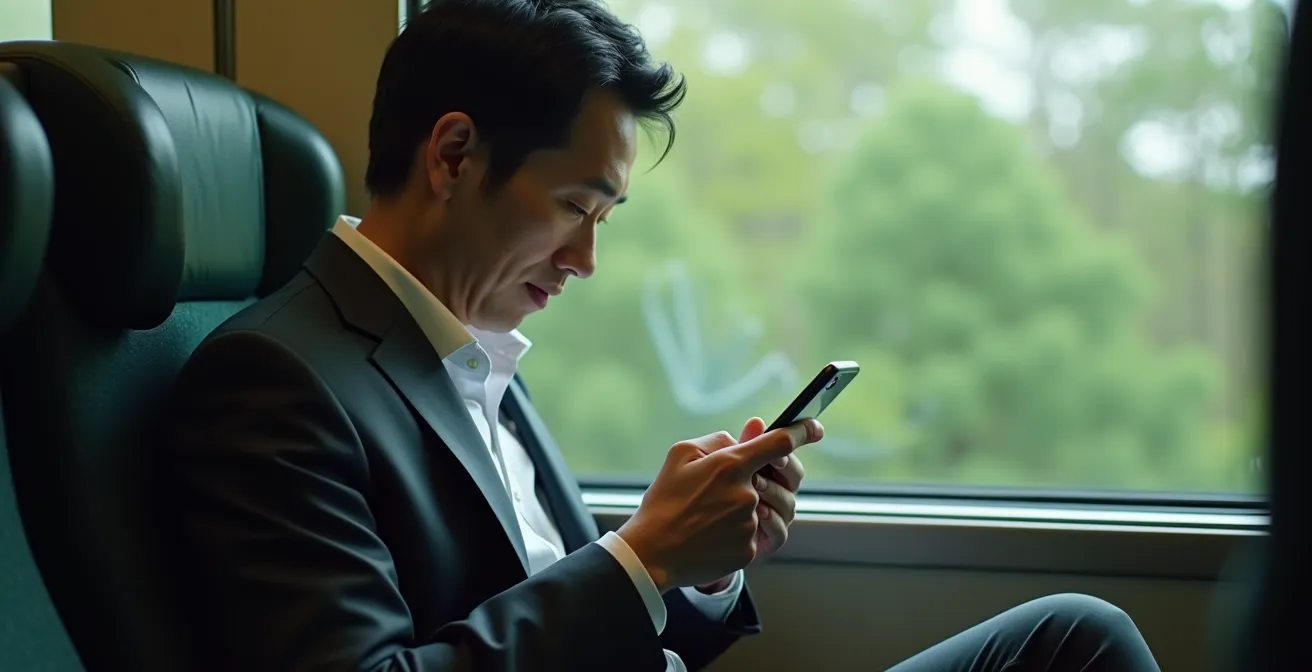
While voice calls are strictly forbidden, the use of smartphones for silent activities is generally acceptable. This is where the distinction between auditory and visual intrusion becomes critical. Texting, browsing the internet, or playing games (with the sound completely off) are permissible because they do not impose on the auditory space of fellow passengers. However, even these activities come with their own set of unwritten rules, especially in the premium “Green Cars” of the Shinkansen, where the expectation for tranquility is at its peak.
In any train car, your digital conduct should be discreet. This means ensuring all sounds are off—not just the ringer, but also keyboard clicks, game sound effects, and notification alerts. In a Green Car, this expectation is amplified. The ambient noise level is lower, so even the vibration of a phone on a tray table can be a disturbance. Bright screens can also be a source of annoyance in the dimly lit, relaxing atmosphere of an evening train, so it’s considerate to dim your display.
The following table, based on common observations and etiquette guidelines, clarifies the difference in expectations between standard train cars and the premium Green Cars.
| Activity | Regular Car | Green Car (First Class) |
|---|---|---|
| Phone Calls | Strictly Prohibited | Even More Strictly Prohibited |
| Texting (Silent) | Acceptable | Acceptable if discreet |
| Video Watching | OK with headphones | OK but avoid bright screens |
| Keyboard Sounds | Should be minimized | Absolutely must be silent |
| Gaming Device Sounds | Must use headphones | Zero tolerance for any sound |
The Sound Leakage Error That Annoys Your Neighbors Instantly
You have dutifully silenced your phone, put on your headphones, and settled in for your journey. You believe you are being a model passenger, but your neighbors are still shooting you annoyed glances. The likely culprit? Sound leakage. This is one of the most common and easily overlooked breaches of train etiquette. The faint, tinny “tsh-tsh-tsh” of music or the muffled dialogue from a video leaking from your headphones is considered just as disruptive and meiwaku as a phone call.
The responsibility for managing sound leakage falls entirely on you. The logic is simple: if others can identify what you are listening to, your volume is too high. This auditory intrusion violates the same principle as a phone call—it forces your private entertainment into the public sphere. As the Japan Transportation Authority states in its guidelines, the expectation of a quiet journey is paramount.
Even phone conversations are discouraged, with announcements regularly reminding passengers to keep their phones on silent mode
– Japan Transportation Authority, Japanese Train Etiquette Guidelines
To avoid this common mistake, you must be proactive. Here are some key points to ensure your audio stays private:
- The Arm’s Length Test: Before you even put your earbuds in, hold one at arm’s length. If you can clearly make out the music or dialogue, it is far too loud for a train.
- Invest in Better Gear: Cheap, open-back earbuds are the worst offenders for sound leakage. Invest in quality in-ear monitors (IEMs) or closed-back headphones, which are designed to isolate sound.
- Set Volume Before Boarding: Adjust your volume to a moderate level in the noisier environment of the station. This will almost certainly be a respectful level for the quiet of the train.
When to Switch to ‘Manner Mode’ Before Boarding?
The transition into the zone of silence begins long before you step onto the train. Many travelers make the mistake of fumbling for their phone’s silent switch as they find their seat, by which time a call or notification may have already disturbed the peace. The correct etiquette is to switch your phone to “Manner Mode” (マナーモード, manā mōdo) proactively. This term, ubiquitous in Japan, refers to the silent or vibrate-only setting.
To build this into an unbreakable habit, link the action to a specific trigger. The most effective method is the “Ticket Gate Trigger.” Make it a reflexive action to silence your phone the moment you tap your IC card (like a Suica or Pasmo) or insert your ticket to enter the station gates. This ensures that by the time you reach the platform—which is also considered a quiet zone—you are already in compliance. This discipline is a common practice, as research shows that Japanese commuters overwhelmingly prefer to use their journey time to read, sleep, or use their phones quietly.
Your responsibility for silence extends beyond just your phone’s ringer. Consider your entire “noise footprint”:
- All Notifications: This includes sounds from text messages, apps, and even smartwatch alerts. A comprehensive silent mode is required.
- Camera Shutter: Japanese phones traditionally had a mandatory, loud shutter sound for privacy reasons. While this is changing, be aware and disable any artificial shutter sound in your camera app before entering the station.
- Physical Noise: Be conscious of the noise your belongings make. The loud clatter of rolling luggage wheels on the platform or the incessant rustling of a plastic convenience store bag are also forms of meiwaku.
Why Being Loud in Public Is the Ultimate Taboo in Japan?
The strict silence on trains is not an isolated rule; it is a manifestation of a much broader cultural norm in Japan that prioritizes public harmony over individual expression. Being loud in any shared public space—be it a library, a quiet cafe, a shrine, or a train—is considered a sign of immaturity and a lack of social awareness. This cultural value is deeply connected to the concept of 空気を読む (kuuki wo yomu), which literally translates to “reading the air.” It is the unspoken ability to perceive the social situation and act accordingly to fit in and maintain harmony.
Case Study: Kuuki wo Yomu – The Art of Reading the Air
The historical roots of this silence culture are tied to Japan’s post-war economic boom. During the rapid urbanization of the 1960s and 70s, millions of people moved from the countryside to sprawling cities, suddenly forced to rely on crowded public transport. This unprecedented density made new behavioral codes urgent. Train companies launched massive public etiquette campaigns promoting quiet behavior, understanding that a peaceful commute was essential for maintaining social stability and preventing the friction of daily life from boiling over.
In this context, a person talking loudly on a train is failing to “read the air.” They are imposing their own needs above the implicit, collective agreement for a tranquil environment. This is why the behavior is seen not just as annoying, but as fundamentally anti-social. As one study on the topic eloquently summarizes, the goal is a seamless, efficient journey for everyone.
Silence is not just a preference but a deeply ingrained social norm that contributes to the overall efficiency, comfort, and tranquillity of train journeys in Japan
– Boston Japanese Trainers Research, The Silent Journey Study
Key Takeaways
- Silence as Respect: On Japanese trains, silence is not merely a preference but a fundamental way of respecting others’ personal and auditory space in crowded environments.
- Zero-Tolerance for Calls: The “no phone call” rule is absolute. In a genuine emergency, you must move to the vestibule area between cars before speaking.
- Sound Leakage is Meiwaku: The faint sound of music from your headphones is considered just as rude as a loud conversation. Use the “arm’s length test” to check your volume.
Nozomi, Hikari, or Kodama: Which Train Saves You Time vs Money?
The Shinkansen (bullet train) network offers different service tiers, primarily the Nozomi, Hikari, and Kodama. While travelers often choose based on speed and cost, a seasoned passenger also considers the “auditory experience.” The type of train you are on can subtly change the expectation of silence. All Shinkansen services are quiet, but the demographic of passengers and the frequency of stops create different atmospheres.
The Nozomi is the fastest, stopping only at major cities. It is the preferred choice for business travelers on long-distance journeys. The atmosphere here is one of focused work or rest. Long, uninterrupted stretches of travel create a “silence marathon” environment where the expectation for absolute quiet is highest. This is the least appropriate place for any form of auditory disruption.
The Hikari stops more frequently and serves a mix of business and leisure travelers. The atmosphere is still very quiet, but the increased passenger turnover at stations means there is slightly more ambient noise from announcements and movement. The expectation of silence remains high.
The Kodama is the slowest service, stopping at all stations. It is primarily used by local travelers, families, and those with more time. The frequent stops and announcements create a more dynamic environment. While loud conversations are still taboo, a brief, quiet exchange between travel companions is more likely to be tolerated here than on a Nozomi. The following table breaks down these nuanced differences.
| Train Type | Stops | Auditory Experience | Passenger Demographics | Silence Expectation |
|---|---|---|---|---|
| Nozomi | Minimal (Super Express) | Long uninterrupted quiet stretches | Business travelers | Highest – ‘silence marathon’ |
| Hikari | Medium (Express) | Moderate announcements | Mixed business/leisure | High |
| Kodama | All stations | Frequent announcements, passenger turnover | Families, local travelers | Moderate – brief conversations more tolerated |
How to Reserve Oversized Luggage Seats on the Shinkansen?
Your commitment to a quiet journey extends beyond your voice and your devices; it includes your belongings. Struggling with oversized luggage, with its accompanying grunts, bangs, and scrapes, is another form of meiwaku that disrupts the tranquil atmosphere of a Shinkansen. To manage this, Japan Railways (JR) has implemented a mandatory reservation system for oversized baggage, which you must use to maintain a low noise profile.
Luggage with total dimensions (length + width + height) between 161 cm and 250 cm requires a reservation for the “oversized baggage area,” which is typically the space behind the last row of seats in a car. You must book a seat in this last row along with the space. Failing to do so is not only an etiquette breach but also incurs a penalty fee. As per current JR regulations, a ¥1,000 fee is charged for bringing oversized luggage aboard without a prior reservation.
Booking this space is simple and can be done online, at ticket machines, or at JR ticket offices when you purchase your Shinkansen ticket. Beyond the reservation, handling your luggage quietly is key:
- Lift Correctly: Lift with your legs, not your back, to place luggage onto the overhead rack (for smaller bags) or into its designated space. This avoids the noise of struggling and straining.
- Place Gently: Never drop your bags. Place them down softly.
- Lock the Wheels: Ensure the wheels on your spinner suitcase are locked to prevent it from rattling or rolling with the train’s movement.
- Consider Delivery: For a truly seamless and silent experience, use Japan’s excellent luggage delivery services (takuhaibin) to send your large bags from one hotel to the next.
By managing your luggage thoughtfully, you are completing the final piece of the puzzle in respecting the train’s quiet environment.
Mastering this auditory etiquette is not optional; it is a fundamental sign of respect that is expected of everyone, visitor and resident alike. It shows you are an observant and considerate traveler. Apply these rules on your next journey to ensure a smooth, respectful, and truly authentic Japanese travel experience.