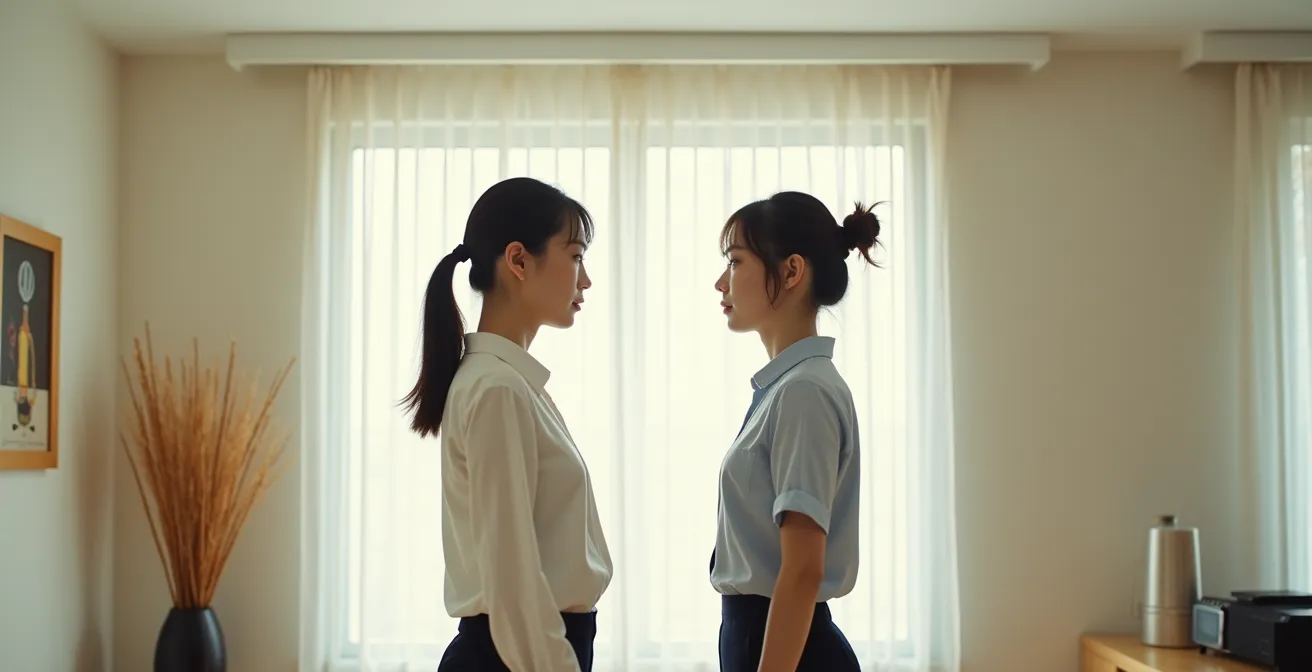
In summary:
- Bow depth is a precise language: a casual 15-degree bow is for greetings, while a 45-degree bow is required for apologies.
- Hand position is not arbitrary; it is gender-specific to convey formal respect (men at sides, women clasped in front).
- Avoid the “bobbing head”; a single, deliberate bow held for 2-3 seconds demonstrates more confidence and respect than multiple, nervous bows.
- Context is key: you are not required to return every bow from service staff, but a nod of acknowledgment is polite.
- The Japanese bow is a form of social punctuation that dictates the rhythm of an interaction, not just a greeting.
For the Western business traveler or tourist in Japan, the simple act of bowing can be a source of significant anxiety. You want to show respect, but the fear of doing it wrong—too deep, too shallow, too often—is palpable. The interaction feels like a test, and you are unsure of the rules. This uncertainty can lead to awkward encounters that undermine the very respect you are trying to convey.
Most guides will offer basic advice: bow from the waist, keep your back straight, and understand that deeper bows equal more respect. While correct, this is like learning the alphabet without understanding grammar. It gives you the pieces but not the ability to form coherent, meaningful sentences. Simply memorizing angles for different situations is insufficient because it ignores the most critical elements: timing, rhythm, and context.
The true key to mastering this custom is to stop thinking of the bow as a static gesture and start seeing it as a form of social punctuation. It is the comma, the period, or the exclamation point in the silent language of Japanese interaction. It dictates the flow of a conversation, establishes hierarchy, and closes transactions with grace. This guide moves beyond mere mechanics to decode the unspoken grammar of the bow.
We will dissect the precise meaning behind different angles, clarify the correct posture to project confidence, and provide a clear framework for navigating the complex choice between a bow and a handshake. By understanding the bow’s role in the overall interactional rhythm, you will learn not just how to bow, but how to use it effectively to build rapport and demonstrate genuine cultural fluency.
This article provides a structured path to mastering this essential skill. Explore the detailed sections below to transform your understanding from hesitant mimicry to confident and respectful execution in any situation you may encounter.
Summary: A Guide to Proper Bowing Etiquette
- Why a 15-Degree Bow Is Insufficient for an Apology?
- How to Position Your Hands During a Bow to Avoid Awkwardness?
- Handshake or Bow: Which Greeting Should You Initiate First?
- The ‘Bobbing Head’ Mistake: Why You Should Stop Bowing Continuously?
- When to Return a Bow from Shop Staff (and When Not To)?
- How to Throw the Coin and Ring the Bell for a Prayer?
- Nakai-san in the Room: How to Behave During a Kaiseki Room Dinner?
- Anticipating Needs: How Omotenashi Redefines Luxury Service
Why a 15-Degree Bow Is Insufficient for an Apology?
In the language of bowing, the angle is not a suggestion; it is a clear statement of intent. A shallow 15-degree bow, known as eshaku, is the equivalent of a casual nod. It is appropriate for informal greetings or acknowledging someone of equal or lower status. Using this angle for an apology, however, sends a message of indifference. It communicates that the offense was trivial and that you do not take the matter seriously, which can worsen the situation.
An apology requires a demonstration of sincere remorse, which is conveyed through a deeper bow. For minor inconveniences, such as being slightly late, a 30-degree bow (keirei) is the standard. For significant business errors or personal offenses, a much deeper bow is necessary. In fact, business etiquette guidelines specify that bows of 45-70 degrees are required for serious apologies. This deepest form of bow, the saikeirei, conveys profound regret and a desire for forgiveness.
The duration of the bow is also critical. A quick dip is insufficient. For an apology to be perceived as genuine, the bow should be held for a minimum of two to three seconds, and even longer for more severe transgressions. This pause demonstrates thoughtfulness and the gravity with which you are treating the issue. Rushing the gesture negates its purpose. Therefore, choosing the correct angle and duration is essential to ensuring your apology is received as a sincere act of contrition rather than a dismissive gesture.
How to Position Your Hands During a Bow to Avoid Awkwardness?
While the angle of the bow conveys the primary message, your overall posture, particularly the position of your hands, completes the picture of respect and professionalism. Fidgeting, keeping hands in pockets, or placing them incorrectly can create a sense of awkwardness that distracts from the gesture itself. Achieving proper postural integrity is a simple yet powerful way to demonstrate that your bow is intentional and well-practiced.
The correct hand position is traditionally gender-specific, a detail that is crucial in formal business settings. For men, the instruction is clear: hands should be placed straight at your sides, with fingers together. The arms should remain straight as you bend from the waist, keeping them aligned with the seams of your trousers. This creates a clean, sharp, and unambiguous silhouette.

For women, the formal position is different. Hands should be clasped gently in front, with one hand over the other, resting just below the abdomen. As you bow, the hands and arms maintain this position. This posture is seen as more modest and formal. Adhering to these gendered conventions is not about outdated norms but about conforming to the established visual language of professional etiquette in Japan. Following these guidelines ensures your bow appears polished and respectful, eliminating any potential for distraction or misinterpretation.
Handshake or Bow: Which Greeting Should You Initiate First?
For a Western professional, the first meeting with a Japanese counterpart presents a classic dilemma: do you offer a hand for a shake, or do you initiate a bow? This moment is your first test of cultural awareness, and a misstep can create a moment of hesitation. The guiding principle in this complex gesture hierarchy is to defer to your host or the senior person present. As a guest, the most respectful action is to wait and mirror their lead.
In many international business contexts today, Japanese professionals will offer a handshake to a Westerner as a sign of global business acumen. If a hand is extended to you, it is appropriate to take it. Often, this results in a hybrid gesture—a handshake combined with a slight bow. If this occurs, focus on the handshake while delivering a small bow or nod; attempting a deep bow while shaking hands is physically awkward and unnecessary. The expert advice for foreigners who are unsure is to simply pause. As the Interac Network’s guide for foreigners notes:
If you are in Japan and you aren’t sure, you should wait until someone else moves first and copy them.
– Interac Network, Guide for Foreigners in Japan
To navigate these situations with confidence, it helps to have a mental framework. The decision often depends on status, setting, and your role as a guest or host. A formal decision matrix can provide clarity in the crucial opening seconds of an introduction.
| Your Status | Their Status | Setting | Recommended Action |
|---|---|---|---|
| Guest/Visitor | Host | Formal Business | Wait and mirror their gesture |
| Junior | Senior | Any | Bow first, deeper angle |
| Foreign Professional | Japanese Colleague | First Meeting | Pause briefly, then reciprocate |
| Equal Rank | Equal Rank | Informal | Light bow or handshake acceptable |
Ultimately, a brief, respectful pause is your most valuable tool. This moment allows your counterpart to initiate the greeting they are most comfortable with, and your ability to respond gracefully will be seen as a sign of respect and emotional intelligence. The data in the preceding table is based on general etiquette rules, further detailed in a comprehensive guide on Japanese customs.
The ‘Bobbing Head’ Mistake: Why You Should Stop Bowing Continuously?
One of the most common and visible mistakes made by foreigners is the continuous, nervous bow—a rapid-fire series of head bobs. This often stems from a well-intentioned but misguided attempt to show continuous respect. However, it projects uncertainty and can create an awkward feedback loop, where each party feels compelled to return the other’s bow endlessly. This disrupts the natural interactional rhythm and turns a graceful gesture into a frantic one.
The dynamic is perfectly captured by the cultural guide Tofugu, which describes the internal monologue of two people caught in this loop. This highlights the social pressure that leads to the “bobbing” phenomenon.
When two such people are bowing to each other, they will often feel compelled to return every bow the other person makes. ‘Hey, he bowed,’ Person A will think, ‘so I’d better bow again!’ Person B, seeing this, will say to themselves, ‘Oh no, she bowed again, so I have to bow, too!’
– Tofugu, Japanese Bowing: The Definitive Guide
The solution is to embrace the principle of postural integrity: one clean, well-executed bow is far more powerful and respectful than a dozen hesitant ones. A proper bow is a deliberate act with a clear beginning and end. By performing a single, controlled bow and holding it for the appropriate duration, you signal the end of the gesture. This gives your counterpart a clear cue that no further reciprocation is needed, gracefully concluding the exchange. If you catch yourself falling into a nervous bobbing pattern, it is crucial to have a strategy to regain composure and reset the interaction.
Your Action Plan: The Recovery Maneuver to Stop Nervous Bobbing
- Pause Deliberately: The moment you notice you are bobbing, consciously stop your motion.
- Reset Your Posture: Return to a straight, upright standing position (seiritsu) to break the cycle.
- Breathe to Compose: Take a single, calm breath to regain your composure and focus.
- Execute a Single, Clean Bow: Perform one final, decisive bow at the correct angle for the situation.
- Hold for Duration: Hold the bow for 2-3 seconds to give it weight and finality.
- Return with Control: Rise slowly and with control back to your upright position, signaling the exchange is complete.
When to Return a Bow from Shop Staff (and When Not To)?
As you navigate daily life in Japan, you will be greeted with bows constantly, especially in retail and service environments. Upon entering a store, you will be met with a chorus of “Irasshaimase!” (Welcome!) accompanied by bows from the staff. For a visitor, the instinct might be to return every single one. However, this is not expected and can even be slightly awkward. Understanding the reciprocity calculus in these situations is key to behaving like a seasoned traveler rather than a confused tourist.
The bows from service staff are part of their professional duty and a component of omotenashi (Japanese hospitality). They are an expression of welcome and gratitude for your patronage, not a personal greeting requiring a formal bow in return. Constantly bowing back to every convenience store clerk or department store employee is unnecessary. Instead, a simple acknowledgment is sufficient and demonstrates good manners.
The appropriate response exists on a spectrum, depending on the context and level of personal interaction:
- Entering a Store: When greeted with “Irasshaimase,” a simple smile and a slight nod of the head are perfectly sufficient. No bow is needed.
- Receiving Service: If a staff member helps you find an item, a more direct nod of acknowledgment is appropriate.
- At Checkout: After paying, a more pronounced nod or a very slight bow (around 5 degrees) as you receive your items and change is a polite way to say thank you.
- Small, Family-Run Shops: In a smaller, more intimate setting where you have direct interaction with the owner, returning a bow more respectfully is appropriate and appreciated.
This nuanced approach shows that you understand the different levels of formality and are not just robotically mimicking every gesture you see.
How to Throw the Coin and Ring the Bell for a Prayer?
For a respectful tourist visiting a Shinto shrine, observing or participating in prayer rituals is a unique cultural experience. The process typically involves making a small offering, ringing a bell, and performing a sequence of bows and claps. Understanding the symbolism behind these actions is crucial to performing them with respect rather than just going through the motions. The offering is not a payment, but a gesture of gratitude and a way to politely get the attention of the kami (deities).
The coin is traditionally tossed—not dropped—into the large offering box called a saisen-bako. While any coin is acceptable, many people prefer to use a 5-yen coin (go-en), as its name is a homophone for the word for good fortune or good relationships (ご縁). After the offering, you will see a thick rope attached to a bell. You should ring the bell once or twice firmly to announce your presence to the kami. The sequence that follows is typically:
- Two deep bows.
- Two loud claps.
- A moment of silent prayer with your hands held together.
- One final, deep bow.
However, for non-believers or those who feel uncomfortable participating, observation is a perfectly respectful alternative. There is no obligation to perform the ritual. If you choose to observe, stand back from the main worship area to avoid disrupting those who are praying, and refrain from taking photos unless signage explicitly permits it. A single, respectful bow toward the shrine before you leave is a sufficient gesture of reverence.
Nakai-san in the Room: How to Behave During a Kaiseki Room Dinner?
A kaiseki dinner, a traditional multi-course Japanese meal, is an immersive cultural experience often enjoyed in a private room at a ryokan (traditional inn). Your host for the evening is the nakai-san, a dedicated attendant who serves your meal with choreographed precision. Interacting with the nakai-san requires a subtle understanding of etiquette; the goal is to show appreciation without disrupting the seamless flow of service.
The nakai-san will enter and exit the room numerous times, presenting each course and clearing dishes. This is not an invitation for extended conversation. Your role as a guest is to facilitate their work and enjoy the experience. Long chats, asking personal questions, or otherwise detaining them can disrupt the timing of the meal for you and other guests. Communication should be minimalist and respectful, using a few key phrases and gestures to convey your gratitude.
A simple, minimalist verbal toolkit is all that is required:
- Upon Arrival: When the nakai-san first enters and greets you, a polite “Onegaishimasu” (I’m in your care) with a respectful nod is appropriate.
- When Served: As each course is placed before you, a slight nod of the head is sufficient. A verbal “thank you” for every single dish is not necessary.
- At Meal’s End: When the service is complete, a sincere “Arigatou gozaimasu” (Thank you very much) accompanied by a respectful nod or slight bow is the correct way to show your appreciation.
You can also show respect by being a considerate guest. If possible, move small items to make space for a new dish, and when a course is finished, you can gather the empty dishes to one side to make clearing them easier. These small, thoughtful actions are a form of non-verbal communication that is deeply appreciated.
Key takeaways
- The angle of a bow is a precise unit of meaning; 15° is a casual greeting, while 45° is a formal apology.
- Postural integrity is key; a single, clean bow held for 2-3 seconds conveys more respect than continuous, nervous bobbing.
- Hand position is a formal, gender-specific detail: men’s hands at their sides, women’s hands clasped in front.
Anticipating Needs: How Omotenashi Redefines Luxury Service
The bowing you encounter in Japan, from business meetings to retail stores, is a visible expression of a much deeper cultural concept: omotenashi. This term is often translated as “hospitality,” but its meaning is far more profound. It is a philosophy of service centered on anticipating needs and providing care wholeheartedly, without any expectation of reward. This is why a Japan National Tourism Organization survey shows a visitor satisfaction rate over 90% with Japanese service quality.
This contrasts sharply with the Western model of service, which often operates on a transactional basis. As highlighted in a comparative analysis of hospitality cultures, Western service frequently comes with an implicit expectation of a tip or other reward. In Japan, however, the act of providing excellent service is its own reward. The meticulous attention to detail, the thoughtful gestures, and the seamless experience are offered from a place of genuine care. This is the reason there is no tipping culture in Japan; to offer a tip can be seen as suggesting the service was not provided unconditionally.
Understanding omotenashi provides the final, crucial context for the act of bowing. The bow from a shopkeeper is not a plea for a purchase but an expression of welcome. The deep bow from a business partner after a successful deal is not just a formality but a sincere acknowledgment of the relationship. These gestures are the physical manifestations of a culture that places immense value on consideration for others. By recognizing this, you move from simply performing a gesture to truly understanding the heart behind it.
Your next step is to begin observing these nuances in practice, transforming knowledge into confident action and turning every interaction into an opportunity to build genuine, lasting respect.