In summary:
- The first step to showing respect is learning to distinguish a Shinto shrine (marked by a torii gate) from a Buddhist temple (marked by a larger, house-like sanmon gate).
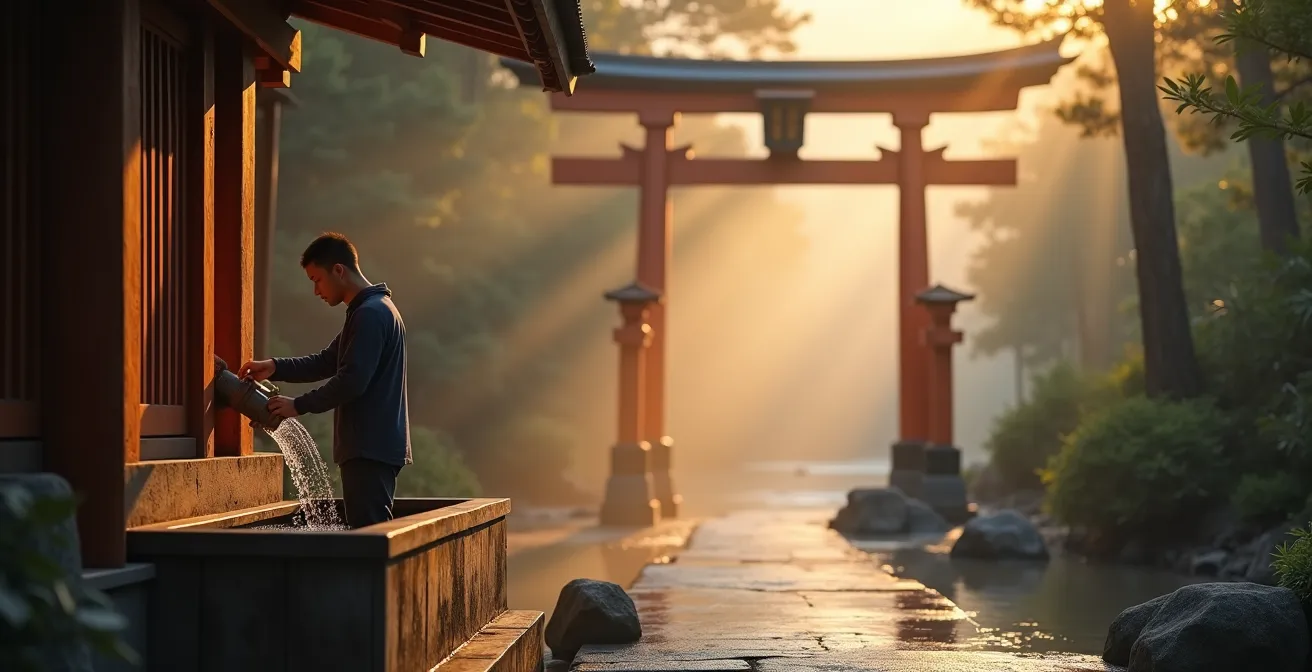
- Before approaching the main hall, you must perform a purification ritual at the chozuya (water pavilion), cleansing your hands and mouth with a single ladle of water.
- The core prayer ritual is known as ni-rei, ni-hakushu, ichi-rei, which translates to “two bows, two claps, one bow,” performed after making a small coin offering.
- Always walk along the sides of the path (sandō) leading to the shrine, as the center (seichū) is reserved for the passage of the deities (kami).
As you approach a serene Shinto shrine in Japan, a feeling of peaceful reverence often washes over you. But for many visitors, this awe is mixed with a touch of uncertainty. You want to be respectful, to participate in the traditions you see, but the sequence of bowing, clapping, and praying can feel like a complex dance for which you don’t know the steps. Many guides offer simple checklists, but these often miss the heart of the matter. Visiting a shrine is not about mechanically following rules; it is a chance to quiet your mind and express sincere gratitude.
As a shrine maiden (miko), I see many visitors who are hesitant, worried about making a mistake. My hope is to gently guide you through not just the “what” but the “why” of these beautiful rituals. The key is not perfect execution, but a mindful intention. Understanding the spirit behind each gesture transforms it from a confusing rule into a meaningful act of communication. From the moment you pass under the torii gate to the final, silent bow, you are embarking on a short, spiritual journey.
This guide will walk you through that journey. We will explore each step, from telling a shrine apart from a temple to the proper way to purify yourself and offer a prayer. By the end, you will be able to approach any shrine with confidence and a deeper appreciation for the customs that have been practiced for centuries.
Summary: What to Do at a Shrine: The 2-Bow, 2-Clap, 1-Bow Rule Explained
- Torii Gate or Pagoda: How to Instantly Tell Shrines From Temples?
- Why You Should Avoid Walking in the Center of the Torii Path?
- How to Throw the Coin and Ring the Bell for a Prayer?
- Omamori Rules: Can You Buy Charms for Different Religions?
- When and Where to Return Your Old Omamori Amulets?
- Why Just Taking Photos Misses the Point of Temple Visits?
- Salt and Stomp: What Do the Pre-Match Rituals Actually Mean?
- How to Purify Your Hands at the Chozuya Without Looking Clumsy
Torii Gate or Pagoda: How to Instantly Tell Shrines From Temples?
Before you can practice the right etiquette, you must first be sure of where you are. In Japan, sacred sites are everywhere, but they primarily fall into two categories: Shinto shrines and Buddhist temples. With over 84,000 Shinto shrines and 77,000 Buddhist temples across the country, distinguishing them is the first step in showing respect. Confusing the two is a common mistake for visitors, but a few simple visual cues can make you an expert in no time.
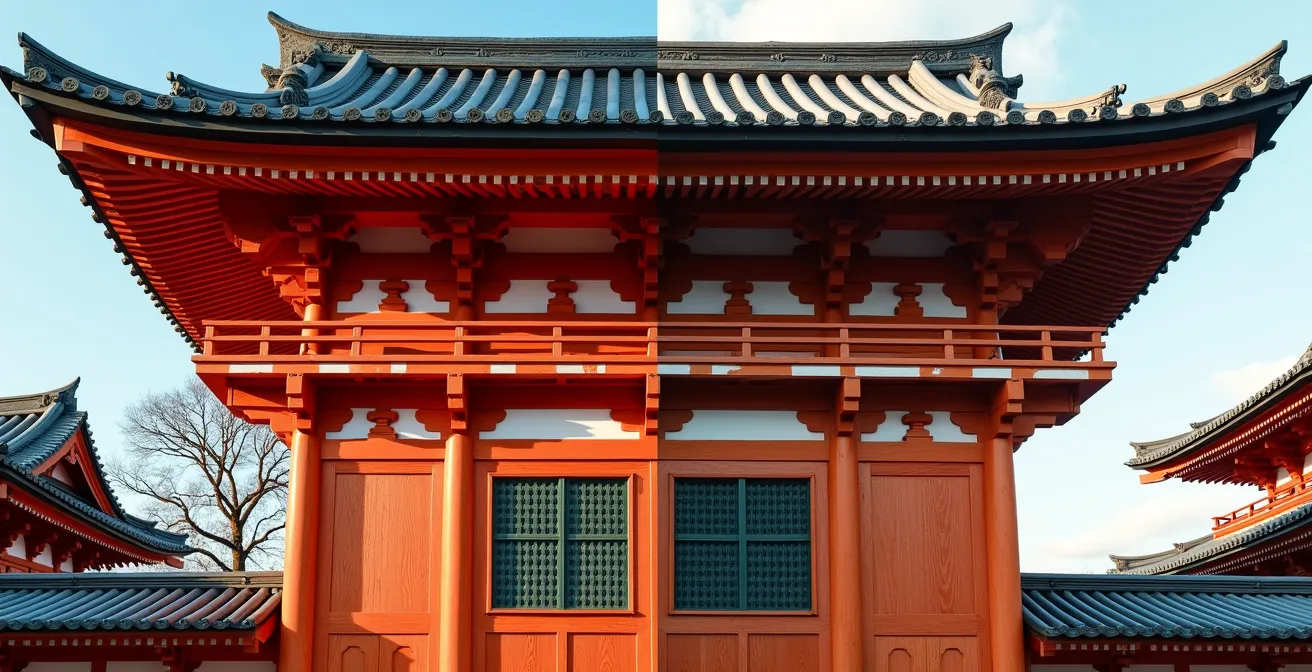
The most immediate giveaway is the entrance. A Shinto shrine is almost always marked by a torii gate, a simple structure usually consisting of two upright pillars and two horizontal crossbars, often painted a vibrant vermilion red. This gate symbolizes the boundary between the mundane world and the sacred space of the kami (deities). In contrast, a Buddhist temple features a more substantial, house-like gate called a sanmon, which is often a large, ornate wooden structure with a roof and sometimes fierce guardian statues on either side. Here are the key differences to look for:
- The Gate: Shrines have simple torii gates. Temples have large, complex sanmon gates.
- Religious Imagery: Temples are filled with statues of Buddha and Bodhisattvas. Shrines, which focus on nature deities, typically do not feature such imagery, though you may see statues of guardian animals like foxes (kitsune) or lion-dogs (komainu).
- The Name: The name of a site is a clear clue. Shrine names often end in “-jinja,” “-jingu,” or “-sha,” while temple names end in “-ji” or “-tera/-dera.”
Why You Should Avoid Walking in the Center of the Torii Path?
Once you pass through the torii gate, you’ll find yourself on the main approach to the shrine, a path known as the sandō. You may notice that many local visitors tend to walk along the sides of this path rather than straight down the middle. This is not by accident; it is a deeply ingrained gesture of respect. The very center of the path is considered the walkway for the deities themselves.
The center of the sando is called the seichu (meaning ‘the exact middle’) and is considered to be the path where the deities pass. For a person therefore, to walk along the same path is deemed disrespectful.
– Yakult Corporation Cultural Guide, Japanese Customs and Etiquette Guide
By consciously choosing to walk on either side of the path, you are making way for the kami, showing humility and reverence before you even reach the main hall. This practice underscores a central theme in Shinto: the physical world is shared with the divine, and human actions should acknowledge their presence. While not a strict rule at every single shrine, it is a custom that is widely observed and appreciated, especially at more significant sites.
Case Study: The Seichū Path Protocol at Ise Jingū
At Ise Jingū, Japan’s most sacred Shinto shrine, this protocol is taken very seriously. The walking etiquette is even more specific: visitors are instructed to walk on the left side of the path at the Outer Shrine (Gekū) and on the right side at the Inner Shrine (Naikū). This formal practice demonstrates how the concept of the seichū, or the “exact middle” path reserved for deities, is a foundational element of shrine worship, rooted in ancient purification rituals established in Japanese mythology.
How to Throw the Coin and Ring the Bell for a Prayer?
As you arrive at the main hall (haiden), you will see an offering box called a saisen-bako and, often, a thick rope attached to a large bell. This is where the central act of prayer takes place. The process might seem intimidating, but its purpose is simple: to politely get the attention of the kami and offer your gratitude or make a wish. The coin you toss is not a payment but a symbolic offering to show your sincerity.
While any amount is acceptable, some coin values are considered particularly lucky due to wordplay in Japanese. For example, a 5-yen coin (go-en) sounds like the word for “good connection” or “fate.” According to tradition, the most common offerings carry symbolic meanings; 15 yen can mean “plenty of good connections,” and 25 yen signifies “double good connections.” However, the sincerity of your prayer is far more important than the amount you offer. Here is the gentle, step-by-step sequence for offering a prayer:
- Approach and Bow: Stand before the offering box and perform a slight bow.
- Make Your Offering: Gently toss your coin into the saisen-bako. Avoid throwing it forcefully.
- Ring the Bell: If a bell is present, take the rope and ring it two or three times. This is done to respectfully announce your presence to the kami.
- The First Two Bows: Bow deeply twice, bending at the waist to about a 90-degree angle.
- The Two Claps: Bring your hands together in front of your chest. Clap your hands twice, keeping your left hand slightly forward to show respect.
- Your Prayer: With your hands still together, offer your prayer silently. This can be a wish for the future or, more traditionally, an expression of gratitude for the present.
- The Final Bow: To conclude, perform one final deep bow.
Omamori Rules: Can You Buy Charms for Different Religions?
After your prayer, you will likely visit the shrine office (shamusho), where you can receive various items, including beautiful protective amulets known as omamori. These small, brocade pouches are consecrated objects, each containing a blessing from the shrine’s deity for a specific purpose, such as good health, success in exams, safe travels, or finding love. They are not mere souvenirs but are meant to be kept close to you, attached to a bag, in your car, or on your person, to provide protection and good fortune.
A common question visitors have is whether it’s acceptable to have omamori from different shrines, or even from both Shinto shrines and Buddhist temples. A popular myth suggests that the gods might get jealous, but this is not the case. It is very common in Japan for people to visit different sacred sites to pray for different things and to carry multiple charms. The key is your intention. You are not being disloyal; you are simply seeking blessings from deities who specialize in different areas.
It is important to treat these charms with respect. They should never be opened, as this is believed to release the blessing contained within. Furthermore, their power is not considered infinite. Traditionally, most omamori cost between ¥300 and ¥1,000 and are replaced annually, as priests explain that each charm has an “expiration date” of about one year. After this period, they should be properly returned.
When and Where to Return Your Old Omamori Amulets?
An omamori is not meant to be kept forever. After about a year, or once its purpose has been fulfilled, its spiritual energy is considered to have waned. During its time with you, it has not only offered protection but has also absorbed a year’s worth of misfortune on your behalf. Therefore, simply throwing it in the trash is seen as highly disrespectful. Instead, there is a proper and beautiful ritual for its disposal, which allows you to express gratitude for the protection it provided.
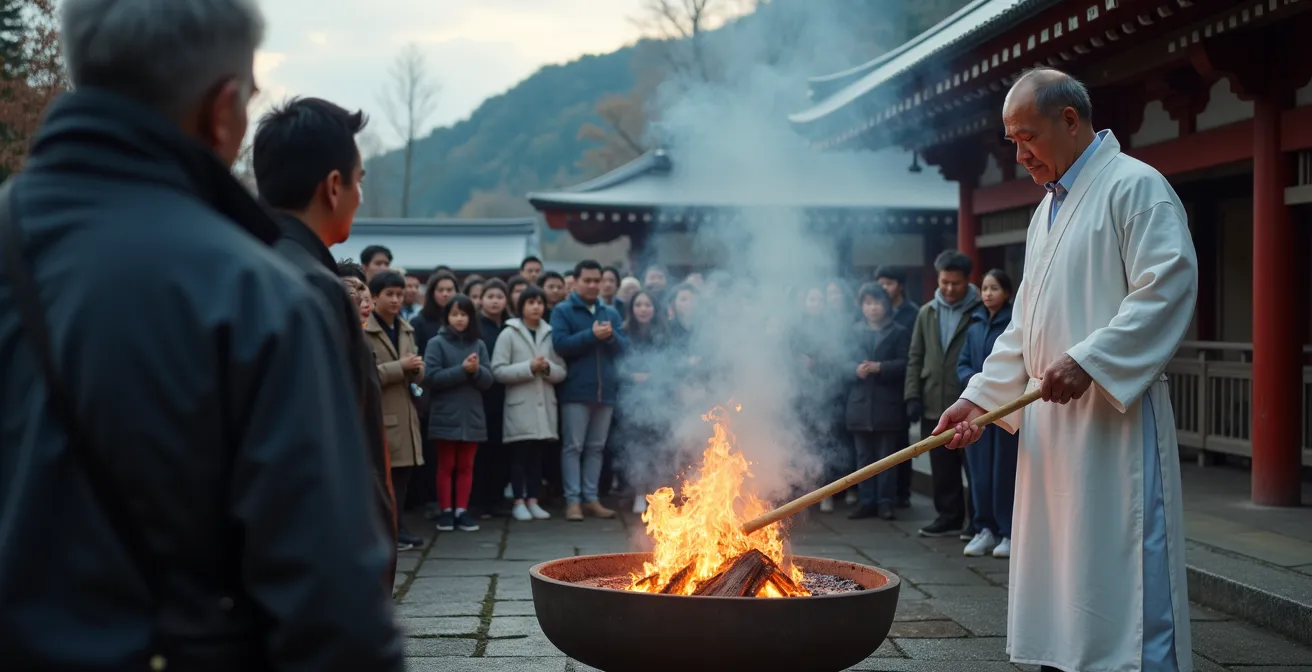
The most appropriate way to return an old amulet is to bring it back to the shrine where you originally purchased it. Most shrines have a designated collection box, often labeled kosatsu-osamedokoro (古札納め所), where you can deposit your old charms, prayer plaques (ema), and other sacred items. These are then purified and ritually burned in a sacred bonfire ceremony.
Case Study: The O-takiage Ritual Fire Ceremony
Especially during the first few weeks of the New Year, shrines and temples conduct a ritual called o-takiage (お焚き上げ). Returned omamori and other decorations from the past year are gathered and burned in a sacred fire on the temple grounds. This ceremony is not just for disposal; it is a powerful act of spiritual cleansing. The fire is believed to purify the items and release the accumulated bad luck from the previous year, transforming a simple act of returning an object into a meaningful ritual of renewal.
Of course, returning to the original shrine isn’t always possible, especially for travelers. In these cases, there are other respectful options:
- Return to Any Shrine: You can generally return your omamori to any other Shinto shrine.
- Mail Service: Many larger shrines accept returns by mail, even from overseas. It’s customary to include a small donation to cover the purification fee.
- Home Disposal (Last Resort): If no other option is available, you can purify the charm at home by wrapping it in a clean piece of white paper, sprinkling it with a bit of salt, expressing your gratitude, and then disposing of it separately from your regular household waste.
Why Just Taking Photos Misses the Point of Temple Visits?
In our modern world, it’s easy to view travel through the lens of a camera, seeking the perfect shot to capture a memory. Shrines and temples, with their stunning architecture and serene landscapes, are undeniably photogenic. However, a visit that consists only of taking pictures misses the very essence of the place. As the Japan Travel Editorial Team notes, you should “don’t just take pictures – experience it.” The true beauty of a sacred site is not just visual; it is an experience that engages all the senses and invites mindful participation.
To truly connect with the atmosphere of a shrine, try to put your camera away for a few moments and engage with your surroundings more deeply. Notice the feeling of the gravel under your feet on the sandō, the scent of aged cypress wood from the shrine buildings, and the sound of the wind rustling through the trees of the sacred grove. These sensory details are what create the unique, peaceful ambiance of the space. Participation, even in small ways, can transform your visit from a passive observation to an active experience.
Your Five Senses Checklist for a Mindful Visit
- Sound: Pause and listen. Can you hear the gentle ringing of a bell, the chirping of birds, or the low murmur of prayers? These sounds are the shrine’s heartbeat.
- Smell: Inhale deeply. Many temples and some shrines have large incense burners (osenko). The fragrant smoke is believed to have healing properties and purifies the air.
- Touch: Feel the cool water at the purification basin. Notice the texture of the wooden offering box. Be mindful of what you touch, and never lay a hand on sacred objects marked as off-limits.
- Sight: Look beyond the wide-angle shot. Observe the intricate details of the roof carvings, the expressions on the faces of the guardian statues, and the way light filters through the leaves.
- Participation: Instead of just watching, take part. Offer a prayer, receive an omikuji (paper fortune), or simply stand in quiet contemplation.
The Origins of the ‘Two Bows, Two Claps, One Bow’ Ritual
The “two bows, two claps, one bow” sequence feels ancient and timeless, and while its roots are deep in Japanese history, the specific form we practice today is a relatively modern codification. Shinto has always involved rituals of bowing and showing respect, but for centuries, practices varied significantly from shrine to shrine and region to region. There was no single, universally accepted method of prayer for the general public.
The movement toward standardization began in the late 19th century, during the Meiji Restoration, a period when Japan was rapidly modernizing and defining its national identity. Shinto was established as the state religion, and with this came a desire to create a unified and formal set of practices that could be taught and followed by all citizens. This ensured a consistent expression of reverence at shrines throughout the nation.
The modern etiquette of ni-rei, ni-hakushu, ichi-rei can be traced back to this era. According to historical records, the ‘Shrine Festival’ codification in 1873, with formal standardization completed in 1907 through the ‘Shrine Festival Rituals and Ceremonial Etiquette’, laid the groundwork for the practice we know today. This formalization did not invent the acts of bowing and clapping—which were already ancient customs—but rather organized them into the specific, elegant sequence that has become the hallmark of Shinto worship.
Key takeaways
- The core prayer ritual at a Shinto shrine is “two bows, two claps, one bow” (ni-rei, ni-hakushu, ichi-rei), performed after a coin offering.
- Before prayer, purification at the chozuya and respecting sacred pathways by walking on the side are crucial gestures of respect.
- The ultimate goal is not perfect mechanical execution but sincere and mindful communication with the kami (deities).
How to Purify Your Hands at the Chozuya Without Looking Clumsy
One of the first and most important rituals you will perform at a shrine is the act of purification, or temizu, at the water pavilion known as the chozuya or temizuya. This is not simply about washing your hands; it is a symbolic cleansing of your body and spirit before entering the sacred presence of the kami. It’s a beautiful, meditative ritual that prepares your heart for prayer. Many visitors feel awkward here, unsure of the sequence and worried about using the shared ladle incorrectly.
Even locals sometimes wonder if they’re doing it right! Many shrines now provide helpful illustrated instruction boards near the temizuya, and during COVID-19, numerous locations replaced shared ladles with flowing spouts to maintain hygiene while preserving the purification tradition.
The key to performing the ritual gracefully is to remember that the entire process should be completed with just one scoop of water. This shows mindfulness and consideration for others. Here is the simple, step-by-step technique:
- Scoop the Water: Pick up the ladle (hishaku) with your right hand and fill it once from the basin. This single scoop must last for the entire ritual.
- Cleanse Your Left Hand: Tilt the ladle to pour a small amount of water over your left hand, cleansing it.
- Cleanse Your Right Hand: Switch the ladle to your now-clean left hand and pour water over your right hand.
- Cleanse Your Mouth: Switch the ladle back to your right hand. Pour a little water into the cupped palm of your left hand.
- Rinse and Spit: Bring your cupped left hand to your mouth to rinse it. Never touch the ladle directly to your lips. Spit the water out discreetly onto the ground or gravel beside the fountain, not back into the basin.
- Cleanse the Ladle: Finally, hold the ladle vertically, allowing the remaining water to run down the handle, thus cleansing it for the next person. Place it back where you found it, face down.
With these gentle steps in mind, your next visit to a Shinto shrine can be a truly meaningful experience. Embrace the moment not as a tourist, but as a respectful guest, and you will find a profound connection that no photograph can capture.
Frequently Asked Questions on What to Do at a Shrine: The 2-Bow, 2-Clap, 1-Bow Rule Explained
Can I buy omamori from multiple shrines?
Yes, shrine staff confirm it’s a myth that buying from several shrines upsets the gods. It’s common in Japan to visit different shrines for different blessings.
What happens if I open my omamori?
Never open it – this releases the blessing and protection. The power is not visible to the eye, and opening it is considered disrespectful to the deity.
Can I carry multiple omamori at once?
Yes, many people carry different ones for work, travel, study, or health. The key is selecting charms that match your needs without unnecessary overlap.