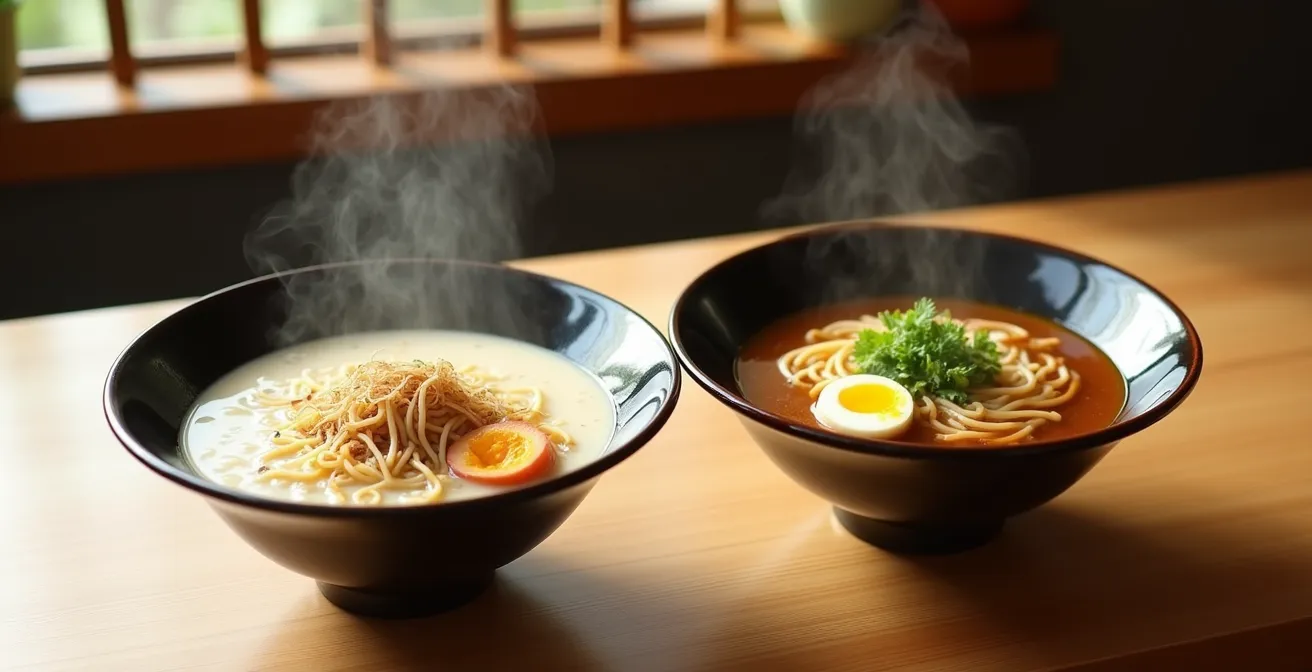
The true difference between Tonkotsu and Miso ramen isn’t just the ingredients; it’s the story of the prefecture simmered into the broth.
- Creamy Tonkotsu is the result of a precise, high-temperature emulsification process perfected in the port city of Hakata.
- Hearty Miso ramen, enriched with butter and corn, is a direct culinary response to the cold climate of Hokkaido.
Recommendation: To truly understand ramen, stop comparing flavors and start tasting the terroir of the broth.
For any true ramen hunter, the debate between Tonkotsu and Miso seems like a fundamental starting point. One is the creamy, pork-bone powerhouse from the south; the other is the savory, fermented soybean champion from the north. Most guides will give you a simple breakdown of ingredients and leave it at that. They’ll tell you Tonkotsu is rich and Miso is salty, and while that’s true, it completely misses the point.
This approach reduces a profound culinary art form to a mere checklist of flavors. The real story isn’t about what’s in the bowl, but why it’s there. The secret to understanding Japan’s most iconic dish lies in treating each regional style not as a recipe, but as a liquid expression of its home—a concept we’ll call the “terroir of the broth.” Why is one broth a lip-coating, opaque emulsion and the other a hearty, warming soup? The answers are found in the history, climate, and industrial spirit of their respective prefectures.
But what if the key to unlocking ramen’s secrets wasn’t just in knowing the difference between Hakata and Sapporo, but in understanding the entire ritual surrounding it? This isn’t just a comparison. This is a ramen hunter’s field guide. We will decode the science behind the broths, explore the historical accidents that created new classics, and arm you with the knowledge to navigate the complex world of Japanese ramen-ya like a seasoned local. We’ll move from the bowl to the counter, learning how to spot an authentic shop, how to order with precision, and even why the way you eat your noodles matters.
This guide will take you on a journey through the heart of Japan’s ramen culture. Below is a summary of the key regions and rituals we’ll explore, giving you the tools to not just eat ramen, but to truly understand it.
Summary: A Ramen Hunter’s Guide to Japan’s Prefectural Bowls
- Why Is Hakata Ramen So Creamy and Why Does It Smell Strong?
- How Butter and Corn Became Staples in Sapporo Ramen?
- Tokyo Shoyu: Why Is Soy Sauce Broth the Classic Standard?
- Chain vs. Independent: How to Spot a Ramen Tourist Trap?
- Hard, Normal, or Soft: How to Specify Noodle Firmness?
- To Slurp or Not: Is It Really Necessary for Taste?
- Festival or Permanent: Where to Find the Best Yatai Stalls?
- How to Order at Standing Noodle Bars Like a Salaryman
Why Is Hakata Ramen So Creamy and Why Does It Smell Strong?
The iconic creaminess of Hakata-style Tonkotsu is not born from cream or milk, but from pure flavor engineering. It’s the result of a violent, rolling boil. Unlike other broths that are gently simmered, Tonkotsu chefs maintain a turbulent boil for 8 to 12 hours. This intense agitation pulverizes pork bones, breaking down their collagen into gelatin and emulsifying the rendered fat into microscopic particles. These particles remain suspended in the water, refracting light and creating that signature opaque, milky-white appearance and velvety, lip-coating texture.
That assertive, funky aroma? That’s the smell of authenticity. It comes from cooking down massive quantities of pork bones for extended periods, releasing deep, primal pork notes. Shops that lack this smell are often cutting corners. Some of the most revered shops amplify this complexity through a perpetual broth technique known as ‘Yobimodoshi’.
Case Study: The ‘Yobimodoshi’ Master Stock of Hakata Gensuke
The global success of Hakata Gensuke, founded by Master Chef Kousuke Yoshimura, is built on the ‘Yobimodoshi’ method. This master stock technique involves continuously blending a portion of the old broth into the new batch each day. This process layers flavors over time, creating a depth and complexity—a soulful umami—that is impossible to achieve in a single cooking session. It transforms the broth from a simple soup into a living, evolving element that carries the history of the shop in every spoonful.
This dedication to a single, perfected process is the essence of Hakata’s culinary identity. The city’s ramen culture is a testament to specialization, where chefs dedicate their lives to mastering one thing: the perfect bowl of Tonkotsu.
How Butter and Corn Became Staples in Sapporo Ramen?
If Hakata Tonkotsu is a product of technical mastery, Sapporo Miso ramen is a direct reflection of its environment. To understand the bowl, you must first understand Hokkaido’s cold, harsh winters. The region demanded a heartier, more robust and calorie-dense meal to combat the cold, and Miso ramen was the perfect answer. The rich, salty, and complex flavor of miso paste creates a deeply warming and satisfying broth that coats the palate and fortifies the body.
The additions of butter and sweet corn, which can seem unusual to outsiders, are a genius stroke of local adaptation. Hokkaido is Japan’s dairy and agricultural heartland, famous for its high-quality butter and incredibly sweet summer corn. Adding a pat of butter that melts into the hot broth introduces a silky richness and a layer of creamy fat that elevates the soup’s warming properties. The sweet corn, in turn, provides bursts of sweetness that cut through the salty intensity of the miso, creating a perfectly balanced flavor profile.
This combination is a cornerstone of Hokkaido’s culinary identity. As noted by travel experts, the pairing is more than just a topping; it’s a creation of synergistic flavor.
Combining miso and butter creates a uniquely satisfying umami flavor that’s become synonymous with Hokkaido cuisine.
– Rakuten Travel Guide, Japan Regional Ramen Varieties Guide
So, when you see butter and corn in a bowl of Sapporo ramen, you’re not just seeing toppings. You’re tasting the terroir of Hokkaido—its cold climate, its agricultural bounty, and its pragmatic approach to creating delicious, soul-warming food.
Tokyo Shoyu: Why Is Soy Sauce Broth the Classic Standard?
Before Tonkotsu’s global fame, there was Shoyu. The clear, dark, and savory soy sauce-based broth is the quintessential Tokyo-style ramen, and for many, the original archetype of Japanese ramen. Its status as the “classic” is no accident; it’s a direct result of geography and history. The modern story of ramen began in 1910, when a Chinese restaurant in Asakusa, Tokyo, started serving a wheat noodle soup that would evolve into what we know today.
The choice of soy sauce (shoyu) as the primary seasoning was a matter of proximity and economics. Tokyo is located near the Chiba and Noda prefectures, the historic heartland of Japanese soy sauce production for centuries. This made high-quality shoyu abundant and affordable, establishing it as the default flavor base. This simple Chinese noodle soup was quickly adopted and adapted by Japanese chefs, who began developing their own secret seasoning blends, or ‘tare’.
This ‘tare’ is the soul of a Shoyu ramen shop. It’s far more than just soy sauce; it’s a complex, guarded recipe often combining multiple types of shoyu, mirin, sake, and other secret ingredients. A chef’s tare is their signature, the element that distinguishes their bowl from a hundred others in the city, as detailed in an official guide to ramen in Japan. The craftsmanship involved in preparing it is a testament to the dedication of the shokunin (artisan).
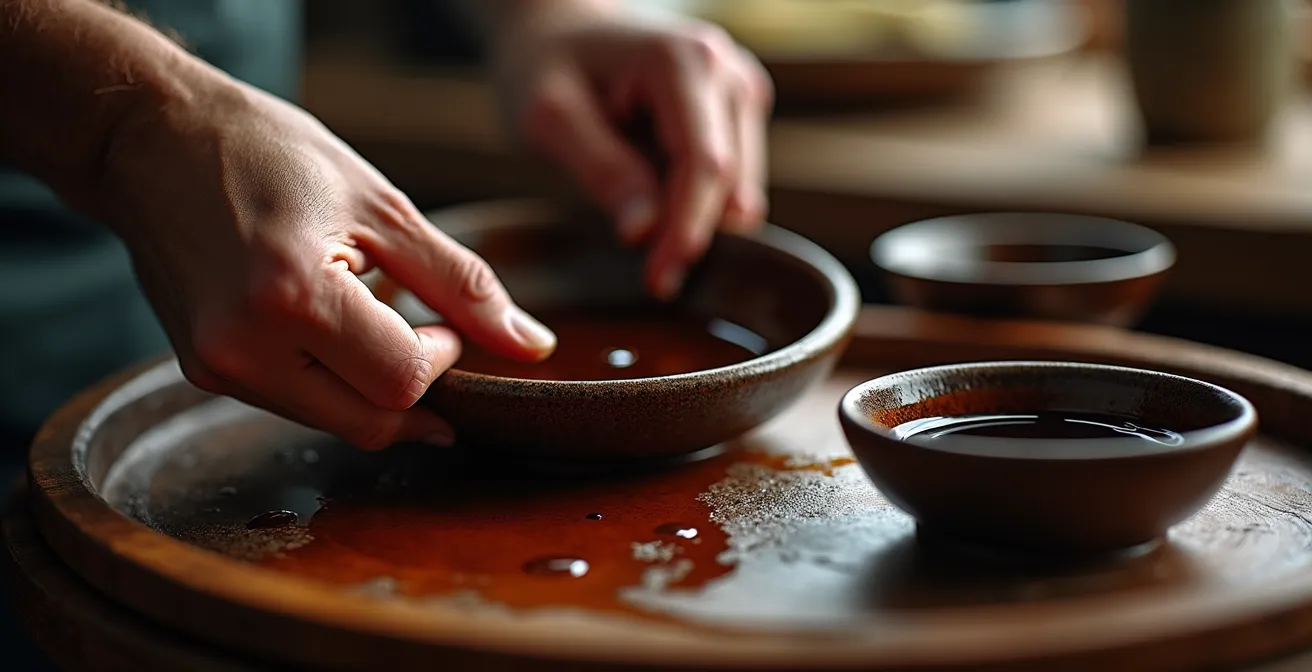
As you can see in the preparation, the process is one of precision and care. This focus on the tare makes Shoyu ramen a canvas for subtle complexity. While Tonkotsu impresses with its powerful body, a great Shoyu bowl captivates with its aromatic depth and clean, refined umami finish, securing its place as the timeless standard of Japanese ramen.
Chain vs. Independent: How to Spot a Ramen Tourist Trap?
Now that you understand the regional soul of ramen, your mission as a hunter is to find its most authentic expressions. In popular areas, it’s easy to fall into a “tourist trap”—a shop that prioritizes flashy presentation and broad appeal over quality and tradition. A true ramen-ya, whether it’s a single-location gem or a quality chain like Ippudo (which began as one legendary shop), displays a set of common characteristics. Your “Ramen Authenticity Matrix” involves observing more than just the food.
First, look at the menu. An authentic shop is a specialist. It will focus on one or two types of ramen and execute them perfectly. A menu with ten or more varieties, from Miso to Tonkotsu to Tan-tan, is a major red flag; it’s a sign of a kitchen that is a jack of all trades and master of none. Second, observe the ordering system. Many serious shops use a ticket vending machine (‘kenbaiki’). This system is efficient, minimizes interaction, and lets the chef focus solely on the ramen. A glossy, multi-language picture menu is often a sign the business caters primarily to tourists.
Finally, look at the clientele and the bowl itself. Is the shop filled with local office workers (salarymen) eating quickly and purposefully? That’s a great sign. Are the bowls simple and functional, or are they overloaded with “Instagrammable” but non-traditional garnishes? Authenticity often lies in simplicity. The following table breaks down these key differences.
| Feature | Authentic Ramen-ya | Tourist Trap |
|---|---|---|
| Menu Range | 1-3 ramen types | 10+ varieties |
| Ordering System | Vending machine | Picture menu |
| Customization | Noodle firmness options | Limited or none |
| Seating | Counter-focused | Table-heavy |
| Price Range | ¥800-1200 | ¥1500+ |
By using these indicators, you can filter out the noise and find the shops that are truly dedicated to the craft. To make it even easier, here is a checklist to run through before you commit to a queue.
Action Plan: Verifying a Ramen Shop’s Authenticity
- Menu Focus: Confirm the shop specializes in one or two ramen types maximum.
- Ordering System: Look for a ‘kenbaiki’ (vending machine) with customization options, a sign of a serious establishment.
- Clientele: Observe if the customers are primarily local workers eating efficiently, indicating an authentic spot.
- Presentation: Evaluate the bowls—simple, functional presentation is more traditional than overly garnished, picture-perfect bowls.
- Language: Note if there is excessive multi-language signage, which often signals a focus on tourists over locals.
Hard, Normal, or Soft: How to Specify Noodle Firmness?
Once you’ve found an authentic shop, the first act of customization in your sensory ritual is specifying noodle firmness. This is especially critical in Hakata-style Tonkotsu shops, which use thin, straight, low-hydration noodles. These noodles cook quickly and, more importantly, continue to soften as they sit in the hot broth. Ordering them firm ensures they maintain a pleasant, chewy texture throughout your meal.
This practice is so ingrained in Hakata ramen culture that it’s directly linked to the kaedama system. Because the thin noodles soften fast, locals eat them quickly and then order a kaedama—an extra serving of freshly cooked noodles—to add to their remaining broth. It’s a method that ensures every bite is at the perfect texture. The kaedama noodle refill system is a practice essential to the culture, as it addresses how quickly the noodles can change in the bowl.
To order like a pro, you need to know the terminology. While ‘katamen’ (hard) is a safe bet for a first-timer, true connoisseurs have a whole glossary at their disposal. The firmness levels are a spectrum, from practically raw to extra soft. Knowing these terms allows you to dial in your experience with absolute precision.
- Konaotoshi (粉落とし): “Flour-dusted.” Essentially raw, just blanched for a few seconds. For the hardcore only.
- Harigane (針金): “Wire.” Extremely firm and stiff.
- Barikata (バリカタ): “Very hard.” A very common order among ramen regulars.
- Katamen (固麺): “Hard.” The standard firm order and a great starting point.
- Futsuu (普通): “Normal.” The chef’s recommended regular cooking time.
- Yawarakame (柔らかめ): “Soft.” Slightly overcooked, for those who prefer a less chewy texture.
- Bariyawa (バリやわ): “Very soft.” Fully cooked and has absorbed some broth.
Don’t be shy. The chef expects you to have a preference. Specifying your noodle firmness is not being picky; it’s showing you respect the craft and are an active participant in creating your perfect bowl. It’s the first step in taking control of your ramen experience.
To Slurp or Not: Is It Really Necessary for Taste?
Let’s debunk a common myth. Slurping your noodles in Japan isn’t just about being polite; it’s a critical technique for flavor enhancement. For a ramen hunter, mastering the slurp is as important as knowing your broths. The act transforms eating from a simple physical process into a full sensory experience by engaging what scientists call retronasal olfaction.
When you slurp, you rapidly draw in noodles, broth, and air into your mouth. This aeration is key. It’s the same principle used by professional wine tasters who noisily aerate wine in their mouths. The process volatilizes the aromatic compounds in the hot broth, allowing them to travel up the back of your throat to your olfactory receptors. This retronasal pathway is responsible for the vast majority of what we perceive as flavor. Simply sipping the broth with a spoon gives you the taste on your tongue (salty, sweet), but slurping unlocks the broth’s full aromatic complexity—the deep porkiness of Tonkotsu or the earthy notes of Shoyu.
The Science of Slurping: Enhancing Umami Perception
Studies on ramen consumption confirm this phenomenon. The combination of aerating the broth and coating the noodles allows diners to experience the full impact of umami. As an official Japanese travel guide explains, slurping also serves a practical purpose: it helps to cool the piping hot noodles just enough to avoid burning your mouth, allowing you to eat them at their ideal temperature and texture without hesitation. It’s a technique born from a perfect marriage of function and flavor.
So, is it necessary? If you want to taste what the chef spent hours, or even days, creating, then yes. Don’t be timid. A hearty slurp is a sign of enjoyment and respect for the chef’s craft. It signals that you’re not just a tourist—you’re a participant in the culture.
Festival or Permanent: Where to Find the Best Yatai Stalls?
For the ultimate old-school ramen experience, the hunt must lead you to a ‘yatai’—a traditional outdoor food stall. These small, intimate carts, often seating just a handful of people, are the historical soul of Japanese street food. While many cities have phased them out, Fukuoka remains the undisputed epicenter of yatai culture. Specifically, the Nakasu Island area in Fukuoka has the highest concentration of traditional ramen stalls in all of Japan, offering an atmosphere that is impossible to replicate in a modern restaurant.
Eating at a yatai is a communal experience. You’ll be elbow-to-elbow with locals, surrounded by the steam and sizzle of the open kitchen. The menu is typically very small—often just one type of ramen, a few side dishes, and drinks. This is not a place for a long, lingering dinner. It’s about getting a quick, delicious, and incredibly atmospheric meal. The best stalls are often permanent fixtures, run by the same family for generations, each with their own fiercely loyal following.
While some yatai appear for specific festivals (‘matsuri’), the most revered ones in Fukuoka are permanent nightly fixtures. To find the best, look for the ones with a steady stream of local customers. A short, fast-moving line of Japanese patrons is the best review you can ask for. The experience is as much about the vibrant, friendly atmosphere as it is about the food. It’s a direct connection to the origins of ramen as a quick, hearty meal for workers.
However, these intimate spaces come with their own set of unwritten rules. Being a good customer is key to being welcomed into the yatai community. Knowing basic etiquette will ensure a smooth and enjoyable experience for everyone.
Key Takeaways
- Ramen’s regional character (terroir) is shaped by local climate, history, and industry—not just ingredients.
- Authenticity is found in specialization; trust shops with small menus, ticket machines, and local clientele.
- The full ramen experience is an active ritual, from specifying noodle firmness to the flavor-enhancing slurp.
How to Order at Standing Noodle Bars Like a Salaryman
You’ve hunted down the perfect shop. Now for the final ritual: eating with the speed and efficiency of a Tokyo salaryman at a ‘tachigui’ (standing-only) noodle bar. This is ramen at its most functional and authentic—a fast, delicious refuelling stop in the middle of a hectic day. There’s no time for chit-chat or indecision. The process is a well-oiled machine, and your goal is to be a smooth-moving part of it.
The entire experience is designed for maximum efficiency. From the moment you enter, every action is purposeful. The key is to observe and follow the flow. This is not the place to linger over your phone or spread out your belongings. It’s about a focused, almost meditative appreciation of the food, executed with speed and respect for the space and the other customers.
To navigate this like a seasoned local, follow this precise protocol:
- Enter and Find the Machine: The ticket vending machine (‘kenbaiki’) is almost always right by the entrance. Go there first.
- Order Before Paying: Make your selection (ramen, extra chashu, egg) on the machine *before* you insert your money.
- Get Your Ticket: Collect your food ticket(s) and your change.
- Find a Spot: Find an open space at the counter and place your ticket on the upper ledge for the chef to see.
- Stow Your Gear: Use the hook under the counter to hang your bag or coat. Keep the counter space clear.
- Eat with Focus: When your bowl arrives, eat efficiently. This is fast dining.
- The Finish: Once you’re done, place your empty bowl up on the counter ledge.
- Clean Up: Use the provided cloth (‘zokin’) to give your small section of the counter a quick wipe before you leave.
Mastering this simple ballet of efficiency is the final step in your journey. It shows you understand that in Japan, ramen can be both a complex art form and a beautifully simple, purposeful meal. It is the ultimate sign of respect for the culture you’ve come to explore.
Now you possess the knowledge. You can distinguish broth by its story, a shop by its soul, and a ritual by its purpose. The real hunt begins now. Go forth and taste the true culinary identity of Japan, one perfect bowl at a time.
Frequently Asked Questions About Yatai Ramen Stalls
How long should I stay at a yatai stall?
Don’t linger too long as seating is limited – typically 30-45 minutes is appropriate for a meal and drink.
What payment method do yatai accept?
Yatai stalls are traditionally cash-only operations, so come prepared with Japanese yen.
Should I order drinks with my ramen?
It’s considered polite to order a drink along with your food, as it supports the small business and enhances the social atmosphere.