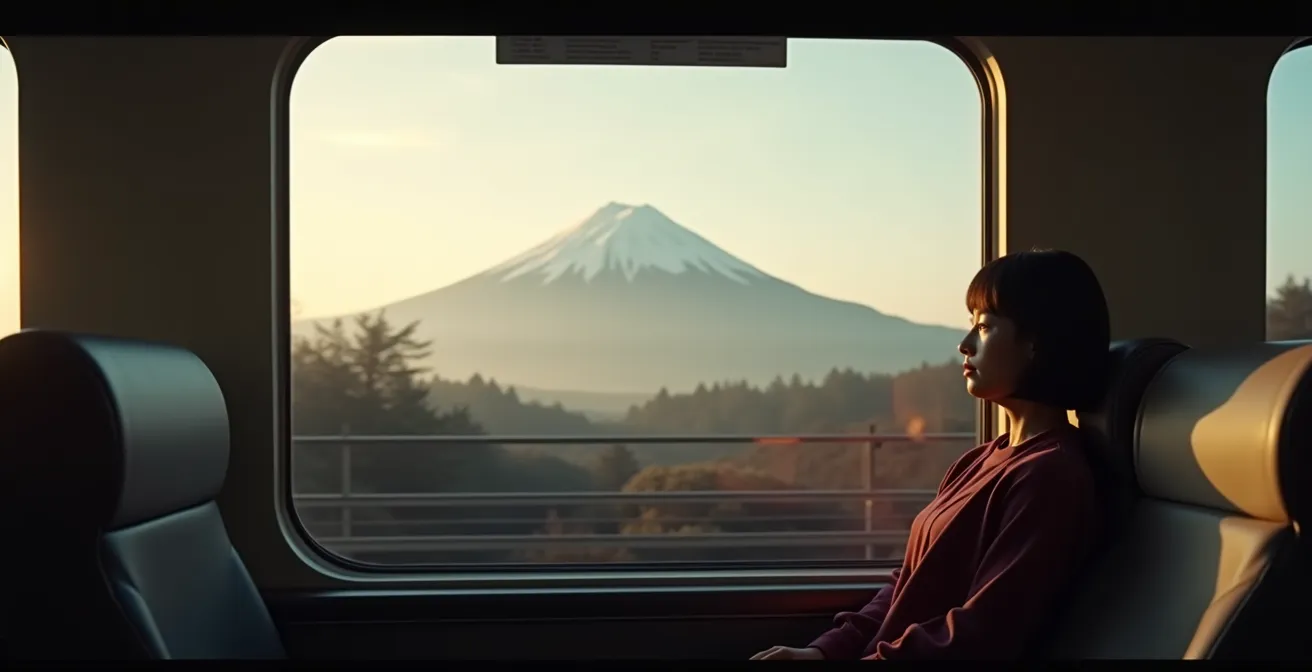
The best Shinkansen view isn’t just Mt. Fuji or the Alps; it’s the one you engineer through total mastery of the travel experience.
- True comfort is a calculated choice based on journey duration and personal value, not just an expensive upgrade.
- The ‘right’ train speed (Nozomi vs. Kodama) should be matched to your journey’s theme, not just the clock.
Recommendation: Focus on optimizing every detail—from power outlets to transfer times—to transform a simple ride into a curated, world-class journey.
For any rail enthusiast, the question seems simple: Tokaido line for the iconic glimpse of Mt. Fuji, or the Hokuriku line for the majestic sweep of the Japanese Alps? This debate dominates travel forums, with each side passionately defending its chosen vista. The classic advice for the Tokaido line is to book a ‘D’ or ‘E’ seat on a train from Tokyo for that perfect, fleeting shot of Fuji-san. But this reduces a Shinkansen journey, one of the world’s greatest engineering and experiential marvels, to a single photo opportunity. A true aficionado knows that the ultimate journey is not merely seen, but meticulously crafted.
The real art of Shinkansen travel—what I call journey crafting—lies in the details. It’s a process of system mastery, where understanding the nuances of the network transforms a standard trip into a seamless, personalized experience. The view from the window is just one element in a symphony of choices. Is the extra legroom in a Green Car worth the premium on a three-hour trip? Which exact train model guarantees a power outlet at your seat? How does the choice between a blistering fast Nozomi and a methodical Kodama define the very nature of your travel day?
This guide moves beyond the superficial ‘Tokaido vs. Hokuriku’ question. Instead, we will deconstruct the elements of a perfect journey. We will treat each decision point not as a logistical hurdle, but as an opportunity for optimization. By mastering these components, you can build a thematic route across Japan where every aspect of the trip, from ticketing to transfers, contributes to your personal, ideal scenic journey. The best view isn’t a passive experience; it’s the satisfying result of a well-executed plan.
To help you navigate these choices, this article breaks down the key decision points for any Shinkansen traveler. We will explore everything from seating and ticketing to on-board etiquette, providing the detailed knowledge needed to elevate your next trip across Japan.
Table of Contents: A Guide to Shinkansen System Mastery
- Standard or Green: Is the Legroom Worth the Upgrade Price?
- Window or Aisle: Which Shinkansen Seat Has the Power Outlet?
- Smoke or Vape: Are There Still Smoking Rooms on the Shinkansen?
- English Menu: How to Buy a Shinkansen Ticket at the Kiosk?
- 8 Minutes: Is It Enough Time to Transfer Shinkansen Lines?
- Nozomi, Hikari, or Kodama: Which Train Saves You Time vs Money?
- How to Handle an Emergency Call While on the Shinkansen?
- Art or History: How to Build a Thematic Route Across Japan?
Standard or Green: Is the Legroom Worth the Upgrade Price?
The first decision in journey crafting is often about class: the workhorse Standard Car versus the premium Green Car. The immediate difference is space and serenity. Green Cars feature a spacious 2×2 seating arrangement, a stark contrast to the 3×2 configuration in Standard Cars. This means wider seats, more elbow room, and a calmer atmosphere with fewer passengers. But is it worth the price, which is often around 30% more expensive than a standard reserved seat?
The answer lies not in a simple ‘yes’ or ‘no’, but in a calculated value judgment. For a short 45-minute hop, the upgrade might feel extravagant. But for a longer 3-4 hour journey, like Tokyo to Kyoto on the Tokaido line, the value proposition changes. The electronic reclining controls, plush carpeting that dampens sound, and dedicated attendant service contribute to a significant reduction in travel fatigue. During peak seasons like Golden Week or cherry blossom season, a Green Car ticket can be a priceless guarantee of tranquility, insulating you from the packed Standard Cars.
A savvy traveler doesn’t guess; they calculate. By viewing the upgrade as an investment in comfort-per-hour, you can make an objective decision that aligns with your travel style and budget. Some analysis even shows that booking a Green Car ticket more than three days in advance on a competitive route like Tokyo-Osaka can reduce the premium to a surprisingly small amount, making it a logical choice for those who plan ahead.
Your Cost-per-Hour Comfort Calculation Framework
- Identify your journey duration in hours (e.g., Tokyo to Osaka is approximately 2.5 hours).
- Calculate the exact upgrade price difference between your desired Standard and Green Car seats.
- Divide the upgrade cost by the journey duration to find your personal “cost-per-hour” for premium comfort.
- Compare this hourly rate to your personal comfort threshold. Is an hour of near-silence and extra space worth that amount to you?
- Factor in peak travel periods; the value of avoiding crowds in a packed Standard Car might justify a higher cost-per-hour.
Ultimately, choosing Green Car is less about luxury and more about experiential optimization. It’s a conscious decision to invest in your own well-being, ensuring you arrive at your destination refreshed and ready to explore, rather than tired and stressed.
Window or Aisle: Which Shinkansen Seat Has the Power Outlet?
For the modern traveler, seat selection goes beyond the simple window-versus-aisle debate. It’s about a critical resource: power. Arriving at your destination with fully charged devices is non-negotiable, and a key element of system mastery is knowing exactly where to find an outlet. Historically, this has been a game of chance on older Shinkansen models, where only window seats were equipped with power sockets along the wall.
However, the fleet is constantly evolving. The newest generation of trains, like the N700S series on the Tokaido line and the E7/W7 series on the Hokuriku line, have resolved this issue entirely. On these models, every single seat—window, middle, and aisle—is equipped with its own power outlet, usually located in the armrest for maximum convenience. This is a game-changer, removing the anxiety of a dying battery and freeing you to choose your seat based on other preferences, like view or ease of access. For the rail enthusiast, identifying your train series before booking becomes a crucial step in journey crafting.

So how do you guarantee power? The most reliable method is to travel on a line and service that predominantly uses these modern trainsets. The table below, based on data from across the JR network, breaks down what you can expect from different models. This isn’t just trivia; it’s actionable intelligence for planning your trip. Knowing that an older 700 series might be running your Kodama service could be the deciding factor in choosing a window seat or packing a power bank.
This table illustrates the power availability across key Shinkansen models, a crucial dataset for any traveler. According to an analysis of Shinkansen amenities, the rollout of newer train generations has made power access far more democratic.
| Train Model | Line | Outlet Location | Coverage |
|---|---|---|---|
| N700S Series | Tokaido | Every seat | 100% |
| E7/W7 Series | Hokuriku | Every seat | 100% |
| Older N700/700 | Tokaido/Sanyo | Window seats only | 40% |
| 500 Series | Sanyo | Limited availability | 20% |
Smoke or Vape: Are There Still Smoking Rooms on the Shinkansen?
For years, the Shinkansen offered a unique amenity that distinguished it from many other world-class high-speed trains: dedicated smoking rooms. These small, ventilated cabins, typically located in cars 3, 7, and 15 on the 16-car Tokaido line trains, were a familiar feature for smokers. However, in a significant policy shift reflecting broader public health trends in Japan, this era has come to an end. Understanding this change is vital for any traveler who smokes or vapes.
As of Spring 2024, JR Central, JR West, and JR Kyushu have officially eliminated all smoking rooms on the Tokaido, Sanyo, and Kyushu Shinkansen lines. This means there is no longer any place to smoke or vape onboard these trains. The spaces that once housed these rooms are being repurposed for storing emergency water supplies, a practical move that underscores the finality of the decision. For vapers, the rules are the same: vaping is not permitted anywhere on the train, including the deck areas between cars.
So, what’s the strategy for a smoker on a long journey from Tokyo to Hakata? The focus now shifts from onboard amenities to platform logistics. This requires a new level of journey crafting, where you must strategically plan for smoking breaks at station stops. This is where the choice of train service becomes critical. The fastest Nozomi trains have very brief stops, often just a minute or two, which is insufficient for a comfortable break. In contrast, the all-stations Kodama trains have significantly longer dwell times at each platform, making them the de facto “smoker’s express” for those who need to plan breaks. Before boarding, you must locate the designated smoking areas on the station platforms, as smoking is strictly prohibited elsewhere in the station.
English Menu: How to Buy a Shinkansen Ticket at the Kiosk?
Navigating a Japanese train station can feel like stepping into the complex, perfectly synchronized heart of a metropolis. For the uninitiated, buying a Shinkansen ticket might seem daunting, but the system is a marvel of user-centric design, even for non-Japanese speakers. The primary self-service method is the reserved seat ticket kiosk (look for the green or purple machines), which features a prominent “English” language button on its home screen. This is your gateway to system mastery.
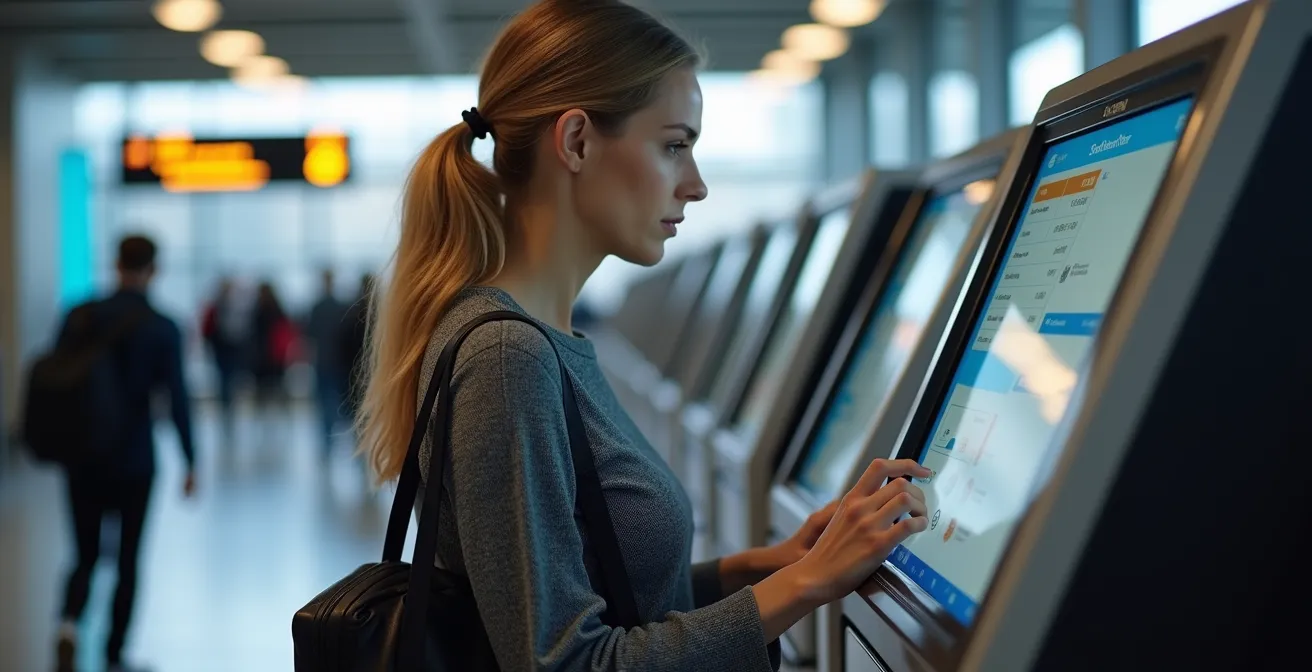
Once in English mode, the interface is intuitive, guiding you through departure/arrival stations, date, time, and seat preferences (window/aisle, car number). The real challenge for many foreign travelers isn’t the language, but the payment. A common frustration is the rejection of foreign-issued credit cards. This is often due to the requirement for a PIN, which not all cards have enabled for such transactions. A critical piece of insider knowledge is to always have a backup. Cash is widely accepted, as are Japan’s ubiquitous IC cards (like Suica or Pasmo), if they have sufficient balance.
Case Study: Solving Foreign Card Payment Failures
Many travelers report that their foreign credit cards are rejected by kiosks. A deep dive into this issue reveals a solution rooted in understanding how tickets are priced. A Shinkansen ticket is composed of multiple parts: a Base Fare, a Super Express Surcharge, and a Seat Reservation Fee. An analysis of kiosk payment systems found that when a single large transaction fails, sometimes paying for these components separately can succeed. This is a high-level hack but can be a lifesaver if you’re in a bind and your primary card isn’t working.
While kiosks are efficient for simple, one-way trips, a true rail enthusiast should know all the tools at their disposal. The SmartEX app is brilliant for tech-savvy travelers, allowing ticketless travel with a QR code or IC card. For complex itineraries involving multiple transfers or a Japan Rail Pass, nothing beats the human touch of the Midori no Madoguchi (ticket office). The table below compares the main methods.
| Method | Best For | Payment Options | Language Support |
|---|---|---|---|
| SmartEX App | Tech-savvy travelers | Credit card only | Full English |
| Kiosk Machine | Quick purchases | Cash/IC card/Credit | English available |
| Midori no Madoguchi | Complex itineraries | All payment types | English staff at major stations |
| Online (1 year advance) | Planning ahead | Credit card | Full English |
8 Minutes: Is It Enough Time to Transfer Shinkansen Lines?
The Shinkansen system is a global benchmark for punctuality, a symphony of precision where trains arrive and depart with split-second accuracy. This reliability extends to connection times, where an 8-minute transfer is often presented as the standard. For a seasoned traveler moving between two adjacent platforms, eight minutes is a lifetime. You’ll have time to disembark, find your next platform, and perhaps even grab a quick drink from a vending machine. But for a first-timer, or in a more complex scenario, that eight-minute window can shrink alarmingly fast.
True journey crafting involves honestly assessing your personal transfer needs. Are you traveling with heavy luggage? Add three minutes. Are you navigating with young children? Add five. Is it your first time in a sprawling labyrinth like Tokyo Station? Add at least another two. The official time is a best-case scenario for an unencumbered, experienced traveler. Your personal transfer time is a more realistic, and therefore more useful, metric. Using station map apps like ‘Japan Transit Planner’ or ‘Google Maps’ ahead of time to visualize the route from your arrival platform to your departure platform is not over-planning; it’s smart travel.
The most critical variable, however, is the station itself. A transfer within the same JR company’s tracks is usually straightforward. The major exception, a crucial piece of knowledge for any rail enthusiast, is at Tokyo Station.
The Tokyo Station Exception makes some transfers a high-risk sprint. Transferring between JR East (Hokuriku) and JR Central (Tokaido) platforms can take 10-15 minutes, making an 8-minute transfer impossible.
– Japan Experience Travel Guide, Journey via the Hokuriku Shinkansen
This single piece of information is invaluable. An 8-minute connection from a Hokuriku line train to a Tokaido line train at Tokyo Station isn’t a tight connection; it’s a failed one. You must cross a significant distance and pass through a separate set of ticket gates. Recognizing this requires looking beyond the timetable and understanding the physical layout of the infrastructure—the very essence of system mastery.
Nozomi, Hikari, or Kodama: Which Train Saves You Time vs Money?
On the Tokaido and Sanyo Shinkansen lines, not all bullet trains are created equal. The choice between the three main services—Nozomi, Hikari, and Kodama—is one of the most strategic decisions in crafting your journey. It’s a classic trade-off between speed and cost, but for the enthusiast, it’s also a choice that defines the rhythm and purpose of your travel. This concept of thematic velocity is key: are you on a surgical strike between major cities, or a meandering exploration of the countryside?
The Nozomi is the undisputed king of speed, stopping only at the most important stations. It’s the fastest way to get between Tokyo, Nagoya, Kyoto, and Osaka, making the Tokyo-Osaka run in about 2.5 hours. However, this speed comes at a premium, especially for Japan Rail Pass holders. A critical fact to know is that a standard JR Pass does not cover the Nozomi; you must purchase a special supplementary ticket, which averages around ¥5,000 for a major route. For travelers without a pass, the Nozomi is the default, most frequent, and most logical choice.
The Hikari is the versatile middle ground. It makes a few more stops than the Nozomi, extending the Tokyo-Osaka journey to about 3 hours, but it is fully covered by the Japan Rail Pass. It’s the go-to choice for pass holders wanting a balance of speed and accessibility. The Kodama is the local service, stopping at every single station on the line. It’s slow, taking nearly 4 hours for the same Tokyo-Osaka route, but it offers unique opportunities. For a budget traveler, the “Puratto Kodama” discount plan offers significant savings on reserved seats if you book in advance, making it a powerful tool for cost-conscious journey crafting. For an explorer, its frequent stops open up smaller, less-visited towns along the historic Tokaido route.
The following table, using data from official timetables, clearly lays out the differences for the popular Tokyo-Osaka route. This information, provided by a detailed guide on the Tokaido Shinkansen, is fundamental to making the right choice.
| Train Type | Journey Time | Stops | JR Pass Valid | Frequency |
|---|---|---|---|---|
| Nozomi | 2.5 hours | Major only | No (supplement required) | 4+ per hour |
| Hikari | 3 hours | More stations | Yes | 2 per hour |
| Kodama | 4 hours | All stations | Yes | 2 per hour |
How to Handle an Emergency Call While on the Shinkansen?
The serene, quiet atmosphere inside a Shinkansen car is not an accident; it’s a deeply ingrained cultural norm. For travelers, especially those from cultures where public phone calls are common, adapting to this environment is a mark of respect and a crucial part of the travel experience. The core principle is to maintain the collective harmony and avoid causing ‘meiwaku’, or trouble for others. This concept of travel purity—an undisturbed journey for all—is paramount.
All phones must be set to silent mode (known as ‘manner mode’ in Japan) before boarding. If you need to take or make a call, it is absolutely mandatory to leave your seat and move to the deck area, the vestibule located between the train cars. These areas are the only designated spaces for phone conversations. Speaking on the phone from your seat, even in a whisper, is considered a significant breach of etiquette. When you receive a call, the proper protocol is a quick, apologetic bow to your neighbors as you stand up and swiftly make your way to the deck.

This isn’t just an arbitrary rule; it’s a reflection of a cultural value placed on shared public space. As one expert on Japanese culture explains, it’s about the collective experience.
Understanding ‘meiwaku’ (bothering others) helps tourists grasp that silence on trains is about collective harmony, not just an arbitrary regulation. The cultural concept runs deeper than simple rules.
– Cultural Guide Expert, Japanese Train Etiquette Guide
Even in the deck area, it’s customary to keep your voice low and your conversation brief. This space is not a private office but a shared transition zone. The expectation is that you will complete your call and return to your seat promptly. For non-urgent communication, using messaging apps is always the preferred method. By adhering to this protocol, you are not just following rules; you are actively participating in and preserving one of the most pleasant aspects of Shinkansen travel.
Key Takeaways
- Your seat is more than a place to sit; it’s your control center for the journey, governing power, view, and comfort.
- The fastest train isn’t always the ‘best’ train; match the train’s speed and stops to your travel philosophy and itinerary.
- Mastery lies in the details: knowing transfer times, ticket nuances, and onboard etiquette elevates your trip from simple tourism to true travel.
Art or History: How to Build a Thematic Route Across Japan?
We return to our original question: Tokaido or Hokuriku? The answer, after mastering the system’s components, becomes clear: why choose? The true art of journey crafting is not in picking one line over the other, but in skillfully weaving them together to create a rich, thematic narrative across Japan. By leveraging the unique strengths of each line, you can design a bespoke itinerary focused on art, history, or any passion you wish to pursue. The Shinkansen network is not just a series of routes; it’s a canvas for your travel ambitions.
Thematic Itinerary: The Samurai Trail Loop
For the history enthusiast, a perfect journey combines both lines. You can start by taking the Hokuriku Shinkansen from Tokyo to Kanazawa, a city that preserves one of Japan’s most beautiful traditional gardens and a beautifully maintained samurai district. After immersing yourself in the feudal culture of the Hokuriku region, you can use local express trains to travel down to Kyoto. From there, the Tokaido Shinkansen becomes your high-speed corridor to explore the castles of Nagoya and the historical sites of Osaka, completing a comprehensive “Samurai Trail” that would be impossible to achieve so efficiently without combining the two main lines.
This same principle applies to the art lover. One could take the Tokaido Shinkansen to Okayama, the gateway to the “art islands” of Naoshima and Teshima in the Seto Inland Sea. After a few days exploring world-class contemporary art installations, you could loop back towards Tokyo via the Hokuriku route. This path takes you through Kanazawa, home to the 21st Century Museum of Contemporary Art, and Toyama, known for its stunning glass art museum. This itinerary transforms the train journey from mere transit into a curated gallery tour, with each stop a new exhibit.
Ultimately, the “better view” is not a static image outside your window. It’s the grand, satisfying vista of a well-planned journey coming to fruition. It’s the feeling of gliding into Kanazawa on the Hokuriku line, knowing it’s a deliberate part of a larger historical exploration that will conclude on the Tokaido line. This is the pinnacle of system mastery: using the entire network as your personal toolset to build an unforgettable, thematic adventure across Japan.
Start planning your own crafted journey today by combining these principles to build an itinerary that reflects your unique travel passions.