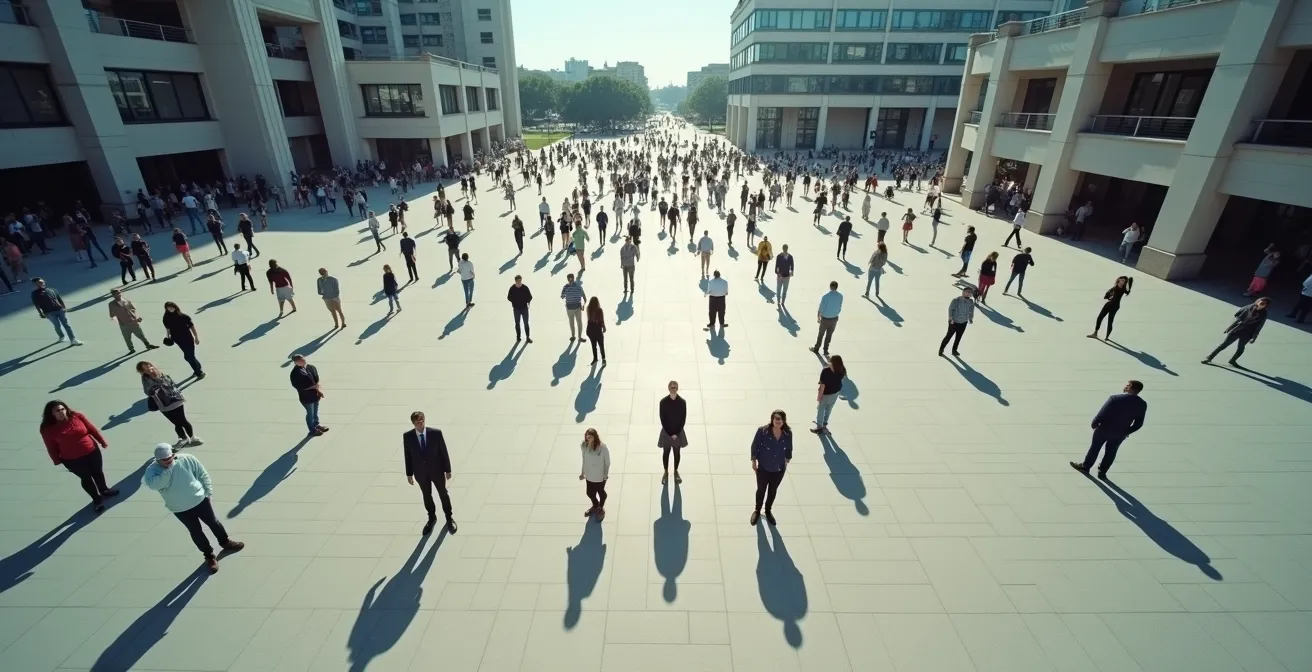
The fear of unintentionally offending in Japan is valid, but memorizing rules is an inefficient strategy.
- Most etiquette “rules” stem from two core cultural principles: maintaining group harmony (wa) and avoiding being a nuisance to others (meiwaku).
- Instead of a checklist, the most effective tool is active observation, allowing you to adapt to any situation.
Recommendation: Focus on understanding these underlying principles. This guide will equip you with the cultural context to act with confidence and respect, rather than just fear of making a mistake.
For the conscientious traveler, the thought of visiting Japan is often paired with a quiet anxiety: the fear of committing a grievous social faux pas. You have likely heard the common refrains—never tip, take your shoes off, don’t stick your chopsticks in rice. While this advice is sound, it represents a surface-level understanding of a deeply nuanced culture. Relying on a memorized list of “don’ts” is like trying to navigate a city with a handful of random street names instead of a map. You may avoid a few wrong turns, but you will never feel truly confident in your direction.
The truth is, Japanese social etiquette is not an arbitrary collection of rules designed to trip up foreigners. It is a logical system built upon a foundational desire for social harmony and the avoidance of inconveniencing others. The key isn’t to memorize dozens of specific actions, but to understand the core principles that drive them. What if the real secret to navigating Japan gracefully wasn’t about knowing what to do, but understanding why it’s done?
This guide moves beyond the simple checklist. We will deconstruct the most common tourist mistakes by examining the cultural logic behind them. By grasping these underlying concepts, you will gain the ability to extrapolate the correct behavior in situations you have never encountered before, transforming your fear of error into a confident awareness. We will explore the critical public behaviors, from managing your voice to managing your trash, and provide a framework for recovering gracefully when you inevitably get it wrong.
To navigate these social intricacies effectively, this guide is structured to explain not just the rule, but the reasoning behind it. Explore the sections below to build a true understanding of Japanese public etiquette.
Table of Contents: Decoding the Unspoken Rules of Japanese Etiquette
- Why Being Loud in Public Is the Ultimate Taboo in Japan?
- How to Manage Your Trash When Public Bins Are Non-Existent?
- Walking While Eating: Why It Is Frowned Upon in Most Areas?
- Standing Left or Right: How to Adapt to Regional Escalator Rules?
- What to Do If You Realize You Have Broken a Social Rule?
- Why Is Phone Talking Considered ‘Meiwaku’ on Commuter Trains?
- Eat and Walk: Is It Rude to Walk While Eating Street Food in Osaka?
- When to Bow: Decoding the Angles for Business and Socializing
Why Being Loud in Public Is the Ultimate Taboo in Japan?
The most immediate and jarring mistake a tourist can make is being loud. In a culture that prizes group harmony, or wa (和), public space is considered a shared environment where personal comfort should not infringe upon the peace of others. Your loud phone conversation or boisterous laughter isn’t just a sound; it is an intrusion, a disruption of this collective serenity. This behavior falls under the critical concept of meiwaku (迷惑), which translates to being a nuisance or a bother to others. Avoiding meiwaku is a fundamental pillar of Japanese social interaction.
The expectation of quiet is not about being unfriendly; it is about being considerate. In the West, public spaces are often seen as a stage for individual expression. In Japan, they are more like a library, where everyone has a right to quiet contemplation. This is why you will see trains full of people in complete silence. It is not sadness or unfriendliness; it is a profound, unspoken agreement of mutual respect. In fact, a survey found that over 52% of Japanese people consider public noise one of the most bothersome tourist behaviors.
To adapt, you must become conscious of your “voice zone.” What is perfectly normal on a street in New York can feel like shouting in a Tokyo café. Pay attention to the ambient volume and match it. The goal is for your conversation to be audible only to your party, creating a private bubble in a public space. This is not about whispering fearfully, but about modulating your volume as a sign of social and spatial awareness.
How to Manage Your Trash When Public Bins Are Non-Existent?
The first thing many visitors notice is the pristine cleanliness of Japan’s streets. The second thing they notice is the complete absence of public trash cans. This paradox can lead to a frantic search for a place to discard a drink bottle or food wrapper, an experience that quickly becomes a lesson in Japanese civic responsibility. The “no-bin” system is not an oversight; it is a deliberate cultural and infrastructural choice that places the responsibility for waste squarely on the individual.
This system has its roots in a practical response to a national tragedy. Most public bins were removed after the 1995 Tokyo subway sarin gas attacks to prevent them from being used to hide dangerous items. However, the system’s success is entirely cultural. The principle is simple: you are responsible for the waste you create. This means carrying your trash with you until you return to your hotel or find an appropriate disposal point. It is a powerful, daily reinforcement of personal accountability and its role in maintaining public order.
Convenience stores (konbini) and vending machines are your allies. They typically have bins, but these are intended for items purchased on-site. While you can sometimes discreetly dispose of a small item, do not treat them as public dumping grounds. The best strategy is to be prepared. Carry a small, dedicated bag for your trash. This simple act signals that you understand and respect the local system, marking you as a considerate traveler, not a clueless one. It turns a potential frustration into a seamless part of your day.
Your Essential Waste Management Kit
- Pack a small reusable silicone or plastic bag for any wet or messy waste.
- Carry a separate, lightweight cloth bag for dry items like paper or plastic bottles.
- Include a small bottle of hand sanitizer or wet wipes for clean-up after handling food.
- Designate a specific pocket in your daypack to keep your waste kit contained and accessible.
- Plan your disposal points: make a mental note to use bins at your accommodation or at convenience stores where you make a purchase.
Walking While Eating: Why It Is Frowned Upon in Most Areas?
Grabbing street food and eating it on the go seems like a normal part of the tourist experience. In Japan, however, the act of aruki-gui, or eating while walking, is generally considered poor manners. This rule is not about hygiene as much as it is about respect and mindfulness. A meal, even a quick snack from a street vendor, is seen as an activity that deserves a moment of pause. To eat while walking is to treat the food—and by extension, the person who prepared it—as an afterthought.
This practice also ties back to the concept of meiwaku. Walking while eating increases the risk of inconveniencing others. You might accidentally bump into someone and spill your food or drink on them. You will also eventually be left holding a greasy wrapper or a sticky skewer with no public bin in sight, creating another problem. As the Travel Channel Cultural Expert notes in their etiquette guide, ” Walking while eating shows disrespect for the meal and the person who made it for you.”

The proper etiquette is to consume your food in the designated area near where you bought it. Most vendors anticipate this and provide a small space, a counter, or at least an area to the side where you can stand and eat. This creates a “consumption zone” where you can enjoy your snack without being a nuisance and, crucially, where there is almost always a bin provided by the vendor for your waste. Taking a few moments to stand still and savor your food is a small act that shows immense cultural respect.
Standing Left or Right: How to Adapt to Regional Escalator Rules?
Escalator etiquette is a classic example of a rule that seems simple but is fraught with regional variations. Most guidebooks will tell you: in Tokyo, stand on the left; in Osaka, stand on the right. While this is generally true, it misses the larger, more important lesson. The real rule of Japanese escalators is not “left or right”; it is “observe and adapt.” Relying on a memorized rule can be a pitfall, as local customs can vary even within a city or in specific locations like airports.
The goal of escalator etiquette is to maintain flow and avoid obstructing those in a hurry. One side is for standing, the other is for walking. Blocking the “walking” lane is a form of meiwaku—you are impeding someone’s progress. The worst thing you can do is stand in the middle or stand with a companion side-by-side, creating a human wall. The key to getting it right every time is to take a brief, two-second pause before stepping onto the escalator. Look at what the people in front of you are doing. Are they lining up on the left? Are they on the right? Simply fall in line. This act of active observation is far more valuable than any memorized rule.
This principle of situational awareness extends to many aspects of Japanese life. Instead of acting on autopilot, you are expected to read the room, observe the flow of people, and adjust your behavior to fit the context. The following table, based on data from travel experts, shows just how much these rules can vary, reinforcing why observation is your most reliable tool.
| City/Country | Stand Side | Pass Side | Special Notes |
|---|---|---|---|
| London | Right | Left | Strictly enforced |
| Tokyo | Left | Right | Recent campaigns discourage passing |
| Washington DC | Right | Left | Metro etiquette |
| Sydney | Left | Right | Follows driving side |
Key Takeaways
- Observe Before You Act: The single most important rule. Watch what locals are doing and follow their lead.
- Prioritize Group Harmony (Wa): Your actions should contribute to, not detract from, the calm and order of a shared space.
- Avoid Being a Nuisance (Meiwaku): Before you act, consider if your action could inconvenience anyone around you.
- Take Personal Responsibility: From your trash to your noise level, you are accountable for your impact on the environment.
What to Do If You Realize You Have Broken a Social Rule?
Despite your best intentions, you will make a mistake. You will talk too loudly, stand on the wrong side, or forget to take off your slippers. In these moments, the Western instinct is often to either ignore it or launch into a verbose, elaborate apology. In Japan, both of these reactions are incorrect. The appropriate response is a quick, subtle, and sincere acknowledgment of your error.
Over-apologizing can be a form of meiwaku in itself, as it draws unnecessary attention and can make the other person feel uncomfortable. The goal is to show you recognize your mistake and are correcting it, without making a scene. A brief moment of eye contact followed by a small, sharp nod or a slight bow is often sufficient. This non-verbal cue says, “I realize my error, I apologize for the inconvenience, and I am correcting my behavior.” Immediately cease the offending action—lower your voice, move to the other side of the escalator, etc. The swiftness of your correction is more important than the apology itself.
Remember, Japanese people are keenly aware that you are a foreigner and do not expect you to know every nuance of their culture. Your intent is what matters most. As Vawn Himmelsbach writes for Bold Traveller Magazine, ” Locals can almost always tell when a tourist’s error is born of ignorance versus arrogance, and the former is almost always forgiven.” A sincere, understated acknowledgment shows your error came from ignorance, not disrespect. It demonstrates humility and a willingness to learn, which will always be met with grace.
Why Is Phone Talking Considered ‘Meiwaku’ on Commuter Trains?
Nowhere is the concept of meiwaku more strictly enforced than on public transportation. Commuter trains and subways in Japan are considered sanctuaries of public silence. While a quiet conversation with a travel companion is sometimes acceptable, taking a phone call is a cardinal sin. This is because a phone call, by its nature, is a one-sided conversation that forces everyone in the vicinity to listen to your personal or business matters. It is seen as a deeply selfish act that shatters the unspoken pact of shared quiet.
You will see signs everywhere instructing passengers to set their phones to “manner mode” (silent) and refrain from talking. This is not a suggestion; it is a rigid social contract. The sound of a ringing phone is jarring, but the sound of a one-sided conversation is considered an active pollution of the shared space. Unlike a conversation between two people in person, where the volume is naturally modulated, phone conversations tend to be louder and more intrusive. It broadcasts your private world into the public sphere, a clear violation of the boundary between uchi (inside) and soto (outside).

If you absolutely must take or make a call, the correct procedure is to get off at the next station and conduct your call on the platform. Then, you can simply board the next train. For non-urgent communication, texting and emailing are the accepted norms. Observe your fellow passengers: they are all engrossed in their phones, but they are doing so silently. They are reading, playing games, or messaging. They are connected to their own digital worlds without imposing them on others. This is the expected behavior, a perfect example of modern technology adapting to timeless cultural values.
Eat and Walk: Is It Rude to Walk While Eating Street Food in Osaka?
The “no eating while walking” rule can seem confusing, especially in a place like Osaka, which is celebrated as Japan’s street food capital. The streets of Dotonbori are lined with vendors selling everything from takoyaki to okonomiyaki. Surely, this is the exception to the rule? The answer is both yes and no, and it perfectly illustrates the importance of observation over rigid rule-following.
While Osaka has a more boisterous and relaxed atmosphere than Tokyo, the underlying principles of etiquette still apply. You will not see locals munching on a snack while weaving through the crowds. Instead, Osaka’s street food culture has perfected the concept of the “designated consumption zone.” The culture is not about walking and eating; it is about buying, stopping, eating, and then moving on. It is a subtle but critical distinction.
This is best demonstrated by the vendors themselves, who have adapted their businesses to the local etiquette. They understand you need a place to eat and a place to dispose of your waste, and they provide for both.
Case Study: Osaka’s Dotonbori Street Food Culture
As detailed by travel experts at publications focusing on Japanese travel, Osaka’s famous Dotonbori district is a masterclass in this principle. Despite being the heart of street food, vendors explicitly expect customers to eat near their stalls. Most provide small standing areas, counters, or are located in food courts. Furthermore, disposal bins are strategically placed at each vendor location, solving both the eating and waste disposal challenges in one elegant system. It proves that a vibrant street food scene can coexist with a culture of respect and cleanliness.
So, in Osaka, you should absolutely indulge in the incredible street food. But do as the locals do: find the space provided by the vendor, or step to the side of the pedestrian flow. Enjoy your food, dispose of your trash in the vendor’s bin, and then continue your exploration. You get to enjoy the food culture without breaking the social contract.
When to Bow: Decoding the Angles for Business and Socializing
The bow is perhaps the most iconic symbol of Japanese etiquette, and also one of the most intimidating for visitors. The depth, duration, and frequency of a bow are all part of a complex social grammar that locals understand instinctively. As a tourist, you are not expected to master this grammar. In fact, an incorrectly performed, overly deep bow can look more awkward than respectful. For most social interactions, a foreigner is not expected to initiate a full bow.
Your goal should be acknowledgment and respect, not a perfect imitation. For greetings, thank yous, and apologies in a casual context (shops, restaurants), a simple, sharp nod of the head is perfectly sufficient and much safer than a clumsy bow. Pair the nod with eye contact and a genuine smile or a look of sincerity, and your respectful intent will be perfectly clear. This approach avoids the potential awkwardness of a poorly executed bow while still honoring the spirit of the gesture.

If a Japanese person bows to you, the most polite thing to do is to return the gesture with a nod or a slight bow from the neck. This is a “mirror and match” approach. You are not trying to replicate the exact depth, but simply to return the gesture of respect shown to you. For a traveler, thinking of the bow less as a required action and more as a responsive gesture can remove much of the anxiety. As travel writer Sarah Miller notes, ” In almost any culture, a simple, warm nod of the head combined with direct eye contact and a genuine smile serves as a polite and respectful acknowledgment.” In Japan, this universal gesture is your safest and most effective tool.
By focusing on the principles of harmony and consideration, you equip yourself to handle any social situation with grace. The goal is not to be a perfect actor, but a mindful and respectful guest in a fascinating culture.
Frequently Asked Questions About Public Etiquette in Japan
Are there exceptions to the no-eating-while-walking rule?
Yes, there are some contexts where it is more acceptable. Designated areas within festivals (matsuri) and theme parks are generally permissive. Additionally, eating an ice cream cone while walking is often seen as more acceptable than consuming messier foods that require wrappers and could potentially create a mess for others.
What if there’s nowhere to stand near the food vendor?
If the vendor offers no space, your responsibility is to find the nearest appropriate spot to stop before you eat. This could be a public bench, a quiet corner in a park, or simply stepping to the side of pedestrian traffic. The key is to be stationary and out of the way of others.
How do locals handle takeaway coffee or drinks?
While more common than food, it is still rare to see people walking long distances while actively sipping a coffee. The general practice is to finish the drink either inside the coffee shop, in a designated seating area outside the shop, or to consume it quickly after purchase before continuing on their journey. It is still considered meiwaku to carry a drink in a crowded area where you might spill it.