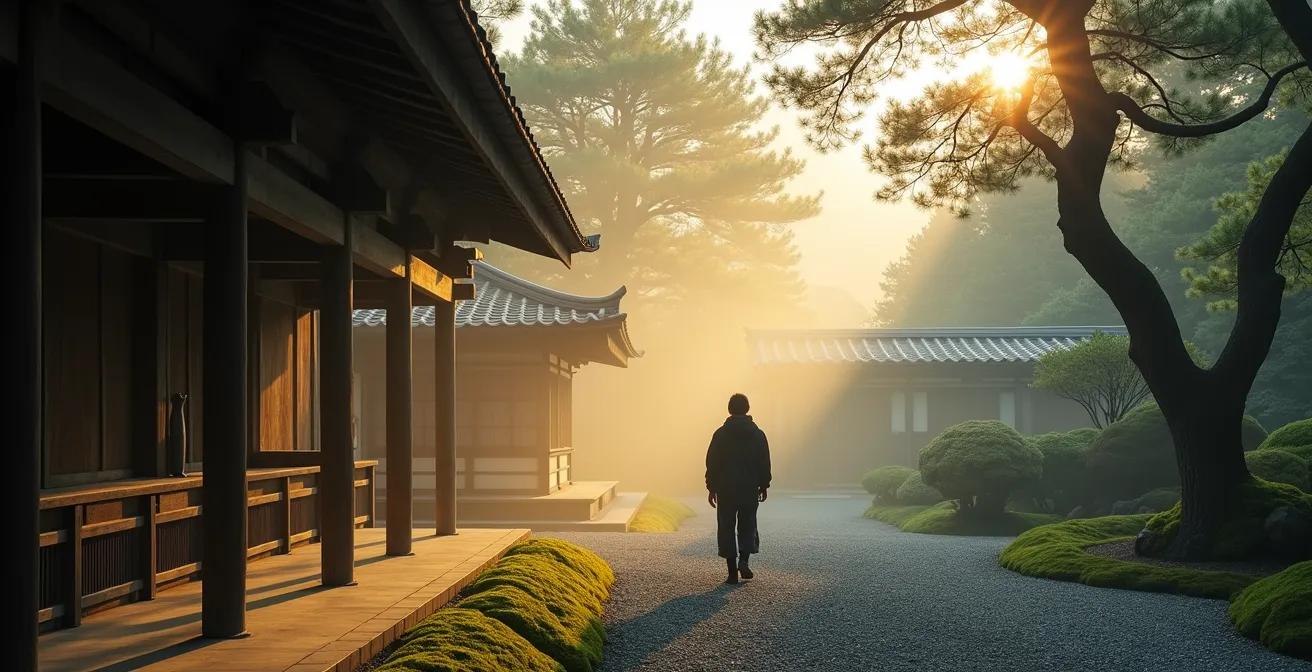
The profound change travelers feel in Japan isn’t about ticking off temples or marveling at skyscrapers. It stems from a fundamental shift in perception. This journey isn’t about what you see, but how you are taught to see. Japan acts as a cultural mirror, compelling you to find stillness in chaos, beauty in flaws, and connection beyond words, ultimately recalibrating your entire inner world.
There’s a common narrative among those who return from Japan. They speak of it in hushed, reverent tones, struggling to articulate a change they feel deep within their bones. It’s more than the memory of cherry blossoms or the thrill of a Shibuya crossing; it’s a subtle but permanent alteration of their inner landscape. Most approach a trip to Japan as an exercise in logistics: a checklist of famous shrines, bullet train schedules, and must-try ramen shops. They seek to conquer the destination, to consume its highlights and return with a camera roll full of evidence. This approach, however, completely misses the point.
The true gift of Japan is not in its sights but in its sensibilities. It’s a culture that has, for centuries, perfected the art of introspection and observation. But if the key to this transformation isn’t found in a guidebook, where does it lie? It lies in shedding the Western mindset of accumulation and instead adopting a Japanese lens of perception. The real journey isn’t about going from Tokyo to Kyoto, but from a state of mental noise to one of quiet awareness, from seeking perfection to appreciating elegant imperfection.
This article will guide you through that emotional journey. We won’t just list destinations; we will explore the psychological shifts that occur when you engage with Japan on its own terms. We will delve into how its unique cultural concepts can rewire your brain, transforming you from a mere tourist into a true cultural explorer, long after you’ve returned home.
Summary: The Japanese Mirror: How a Journey East Rewires Your Inner World
- How Finding Silence in Tokyo’s Chaos Reset My Mental State
- Wabi-Sabi: How Imperfection Redefines Beauty for Visitors
- The ‘Checklist’ Trap: Why Rushing Ruins the Spirit of Japan
- Neon Lights or Natural Stars: Deciding Where to Spend Your Evenings
- When to Schedule ‘Zero Days’ to Absorb the Cultural Shock
- Why Omotenashi Is About Anticipation, Not Just Reaction?
- Beyond Kinkaku-ji: Which Unknown Temples Offer Real Zen?
- How to Move Beyond Tourism and Connect With Real Locals?
How Finding Silence in Tokyo’s Chaos Reset My Mental State
The first paradox a traveler encounters in Japan is the discovery of profound silence in the heart of its most deafening city. Tokyo, a metropolis of nearly 14 million people, should be an assault on the senses. Yet, on a crowded subway car, you’ll find no one speaking on their phone. In a bustling department store, the ambient noise is a low, respectful hum. This external quiet is not just a social norm; it’s an invitation. It creates a vacuum that is immediately filled by your own internal chatter, forcing a confrontation with the “mental noise” we constantly generate to distract ourselves.
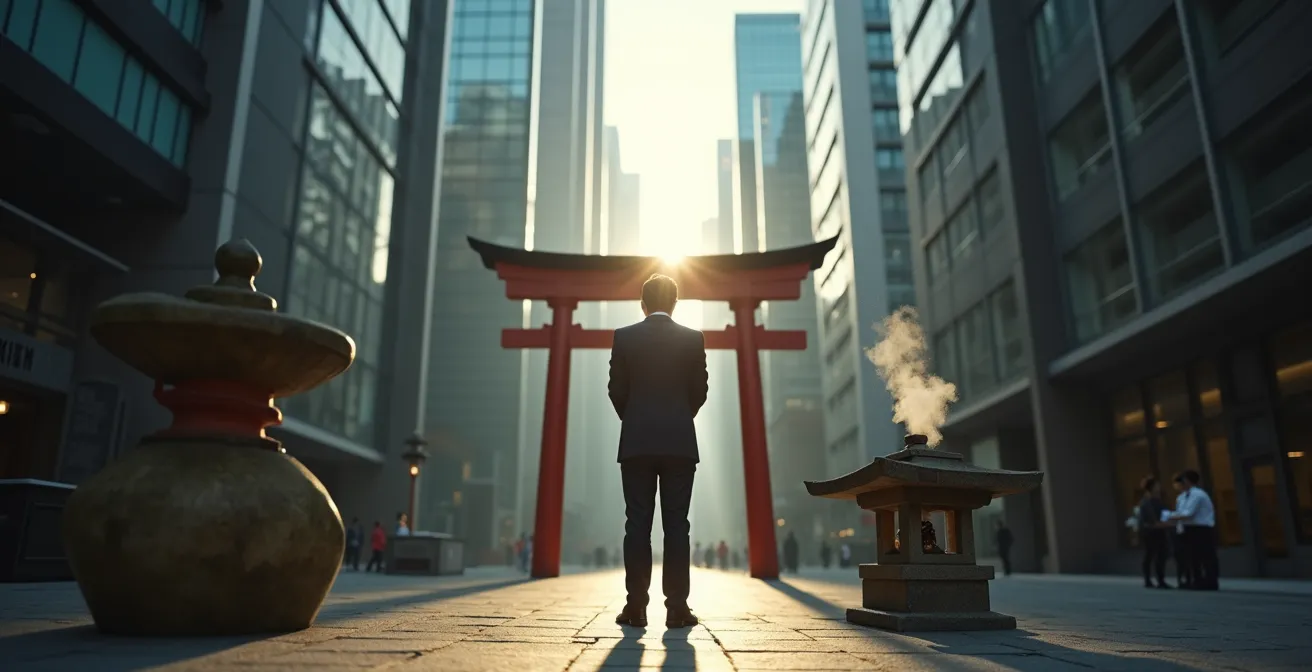
This experience is what cultural psychologists refer to as a perceptual shift. Instead of projecting noise outward, the environment turns your focus inward. As Dr. Takashi Nakajima noted in a study on transformative travel, this dynamic is unique. He states:
The quiet public spaces like subways force a confrontation with one’s own ‘mental noise,’ leading to a state of heightened self-awareness and introspection that is rare in Western environments.
– Dr. Takashi Nakajima, Japanese perspectives on transformative travel experience study
Suddenly, you are acutely aware of your own anxieties, your racing thoughts, your mental to-do lists. This isn’t uncomfortable; it’s diagnostic. By first acknowledging the noise, you can then begin to find the silence between the thoughts. This is the first step in rewiring your brain: learning to locate the serene sanctuaries within your own mind, even when standing in the middle of a chaotic urban jungle.
Wabi-Sabi: How Imperfection Redefines Beauty for Visitors
Once your mind is quieted, your eyes can truly begin to see. In the West, we are conditioned to value the new, the flawless, the symmetrical. Beauty is synonymous with perfection. Japan offers a radical alternative: wabi-sabi. This is the philosophy of finding beauty in imperfection, impermanence, and incompletion. It is the moss growing on a stone lantern, the subtle crack in a handmade teacup, the weathered wood of a temple gate. These are not flaws to be fixed; they are testaments to the passage of time, imbued with a quiet, soulful history.
Engaging with wabi-sabi is an active practice of unlearning. It retrains your eye to find character in what you once saw as decay. You begin to appreciate the grace of a bent tree over a perfectly straight one. This mindset has a profound psychological effect, fostering humility and acceptance.
Case Study: Transformative Experiences at Historical Sites
A study of Japanese adults visiting domestic historical sites, including disaster-scarred locations in Tohoku, revealed a powerful connection between wabi-sabi and personal growth. These “imperfect” landscapes, marked by history and loss, were not seen as depressing. Instead, they fostered deep emotional responses and reflection. Visitors reported experiencing enhanced humility and a deeper recognition of personal limitations after confronting these powerful symbols of impermanence.
This principle teaches you to be gentler, not just with the world around you, but with yourself. It allows you to see the beauty in your own “cracks” and “weathered surfaces.” It is an antidote to the relentless pursuit of an unattainable, airbrushed perfection that defines so much of modern life. To truly internalize this, you must become an active participant, not just a passive observer.
Your Wabi-Sabi Hunt: Training Your Eye for Imperfect Beauty
- Morning Observation: Seek out weathered surfaces on temple gates or old buildings. Note how age adds character rather than diminishing value.
- Texture Mapping: Photograph (mentally or physically) three instances of beautiful decay—moss on stone, rust on metal, or frayed fabric edges.
- Natural Asymmetry Quest: Find five objects in gardens or streets that gain their beauty from imperfection, like a bent tree, a cracked piece of pottery, or an uneven stone path.
- Seasonal Acceptance: Document one element showing *mono no aware* (the pathos of things)—fallen cherry blossom petals, autumn leaves, or morning dew—acknowledging transient beauty.
- Personal Reflection: End each day by noting one “imperfect” moment or observation that held unexpected beauty or meaning for you.
The ‘Checklist’ Trap: Why Rushing Ruins the Spirit of Japan
The greatest enemy of the transformative Japanese experience is the checklist. A traveler armed with a rigid itinerary, rushing from one “must-see” spot to the next, is effectively blind and deaf to the subtleties of the culture. They may “see” the Golden Pavilion, but they will miss the way the light reflects off its surface in a fleeting moment. They may “eat” at a famous sushi counter, but they will miss the silent, meditative dance of the chef’s hands. This frantic pace is a Western imposition, a desire to conquer and quantify that is antithetical to the Japanese spirit.
The journey’s true value lies in the unplanned moments: the discovery of a tiny, hidden shrine in a residential alley; a spontaneous conversation with a shop owner; the simple act of sitting in a park and watching the world go by. These moments cannot be scheduled. They only arise when you create space for them. Interestingly, recent travel data suggests a growing movement away from this rigid model. Tourism data reveals that 35% of travelers in 2024 were solo adventurers, a demographic often more inclined toward spontaneous and introspective journeys.
To let Japan change you, you must give it time. You must be willing to get lost. You must prioritize depth over breadth. Choose to explore one neighborhood deeply rather than skimming the surface of five. Spend an entire afternoon in one temple garden rather than rushing to see three. It is in these moments of unstructured presence that the country reveals its secrets. It’s a shift from a “doing” mode to a “being” mode, and it is in this state of being that true connection and understanding can finally take root.
Neon Lights or Natural Stars: Deciding Where to Spend Your Evenings
Nowhere is the choice between two modes of being more apparent than in how you spend your evenings. Japan offers a fascinating duality: the electric, Blade Runner-esque dreamscapes of its cities, and the profound, dark stillness of its countryside. A traveler can find themselves in the neon-drenched chaos of Shinjuku one night and under a blanket of stars at a mountain ryokan the next. The transformative traveler understands that these are not just different activities, but different states of consciousness. Each offers a unique path to self-discovery.
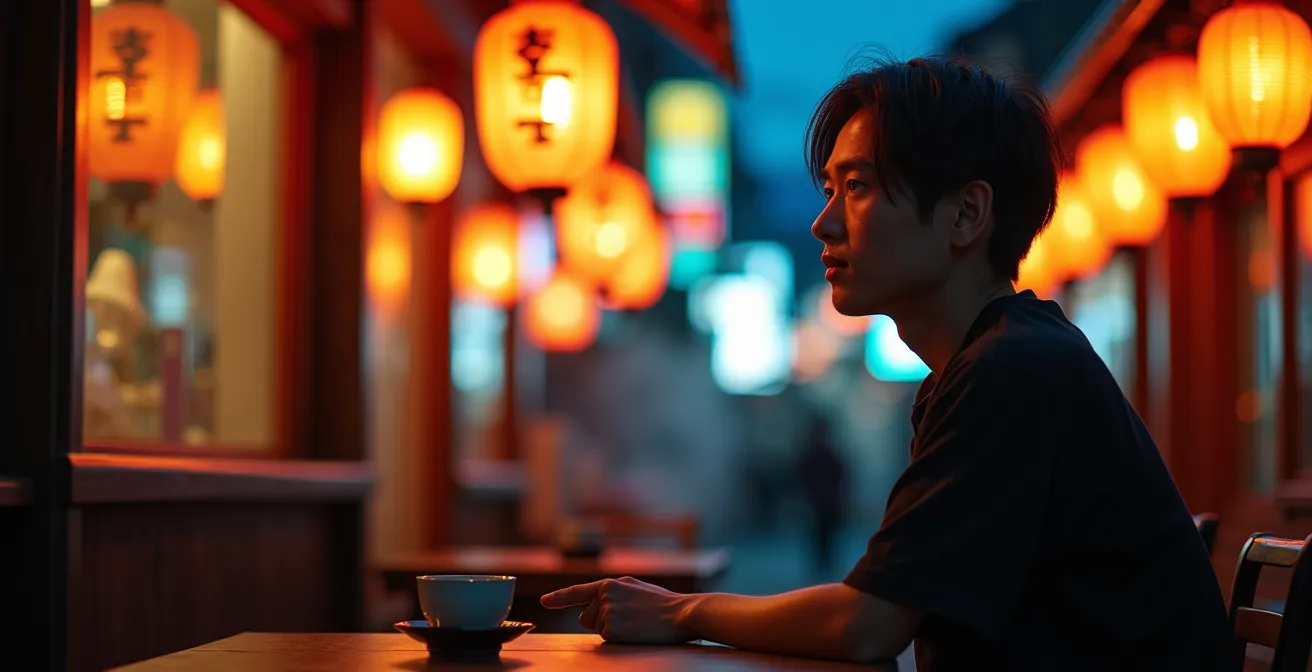
The Japan National Tourism Organization suggests a powerful framework for this choice. It’s not about which is “better,” but what kind of experience you are seeking. Do you wish to dissolve the self or find the self? According to their guide on mindfulness:
Frame neon lights as an experience of ‘dissolving the self’ into a collective, energetic whole. Frame natural stars as an encounter with ‘Yūgen’ – a profound, mysterious grace and an awareness of the universe.
– Japan National Tourism Organization, Meditation and Mindfulness: A Wellness Journey Through Japan
Choosing the neon is an act of surrender to a collective energy, a joyful loss of individuality in a sea of light and sound. Choosing the stars, by contrast, is an encounter with the vastness of the cosmos and, by extension, the vastness of your own inner world. The key is to make the choice with intention. Don’t just follow the crowds; ask yourself what your soul needs tonight: the electric hum of humanity or the silent whisper of the universe?
Case Study: The ‘Third Atmosphere’ of Nighttime Experiences
Yamagata Prefecture has cultivated experiences that bridge this gap. Visitors participating in nighttime temple visits or after-dark Kurokawa Noh performances describe encountering a “Third Atmosphere.” This liminal space, created by the spectral beauty of lantern-lit ceremonies against a backdrop of natural darkness, is neither purely urban nor purely natural. Participants consistently report that this blending of modern life and ancient ritual provides uniquely transformative emotional experiences, allowing them to hold both the neon and the stars in their mind at once.
When to Schedule ‘Zero Days’ to Absorb the Cultural Shock
The experiences described so far—the inner silence, the embrace of imperfection, the intentional evenings—are potent. They bombard the psyche with new information and feelings. This influx can be overwhelming, a phenomenon often dismissed as “culture shock.” However, the transformative traveler sees this not as a negative side effect, but as the very process of rewiring taking place. To facilitate this process, one of the most crucial tools is the “Zero Day”: a day with absolutely nothing planned.
A Zero Day is not a “rest day” in the traditional sense. It’s an integration day. It is a deliberate act of creating empty space in your itinerary for your mind and soul to catch up. On this day, you don’t visit a temple or a museum. You might go to a local coffee shop (*kissaten*) and write in a journal for three hours. You might sit on a park bench and simply watch. You might rent a bicycle with no destination in mind, following only the paths that feel right. The goal is to stop accumulating new experiences and start processing the ones you’ve already had. This need for slow integration is even backed by science.
The mind needs time to form new neural pathways and make sense of paradigm-shifting experiences. A study on behavioral patterns highlights this slow process, noting that for significant shifts, behavior recovery occurs slowly over multiple weeks. While you may not have weeks, a single, well-placed Zero Day can act as a powerful catalyst for this internal work. It allows the subtle lessons of Japan to move from your short-term memory into your long-term understanding—from an observation into a part of your being. Scheduling these days of intentional nothingness is perhaps the most productive thing you can do on a journey of transformation.
Why Omotenashi Is About Anticipation, Not Just Reaction?
As your internal world begins to shift, you’ll start to notice a profound change in how you perceive interactions with others. This is often sparked by experiencing omotenashi, the unique Japanese concept of hospitality. It is frequently mistranslated as merely “good service.” This is a gross oversimplification. Service is reactive; omotenashi is anticipatory. It is the selfless act of anticipating a guest’s needs before they are even aware of them themselves.
It’s the hot towel on a cold day, the umbrella placed by your door before the forecast even calls for rain, the dish recommended by a chef who has quietly observed your preferences. These acts are performed without any expectation of a reward or even a “thank you.” This is not a transaction; it is a form of care. Experiencing this can be deeply moving and fundamentally alters your own approach to relationships.
Case Study: The Lasting Impact of Anticipatory Care
A 2024 study on transformative travel found that exposure to omotenashi created lasting behavioral changes in Western visitors. After staying in traditional inns (*ryokans*), participants reported developing enhanced compassion and conscientiousness. One traveler, who found an umbrella placed by their door on a cloudy morning, described the act as “care for my future self.” This single, small gesture fundamentally changed their understanding of generosity, shifting it from a reactive response to a proactive consideration of others’ future well-being.
As you become the recipient of such thoughtful acts, you start to pay more attention. You begin to notice the subtle cues and unspoken needs of those around you. YouTuber Greg Lam, known for his deep dives into Japanese culture, explains that omotenashi “trains you to become more observant and empathetic.” You are learning to anticipate, not just react. This is a powerful skill to bring back home, transforming your interactions from transactional encounters into opportunities for genuine, selfless connection.
Key Takeaways
- True transformation in Japan comes from shifting your perception, not just your location.
- Embrace concepts like Wabi-Sabi (imperfect beauty) and ‘Ma’ (meaningful silence) to deepen your experience.
- Schedule ‘Zero Days’ without plans to allow for genuine cultural absorption and introspection.
Beyond Kinkaku-ji: Which Unknown Temples Offer Real Zen?
Many travelers come to Japan seeking “Zen,” but they often look for it in the wrong places. They flock to the most famous, photogenic temples like Kinkaku-ji in Kyoto, expecting to find enlightenment amidst a sea of selfie sticks. While these places are undeniably beautiful, their crowded, tourist-focused nature makes them poor environments for genuine introspection. The truth is, Zen is not an aesthetic to be consumed; it is a practice to be undertaken.
Zen is a practice, not an aesthetic. The journey’s goal is to learn to see Zen anywhere – in the meticulous arrangement of a bento box, the focused movements of a street cleaner, or the rhythmic sounds of a knife-maker’s workshop.
– John Daub, Only in Japan
The real Zen is found not in grand pavilions, but in small, focused actions. It’s in the quiet concentration of shakyo (sutra copying) at a small temple, where the act of tracing characters becomes a form of meditation. It’s in joining an early morning chanting service at a temple lodging (*shukubo*), feeling the rhythm of monastic life. It’s in watching a *shokunin* (master artisan) polish a knife, their movements so focused and perfected that their work becomes a spiritual discipline.
To find real Zen, you must look beyond the tourist trail. Seek out smaller, lesser-known temples that offer zazen (sitting meditation) sessions open to the public. Visit a craftsman’s workshop and simply observe. The goal is not to “find” Zen as if it were a hidden object, but to practice it. It’s about cultivating a state of mindful presence and focused attention, a state that can be achieved anywhere, from a centuries-old meditation hall to a bustling urban workshop. This is the true teaching of Zen: that the sacred can be found in the mundane, if only we learn how to look.
How to Move Beyond Tourism and Connect With Real Locals?
The final, and perhaps most rewarding, stage of a transformative journey is genuine human connection. This can feel like the most daunting challenge in a country with a significant language barrier and a culture that values privacy. The key, as with all things in Japan, lies in a subtle shift of approach. Connection is rarely forged through direct questions or grand gestures. It is built in the shared spaces of quiet appreciation and mutual respect.
One of the most effective ways to bridge the gap is through shared passions. Instead of just observing, participate. Join a one-day pottery class, a tea ceremony, or an indigo dyeing workshop. In these settings, the shared focus on the craft becomes the language.
Case Study: Connection Through Shared Craft
The work of YouTubers Rachel and Jun has documented how joining workshops creates natural bridges. Their series on *shokunin* (master artisans) shows that when a visitor learns alongside local students, the dynamic shifts from tourist-and-local to that of fellow learners. This shared vulnerability and focus on a common goal often transcends language barriers, leading to spontaneous dinner invitations and lasting friendships built on a foundation of mutual interest, not transactional tourism.
Another powerful mindset shift is to see yourself as a “giver,” not just a “taker.” As Chris Broad of the “Abroad in Japan” channel suggests, the simple act of bringing small, unique gifts from your home country—a local chocolate, a small craft—can change the entire dynamic of an interaction. It turns a one-way encounter into a reciprocal exchange. The same applies to social settings like a local bar (*izakaya*). Sit at the counter to signal openness. If someone offers you a drink, graciously accept and offer to buy the next round. You are participating in a ritual of community, not just ordering a beverage.
Your next journey, whether to Japan or elsewhere, can be more than a vacation. Start by looking for the silence between the sounds, the beauty in the cracks, and the unspoken needs of others. The real destination is the person you become along the way.