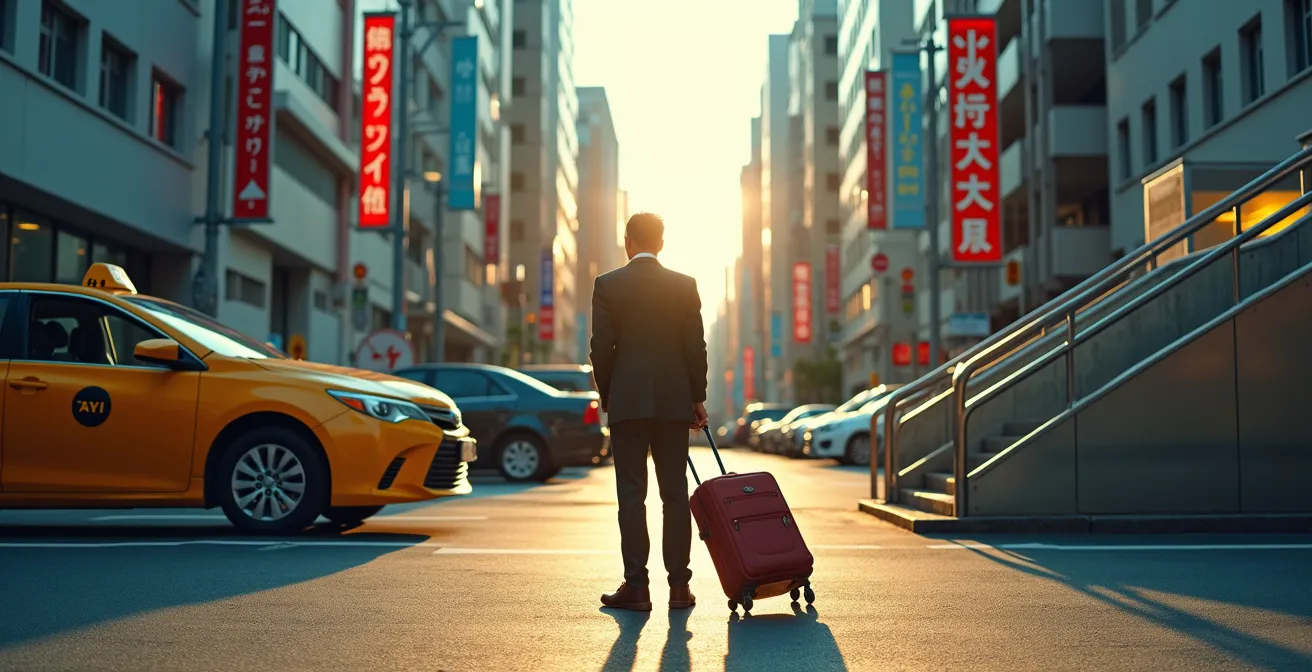
The smartest way to get around Tokyo isn’t always the cheapest; it’s about calculating the ‘Cost-of-Hassle’ for every trip.
- The subway is efficient for long distances but creates “last mile” problems and high stress during peak hours.
- Taxis and ride-hailing apps are invaluable for short, direct trips, especially with luggage, in bad weather, or to bypass massive, confusing stations.
Recommendation: Blend your transport. Use the subway for the main journey and a taxi or scooter for the final connection from the station to your destination.
The standard advice for any traveler in Tokyo is simple: take the subway. It’s punctual, extensive, and undeniably cheaper than a taxi. On paper, the debate is over before it begins. But as anyone who has actually lived here knows, the real currency of Tokyo transport isn’t just yen; it’s a complex trade-off between money, time, and mental energy. The question isn’t just “which is cheaper?” but “when is the convenience of a taxi worth the extra cost?”
Most guides focus on the price, telling you that taxis are a luxury to be avoided. They’ll hand you a subway map and wish you luck. But this ignores the hidden “Cost-of-Hassle”: the 15-minute walk through a labyrinthine station to find your exit, the stress of squeezing into a rush-hour train, or the simple frustration of a route that two train lines almost cover, but not quite. This is what locals understand implicitly. We don’t just see a price tag; we see a calculation of effort.
This guide abandons the simplistic “subway good, taxi bad” narrative. Instead, we’ll adopt a street-wise, pragmatic approach. We’re going to break down the specific situations where spending on a cab is not just a splurge, but the smartest, most efficient decision you can make. It’s about mastering situational transport, understanding system friction, and learning to blend different modes of travel to conquer the city like a local, not just a tourist with a rail pass.
This article provides a framework for making those split-second decisions. We will explore the best apps for hailing a cab, the unspoken rules of bus and train etiquette, the utility of electric scooters for short hops, and how your choice of neighborhood impacts your daily transport calculus. By the end, you’ll be able to weigh the cost in yen against the cost in hassle and always make the right call.
Summary: A Pragmatic Guide to Tokyo’s Taxi vs. Subway Dilemma
- Uber or GO: Which Taxi App Works Best in Japan?
- Front or Back: How to Board and Pay for the Bus in Kyoto?
- Luup Scooters: How to Rent Electric Scooters in Tokyo?
- Station Exit: Why Can Walking Within the Station Take 15 Minutes?
- Compact Stance: How to Fit Into a Packed Train Without Anger?
- Vending Machines and Konbini: Where Else Can You Pay With IC Cards?
- Why You Must Line Up Exactly on the Platform Number Markings?
- East or West Tokyo: Where Should You Base Your Stay?
Uber or GO: Which Taxi App Works Best in Japan?
Forget trying to hail a cab on the street like you see in movies. In Tokyo, your phone is your best tool. The main battle is between two apps: Uber and GO. For most international travelers, Uber is the default choice because of its familiar English interface and seamless integration with foreign credit cards. You set your destination in the app, and the language barrier with the driver dissolves. It’s the path of least resistance. However, it’s important to know that you’re hailing a standard licensed taxi at meter rates; the cheap UberX or Pool options you know from home don’t exist here.
The local champion, however, is the GO app. While it might require a bit more setup, its advantage is sheer availability. GO is partnered with a massive network of taxi companies across Japan, meaning you’ll almost always find a car faster, especially outside central Tokyo. It’s the app the locals use, and it frequently offers discount coupons and promotions, like first-ride offers. A key advantage is its flat-rate airport service; an official guide shows that a trip can be locked in from 6,900 JPY for Tokyo’s 23 wards to Haneda Airport, removing any anxiety about a ticking meter in traffic. The pragmatic choice often comes down to this: use Uber for guaranteed English support and easy payment, but have GO ready for better availability and potential savings.
Ultimately, having both apps installed is the best strategy. You can compare wait times and fares in real-time, choosing the best option for your specific situation, which is the core of smart urban travel.
Front or Back: How to Board and Pay for the Bus in Kyoto?
While this guide focuses on Tokyo, a quick detour to Kyoto’s bus system perfectly illustrates a key point: every city and transport system has its own unwritten rules. In Kyoto, where buses are king, you board through the rear door and exit through the front, paying as you leave. In Tokyo, the opposite is true for most city buses—you board at the front and pay immediately. Getting this wrong doesn’t just mark you as a tourist; it disrupts the flow and efficiency that the entire system is built on. It’s a small example of “system friction” that can add unnecessary stress to your journey.
Buses are a fantastic tool for what locals call “situational transport.” They often handle cross-town routes that subways manage poorly. For instance, getting from a hub like Roppongi to Shimbashi is far more direct by bus than by a convoluted series of train transfers. This is where the bus shines, acting as a strategic alternative for specific journeys where the subway’s rigid lines don’t align with your desired path. It’s a perfect solution for medium-length trips where a taxi feels excessive but the subway is inefficient.
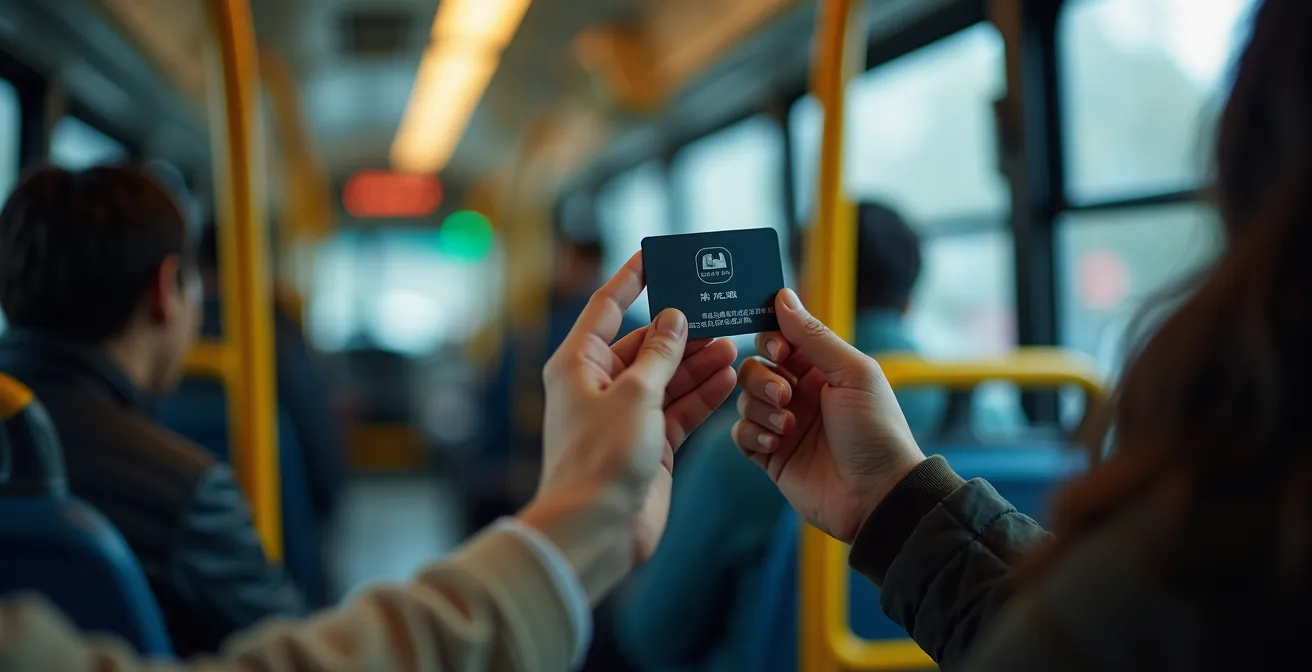
The key takeaway is to observe before you act. Watch what the locals do. Is there a line forming at the back door? Are people tapping their IC cards as they get on or off? A moment of observation can save you from the mild embarrassment and delay of trying to board through the exit. This principle of observing local customs applies to all forms of transport in Japan.
Don’t dismiss the bus. It might not have the high-tech appeal of the subway, but for the savvy traveler, it’s an essential part of a blended transport strategy, bridging the gaps left by the rail network.
Luup Scooters: How to Rent Electric Scooters in Tokyo?
One of the biggest challenges in Tokyo is the “last mile” problem. The subway gets you close, but your destination might still be a 10-15 minute walk from the station exit. This is where the Cost-of-Hassle skyrockets, especially if you have luggage or the weather is bad. Enter Luup, the ubiquitous green-and-white electric scooters and bikes you’ll see parked all over the city. These are a game-changer for short, solo trips. To use them, you’ll need to download the app, register with a phone number, and upload a photo of your driver’s license. Once set up, you simply scan a QR code to unlock a scooter and you’re off.
The appeal is the blend of cost and convenience for specific situations. It’s cheaper than a taxi’s base fare but gives you the same door-to-door advantage. You’re not beholden to train schedules or station locations. It’s the ultimate tool for a solo traveler with a small bag who wants to cover 1-2 kilometers quickly while enjoying the sights and sounds of the neighborhood. However, they are not a universal solution. They’re impractical in the rain, useless if you have luggage, and require finding a designated parking port near your destination.
A comparative analysis highlights the specific niche Luup fills. For a short journey, the cost difference between a scooter and a taxi is significant, making the scooter an obvious choice for the budget-conscious traveler who meets the right conditions. This data is detailed in an analysis of Tokyo transport options.
| Transport Option | Distance | Approximate Cost | Best For |
|---|---|---|---|
| Luup Scooter | 10 minutes/2km | ~¥200 | Solo, good weather, no luggage |
| Taxi (base fare) | First 1-2km | ¥730 | Groups, luggage, any weather |
| IC Card subway | 1-2 station hops | ¥170-200 | Underground routes, rush hour |
Think of Luup as another tool in your transport arsenal. It won’t replace the subway for long hauls, but for conquering that final, often frustrating, last mile, it can be the smartest and most enjoyable choice available.
Station Exit: Why Can Walking Within the Station Take 15 Minutes?
The single biggest hidden time-sink in Tokyo’s subway system isn’t train delays; it’s the stations themselves. Major hubs like Shinjuku, Shibuya, and Tokyo Station are less like transit stops and more like underground cities. It is not an exaggeration to say that walking from your train platform to your desired exit can take 10 to 15 minutes. This is the “system friction” that guidebooks rarely prepare you for. You might arrive “on time” according to the train schedule, only to find yourself hopelessly lost in a maze of interconnected tunnels, department stores, and a dozen different exits.
This is where the high cost of a taxi suddenly starts to look very reasonable. If you’re carrying luggage, heading to a business meeting, or simply exhausted after a long day, paying the ¥730 flag-fall fare to be dropped off directly at your hotel entrance instead of navigating a subterranean labyrinth can be the best money you’ll spend all day. The problem is so notorious that travel experts specifically warn about it. As Lonely Planet aptly puts it in their transport guide,
Some large stations, most notably Shinjuku, can be a maze for the uninitiated
– Lonely Planet, Lonely Planet Tokyo Transportation Guide
The key is to use your navigation app before you even get on the train. Google Maps and other apps are remarkably precise, often telling you not just which exit to use (e.g., “Exit A5”), but which train car to board for the quickest connection to that exit’s staircase. Paying attention to these small details can drastically cut down on in-station walking time. But when the stakes are high or your energy is low, a taxi that bypasses the station chaos entirely is a strategic and often wise investment.
Don’t underestimate the station. It’s a journey within a journey, and factoring in this walking time is crucial for calculating the true duration of any subway trip.
Compact Stance: How to Fit Into a Packed Train Without Anger?
Tokyo’s rush hour is legendary for a reason. During the peak windows of roughly 7:00-9:00 AM and 5:00-7:00 PM, trains on major lines like the Yamanote and Chuo are notoriously packed to levels that can be shocking for first-time visitors. This is the absolute peak of the “Cost-of-Hassle.” While the train is still the most efficient way to move large numbers of people, the personal experience can be intensely claustrophobic and stressful. In this scenario, the premium for a taxi isn’t just for convenience; it’s for sanity and personal space.
If you absolutely must travel during these times, there is an art to surviving it. The first rule is to manage your footprint. If you have a backpack, take it off and hold it by your side or place it between your feet. Don’t be the person who spins around and hits three people with their bag. Secondly, position yourself strategically. If you’re only going one or two stops, stay near the doors. If you have a longer ride, make your way towards the center of the car to allow people to flow in and out. It’s a silent, coordinated dance of spatial awareness.

Many train lines also offer women-only cars during morning rush hour, typically marked with pink signage on the platform. This can be a significantly more comfortable option for those who can use them. However, if you are carrying large luggage, are dressed for an important event, or simply cannot handle extreme crowding, this is the moment to definitively choose a taxi. No amount of money saved is worth starting your day with that level of stress.
Your Action Plan: Surviving Tokyo’s Packed Trains
- Calculate the stress cost: Avoid traveling at peak rush hour (7:30–9am & 5–7:30pm) whenever possible.
- Position yourself strategically: Stand near the doors if getting off soon, or move to the center for longer journeys.
- Remove your backpack: Hold it low by your side or place it between your feet to minimize your footprint.
- Assess the taxi premium: Consider the extra cost worth it if you’re carrying luggage, feeling claustrophobic, or dressed formally.
- Use designated cars: Look for women-only cars (usually marked in pink) during designated hours for more comfort.
Rush hour is a test of your resolve. Knowing the etiquette makes it bearable, but knowing when to opt out and call a cab is the mark of a truly savvy traveler.
Vending Machines and Konbini: Where Else Can You Pay With IC Cards?
One of the subway system’s most powerful advantages over taxis has nothing to do with the trains themselves. It’s the integrated ecosystem built around the IC cards—Suica, Pasmo, and others. These aren’t just train tickets; they are de facto debit cards for a massive part of daily life in Tokyo. Once you’ve loaded your card to use the subway, you’ve unlocked a world of frictionless payment. This significantly lowers the overall “Cost-of-Hassle” associated with the train system.
This integration is seamless. You can tap your card to buy a drink from a vending machine on the platform, grab a snack at a *konbini* (convenience store) inside the station, pay for a locker to store your bags, and even use it at many shops and restaurants across the city. According to a guide on getting around Tokyo, these cards are your “best friend,” working on trains, subways, and buses, and accepted at countless retail locations. This creates a powerful incentive to keep your IC card topped up and ready to go.
This contrasts sharply with taxis, which, while increasingly accepting credit cards, can still be a cash-heavy transaction. The convenience of simply tapping your IC card for multiple small purchases throughout the day without fumbling for coins or worrying about card compatibility cannot be overstated. It makes the entire experience of using the public transport network feel smoother and more connected to the rhythm of the city. The subway isn’t just a way to get from A to B; it’s the backbone of a vast and convenient payment network.
So when you choose the subway, you’re not just choosing a mode of transport. You’re opting into a highly efficient, integrated system that simplifies many other aspects of your day.
Why You Must Line Up Exactly on the Platform Number Markings?
To an outsider, the sight of commuters in Tokyo lining up with perfect precision on painted markings on the subway platform can seem like an extreme form of social discipline. But this isn’t just about being polite; it’s a fundamental component of the system’s legendary punctuality. Those markings on the ground indicate exactly where the train doors will open. By lining up there, passengers create clear channels for people getting off the train, allowing for an incredibly efficient exchange. This process, repeated thousands of time a day, is what allows trains to depart on schedule, often down to the second.
Standing in the wrong spot, even by a foot or two, can disrupt this delicate choreography. You might inadvertently block the path of disembarking passengers, causing a small but cumulative delay. It’s the ultimate expression of how individual actions contribute to the collective good. The system works because everyone agrees to follow the rules. It’s a core part of the “system” that you are buying into when you choose the subway over a taxi. In a cab, you are an individual; on the subway, you are part of a massive, synchronized organism.
This level of order also serves a practical purpose for you as a traveler. The markings often correspond to specific car numbers, and sometimes even color-coding for things like women-only cars or cars with less seating. By paying attention, you ensure you’re boarding the right car and not causing a disruption. While it might feel rigid at first, you quickly come to appreciate the calm and efficiency it creates compared to the chaotic scrum of boarding a train in many other world cities.
Embracing this small act of conformity is your part of the social contract that makes the Tokyo subway one of the best in the world. It’s a small price to pay for unparalleled punctuality.
Key takeaways
- The best transport choice in Tokyo is situational, weighing the yen cost against the “Cost-of-Hassle” (stress, time, physical effort).
- Taxis are strategically essential for solving the “last mile” problem, handling luggage, and bypassing complex, maze-like train stations.
- Mastering the public transport system means understanding its unwritten rules, from bus boarding procedures to precise platform etiquette.
East or West Tokyo: Where Should You Base Your Stay?
Your choice of neighborhood in Tokyo will have a profound impact on your daily transport calculus and the frequency with which you’ll find a taxi worth the cost. The city can be broadly divided into two personalities: the modern, sprawling hubs of West Tokyo (like Shinjuku and Shibuya) and the more traditional, compact areas of East Tokyo (like Ueno and Asakusa). Your experience navigating each is vastly different. West Tokyo is characterized by its massive, multi-layered train stations. While they offer incredible connectivity, their complexity is a major source of “system friction.”
Staying in the West means you’ll likely face a higher daily “Cost-of-Hassle.” You may find yourself relying on taxis more often for that last mile from the station to your hotel, simply to avoid the stress of navigating Shinjuku Station with luggage. In contrast, stations in East Tokyo are generally smaller and more straightforward. However, the trade-off is that you may need taxis for different reasons, such as for cross-town trips to the West side for nightlife or shopping, where subway connections can be less direct. As a helpful guide to Tokyo’s neighborhoods points out, the transport trade-offs are a key factor in deciding where to stay.
| Area | Station Complexity | Taxi Necessity | Best For |
|---|---|---|---|
| West Tokyo (Shinjuku/Shibuya) | Very Complex | High for last-mile | Nightlife, shopping, business |
| East Tokyo (Ueno/Asakusa) | Simple | High for cross-town trips | Culture, temples, quieter stays |
| Central (Tokyo Station) | Large but organized | Medium | Shinkansen access, business |
Basing yourself near a central, well-organized hub like Tokyo Station can offer a good balance, but there’s no single “best” answer. The right choice depends on your itinerary and your tolerance for complexity. A stay in the West demands a higher budget for situational taxis, while a stay in the East might require a different kind of transport planning. This strategic choice of accommodation is perhaps the most important transport decision you’ll make.
By understanding this East vs. West dynamic before you book, you can proactively manage your transport budget and your daily stress levels, ensuring a much smoother and more enjoyable trip.
Frequently Asked Questions about Navigating Tokyo’s Transport
Why are platform markings so important in Tokyo?
They ensure efficient boarding and alighting, allowing the system to maintain its famous punctuality. By lining up precisely, passengers create clear channels for those exiting, which minimizes dwell time at stations.
What happens if I stand in the wrong spot?
You may block other passengers, disrupting the smooth flow and causing minor delays. You could also inadvertently board the wrong type of car, such as a women-only car during designated hours, which can be a social faux pas.
Is this level of order stressful for visitors?
It can be initially, but most visitors quickly come to appreciate the resulting efficiency and calmness. The predictability of the system ultimately reduces stress compared to the uncertainty and potential chaos of traffic delays in taxis or less organized transport systems.