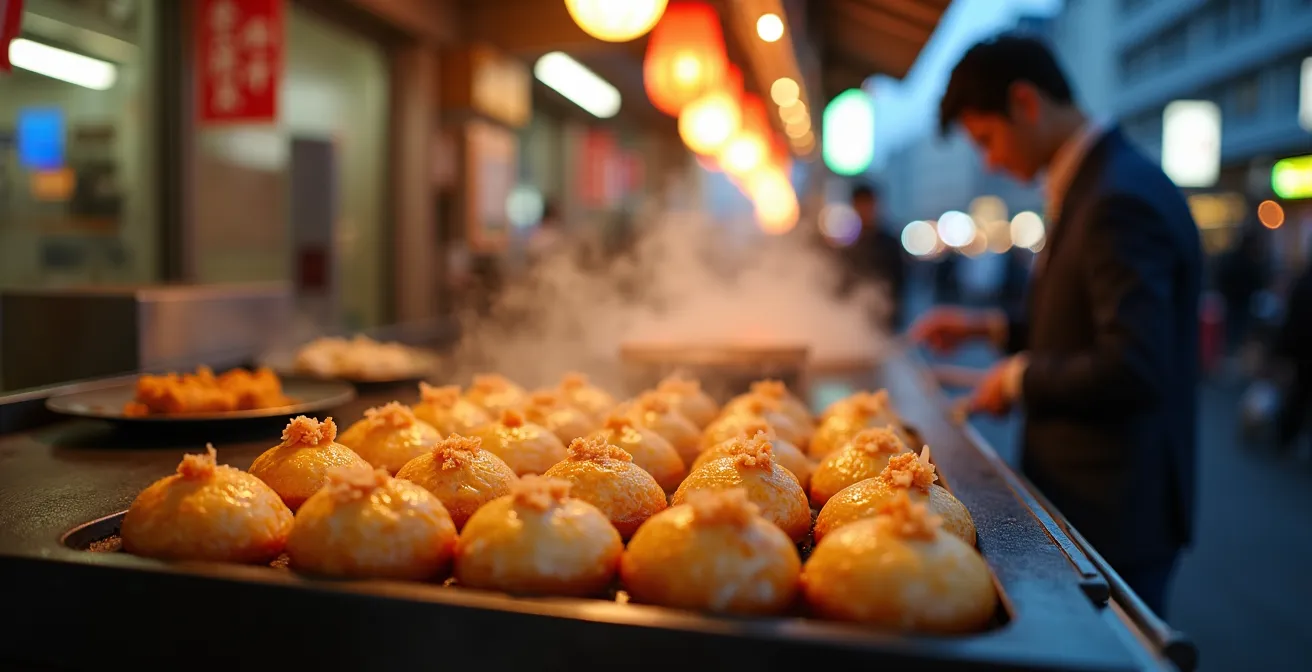
The real choice isn’t just between takoyaki and okonomiyaki; it’s about mastering the unspoken rules of hygiene and respect that define Osaka’s food culture.
- Eating street food in Osaka involves specific techniques, like poking takoyaki to release steam and using cabbage as a spoon for extra kushikatsu sauce.
- Cultural norms like avoiding walking while eating (tabe-aruki) are rooted in a collectivist mindset focused on preventing messes and respecting public space.
Recommendation: Focus first on understanding the ‘why’ behind the rules—it unlocks the confidence to enjoy Osaka’s legendary food scene like a local, not just a tourist.
The sizzle of batter on a hot griddle, the savory aroma of dashi and pickled ginger, the sight of a vendor’s lightning-fast hands—this is the sensory welcome to Osaka’s streets. For any hungry traveler, the immediate dilemma presents itself: do you go for the spherical, molten-hot takoyaki, or the hearty, pancake-like okonomiyaki? While both are pillars of Kansai’s “soul food,” this question is just the entry point. The true challenge isn’t what to eat, but how to eat it with the respect and know-how of a local.
Many guides will offer a simple list of prohibitions: don’t burn your mouth, don’t double-dip, don’t walk and eat. This advice, while well-intentioned, often creates more anxiety than clarity. It misses the fundamental “why” behind these customs—a deep-seated cultural logic rooted in communal hygiene, consideration for others, and a philosophy of pure, unadulterated enjoyment known as kuidaore. This guide moves beyond the simple “don’ts” to reveal the “hows” and “whys.” We will decode the unspoken rules and uncover the clever workarounds that allow you to navigate Osaka’s vibrant food scene safely, deliciously, and respectfully.
This article provides a structured path to mastering the art of street food in Osaka. We’ll explore the essential etiquette, learn practical techniques for enjoying the most popular dishes, understand where and when to eat, and decode the very philosophy that makes this city the “Kitchen of Japan.”
Summary: Navigating Osaka’s Street Food Scene
- Lava Hot: How to Eat Takoyaki Without Burning Your Tongue?
- Kushikatsu Rule: Why Must You Never Dip Twice in the Sauce?
- Eat and Walk: Is It Rude to Walk While Eating Street Food in Osaka?
- Walking While Eating: Why It Is Frowned Upon in Most Areas?
- Festival or Permanent: Where to Find the Best Yatai Stalls?
- Fried Chicken or Oden: How to Order Hot Food at the Counter?
- Cheap or Tourist Trap: How Much Should You Pay for Crab Legs?
- Kuidaore: Why Spending All Your Money on Food Is the Osaka Way?
Lava Hot: How to Eat Takoyaki Without Burning Your Tongue?
The first encounter with takoyaki is a rite of passage. These golden-brown spheres, crispy on the outside and concealing a molten, savory core with a tender piece of octopus, are notoriously hot. A common tourist mistake is to pop one in your mouth immediately, resulting in a painful lesson. The key is not just patience, but a specific technique that signals you know what you’re doing. The “dancing” of the bonito flakes on top, caused by the rising heat, is your first indicator of the intense temperature within.
The local method is a simple but effective act of culinary engineering. Instead of waiting indefinitely, you create a vent. This shows respect for the food and an understanding of its properties. To enjoy takoyaki like an Osaka local, you must first create a small escape route for the lava-like interior. This is the single most important step to avoid a scorched palate.
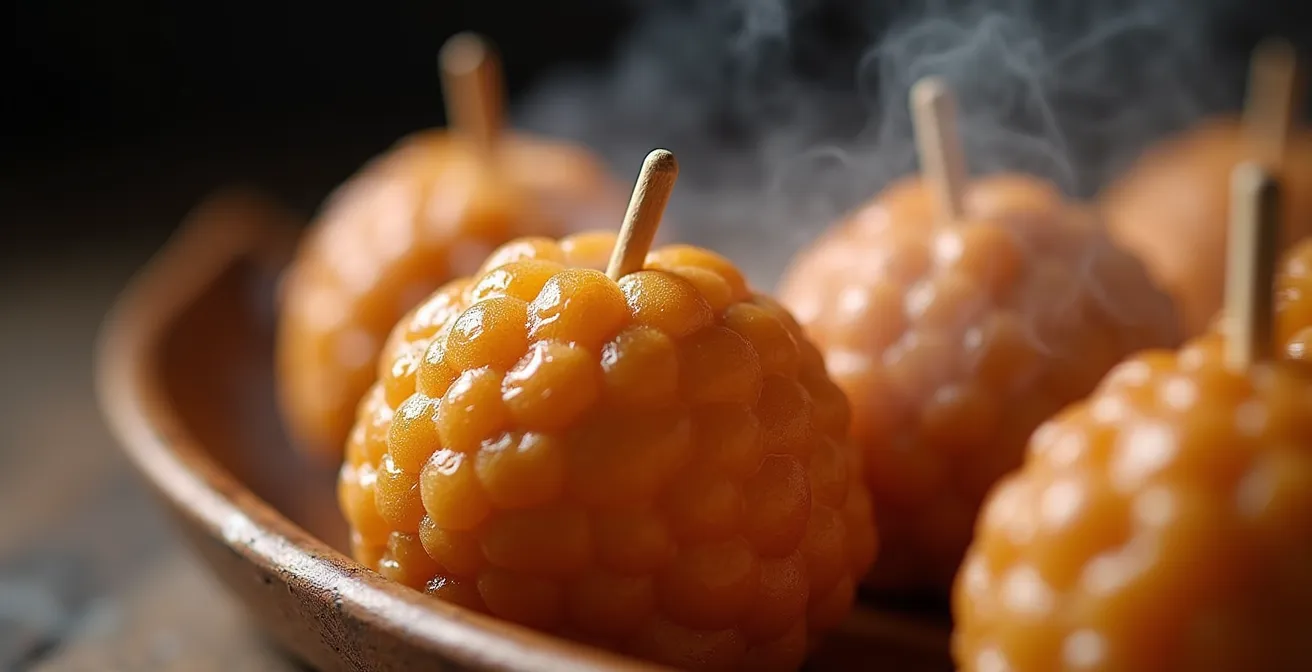
As the image demonstrates, a small puncture makes all the difference. Use your wooden pick to gently poke a hole in the top of a ball. You will see a wisp of steam escape, releasing the intense pressure and heat trapped inside the batter. It’s best to start with a takoyaki from the edge of the boat-shaped tray, as they cool faster than the ones in the center. After poking the hole, take a tiny initial bite to test the temperature before committing to the whole thing. This methodical approach is the hallmark of an experienced street food enthusiast.
Your Action Plan: The Safe Takoyaki Technique
- Wait and Watch: Give it 30-60 seconds after receiving your order. The bonito flakes’ “dancing” should slow down.
- Create a Vent: Use your wooden pick to poke a small hole in the top of the takoyaki ball to release the trapped steam.
- Start from the Edge: Begin with the takoyaki on the outer edge of the tray, as they cool down the quickest.
- Test Bite: Take a small, cautious bite to gauge the internal temperature before enjoying the rest.
- The Sacrifice: For maximum safety, break the first takoyaki completely open to let it cool rapidly while you start on the next.
Kushikatsu Rule: Why Must You Never Dip Twice in the Sauce?
Kushikatsu, deep-fried skewers of meat, seafood, and vegetables, is another Osaka essential. When you sidle up to a counter, you’ll notice a communal stainless-steel container of thin, dark dipping sauce. Herein lies the most sacred rule of kushikatsu etiquette: thou shalt not double-dip. This isn’t just a quirky local custom; it’s a fundamental rule of public hygiene. The sauce pot is shared by all customers, and dipping a skewer you’ve already bitten into would be a major sanitary faux pas.
Breaking this rule is the fastest way to identify yourself as a clueless tourist and earn stern looks from the staff and fellow diners. The system relies on everyone’s cooperation to keep the shared sauce clean. But what if you need more sauce after your first bite? This is where a clever, and perfectly acceptable, “hack” comes into play. The complimentary bowl of raw cabbage served with your meal is not just a palate cleanser; it’s your tool for acquiring more sauce.
You can use a clean piece of cabbage as a makeshift spoon. Dip the cabbage leaf into the communal pot, scoop up some sauce, and drizzle it over your kushikatsu. This technique allows you to get all the sauce you want without ever contaminating the shared container. Remember, the rule applies to the cabbage as well—once a piece has touched your plate or your mouth, it cannot go back into the sauce pot. Always use a fresh leaf for each scoop.
Eat and Walk: Is It Rude to Walk While Eating Street Food in Osaka?
In many Western cultures, grabbing a bite and eating it on the move is normal. In Japan, this practice, known as tabe-aruki (食べ歩き, “eating while walking”), is generally frowned upon. While Osaka’s vibrant food culture makes it feel like an exception, the underlying principle of avoiding tabe-aruki still holds true in most situations. The core reason is a blend of practicality and social consideration: eating while walking increases the chances of making a mess, whether it’s dropping food, spilling a drink, or accidentally bumping into someone with greasy hands.
The seriousness of this norm is evident in other parts of Japan. For instance, the city of Kamakura introduced an ordinance against eating while walking to maintain cleanliness and public order. The proper etiquette is to find a designated spot to stand and eat. Most street food vendors either have a small standing area near their stall or expect you to consume your food right there before moving on. You should finish your food and dispose of the waste in the bin provided by the vendor.
However, the rule isn’t absolute. There are specific contexts where tabe-aruki is acceptable. During festivals (matsuri), the atmosphere is more relaxed, and walking with food is common. Similarly, in certain designated tourist-heavy street food zones, the practice is more tolerated. The key is to be observant. If you see locals standing near the stall to eat, you should do the same. If everyone is on the move with snacks in hand, it’s likely an accepted zone.
Walking While Eating: Why It Is Frowned Upon in Most Areas?
The aversion to “eating while walking” goes deeper than just preventing litter. It is rooted in a cultural concept of public conduct and consideration for others. The practice is considered gyougi ga warui (行儀が悪い), a term that translates to “bad manners” or “poor form.” This isn’t about being judgmental; it’s about a collective mindset focused on maintaining harmony and avoiding potential inconvenience to those around you.
As the Japanese cultural experts at Coto Academy explain, it’s a matter of social consciousness:
It’s considered gyougi ga warui (行儀が悪い) — bad manners or rude.
– Japanese cultural consensus, Coto Academy Japanese Language School
This idea is part of a broader philosophy of collectivism, where individuals are taught to consider how their actions might affect the community before acting. A tangible example illustrates this perfectly: a tourist in Arashiyama, Kyoto, was gently advised not to walk with their soft-serve ice cream. The underlying concern wasn’t just about the tourist making a mess, but the potential to spill it on a passerby rushing to an important meeting. The focus is on anticipating and preventing any negative impact on others, no matter how small.
By standing still to eat, you show respect for public cleanliness and for the people sharing the space with you. You contain your potential mess to one spot and can properly dispose of your trash. This small act of mindfulness is a significant gesture of cultural understanding and respect, elevating you from a simple consumer to a considerate participant in the local etiquette.
Festival or Permanent: Where to Find the Best Yatai Stalls?
Osaka’s street food can be found in two primary settings: temporary stalls known as yatai that pop up during festivals (matsuri), and permanent shops, often clustered in covered shopping arcades called shotengai. Both offer incredible food, but they provide different experiences. Yatai at festivals are all about energy, atmosphere, and high turnover. The food is cooked fresh and fast to serve massive crowds, creating a vibrant, bustling environment.
Permanent stalls, on the other hand, are the bedrock of the local food scene. You’ll find them in iconic areas like Dotonbori, Shinsekai, and the sprawling Tenjinbashisuji Shotengai. These shops have been run by the same families for generations, and their quality is staked on their long-standing reputation. Here, the atmosphere is more local and authentic, and you might have a chance to interact with the vendor. While festival stalls are great for seasonal treats, the permanent shops are where you’ll find the most consistent, time-tested versions of classics like takoyaki and okonomiyaki.
The following table breaks down the key differences to help you decide which experience you’re looking for.
| Aspect | Festival Yatai (Temporary) | Shotengai Shops (Permanent) |
|---|---|---|
| Location | Matsuri venues, seasonal events | Tenjinbashisuji, Dotonbori, Shinsekai |
| Operating Hours | Event-specific, often evenings | Daily, typically 11am-10pm |
| Quality Indicators | High turnover, fresh cooking | Long-standing reputation, consistent quality |
| Price Range | ¥300-800 per serving | ¥300-800 for takoyaki, ¥800-1500 for okonomiyaki |
| Atmosphere | Festive, crowded, energetic | Local, authentic, less touristy |
Fried Chicken or Oden: How to Order Hot Food at the Counter?
Beyond the famous griddles of takoyaki and okonomiyaki, some of Osaka’s best hot snacks are found at the most unexpected of places: the convenience store, or konbini. Chains like FamilyMart, Lawson, and 7-Eleven are not just for drinks and packaged goods; they have heated counters offering a delicious array of hot foods, from fried chicken (karaage) to simmering pots of oden.
Ordering can seem intimidating if you don’t speak Japanese, but the system is designed for efficiency. For items like fried chicken or skewers, you can simply point and say “Kore o kudasai” (“This, please”). The clerk will bag it for you. Ordering oden is slightly more interactive. You’ll be given a partitioned container and tongs. You then select the items you want from the simmering broth. Safe and delicious bets for a first-timer include the daikon radish (melts in your mouth), tamago (a hard-boiled egg that has absorbed the savory broth), and chikuwa (a tube-shaped fish cake).
After you’ve made your selections, you hand the container to the clerk. They will top it off with broth and calculate the price. You then pay for everything at the main register along with any other items. Be prepared for common questions like “fukuro wa?” (Do you need a bag?). A simple “hai” (yes) or “iie” (no) will suffice. This simple process unlocks a world of cheap, delicious, and authentically local hot food, available 24/7.
Cheap or Tourist Trap: How Much Should You Pay for Crab Legs?
Osaka’s reputation for amazing food also attracts tourist traps. So, how do you distinguish an authentic, high-quality stall from an overpriced one targeting visitors? Price is one indicator. While items like grilled crab legs can vary wildly, core street foods have a fairly standard price range. According to current Osaka street food pricing, a serving of takoyaki (usually 6-8 balls) should cost between ¥300-¥800, while a satisfying okonomiyaki will run from ¥800-¥1,500. If prices are significantly higher without a clear reason (like premium ingredients), be wary.
However, the best indicators of quality go beyond price. First, observe the vendor’s craft. A passionate vendor moves with energetic, skillful precision, taking pride in their work. Second, check for freshness. Are the ingredients fresh and being cooked to order, or are they sitting pre-cooked under a heat lamp? Authentic takoyaki, for example, should have a crispy exterior that gives way to a molten, almost liquid center, with a tender piece of octopus—never rubbery. Third, look for a line of locals, not just tourists. If people from the neighborhood are willing to wait, it’s almost always a sign of a high-quality, trusted establishment.
Ultimately, separating the gems from the traps requires engaging your senses. Look at the ingredients, watch the preparation, and trust the judgment of the local clientele. A few moments of observation can be the difference between a memorable meal and a disappointing, overpriced snack.
Checklist: Auditing a Food Stall’s Quality
- Clientele Check: Is the line composed of locals, or is it exclusively tourists? A local presence is a strong vote of confidence.
- Freshness Audit: Are ingredients being cooked to order? Or are finished products sitting under heat lamps?
- Vendor’s Pride: Does the vendor exhibit skillful, energetic preparation, or do they seem disinterested? Pride in craft often equals quality in the product.
- Texture Test (Post-Purchase): For takoyaki, is the exterior crispy and the interior molten? Is the octopus tender or rubbery? This confirms authenticity.
- Price vs. Value: Does the price align with the local standard? If it’s higher, is there a clear justification (e.g., larger portion, premium ingredients)?
Key Takeaways
- The rules of Osaka street food are based on hygiene and social consideration (gyougi ga warui).
- Master practical “hacks” like poking takoyaki to release steam and using cabbage as a spoon for extra kushikatsu sauce.
- Avoid walking while eating (tabe-aruki); instead, stand near the vendor’s stall to eat, unless you are at a festival.
Kuidaore: Why Spending All Your Money on Food Is the Osaka Way?
To truly understand Osaka’s obsession with food, you must know the word kuidaore (食い倒れ). It translates literally to “eat until you drop” or “eat until you go bankrupt.” This isn’t just a quirky slogan; it’s the city’s defining philosophy. It embodies a passionate, all-consuming love for food, where spending one’s money on culinary experiences is seen as a worthy, joyful pursuit. This spirit is visible everywhere, from the bustling stalls of Dotonbori to the humble counters of a neighborhood shotengai.
This philosophy is not a modern invention. Its roots run deep into the city’s history. During the Edo period, Osaka served as the commercial hub for Japan’s rice and goods distribution, earning it the nickname “the Nation’s Kitchen” (天下の台所, tenka no daidokoro). This historical role as the country’s pantry fostered a unique food culture where quality, variety, and accessibility became central to the city’s identity. The kuidaore spirit grew from this foundation of abundance and a population that prided itself on its discerning palate.
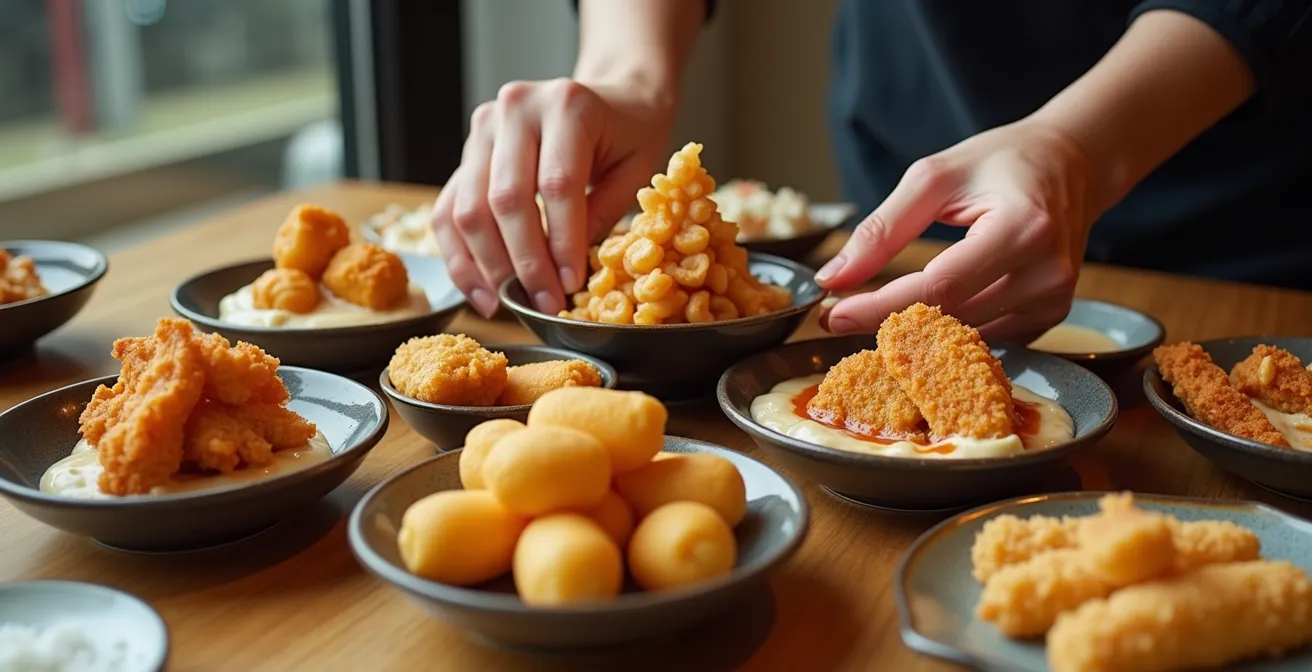
Today, embracing kuidaore means diving headfirst into the city’s offerings. It means trying not just takoyaki and okonomiyaki, but also kushikatsu, udon, and whatever else catches your eye. It’s about prioritizing the experience of taste and community over material possessions. For a visitor, participating in kuidaore is the ultimate sign of respect for Osaka’s culture. It means eating with enthusiasm, trying new things, and understanding that every bite is part of a centuries-old tradition of culinary excellence.
Now that you are armed with the etiquette and philosophy of Osaka’s streets, the only thing left to do is to go out and “eat until you drop,” confidently and respectfully.