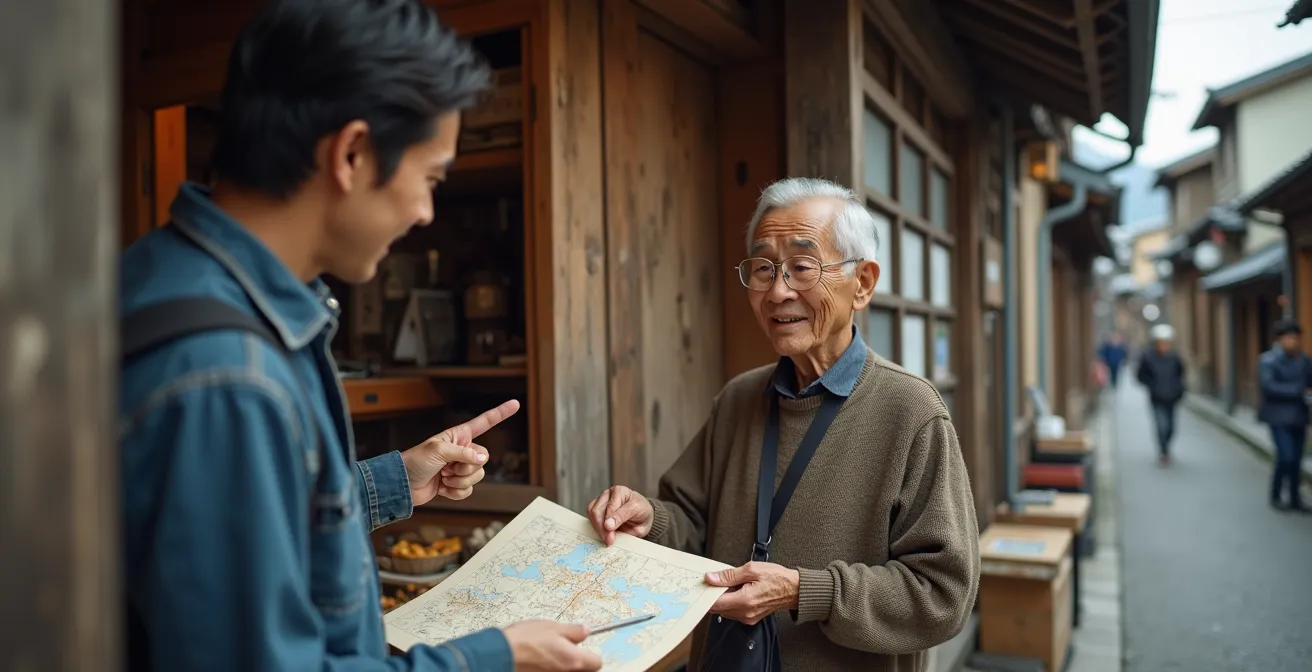
The real challenge of communicating in rural Japan isn’t the language barrier itself, but the misunderstandings that arise from well-intentioned but flawed attempts to cross it.
- Relying on direct English or basic translation apps often leads to polite but incorrect “yeses”.
- Success lies in a “system of clarification” combining simplified language, culturally-aware gestures, and smart app usage to confirm understanding.
Recommendation: Shift your goal from simple translation to active verification. Ask simple questions, observe non-verbal cues, and always confirm you’ve been understood to transform potential frustration into genuine connection.
The dream of rural Japan is a powerful one: misty mountains, serene temples, and warm encounters with locals far from the tourist crowds of Tokyo and Kyoto. For the adventurous traveler, it’s the ultimate prize. But this dream often collides with a stark reality: the language barrier. Many guides will tell you to learn a few phrases or just use a translation app. While helpful, this advice often misses the deeper, more frustrating part of the challenge—not the silence, but the misunderstandings. It’s the polite nod that you mistake for agreement, the directions that lead you in a circle, the feeling that you’re talking, but not truly connecting.
This guide offers a different approach. We won’t just cover the basic tools; we’ll introduce a complete system of clarification. The goal isn’t just to speak *at* someone in English or through a screen, but to create a closed communication loop that ensures you are genuinely understood. This involves a fundamental shift in mindset: from focusing on what you want to *say*, to confirming what they have *heard*. We’ll explore why your school English might not work, how to use technology without being rude, and how to read the subtle signals that tell you more than words ever could. By mastering this system, you can move beyond transactional interactions and forge the real, memorable connections that make rural travel so rewarding.
For those who prefer a more visual format, the video below offers a different kind of cultural immersion. While it might not teach you Japanese, it’s a classic that has a way of transcending language barriers all on its own.
This comprehensive guide is structured to build your communication toolkit from the ground up. We’ll start by understanding the landscape, move through the essential tools and techniques, and finish with strategies for creating authentic human connections. Use the summary below to navigate through the key pillars of your new communication system.
Summary: A Guide to Wordless Communication in Rural Japan
- Why You Cannot Rely on English in Rural Prefectures?
- How to Use Translation Apps Without Breaking the Flow of Conversation?
- Gestures vs. Words: What Works Best When Language Fails?
- The ‘Yes’ Trap: Why Locals Nod Even When They Don’t Understand
- How to Simplify Your English Questions to Get Better Answers?
- DeepL or Google: Which Translation App Is More Accurate for Japanese?
- Guide or Solo: Do You Need a Translator for Rural Activities?
- How to Move Beyond Tourism and Connect With Real Locals?
Why You Cannot Rely on English in Rural Prefectures?
The first step in our system of clarification is accepting a fundamental truth: outside of major cities and tourist hubs, English is not a reliable safety net. While Japan has compulsory English education, the focus is often on grammar and reading, not conversational fluency. The result is a population that may recognize words but lacks the confidence or practice to speak them. This effect is magnified in rural prefectures, where exposure to foreigners is minimal and the need for daily English is virtually nonexistent.
The statistics paint a clear picture. For instance, a 2024 study on English education challenges revealed that under 45% of junior high school English teachers met the CEFR B2 benchmark for proficiency, with rates expected to be lower in more isolated regions. This urban-rural divide is stark. Data from the EF English Proficiency Index showed the largely rural Chugoku region of western Japan scoring 44 points lower than Tokyo. This isn’t a criticism, but a crucial piece of context for the adventurous traveler. Assuming you can fall back on English will only lead to frustration for both you and the person you’re trying to communicate with.
Instead of hoping for an English speaker, it’s far more effective to assume you won’t find one. This mindset shift is liberating. It forces you to be resourceful and proactive, relying on the tools and techniques we’ll explore next, rather than on luck. It replaces a strategy of hope with a strategy of preparation, which is the cornerstone of successful communication in the Japanese countryside.
How to Use Translation Apps Without Breaking the Flow of Conversation?
Translation apps are a modern miracle for travelers, but using them effectively in Japan is an art form that balances technology with etiquette. Simply holding up your phone and speaking into it can feel abrupt and disruptive in a culture that values harmony and subtlety. To integrate these tools smoothly, you must treat the app not as a translator, but as a polite intermediary. The goal is to make the exchange feel like a shared effort, not a demand.
This begins before you even speak. Have your question fully typed out and ready to show. This simple act respects the other person’s time, preventing them from having to wait awkwardly as you fumble with the screen. When you present your phone, do so with a slight bow and hold it at a comfortable viewing angle. This small gesture transforms the interaction from a transactional query into a polite request. Keep the audio output volume low or off entirely; the visual text is often more than enough and avoids disturbing the quiet ambiance of a rural shop or restaurant.
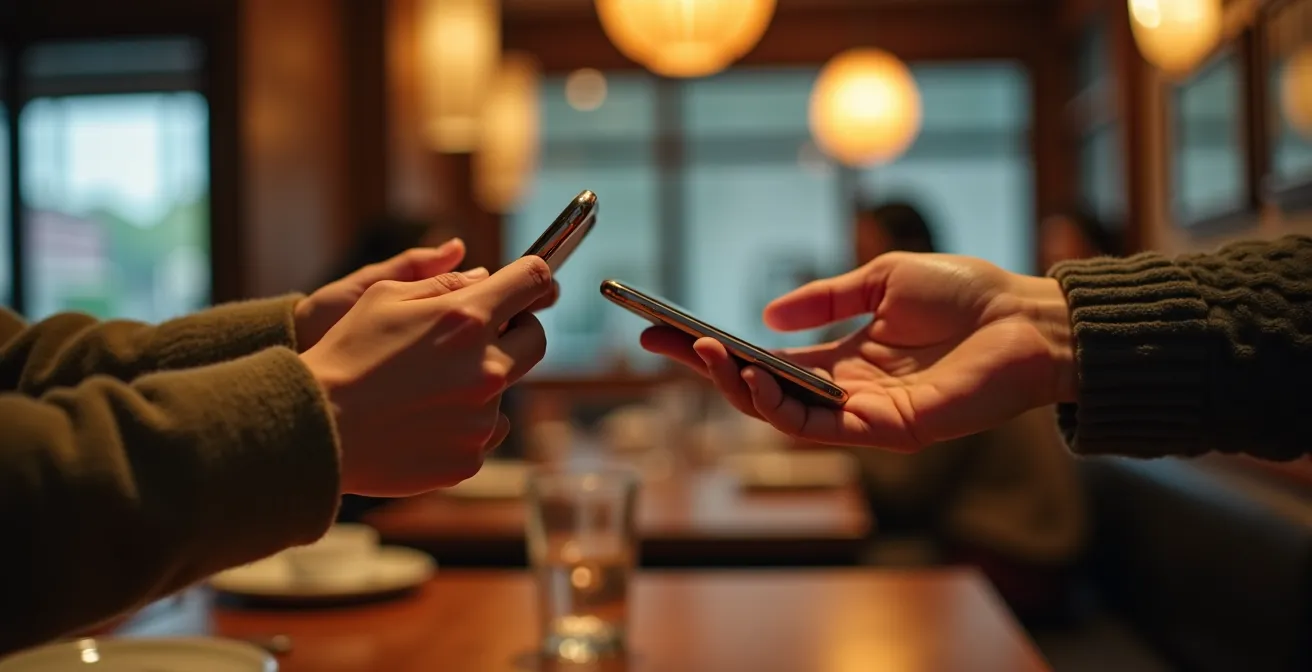
As the illustration shows, the exchange is about a shared gesture, not just the technology. Remember to download the offline Japanese language pack for your chosen app before you leave home. This is non-negotiable for rural travel, where data service can be spotty or non-existent. An offline pack ensures your communication toolkit is always available when you need it most. By following this etiquette, you turn a potentially clunky process into a smooth, respectful, and far more effective conversation.
Your Action Plan: Using Translation Apps Politely
- Prepare Offline: Download Google Translate’s offline Japanese language pack before your departure to ensure functionality without a data connection.
- Type First, Show Second: Compose your full question on the screen first, then present the phone to your counterpart to avoid making them wait.
- Leverage the Camera: Use the camera or image translation feature for instant, non-intrusive translation of menus, signs, and product labels.
- Minimize Audio Disruption: Keep the app’s audio output at a minimal volume or turned off in quiet settings like restaurants, temples, or shops.
- Gesture Respectfully: Show your phone screen while offering a slight bow or nod; this small act of politeness makes the interaction much smoother.
Gestures vs. Words: What Works Best When Language Fails?
When digital tools aren’t an option, your body becomes your primary communication device. But the language of gestures is not universal. A simple point or head shake that seems obvious to a Westerner can be ambiguous or even impolite in Japan. Mastering a few key Japanese gestures is a critical part of your communication system, often proving more effective and immediate than fumbling with an app. The core principle is to use clear, culturally-appropriate signals that reduce the chance of misinterpretation.
As the Japan Dev Editorial Team notes in their guide, “Cracking The Code: Japanese Nonverbal Communication”:
The Japanese language relies heavily on context and gestures… Japanese people often choose to stay silent instead of going into conflict to preserve societal harmony.
– Japan Dev Editorial Team, Cracking The Code: Japanese Nonverbal Communication
This insight is key: using the right gesture shows respect for this harmony and makes it easier for someone to help you. For instance, instead of pointing with your index finger (which can be seen as aggressive), use an open palm gesture to indicate a direction or an object. When referring to yourself, touch your index finger to your nose rather than pointing at your chest. Waving a hand back and forth in front of your face means “no” or “not possible,” a much clearer signal than a simple head shake.
Understanding these differences is fundamental. The following table breaks down some of the most common and useful gesture translations for your travels.
This table compares common gestures and highlights the Japanese style, providing a practical reference for non-verbal communication.
| Gesture | Japanese Style | Western Style | Meaning |
|---|---|---|---|
| Pointing at self | Index finger to nose/face | Hand to chest | Referring to oneself |
| Indicating direction | Open palm gesture | Index finger pointing | Showing direction |
| Saying ‘No’ | Hand wave in front of face | Head shake | Refusal/Negative |
| Asking for bill | Making X with arms/fingers | Writing gesture in air | Check please |
| Agreement | Repeated nodding (aizuchi) | Single nod | Understanding/Listening |
The ‘Yes’ Trap: Why Locals Nod Even When They Don’t Understand
This is perhaps the single most important concept for any traveler in Japan to grasp: the word “hai” (yes) and the accompanying nod do not necessarily mean “I agree” or “I understand.” This is the “Yes Trap,” a common source of confusion that can derail the best-laid plans. In Japanese culture, nodding and saying “hai” is a form of aizuchi, or active listening. It’s a conversational backchannel that signals “I am listening to you,” “I’m following along,” or “I acknowledge you are speaking.” It is not a confirmation of comprehension.
Falling into the Yes Trap is easy. You ask a complex question, receive a series of enthusiastic nods and “hais,” and walk away believing you have your answer—only to find out later you were completely misunderstood. This isn’t deception; it’s a cultural difference in communication style, rooted in the desire to be polite and show engagement. To escape this trap, you must actively build a verification step into every important conversation. This is the core of our system of clarification.
Case Study: The ‘Aizuchi’ Misunderstanding
An often-cited example of aizuchi in a business context illustrates this perfectly. During negotiations, a Western team received constant nods and “yes” responses from their Japanese counterparts, leading them to believe the deal was secured. They were shocked when the proposal was later rejected. The “yes” they heard was not agreement, but simply an affirmation that they were being listened to. This highlights the critical difference between Western affirmation and Japanese active listening signals.
So how do you verify true understanding? After receiving a “yes,” use one of these techniques:
- Ask for a confirming gesture. After asking for directions, take one step in the indicated direction and look back with a questioning expression. A correct nod now means much more.
- Use a verification phrase. A simple “Daijoubu desu ka?” (“Is it okay?”) after receiving a “yes” can prompt a more considered response.
- Observe subtle counter-signals. A slight sucking of the teeth, a hand grabbing the back of the neck, or a downward glance often accompany a polite “hai” but signal difficulty or a negative answer. These are the true signals you should be looking for.
How to Simplify Your English Questions to Get Better Answers?
After learning to listen for the real signals, the next step in our system is to control what you send. The English you speak can be the biggest barrier to being understood. Complex sentences, polite fluff, and idiomatic phrases are conversational static. To get clear answers, you need to use Minimal Viable English—stripping your language down to its absolute, functional core. This isn’t about “dumbing down” your speech; it’s about engineering it for maximum clarity.
Think in keywords, not sentences. Instead of “Excuse me, I was wondering if you could possibly tell me where I might find the nearest train station?”, simplify to “Station? Where?”. The politeness is conveyed through your tone, your smile, and your bow, not through convoluted grammar. Open-ended questions are difficult to process. Instead, formulate simple yes/no questions. “Do you have ramen?” is infinitely better than “What kind of noodle dishes do you serve?”
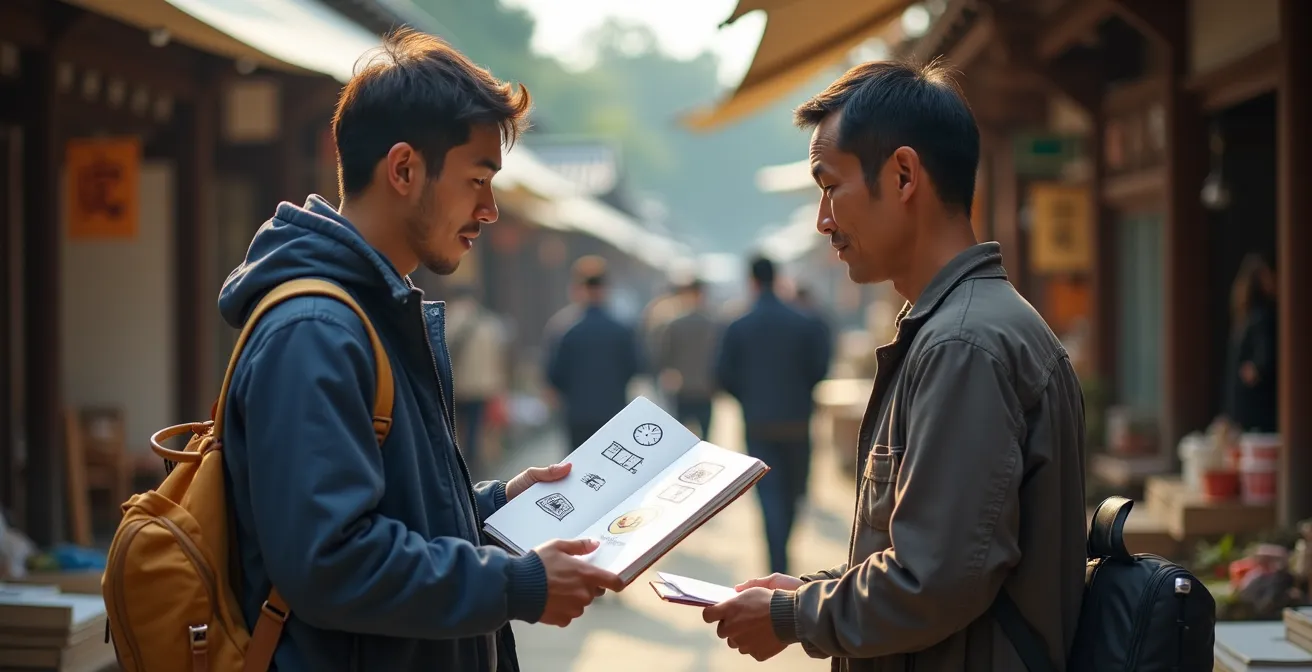
As this image suggests, simplicity is a bridge. Even a simple drawing can be more effective than a complex sentence. Avoid phrasal verbs (“check in,” “look up”) and stick to single, concrete verbs. Instead of “I’d like to check in to my reservation,” try “I have reservation.” It feels blunt to a native English speaker, but it’s crystal clear to someone translating on the fly. This directness, paired with polite non-verbal cues, is a powerful combination for effective communication.
This table provides practical examples for simplifying your English, making it easier for non-native speakers to understand your requests.
| Complex Phrase | Simplified Version | Why It Works |
|---|---|---|
| Could you possibly tell me where I might find… | Where is…? | Direct, simple structure |
| I was wondering if you have… | Do you have…? | Clear yes/no question |
| Would it be possible to get to the station by 3 PM? | Station? 3 PM OK? | Key words only |
| I’d like to check in to my reservation | I have reservation | Eliminates phrasal verb |
| Can you help me figure out… | Please help | Universal simple request |
DeepL or Google: Which Translation App Is More Accurate for Japanese?
When it comes to digital translation, the two heavyweights are Google Translate and DeepL. While both are powerful, they have distinct strengths and weaknesses for the traveler in Japan. Choosing the right one for the right situation is a key part of your technology toolkit. It’s not about which one is “best” overall, but which is the best tool for a specific job.
Google Translate is the undisputed champion of versatility and on-the-go functionality. Its killer feature is the camera translation (Word Lens), which allows you to point your phone at a menu, sign, or packet of food and see an instant, augmented-reality translation. This is invaluable for navigating daily life. Furthermore, its offline mode is robust, allowing you to download the entire Japanese language pack for full functionality without a data connection—an essential feature for rural areas. While its translations can sometimes be literal, its practical features are unmatched for a traveler in the field.
DeepL, on the other hand, excels at nuance and politeness. It is widely regarded as producing more natural-sounding and contextually aware translations, especially for longer sentences. If you need to compose a polite email to a ryokan owner or understand the subtleties of a formal notice, DeepL is often superior. However, it lacks the real-time camera translation and has more limited offline capabilities, making it less of a field tool and more of a precision instrument for when accuracy and tone are paramount.
The following table, based on common features, breaks down their respective advantages for travel in Japan.
This comparison helps you decide which app to use based on your specific needs, from reading menus to composing formal requests.
| Feature | Google Translate | DeepL | Best Use Case |
|---|---|---|---|
| Camera Translation | Excellent real-time | Not available | Reading menus & signs |
| Offline Mode | Full functionality | Limited | Rural areas without data |
| Nuance & Politeness | Basic | Superior | Formal requests & emails |
| Voice Input | Very good | Good | Quick conversations |
| Interface Languages | 100+ | 31 | Multi-language travelers |
Guide or Solo: Do You Need a Translator for Rural Activities?
With a solid system of clarification, you can accomplish an incredible amount on your own in rural Japan. But it’s equally important to recognize the system’s limits. The decision to hire a guide or translator isn’t a sign of failure; it’s a strategic choice to enhance your experience for specific activities where context and deep understanding are paramount. Knowing when to go solo and when to call in an expert is a sign of a smart traveler.
You can confidently go solo for many activities. Hiking on well-marked trails, visiting public onsen (where rules are often posted with pictograms), exploring the grounds of open temples, and shopping in markets with visible prices are all perfectly manageable. In these situations, your toolkit of gestures, simplified English, and translation apps will be more than sufficient. For low-stakes interactions, going solo is part of the adventure.
However, a guide becomes essential when the experience is built on cultural context and etiquette. Think of a traditional tea ceremony, a craft workshop with a master artisan, or a visit to a temple that requires special permissions. In these cases, a translator does more than just change words; they act as a cultural bridge, explaining the nuances, history, and unspoken rules that give the experience its meaning. Furthermore, research on Japan’s regional language capabilities shows that English-speaking guides are scarce in rural areas, so booking one in advance through a local tourist office is crucial if you foresee needing one. Many tourist offices also offer free volunteer guides, which are a fantastic resource for gaining local insights without the cost of a professional.
Key Takeaways
- The goal isn’t just translation, but a “system of clarification” to ensure you’re truly understood.
- The Japanese “hai” (yes) often means “I’m listening,” not “I agree.” Always verify understanding.
- Simplify your English to keywords and use culturally appropriate gestures over complex sentences for better results.
How to Move Beyond Tourism and Connect With Real Locals?
Mastering the tools of communication—apps, gestures, simplified English—is the first step. It allows you to navigate, to order, to ask. But the ultimate goal of the adventurous traveler is to connect. Moving beyond transactional encounters to share a genuine human moment is the real prize of venturing into rural Japan. This final layer of your communication system isn’t about tools, but about attitude and action. It’s about showing appreciation, participating with enthusiasm, and creating familiarity.
One of the most powerful universal languages is the shared enjoyment of food. A loud, enthusiastic “Oishii!” (Delicious!) accompanied by a big smile and a nod toward your bowl of noodles can create an instant bond with a restaurant owner. It communicates more gratitude and appreciation than a fumbled “thank you” ever could. Similarly, when you encounter a local festival, don’t just observe from the sidelines. Participate. Clap along with the music, try the festival food, and mirror the joyful energy around you. Your enthusiastic participation is a powerful signal of respect and interest.
Building familiarity is another key strategy. Instead of visiting a different coffee shop every morning, frequent the same one. The second time you enter, you’re no longer a stranger. By the third, you’re a regular. A simple bow and smile of recognition can open doors to small conversations and a feeling of belonging. Bringing small, thoughtful gifts from your home country for a shopkeeper who has been particularly kind or helpful is another time-honored way to show appreciation and build a bridge. These small acts of reciprocity and enthusiasm are what transform a tourist into a welcome guest, creating the memories that last long after the words have been forgotten.
Embracing the challenge of communication with this system of clarification will not only make your journey smoother but will fundamentally transform it. It turns potential moments of frustration into opportunities for connection, laughter, and shared humanity. Your adventure in rural Japan awaits.
Frequently Asked Questions on Communicating in Rural Japan
When is a guide essential in rural Japan?
A guide is essential for experiences where deep cultural context and specific etiquette are crucial for participation and respect. This includes activities like traditional tea ceremonies, private craft workshops with artisans, or visiting restricted temples or sacred sites where a local’s introduction is necessary.
What activities can be done solo despite language barriers?
Many activities are perfectly suited for solo exploration. These include hiking on clearly marked trails, visiting public onsen (hot springs) which typically have posted rules with diagrams, exploring open-access temples and shrines, and shopping at local markets where prices are displayed.
How can volunteer guides help?
Volunteer guides are a fantastic resource offered by many rural tourist information centers. They are local residents who are passionate about sharing their culture. While they may not be professional translators, they can provide invaluable cultural context, help with basic communication, and offer a genuine, non-commercial perspective on their hometown, all without the high cost of a professional guide.