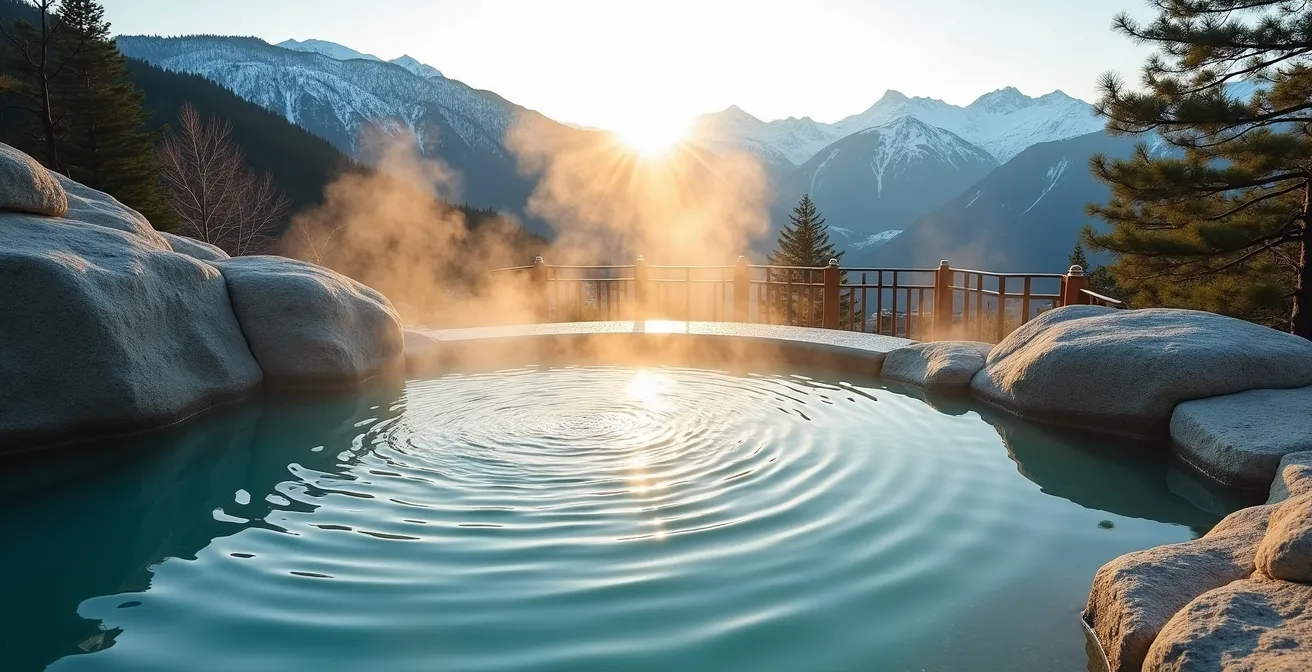
The greatest rotenburo experience isn’t found, it’s curated by understanding the aesthetic balance between opposing sensations.
- Instead of just chasing a famous view, consider the complete sensory profile: the sound of rain, the texture of the water, the contrast of hot skin and cold air.
- Privacy isn’t a compromise; enclosed, intimate baths are designed for introspection and a focus on non-visual senses like sound and scent.
Recommendation: Approach your choice not as a tourist ticking a box, but as a connoisseur composing a moment of perfect, personalized tranquility.
The quintessential image of a Japanese journey often involves a rotenburo, an open-air hot spring. We picture ourselves submerged in steaming, mineral-rich water, gazing at snow-capped mountains or a dramatic coastline. The pursuit of the “best view” has become the primary metric for many travelers, a visual trophy to bring home. We hunt for the ryokan with the most epic panorama, believing the quality of the soak is directly proportional to the grandeur of the scenery.
But this focus on the visual is a profound misunderstanding of the art of Japanese bathing. It reduces a deeply multi-sensory ritual to a mere photo opportunity. What if the most sublime experience isn’t about the expansive vista, but the intimate enclosure of a bamboo fence? What if the sound of gentle rain on a wooden roof is more restorative than a star-filled sky? The true connoisseur of rotenburo knows that the ultimate experience is not about finding a perfect location, but about the art of sensory curation—a conscious act of balancing temperature, texture, sound, and scent to achieve a specific state of mind.
This guide moves beyond the postcard images to explore the nuanced choices that define a truly transcendent rotenburo soak. We will delve into the thermal dialogue between your body and the elements, the protocols of shared spaces, the value of engineered privacy, and the very composition of the water itself. It’s time to shift from being a passive visitor to an active participant in crafting your own moment of aesthetic perfection.
To help you master this art of selection, this article breaks down the essential elements to consider. From regulating your temperature to choosing between neon cityscapes and natural starlight, each section provides the insights needed to curate your ideal open-air bathing experience.
Summary: A Critic’s Guide to the Perfect Rotenburo Soak
- Head Hot, Body Cold: How to Regulate Your Temperature in Winter Baths?
- Towel or Naked: What Is the Protocol for Mixed Open-Air Baths?
- Kashikiri Baths: Is It Worth Paying Extra for Private Outdoor Soaking?
- Rain or Shine: Is Rotenburo Enjoyable During a Typhoon?
- View or Privacy: Why Do Some Rotenburo Have Fences Blocking the Scenery?
- Neon Lights or Natural Stars: Deciding Where to Spend Your Evenings
- Left over Right: How to Wear Your Yukata Without Looking Like a Corpse?
- Sulfur or Iron: Which Water Type Heals Muscle Pain Best?
Head Hot, Body Cold: How to Regulate Your Temperature in Winter Baths?
The magic of a winter rotenburo lies in the exquisite contrast between the searing heat of the water and the crisp, cold air on your face and shoulders. This is the heart of the thermal dialogue. However, mastering this experience without dizziness or discomfort is a subtle art. The goal is to avoid overheating your head while your body remains submerged in blissful warmth. Pushing your limits is not the goal; duration and comfort are. According to onsen experts, the ideal length of a soak is highly dependent on the water’s heat; bathing recommendations can range from 5 minutes maximum at 42°C (105.8°F) to a leisurely 40 minutes at 36°C.
The most iconic and effective tool for this is the small tenugui towel. Soaked in cold water and folded neatly on top of your head, it acts as a personal cooling system, preventing the light-headedness that can cut a perfect soak short. This isn’t just for show; it’s a critical piece of equipment for prolonged bathing. To further manage your body’s response to the intense temperature differential, follow these proven techniques:
- Enter gradually: Never plunge in. Allow your body to acclimate slowly, foot by foot.
- Take strategic breaks: Every 10-15 minutes, sit on the edge of the bath with just your legs in the water. This allows your core temperature to stabilize without getting cold.
- Practice ‘yuzamashi’: This is the art of the “post-bath cooling.” Between soaks, sit in the cool air for a few moments before re-entering. This amplifies the sensory experience and resets your body.
- Stay hydrated: The intense heat and steam can lead to dehydration. Keep a bottle of water nearby and drink frequently between sessions.
By actively managing this thermal exchange, you transform the bath from a simple hot soak into a dynamic, invigorating experience that you control.
Towel or Naked: What Is the Protocol for Mixed Open-Air Baths?
The question of modesty is often a source of anxiety for first-time onsen visitors, especially concerning the towel. The rule is simple: the large bath towel is for drying off in the changing room only, while the small tenugui towel is your companion to the bath. However, its purpose is not for covering yourself in the water. The tenugui should not enter the bath, as it can be seen as unclean. The proper protocol is to place it on your head, as mentioned for temperature regulation, or set it on a nearby rock.
This principle of nudity is central to the traditional onsen experience. It is a state of “hadaka no tsukiai,” or “naked communion,” where social statuses are stripped away, allowing for a more fundamental human connection. While most rotenburo are now gender-separated, some traditional establishments still offer konyoku, or mixed-gender baths. The protocol here is evolving. Historically, nudity was the norm for all. Today, facilities that preserve this tradition, such as Takaragawa Onsen, often require all bathers to wear special bathing garments (yuami-gi) to ensure comfort for a modern, international clientele.
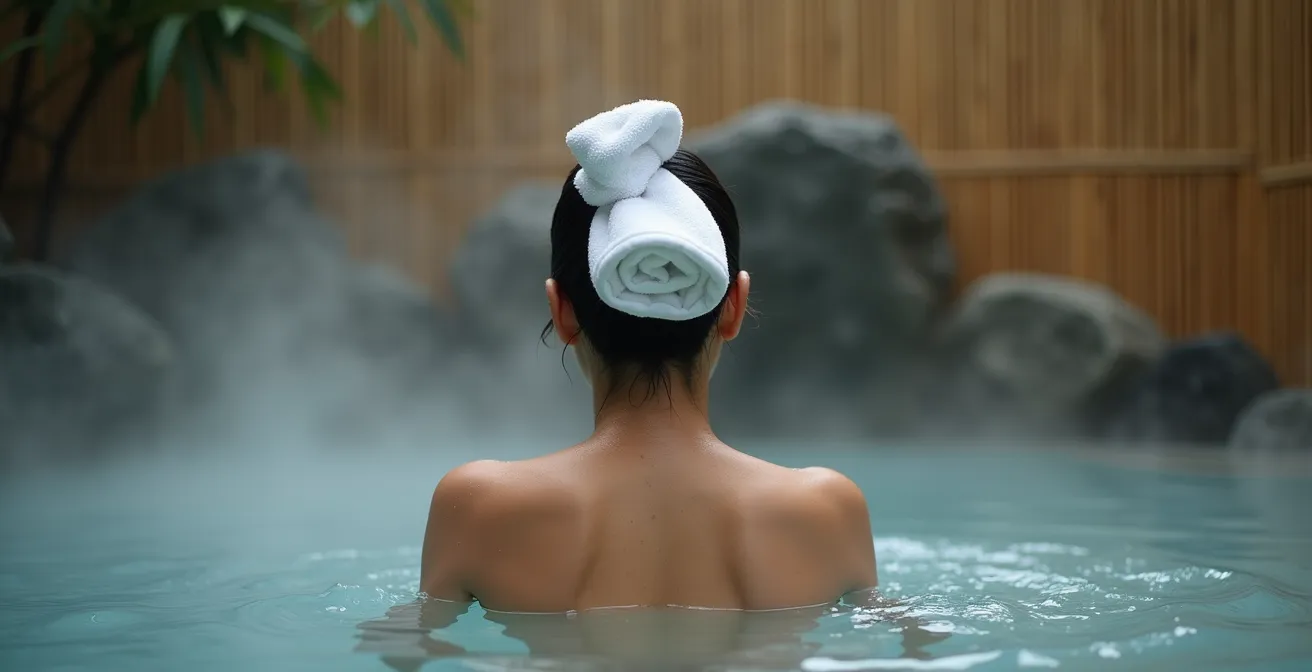
This shift reflects a broader trend. Even at famous historic sites like Sukayu Onsen, known for its “1,000-Person Bath,” the traditional mixed-bathing model is now supplemented with women-only hours to provide more options. When in doubt, observe how local bathers behave and follow the specific rules of the ryokan. The tenugui is for modesty while walking to and from the bath, and for placing on your head—never for swimming or soaking.
Kashikiri Baths: Is It Worth Paying Extra for Private Outdoor Soaking?
For those who find the prospect of communal bathing daunting—whether due to shyness, a desire for intimacy, or the presence of tattoos—the kashikiri-buro, or private-hire bath, is a sublime alternative. These are smaller rotenburo that can be reserved by the hour, offering a secluded slice of hot spring heaven for couples, families, or solo bathers seeking solitude. But does the added cost justify the experience? The answer lies in your personal definition of luxury.
The primary benefit is, of course, absolute privacy. This is particularly crucial for visitors with tattoos, which are still associated with yakuza in many parts of Japan and can lead to refusal of entry at communal baths. As the official guidelines from Shima Onsen Kashiwaya Ryokan state, it provides a crucial service:
Private onsen and rooms with open-air baths provide extra privacy, flexibility, and peace of mind for guests with tattoos.
– Shima Onsen Kashiwaya Ryokan, Official Ryokan Guidelines
This control extends beyond just privacy. You command the ambiance, the timing, and the energy of the space. It allows for quiet conversation, meditative silence, or simply the freedom to relax completely without social awareness. However, this seclusion can come with a trade-off, as a private bath may not always offer the same grand, panoramic vistas as the main communal rotenburo.
This table outlines the key differences to help you decide where to invest your time and money.
| Aspect | Private Kashikiri Bath | Communal Rotenburo |
|---|---|---|
| Cost Range | ¥3,000-¥8,000 per hour | ¥500-¥1,500 entry fee |
| Experience Control | Complete control over ambiance and timing | Shared energy and social atmosphere |
| Best For | Couples, families, tattoo owners | Solo travelers, cultural immersion seekers |
| View Quality | Often smaller, may have limited views | Usually larger with panoramic vistas |
| Availability | Requires advance booking | Generally available during operating hours |
Rain or Shine: Is Rotenburo Enjoyable During a Typhoon?
While the fantasy of a rotenburo often involves clear blue skies or a gentle snowfall, some of the most profound and memorable soaks occur in less-than-perfect weather. While bathing during a typhoon is extremely dangerous and strictly prohibited, experiencing a rotenburo during a light to moderate rainfall can be a transcendent sensory experience. It is a moment where the aesthetic balance of the elements is on full display.
The cool touch of raindrops on your warm face and shoulders creates a delightful, tingling contrast. The soundscape transforms; the world is muffled, replaced by the gentle, percussive rhythm of water meeting water, wood, and stone. As one bather beautifully described it:
I’ve sat in a rotenburo while light rain fell, and it was one of the most relaxing experiences ever. The percussive sound of drops on the wooden roof, combined with the warmth of the water against the cool raindrops on my face, created an unforgettable sensory contrast.
This principle of finding beauty in imperfect conditions is at the heart of the Japanese aesthetic of wabi-sabi. The ultimate expression of this is the winter rotenburo. For example, the ephemeral ice village at Shikaribetsu-ko Onsen in Hokkaido offers the chance to soak in 40°C water surrounded by walls of pure ice. The sight of snowflakes melting on your skin while your body is enveloped in deep heat is an experience that borders on the spiritual. So, do not be deterred by a cloudy forecast. An overcast sky can mute the light, making the steam appear more dramatic, while a light drizzle offers a free, natural soundtrack for your soak.
View or Privacy: Why Do Some Rotenburo Have Fences Blocking the Scenery?
It can be perplexing to arrive at a renowned rotenburo only to find the much-anticipated “view” is partially or completely obscured by a high bamboo fence or a strategically placed rock. Is this a design flaw? A compromise for security? In many cases, it is a deliberate and sophisticated aesthetic choice. This design philosophy moves away from the “borrowed landscape” of a grand vista and toward the creation of an intimate, introspective world. The goal is not to look *out*, but to be fully *present*.
As one design guide explains, this is about curating a focused experience. According to a guide on Rotenburo Design Philosophy, some baths are designed “with high walls and open space to maximize the use of nature, creating an intimate, introspective world rather than borrowing a grand vista.” In these enclosed spaces, your other senses are heightened. You become more aware of the gurgle of the spring, the mineral scent of the water, the texture of the steam on your skin, and the feel of the smooth stones underfoot. The fence isn’t blocking the world; it’s framing a microcosm for you to inhabit.
Other designs use a technique called shakkei, or “borrowed scenery,” where the barrier artfully frames a specific, curated portion of the landscape—a single maple branch, a distant mountain peak, a slice of the sky—turning nature into a living painting. This choice between an open panorama and an enclosed sanctuary is fundamental to curating your experience. One is expansive and exhilarating; the other is focused and meditative.
Your Checklist: Choosing Between Scenery and Seclusion
- Assess your priority: Are you seeking the awe of a panoramic view or the deep peace of complete privacy and security?
- Consider gender-specific design: Be aware that women’s baths often prioritize security, which may result in more enclosed designs compared to the men’s side.
- Look for “shakkei” designs: Research if the ryokan is known for artfully framing partial views, which can be more poetic than a full panorama.
- Focus on non-visual senses: In enclosed baths, consciously shift your attention to the sound of the water, the scent of the wood and minerals, and the texture of the steam.
- Optimize for solitude: For scenic communal baths, choose early morning or late-night sessions for a higher chance of having the view all to yourself.
Neon Lights or Natural Stars: Deciding Where to Spend Your Evenings
The rotenburo experience is not confined to the bath itself; it is deeply colored by its surroundings, especially after dark. The choice between a rural mountain retreat and a chic urban spa will fundamentally alter the character of your evening soak. A rural onsen, like those found in the quiet valleys of Akita or Nagano, offers an unparalleled connection to nature. Here, your evening is scored by the sound of crickets and the deep silence of the forest. The only light comes from the moon and a canopy of natural stars, a humbling spectacle increasingly rare in our modern world.
Conversely, an urban rotenburo offers a completely different, yet equally mesmerizing, kind of beauty. Perched on a rooftop in Tokyo or Osaka, you float above a glittering expanse of neon and city lights. The ambient hum of the metropolis below becomes a unique form of white noise, creating a feeling of being both a part of and completely removed from the vibrant energy of the city. The post-bath experience follows suit: in the countryside, it’s a quiet evening in a tatami room enjoying a traditional kaiseki meal; in the city, it’s the prelude to a night out exploring vibrant dining and entertainment options.
Coastal rotenburo offer a third sensory profile, where the evening is defined by the rhythmic crash of ocean waves and the salty sea breeze. Watching the sunset paint the sky from the comfort of a hot spring like Furofushi Onsen is an unforgettable experience. There is no single “best” setting; the right choice depends entirely on the atmosphere you seek. Do you crave the introspective silence of nature or the detached, god-like perspective of floating above a bustling city?
Left over Right: How to Wear Your Yukata Without Looking Like a Corpse?
After a restorative soak, the experience continues with the donning of a yukata, the light cotton robe provided by the ryokan. This is not just a bathrobe; it’s a key part of the cultural ritual of relaxation. Walking the halls of the ryokan or the stone paths of an onsen town in your yukata and geta (wooden clogs) is a moment of pure, unadulterated holiday bliss. However, there is one crucial rule of etiquette that separates the seasoned traveler from the hapless tourist: how you wrap it.
The rule is simple but absolute: always wrap the left side over the right side. This method allows the hand to slide into the robe easily. Wrapping the right side over the left is reserved for dressing the deceased for burial, so wearing it this way is a significant and unsettling cultural faux pas. It’s the quickest way to draw concerned or confused stares from staff and other guests. Getting this small detail right is a sign of respect and cultural awareness.
To properly complete your post-onsen transformation, follow these simple steps:
- Dry your body completely. A damp body makes the yukata cling uncomfortably.
- Drape the yukata over your shoulders and wrap the left panel over the right panel across your chest.
- Adjust the hem so it falls just above your ankles. It shouldn’t drag on the floor.
- Tie the obi (sash) snugly around your waist. The bow is typically tied in the back for men and women in a ryokan setting, though a side bow is also acceptable.
- Slip on the provided geta or slippers to complete the ensemble.
- Walk with short, shuffling steps to enjoy the classic “karankoron” sound of geta clogs on the pavement.
Wearing the yukata correctly is more than just following a rule; it’s about fully immersing yourself in the tranquil, timeless rhythm of onsen life.
Key Takeaways
- The ultimate rotenburo experience is an act of “sensory curation,” not just a search for a view.
- Aesthetic balance is key: appreciate the contrast between hot water and cold air, enclosed privacy and open vistas, silence and ambient sound.
- Etiquette is part of the experience; understanding the use of the towel and how to wear a yukata shows respect and enhances immersion.
Sulfur or Iron: Which Water Type Heals Muscle Pain Best?
Beyond the view, the temperature, and the setting lies the most fundamental element of the rotenburo: the water itself. It is not just hot water; it is a complex cocktail of minerals dissolved over centuries, a liquid medicine with a distinct character, texture, and scent. The Japanese Hot Springs Act officially categorizes therapeutic waters into 10 distinct types, each with its own purported health benefits. For the traveler seeking relief from the aches of a long journey, two types are particularly noteworthy: sulfur and iron.
Sulfur onsen (Io-sen) are instantly recognizable by their characteristic “rotten egg” smell and milky, bluish-white appearance. While the scent can be initially off-putting, these waters are prized for their therapeutic properties. They are said to soften the skin, aid in detoxification, and are particularly effective for chronic muscle pain, joint stiffness, and arthritis. The feeling is of soaking in a silky, potent elixir.
Iron-rich onsen (Gantetsu-sen), on the other hand, are typically clear when they emerge from the ground but turn a rusty reddish-brown upon contact with air. These “red waters” are high in iron, which is believed to help with fatigue and anemia. They are excellent for warming the body to its core and are highly recommended for general muscle soreness and recovery. The water often has a slightly metallic taste and feels substantial on the skin. A prime example is Kusatsu Onsen, whose highly acidic sulfurous waters are legendary; locals claim they can cure anything but a broken heart. The output is so potent that it can corrode metal, yet the traditional yumomi cooling process makes it perfect for bathing.
The choice is a matter of sensory preference and desired outcome. Do you seek the potent, skin-softening embrace of a sulfur bath, or the deep, restorative warmth of an iron-rich spring? Paying attention to the water’s “terroir” is the final, most intimate step in curating your perfect soak.
Begin planning your next journey not by chasing a destination, but by actively curating the sensory experience you desire. Choose your water, your view, your soundtrack, and immerse yourself completely in the art of the rotenburo.