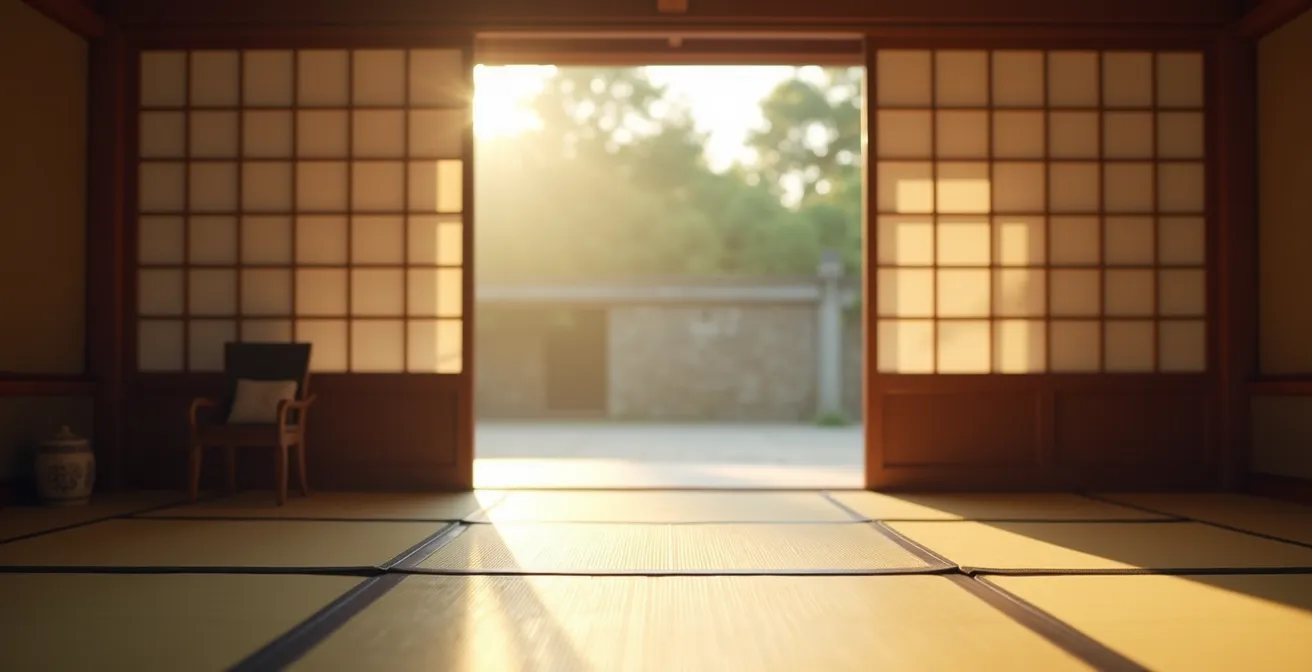
Japanese shoe etiquette isn’t just about politeness; it’s a physical ritual for maintaining a sacred separation between the ‘pure’ inside and ‘impure’ outside.
- The genkan divider is a critical boundary, not just a step. Crossing it with shoes on is a major faux pas.
- Slippers operate in a sub-system: hallway slippers are for general areas, toilet slippers never leave the bathroom, and neither should ever touch tatami mats.
Recommendation: Instead of memorizing rules, think in terms of ‘zones of purity’. Your footwear is the key to navigating them respectfully.
Entering a Japanese home, temple, or traditional ryokan for the first time is an exercise in mindfulness. The serene interiors, the scent of straw and wood, and the quiet dignity of the space are captivating. Yet, for many visitors, this experience is tinged with a subtle anxiety, centered on one critical question: what do I do with my shoes? With Japan seeing a massive influx of international visitors, this question is more relevant than ever. In 2024 alone, a study shows that a record-breaking 36.8 million tourists visited Japan, highlighting the growing need for cultural understanding.
Many guides will offer a simple checklist: take shoes off here, put slippers on there. But this approach misses the entire philosophy. Japanese footwear etiquette is not a random collection of rules. It is a deeply ingrained system for maintaining a separation between the external, “impure” world (fujō) and the internal, “pure” space (seijō). Every threshold—the genkan step, the tatami edge, the bathroom door—is a significant boundary. Understanding this single principle of purity is the key that unlocks all the rules, transforming a list of chores into a graceful, respectful ritual.
This guide moves beyond simple instructions. We will explore the logic behind each step, from the non-negotiable genkan divide to the subtle art of walking on tatami. By understanding the ‘why,’ you will be able to navigate any traditional Japanese space not just correctly, but with genuine confidence and consideration.
Summary: A Detailed Guide to Navigating Japanese Footwear Customs
- Why Stepping on the Genkan Divider Is a Major Faux Pas?
- How to Choose Socks That Won’t Embarrass You in Public?
- Toilet Slippers vs. Hallway Slippers: Avoiding the Grossest Mistake
- Locker or Shelf: Where to Put Shoes at an Izakaya Entrance?
- How to Walk on Tatami Mats Without Damaging the Straw?
- The Footwear Error That Disrespects Sacred Wooden Halls
- Futon vs. Bed: Will Your Back Survive Sleeping on the Floor?
- Dinner Times and Curfews: How to Survive Ryokan Schedules?
Why Stepping on the Genkan Divider Is a Major Faux Pas?
The genkan, or Japanese entryway, is more than just a place to leave shoes. It is the primary threshold between the outside world and the private sanctuary of the home. The raised floor level inside is not merely an architectural feature; it is a clear, physical demarcation of purity. The lower, tiled area is where outdoor shoes, carrying the dirt and impurities of the street, belong. The raised wooden or tatami area is the beginning of the clean, interior space. Stepping on the divider (the wooden beam called a kamachi) with your outdoor shoes is akin to dragging the outside world directly into the pristine interior.
This action is considered a significant breach of etiquette because it fundamentally misunderstands the purpose of the space. It contaminates the boundary itself, defeating the purpose of having a separate zone. The correct procedure is a fluid, two-part motion: sit or stand on the lower level, remove your shoes, and then step up onto the raised floor in your socks or bare feet, without your shoes ever touching the upper level. Your shoes should then be turned to face the door, an act of consideration (omoiyari) that makes them easy to slip on when leaving.
In response to growing tourism, prefectures like Ishikawa have even launched social media campaigns to educate visitors on these finer points, including how to properly remove shoes at the genkan. This illustrates just how fundamental this single piece of etiquette is to maintaining harmony and respect in a Japanese home.
Ultimately, respecting the genkan divider is the first and most important signal you can send that you understand and value the sanctity of your host’s home.
How to Choose Socks That Won’t Embarrass You in Public?
Once you’ve successfully navigated the genkan and removed your shoes, the focus shifts. Your socks are now your primary footwear, and they are on full display. In a culture that values cleanliness and attention to detail, the state of your socks is not a trivial matter. They are a reflection of your personal preparedness and respect for the environment you are entering. Presenting clean, hole-free socks is a sign that you anticipated the shoe-removal custom and came prepared. Worn-out, mismatched, or, worst of all, holy socks can be a source of mild embarrassment for both you and your host.
The key is preparation. Before your trip, audit your sock collection. Discard any pairs with visible wear or holes. When packing, consider the following:
- Pack Easily Removable Shoes: You’ll be taking them off frequently. Slip-on shoes are a traveler’s best friend in Japan.
- Bring Extra Pairs: If you plan on visiting multiple temples, restaurants, and homes in one day, having a fresh pair of socks to change into can be a welcome comfort.
- Consider No-Show Socks: For those who prefer not to wear full socks, especially in warmer weather, “footie” style no-show socks are an excellent compromise, providing a clean barrier between your feet and the floor.
This attention to detail extends beyond simple appearance. It’s a non-verbal way of communicating that you are a considerate guest. Your host has gone to great lengths to provide a clean, welcoming interior, and your clean socks are a gesture of reciprocation, ensuring you do not bring dirt or sweat onto their pristine floors.

As shown, the transition from the lower genkan to the raised interior is a moment of presentation. Having clean, presentable socks ensures this moment is one of respect, not awkwardness. It’s a small detail that speaks volumes about your cultural awareness.
Think of your socks as part of your “indoor uniform.” Ensuring they are presentable is a simple yet powerful way to demonstrate respect and integrate seamlessly into the social fabric.
Toilet Slippers vs. Hallway Slippers: Avoiding the Grossest Mistake
Upon entering a Japanese home or ryokan, you will often be offered a pair of indoor slippers (house slippers) to wear in hallways and common rooms. However, this introduces a new layer to the system of purity: the bathroom. The bathroom is considered the most potentially “impure” area within the home, and it has its own dedicated footwear: toilet slippers. These are typically made of rubber or plastic and are left just inside the bathroom door for exclusive use within that space.
The rule is absolute: you must switch from your house slippers to the toilet slippers upon entering the bathroom, and, crucially, switch back when you leave. Forgetting to change back and walking out into the hallway still wearing the toilet slippers is the “classic gross mistake.” The Japanetic Editorial Team from the learning platform Migaku notes this common error:
Forgetting to change back and walking around in toilet slippers is a classic mistake that Japanese people find pretty funny (and gross)
– Japanetic Editorial Team, Japan Shoe Etiquette: Essential Guide to Removing Footwear
This mistake effectively tracks the bathroom’s “impurity” throughout the rest of the clean house. To avoid this, it’s helpful to understand the distinct roles of each slipper type, which is a core concept for anyone staying in a traditional inn. An analysis of Japanese customs provides a clear breakdown.
| Slipper Type | Appearance | Where Used | Key Rule |
|---|---|---|---|
| House Slippers | Fabric or soft material, neutral colors | Hallways, living areas | Remove before stepping on tatami |
| Toilet Slippers | Plastic/rubber, often marked ‘WC’ | Bathroom only | Never wear outside bathroom |
| Guest Slippers | Disposable or clean sets | Provided at entrance | Use throughout visit except tatami/toilet |
The system is logical: a specific tool for each level of purity. By pausing at the bathroom door to consciously make the switch, you are participating in the home’s ritual of cleanliness.
Mastering the slipper swap is a clear sign that you have graduated from a novice guest to one who truly understands the underlying principles of Japanese home life.
Locker or Shelf: Where to Put Shoes at an Izakaya Entrance?
The principles of shoe etiquette extend beyond private homes and into many public establishments, particularly traditional restaurants, izakayas, and onsens. At the entrance of such places, you will almost always find a designated area for shoe storage, known as a getabako. A getabako can range from a simple set of open shelves to a large cabinet of small lockers, often with wooden keys. Its purpose is identical to that of a home genkan: to maintain a clean interior by keeping outdoor shoes separate.
Upon arrival, the process is the same as at a home: remove shoes before stepping onto the raised interior floor. The question then becomes where to put them. Look for cues. If there are open shelves, place your shoes neatly on one. If there are lockers (getabako), find an empty one, place your shoes inside, and take the key with you. In some smaller establishments, there may simply be a space on the floor by the genkan; in this case, place your shoes neatly together with the toes pointing towards the door.
This organized system is not just about cleanliness but also about order. It prevents a chaotic pile of shoes at the entrance and ensures a smooth flow of traffic. For first-time visitors, having a clear mental checklist can make this process feel less intimidating and more automatic.
Your Mental Checklist for Any Japanese Entrance
- Assess the Threshold: Identify the line between the lower (shoe) area and the raised (clean) floor. Pause here.
- Perform the Ritual: While on the lower level, turn to face away from the interior. Slip your feet out of your shoes one by one, stepping backward onto the raised floor.
- Store with Care: Locate the designated storage (shelf, locker, or floor space). Place your shoes neatly.
- Confirm the Turn: Always turn the shoes so the toes point outward, toward the exit. This is a gesture of consideration for your own departure.
- Proceed with Correct Footwear: Step into any provided indoor slippers, and be mindful of where they are and are not allowed (e.g., not on tatami).
Whether it’s a small, shared chest in a home or a large bank of lockers in a restaurant, the getabako is a fundamental piece of Japanese spatial organization. Using it correctly is a simple and effective way to show you respect the establishment’s rules and customs.
This small act of organization is a shared responsibility that contributes to a pleasant experience for all patrons.
How to Walk on Tatami Mats Without Damaging the Straw?
You’ve successfully navigated the genkan, your socks are immaculate, and you’ve mastered the slipper swap. Now you face the inner sanctum of many traditional Japanese spaces: the tatami room. Tatami mats are made from tightly woven rice straw (igusa) and are the heart of traditional Japanese interior design. They are both flooring and furniture, serving as the surface for sitting, dining, and sleeping. They are also delicate.
The number one rule of the tatami room is simple: no footwear of any kind is permitted. This includes the indoor slippers you may have been wearing in the hallway. You must step out of your slippers and leave them in the hallway, with the toes pointing outward, before stepping onto the tatami in your socks. Walking on these delicate mats with slippers, or even dragging hard-soled luggage across them, can easily fray, snag, or crush the woven straw, causing irreversible damage.
Respect for these traditional spaces is deeply ingrained in Japanese culture, as evidenced by the fact that Japanese domestic tourism statistics show a massive 25.1 trillion yen was spent by domestic travelers in 2024, much of it on experiences involving traditional spaces like ryokans and temples. This shows a profound domestic appreciation and care for these environments, a standard which visitors are expected to uphold. When walking on tatami, do so gently. Avoid scuffing your feet, and never drag heavy items across the surface. This care is not just about preservation; it’s about honoring a craft and a central element of Japanese aesthetic and cultural heritage.
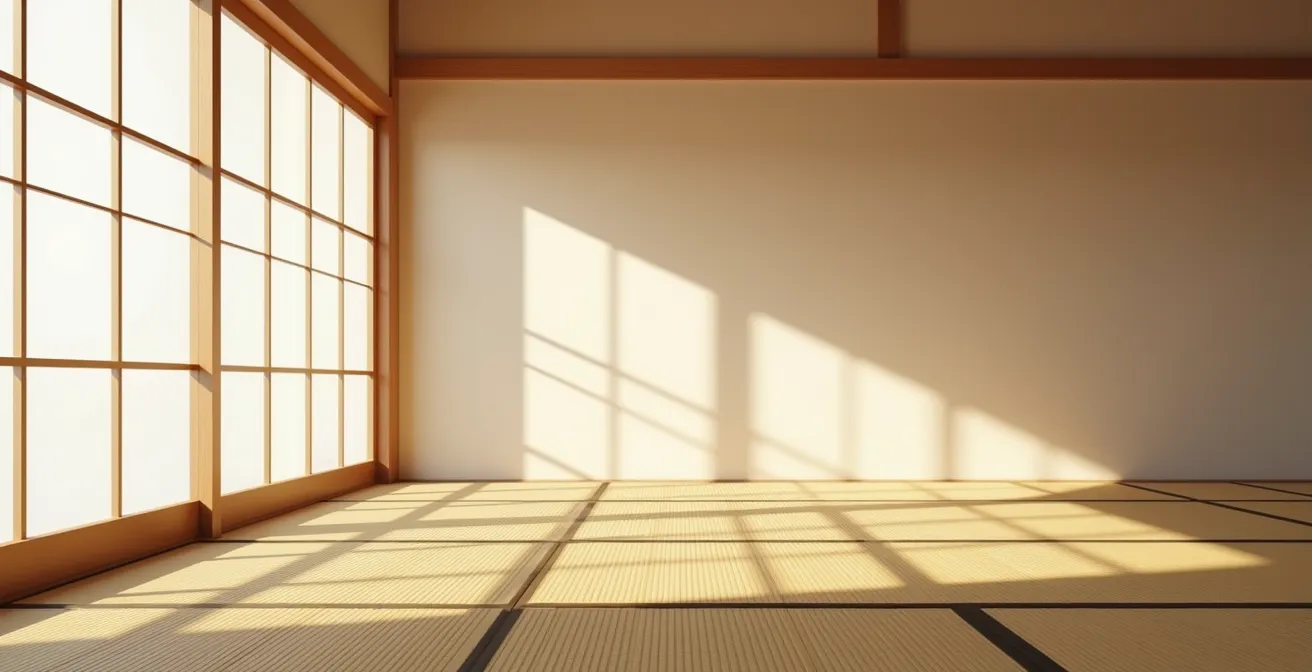
The pristine, uniform surface of a tatami room is a testament to careful maintenance and respectful use. By treating it with gentle care, you are participating in the preservation of a living tradition.
Your gentle footsteps become a quiet acknowledgment of the craftsmanship and cultural significance woven into the very floor beneath you.
The Footwear Error That Disrespects Sacred Wooden Halls
The intricate system of shoe removal and zones of purity is not a recent invention. Its roots are deeply entwined with the spiritual history of Japan. While Shintoism, Japan’s indigenous religion, has its own concepts of purity, the strict separation of indoor and outdoor spaces was profoundly influenced by the arrival of Buddhism in the 6th century. This philosophy is most evident when visiting temples and shrines.
Many sacred halls, particularly those with polished wooden floors, are considered highly purified spaces. Entering them with outdoor shoes is unthinkable. As the Japanetic Editorial Team explains, the very ground is considered sacred. They state that in this context, “Buddhism brought the concept of pure and impure spaces to Japan in the 6th century. Temple floors became sacred ground where shoes would contaminate the spiritual environment.” The act of removing shoes before stepping onto the cool, dark wood of a temple hall is therefore more than a rule of cleanliness; it is an act of spiritual respect. It’s a physical gesture that acknowledges you are leaving the mundane, “impure” world behind to enter a space of reverence and tranquility.
It is important to note, however, that this rule is not universal for every building in Japan. You are not expected to remove your shoes in department stores, modern hotels, or public administrative buildings. The custom is reserved for spaces that are considered private or sacred: homes, traditional inns (ryokans), many traditional restaurants, and, of course, the inner halls of temples and shrines. Paying attention to the entrance—looking for a genkan, shelves for shoes, or a sign—is the surest way to know what is expected.
The simple act of stepping out of your shoes becomes a moment of transition, preparing your mind and spirit for the experience within the sacred space.
Futon vs. Bed: Will Your Back Survive Sleeping on the Floor?
For many first-time visitors to a ryokan, the evening brings a unique experience: the room’s transformation from a living/dining area into a bedroom. The low table is moved aside, and the staff lays out your bedding for the night: a futon. For those accustomed to plush Western-style beds, the idea of sleeping on a mattress on the floor can be daunting. However, the Japanese futon is a sophisticated sleeping system designed for comfort and practicality within the context of a tatami room.
A futon is not just a thin mattress. It’s a set, typically consisting of a mattress (shikibuton) and a duvet (kakebuton). Crucially, it always rests on the tatami mat floor, which itself provides a slight, natural give thanks to its woven straw construction. This combination creates a firm but supportive sleeping surface that many people find beneficial for posture. However, if you are a side-sleeper or are used to a softer bed, it can take some getting used to.
If you’re concerned about comfort, you have options. Most ryokans are accustomed to guests with different needs and will happily provide an extra mattress for more cushioning. Don’t be shy to ask. Here are a few tips for a comfortable futon experience:
- Request an Extra Mattress: The phrase “mō ichi-mai shikibuton, onegai shimasu” (one more mattress, please) is your friend.
- Fold Strategically: You can fold the mattress in certain ways to create more padding under your hips and shoulders.
- Embrace the Firmness: Consider the potential health benefits. Many find that a firmer surface helps alleviate back pain.
- Trust the System: Remember that millions of people sleep this way comfortably every night. View it as an integral part of the authentic ryokan experience you came for.
Sleeping on a futon is a direct, tactile connection to the traditional Japanese way of life. It’s an experience that goes beyond mere accommodation, grounding you in the very architecture and customs of the space you inhabit.
Instead of a challenge for your back, the futon can become a highlight of your authentic journey into Japanese culture.
Key Takeaways
- Japanese footwear etiquette is a system based on separating ‘pure’ indoor spaces from the ‘impure’ outside, not just arbitrary rules.
- The genkan (entryway), tatami mats, and bathrooms each represent different levels of purity with their own specific footwear (or lack thereof).
- Showing respect involves more than removing shoes; it includes the condition of your socks, how you place your shoes, and how you move through the space.
Dinner Times and Curfews: How to Survive Ryokan Schedules?
The structured nature of a traditional Japanese ryokan extends beyond the physical space to the dimension of time itself. Unlike a modern hotel where you are largely left to your own devices, a ryokan operates on a schedule that is designed to provide you with a seamless and holistic experience, centered around meals and bathing. Understanding and respecting this schedule is just as important as knowing where to put your shoes.
Dinner (yūshoku) is a highlight of the ryokan stay. It is often an elaborate multi-course kaiseki meal, served in your room or a private dining area. This meal is served at a very specific time, typically between 6:00 PM and 7:30 PM. Punctuality is essential. Arriving late can disrupt the kitchen’s meticulous timing and affect the quality of your meal, which is prepared to be enjoyed at its peak freshness. Similarly, breakfast (chōshoku) is also served within a specific time window.
The other key temporal marker is the curfew. Most ryokans are family-run establishments, not 24/7 hotels. The main doors are often locked for the night, usually around 10:00 PM. This is done for security and to allow the staff to rest. If you plan on a late-night stroll, it is imperative to inform the staff in advance so they can make arrangements for your return. Simply assuming you can come and go as you please is a major breach of etiquette that can cause significant inconvenience. By aligning yourself with the ryokan’s rhythm, you show respect for the staff and allow them to provide you with the best possible service, ensuring your entire stay is harmonious.
Embracing the schedule is not a restriction but an invitation to slow down and immerse yourself fully in a more deliberate and mindful way of life.
Frequently Asked Questions on Shoes Off: Where to Draw the Line Between Genkan and Tatami?
What time is dinner typically served at a ryokan?
Dinner is usually served between 6:00 PM and 7:30 PM, allowing time for evening onsen bathing afterward.
Can I request a different dinner time?
Many ryokans can accommodate slight adjustments if requested in advance, especially during less busy periods.
What happens if I miss the curfew?
Most ryokans lock their main entrance around 10 PM. If you plan to return late, inform the staff beforehand to arrange entry.