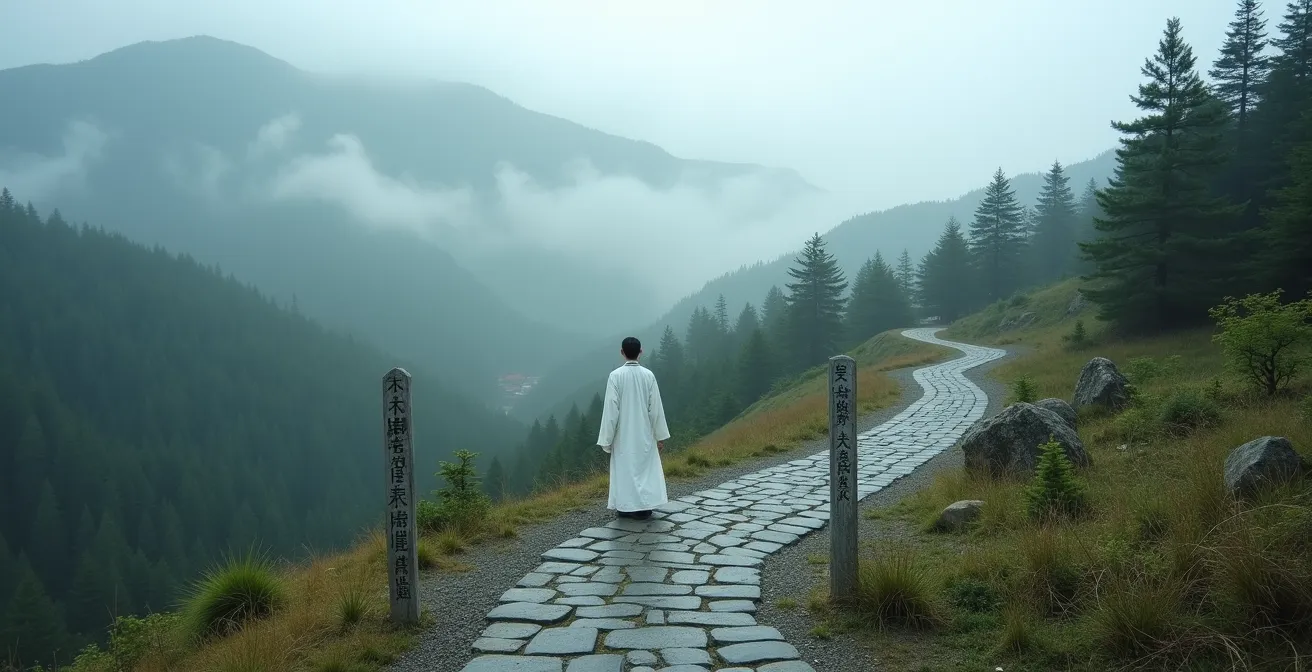
The transformative power of a pilgrimage isn’t in the trail you walk, but in the friction you overcome; choosing between Shikoku and Kumano Kodo is choosing your crucible.
- The Kumano Kodo offers a structured, UNESCO-managed challenge with English support, ideal for a profound yet accessible spiritual journey.
- The Shikoku Pilgrimage demands radical self-reliance through its length and deep cultural immersion, making the language barrier and logistical hurdles the primary engine of change.
Recommendation: Assess your tolerance for uncertainty. If you seek transformation through supported challenge, choose Kumano Kodo. If you seek to be broken down and rebuilt by raw, unfiltered reality, commit to Shikoku.
You feel the pull. It’s a quiet ache for something more than a vacation, a hunger for a journey that does more than just rack up miles—it reshapes you from the inside out. Japan’s ancient pilgrimages, the Kumano Kodo and the Shikoku Henro, call to seekers like you. The common wisdom is simple: the Kumano Kodo, a UNESCO World Heritage site, is the curated, foreigner-friendly choice. The Shikoku Pilgrimage, a colossal 1,200-kilometer loop, is the hardcore, authentic alternative for those who want a tougher test.
This advice is true, but it misses the entire point. It treats the challenges—the language barriers, the risk of getting lost, the sheer physical grind—as bugs to be avoided rather than the very features that spark transformation. The real choice isn’t between an “easy” path and a “hard” one. It’s about choosing your engine of change. Transformation isn’t a reward waiting at the end; it’s a byproduct of the friction you endure along the way. It’s forged in the moments of forced humility when you can’t communicate, in the radical self-reliance of pitching a tent in an unfamiliar land, and in the trust you must place in total strangers.
But what if the true key to unlocking this change lies not in avoiding difficulty, but in selecting the right kind of crucible for your soul? This guide isn’t a simple comparison of stats and logistics. It’s an expedition briefing. We will dissect the specific, raw challenges of each path—from hitchhiking etiquette and bear encounters to the profound impact of visiting depopulating villages. By understanding the unique transformative friction of each trail, you won’t just choose a route; you’ll choose the person you want to become.
This article breaks down the core challenges you’ll face on the ground, moving beyond tourist advice to provide an operational understanding of these transformative journeys. The following sections will equip you to make a decision based not on comfort, but on the kind of growth you are truly seeking.
Summary: A Guide to Choosing Your Transformative Japanese Pilgrimage
- Is Hitchhiking in Japan Safe and Legal for Foreigners?
- Park or Campsite: Can You Pitch a Tent Anywhere in Japan?
- One Day or Two: How Long Does It Take to Cycle Across the Inland Sea?
- Google Translate Offline: How to Survive When You Have No Signal?
- Is Rural Japan Safe for Solo Female Hitchhikers and Campers?
- Bell or Spray: How to Protect Yourself From Bears in Japanese Forests?
- Why You Cannot Rely on English in Rural Prefectures?
- Why Visiting Rural Villages Helps Fight Depopulation?
Is Hitchhiking in Japan Safe and Legal for Foreigners?
Hitchhiking in Japan is not just legal; it’s an unofficial part of the pilgrimage experience, a first test of trust and humility. Forget the threatening narratives common in the West. The practice operates on a different cultural frequency, grounded in the fact that Japan has one of the lowest crime rates in the world. For a pilgrim, or henro, hitchhiking isn’t about saving a few yen. It’s a practical tool for leapfrogging dangerous road sections or making up lost time, but its real value is as an engine for human connection.
Success isn’t about luck; it’s about signaling. Your appearance—clean, non-threatening, perhaps even wearing the symbolic white vest and sedge hat of a pilgrim—is your resume. A simple, handwritten sign with your destination in Japanese characters (e.g., “Temple #23”) does the work of a thousand words. This isn’t just about getting a ride; it’s about participating in a system of goodwill. The tradition of osettai (alms or gifts to pilgrims) is alive and well, and a ride is a modern form of this generosity.
The experience can be profoundly moving. It’s not uncommon for elderly Japanese couples to pick up foreign pilgrims, treating them not as strangers but as adopted grandchildren for the afternoon. They might offer you food, go out of their way to ensure you reach your temple, and try to communicate through a mix of gestures and simple words. This is transformative friction in action: you are stripped of your linguistic confidence and forced to rely on pure intention and shared humanity. It’s an exercise in vulnerability that pays dividends in faith in your fellow person.
Park or Campsite: Can You Pitch a Tent Anywhere in Japan?
The short answer is no. The long answer is a lesson in navigating rules, both written and unwritten, which is a core part of the pilgrimage experience. While the idea of pitching a tent under the stars next to a serene temple is romantic, Japan is a society built on order and respect for public and private space. Wild camping, or yaei, is generally frowned upon and can be illegal in national parks and private property. However, the pilgrimage tradition has its own set of informal rules, a space where the letter of the law is sometimes bent by a spirit of compassion for the traveling henro.
This is where you’ll see a stark difference in approach; surveys suggest that while wild camping is practiced by a minority of Japanese pilgrims, it’s far more common among foreigners, with an estimated 30% of foreign pilgrims choosing to camp wild. This isn’t a rebellion, but an embrace of radical self-reliance. The accepted practice for pilgrims is often nojuku (sleeping outdoors), which has a long tradition. However, a tent complicates things. The key is discretion and respect: arrive late, leave early, and leave no trace. Public parks, covered benches, or designated rest huts (zenkonyado) are common spots for nojuku.
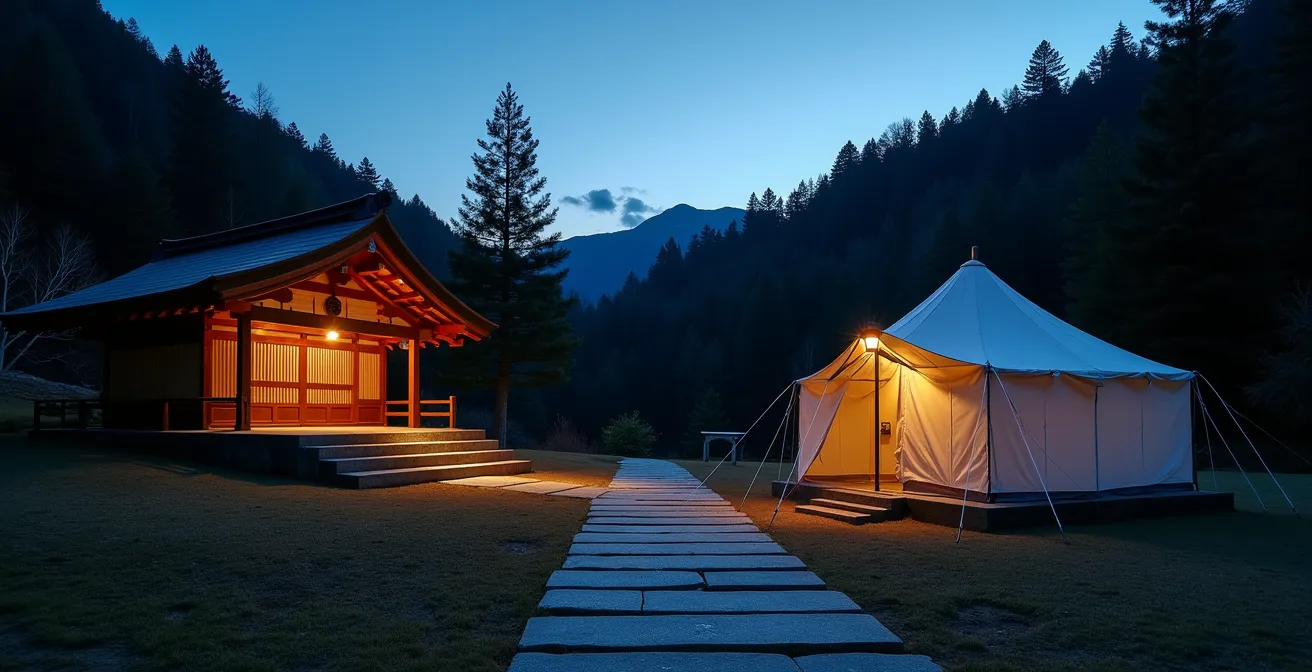
As the image suggests, the choice isn’t always between a five-star hotel and a ditch. Many temples offer shukubo (temple lodgings) for a fee, providing a comfortable bed and a taste of monastic life. Official campsites (kyampu-jo) are another safe and legal option, though they may require booking and can be off-route. Choosing to camp is choosing a deeper, grittier immersion, trading comfort for freedom and a deeper connection to the landscape.
This table outlines the crucial distinctions between the accepted practice of sleeping outdoors and setting up a formal camp.
| Aspect | Nojuku (Sleeping Outdoors) | Official Camping |
|---|---|---|
| Legal Status | Not banned as relief measure for homelessness | Fully legal at designated sites |
| Tent Use | Not allowed – becomes ‘yaei’ with tent | Permitted with proper facilities |
| Pilgrim Context | Long tradition but increasingly restricted | Preferred by local communities |
| Best Practice | Pack up by 06:30 if emergency | Book in advance at kyampu-jo |
One Day or Two: How Long Does It Take to Cycle Across the Inland Sea?
The Shimanami Kaido is more than just a bike ride; for a pilgrim, it’s a vital decompression chamber. This 70-kilometer cycling route, connecting Shikoku to Japan’s main island of Honshu via a series of spectacular bridges and islands, serves as the perfect epilogue or prologue to the Shikoku 88 Temple Pilgrimage. The time it takes is a matter of intent. According to official tourism data, experienced cyclists can conquer it in four hours, while those who wish to savor the journey can stretch it into a leisurely 10-hour day or a relaxed two-day affair.
For the backpacker or spiritual seeker, the two-day option is the superior choice. It transforms the ride from a physical challenge into a rolling meditation. It allows you to explore the small island communities, sample local citrus, and stay in a traditional ryokan or minshuku. This isn’t a race; it’s a transition. After weeks of walking at a contemplative 4 km/h, the sudden shift to the dynamic motion of a bicycle offers a new perspective. You move from the internal, meditative world of the walking pilgrim to the expansive, kinetic freedom of the cyclist.
The strategic genius of this route is its direct link to the pilgrimage itself. Six of the 88 sacred temples are located in Imabari, the starting point of the Shimanami Kaido on the Shikoku side. This makes the route a natural extension of the Henro path. You can complete your final temples and then immediately channel that spiritual momentum into a physical journey of a different kind. It’s the perfect way to process the immense experience of the pilgrimage, allowing the mental and emotional changes to settle while your body engages in a new, exhilarating rhythm. It’s not a detour; it’s the final chapter of your transformation.
Google Translate Offline: How to Survive When You Have No Signal?
Losing your phone signal in the mountains of Shikoku isn’t a crisis; it’s an opportunity. It’s the moment the training wheels come off and you are forced into a more fundamental, and ultimately more rewarding, form of communication. While offline apps are an essential backup, true survival—and growth—comes from embracing the analog world. This is where the inability to communicate with perfect clarity becomes the feature, not the bug. It forces you to be patient, resourceful, and deeply present.
The real ‘change’ happens in the spaces between the words
– Traditional henro wisdom
Your most powerful tools are not digital. They are your nōkyōchō (the pilgrim’s stamp book), a pen, and a genuine smile. At a temple, your stamp book is an instant conversation starter, a visual testament to your journey that needs no translation. On the road, a piece of cardboard with your destination’s name copied from a map, with the character ‘方面’ (hōmen, meaning ‘in the direction of’) added, is universally understood. Learning a handful of directional words—Kita (North), Minami (South), Higashi (East), Nishi (West)—gives you a compass for basic interactions.
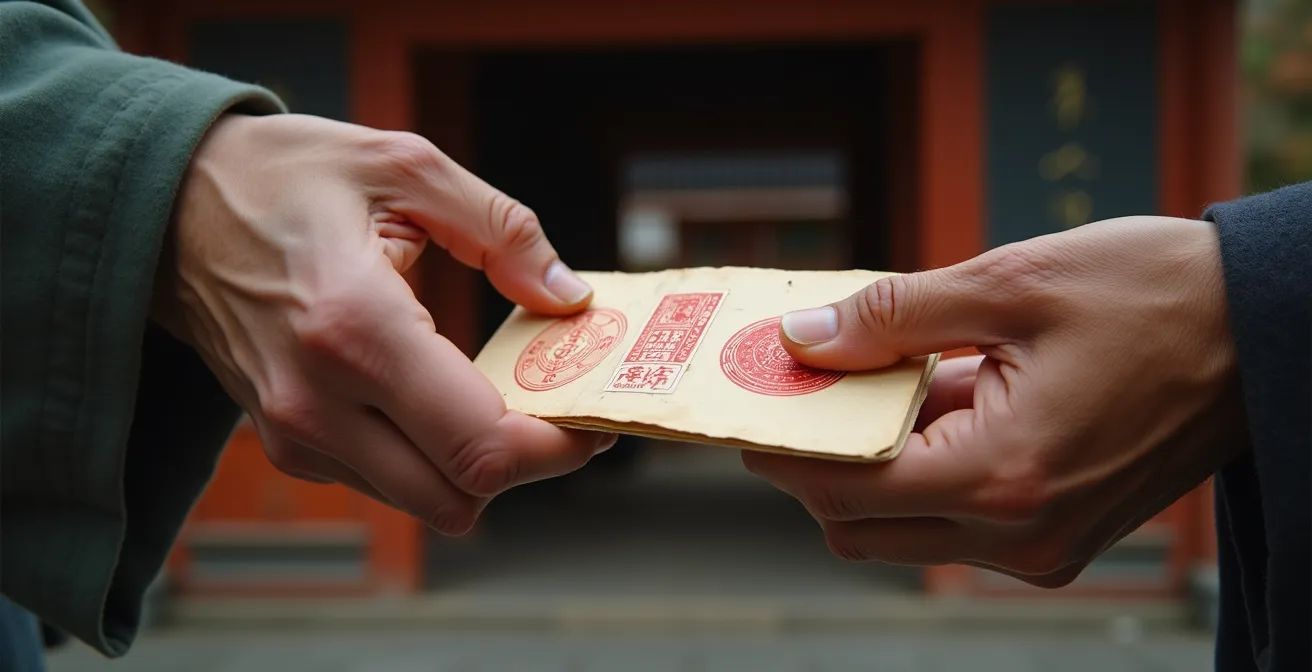
When words fail, the “Art of Point and Smile” becomes your lingua franca. It’s a language of shared humanity that can solve surprisingly complex problems. This forced reliance on non-verbal cues is a powerful form of transformative friction. It strips away intellectual arrogance and replaces it with a raw, humble need for connection. You learn that a shared laugh or a gesture of kindness is a far more potent form of communication than a perfectly translated sentence. You don’t just survive without a signal; you thrive.
Your Digital Disconnection Action Plan
- Offline Maps: Download detailed offline maps for the entire region in an app like Google Maps or Maps.me before you start.
- Language Packs: Ensure the Japanese language pack is fully downloaded for offline use in your preferred translation app.
- Essential Phrases: Create a digital or physical “cheat sheet” with screenshots of key phrases like “I am a pilgrim,” “Where is temple #X?”, and “May I camp here?”.
- Analog Backup: Carry a pocket-sized, durable paper map of the pilgrimage route and a simple Japanese phrasebook.
- Power Strategy: Invest in a high-capacity power bank and be aware of charging etiquette, often available at convenience stores or paid rest areas.
Is Rural Japan Safe for Solo Female Hitchhikers and Campers?
For a solo female traveler, the question of safety is paramount. In the context of rural Japan, and especially on the pilgrimage trails, the answer is a resounding yes, but the reason why is a profound lesson in social dynamics. The baseline is Japan’s exceptionally low crime rate, but the true protective layer is the identity of the pilgrim. When you don the white vest and carry the pilgrim’s staff, you cease to be just a foreign woman; you become an o-henro-san, an honored figure deserving of respect and support.
This pilgrim identity is a powerful social equalizer. Personal accounts from solo female hitchhikers are overwhelmingly positive, with many reporting that 90% of the time it took 5 minutes or less to secure a ride. The people who stop are not predatory; they are participants in the culture of omotenashi (wholehearted hospitality) and osettai. Drivers range from families with children and elderly farmers to other single women, all acting out of a genuine desire to help a person on a spiritual quest. They might offer you drinks, a meal, or even a place to stay for the night, all without any expectation of return.
This bubble of safety extends to camping. While discretion is always wise, the fear of assault or harassment that might be present in other parts of the world is virtually non-existent here. The greatest risk is not from people, but from weather or wildlife. The transformative element for a solo female traveler is immense. It’s an opportunity to deconstruct ingrained fears and operate in an environment of profound trust. It allows you to focus your energy not on self-preservation from human threat, but on the internal and physical challenges of the journey itself. It’s a rare and powerful freedom.
Bell or Spray: How to Protect Yourself From Bears in Japanese Forests?
The question of bear protection is not just about gear; it’s about philosophy. It forces you to decide what kind of visitor you are in nature. Are you seeking to announce your presence and coexist, or are you preparing for a conflict? This choice is perfectly encapsulated in the debate between the bear bell and bear spray, a decision that speaks volumes about your mindset on the trail.
The bear bell (kuma-suzu) is the Japanese way. It’s a tool of harmony. The constant, gentle jingle is not meant to be an aggressive deterrent but a polite announcement: “I am here, I am just passing through, let’s share this space without startling one another.” It reflects a deep-seated Shinto belief in the spirit of all things and a desire to move through the world without causing disruption. For a pilgrim, using a bell aligns with the mindset of being a humble visitor in a sacred landscape. You are not conquering the mountain; you are being granted passage.
Bear spray, on the other hand, represents a Western, confrontational mindset. It is a weapon of last resort, a tool for a worst-case scenario. While it can be effective, carrying it frames your interaction with wildlife as a potential conflict. Visitor centers in national parks provide crucial, up-to-date information on recent bear sightings and will be your best resource for assessing the actual risk in a given area. On trails like the Kumano Kodo, which pass through more remote forests, this awareness is critical.
The choice is a form of transformative friction, forcing you to confront your own relationship with fear and the wild. Do you place your faith in a tool of harmony or a tool of defense?
| Method | Philosophy | Pilgrim Mindset | Effectiveness |
|---|---|---|---|
| Bear Bell | Announcement & harmony – ‘I am here, let’s share’ | Visitor in nature | Check latest bear sighting updates |
| Bear Spray | Defense & conflict – last resort protection | Conqueror mindset | For emergency situations only |
| Risk Areas | Visitor centers provide bear sighting alerts and safety updates before heading to campgrounds | ||
Why You Cannot Rely on English in Rural Prefectures?
On the Kumano Kodo, you’ll find a safety net. Managed as a UNESCO World Heritage site and popular with international visitors, it features regular information boards in English. It allows you to understand the history and navigate with relative ease. On the Shikoku Pilgrimage, that net is gone. Outside of major cities, English evaporates. This is not an oversight; it is the unfiltered reality of rural Japan. For the spiritual seeker, this is the single most powerful engine of change.
The inability to communicate easily is not a bug, but the feature that forces humility, patience, and reliance on non-verbal cues
– Cultural immersion perspective
This forced immersion is what distinguishes the two pilgrimages on a transformative level. The Kumano Kodo offers transformation with a degree of comfort. Shikoku offers transformation through total submersion. When you cannot ask for directions, order food, or book a room with linguistic confidence, you are stripped of your adult competence. You become, in a sense, a child again—reliant on gestures, kindness, and the intuitive understanding of strangers. This state of forced humility is profoundly uncomfortable at first, and then, deeply liberating.
It rewires your brain. You learn to read atmospheres, to interpret the subtle language of a bow or a smile. You become hyper-aware of your surroundings in a way that is impossible when you are insulated by a common language. The frustration of not being understood gives way to the triumph of a successfully mimed request for a bowl of noodles. This daily struggle and small victory is the gritty, unglamorous work of transformation.
The following table, based on pilgrim reports, highlights the fundamental difference in the level of immersion between the two trails. Choosing between them is choosing your desired level of support.
| Aspect | Kumano Kodo (Nakahechi) | Shikoku 88 Temples |
|---|---|---|
| English Signage | Information boards in English at regular intervals | Minimal English support |
| Foreign Visitors | Popular pilgrimage favored by non-Japanese | Frequented mostly by Japanese pilgrims |
| Immersion Level | Moderate – UNESCO management | Full and deep immersion in all things Japanese |
| Transformation Factor | Comfort with occasional support | Total submersion into rural life |
Key Takeaways
- True transformation comes from “transformative friction”—the challenges you overcome, not the sights you see.
- The choice between Shikoku and Kumano Kodo is a choice between two types of challenge: raw immersion (Shikoku) versus structured spirituality (Kumano).
- Safety in rural Japan is exceptionally high, with the “pilgrim” identity acting as a social passport that encourages trust and support from locals.
- Losing digital connectivity and language proficiency is not a failure; it’s a feature that forces humility, resourcefulness, and genuine human connection.
- Your journey is not just a personal quest; it’s a vital injection of energy and economic support into Japan’s depopulating rural communities.
Why Visiting Rural Villages Helps Fight Depopulation?
Your pilgrimage is not a solitary act performed in a vacuum. Every step you take, every yen you spend, and every interaction you have is part of a larger ecological and economic system. This is nowhere more apparent than in the rural villages of Shikoku, many of which are facing the slow-motion crisis of depopulation (kaso). While the Kumano Kodo’s concentrated route supports a specific corridor, the vast, sprawling nature of the Shikoku’s 1,150km route supports hundreds of small communities, making your presence there an act of profound significance.
The economic impact is obvious. Your purchase of noodles at a family-run shop, your stay at a local minshuku, or even buying a drink from a vending machine provides a small but vital stream of revenue. However, the true value you bring is something less tangible but far more important: kehai, or the feeling of human presence. In landscapes where the population is aging and shrinking, the sight of a pilgrim walking the ancient path is a sign of life. It’s a confirmation that this place, this culture, still matters to the outside world.
There can be a tension here. As local communities see the pilgrimage’s popularity grow, there is an evolving desire for pilgrims to contribute economically, especially as more travelers choose to camp wild rather than use paid lodgings. Yet, the gift of your presence remains paramount. You are carrying energy, curiosity, and a connection to the global community into places that are becoming increasingly isolated. Your journey ceases to be purely a quest for personal transformation and becomes a symbiotic exchange. You receive hospitality, history, and spiritual nourishment; in return, you offer the village the invaluable gift of your presence, a whisper of life against the silence of depopulation.
The map is not the territory. The real journey begins when you choose your crucible. It’s time to start planning the friction that will forge you.