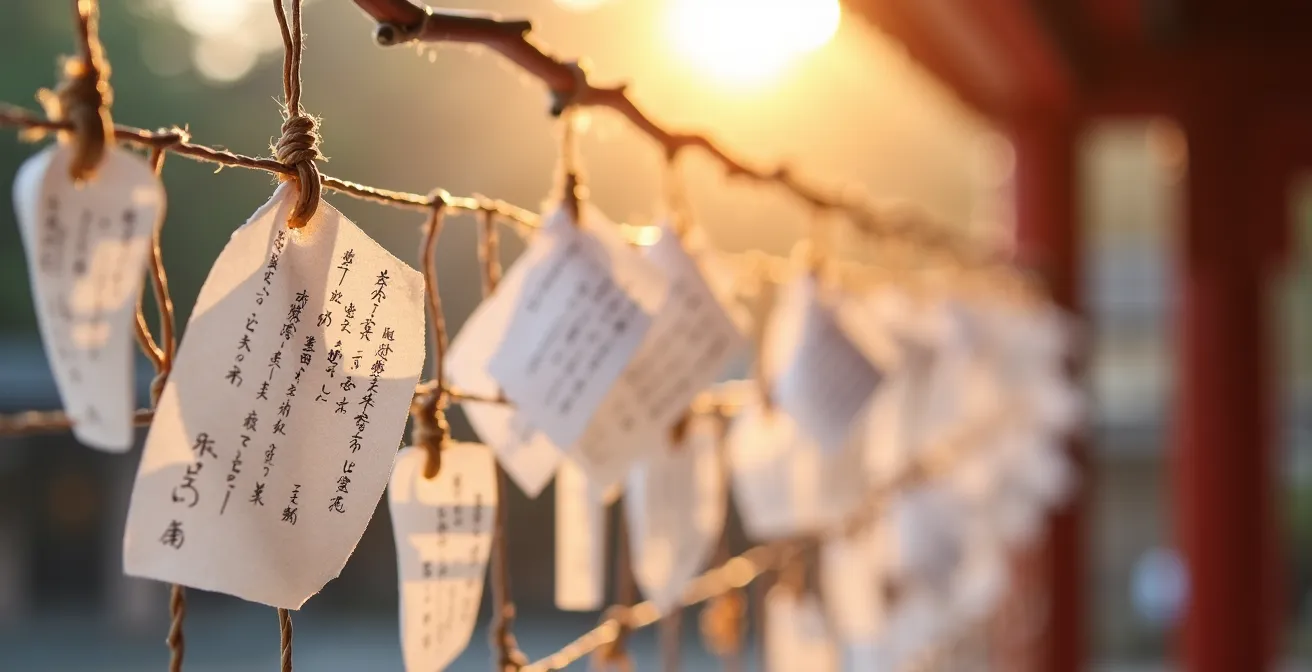
Contrary to the sinking feeling it causes, drawing ‘bad luck’ (凶, kyō) at Senso-ji Temple isn’t a curse; it’s a rare invitation to participate in an authentic purification ritual that most tourists miss.
- Senso-ji intentionally maintains a historically authentic, high probability of drawing bad fortunes (around 30%).
- Tying the slip to the designated wires isn’t just “getting rid of it”—it’s a formal ritual to leave the misfortune behind and allow priests to purify it collectively.
Recommendation: Embrace a ‘bad’ fortune as a unique opportunity for a deeper, more meaningful connection with the temple’s spiritual purpose, beyond simple sightseeing.
The moment is unmistakable. You shake the heavy, hexagonal metal box, a single bamboo stick clatters out, and you match its number to a drawer. You pull out the small paper slip—the omikuji. Your eyes scan for the key character, and your heart sinks. There it is: 凶 (kyō). Bad Fortune. For a superstitious traveler at Tokyo’s ancient Senso-ji Temple, it can feel like a devastating verdict, a dark cloud cast over your entire trip. The immediate instinct is often one of panic, a frantic search for the designated wires to tie the cursed paper and flee its influence.
While this reaction is common, it misses a profound cultural secret. As a historian of Japanese folklore, I can tell you that receiving a ‘bad luck’ slip at Senso-ji is not a failure. It’s an invitation. Most visitors get good fortunes, smile, and put the paper in their wallet. But you? You have been given a rare opportunity to engage in a deeper ritual, a moment of active participation that connects you more authentically to the temple’s 1,400-year history than any photograph ever could. The common advice—”just tie it up”—is correct, but it’s the *why* that transforms the experience from one of fear into one of privilege.
But to truly understand the gift hidden within that slip of ‘bad luck’ paper, we must first understand the world it comes from. Senso-ji is not just a building; it’s a living ecosystem of faith, commerce, history, and ritual. By exploring its vibrant approach, its hidden corners, and its place in the heart of Tokyo, we can reframe our understanding of luck and discover why the most meaningful moments are often the ones we initially fear.
Summary: A Visitor’s Complete Guide to the Senso-ji Experience
- Melon Pan or Ningyo Yaki: Which Snack Is the King of Nakamise Street?
- Rip-off or Tradition: Is an Asakusa Rickshaw Ride Worth the Cost?
- Day or Night: Why Visiting Senso-ji After Dark Is Magical?
- Kaminarimon: What Does the Giant Red Lantern Actually Symbolize?
- Kappabashi: How to Walk From the Temple to the Plastic Food Capital?
- Why Just Taking Photos Misses the Point of Temple Visits?
- Omamori Rules: Can You Buy Charms for Different Religions?
- East or West Tokyo: Where Should You Base Your Stay?
Melon Pan or Ningyo Yaki: Which Snack Is the King of Nakamise Street?
Your journey to the omikuji drawers begins on Nakamise-dori, the vibrant, crowded street leading to the temple’s main hall. This is the first layer of the Senso-ji experience: a sensory overload of sights, sounds, and, most importantly, smells. The air is thick with the sweet aroma of warring snacks, two of which stand as giants in this culinary battlefield: Melon Pan and Ningyo Yaki. Melon Pan, a large, sweet bun with a crisp, cookie-like crust, offers a satisfyingly simple and filling treat. Its appeal is immediate and universal.
In the other corner is Ningyo Yaki, or “doll cakes.” These are small, intricate cakes filled with sweet red bean paste (anko), cooked in cast-iron molds shaped like pigeons, pagodas, or other Asakusa symbols. They are more than a snack; they are edible souvenirs, a taste of local history. While the giant, warm Melon Pan might seem like the obvious choice for a hungry tourist, the delicate Ningyo Yaki represents a deeper connection to the place itself. Choosing one isn’t just about satisfying hunger; it’s about deciding what kind of experience you want to have. Are you here for a quick, satisfying bite, or to taste a piece of local tradition?
Your Nakamise Street Food Tasting Plan
- Visit between 9:00 AM and 7:00 PM when the majority of shops are open for the best selection.
- Look for Ningyo Yaki stalls with visible molds, as seeing them made is a key indicator of freshness.
- Eat your snack in the designated area in front of the shop; walking while eating is considered poor manners and is not allowed on the crowded street.
- Consider trying Agemanju (deep-fried manju buns), a delicious local favorite often overlooked by tourists.
- Budget around 300-600 yen per snack, allowing you to sample multiple treats without breaking the bank.
Ultimately, there is no wrong answer. The “king” of Nakamise is whichever snack best aligns with your personal pilgrimage. Both are delicious entry points into the bustling world that surrounds the sacred ground of the temple.
Rip-off or Tradition: Is an Asakusa Rickshaw Ride Worth the Cost?
As you navigate the crowds of Nakamise, you’ll inevitably be greeted by the cheerful calls of rickshaw pullers, known as shafu. These energetic young men and women, dressed in traditional garb, offer guided tours from the comfort of their two-wheeled carriages. For many visitors, the question immediately arises: is this an authentic cultural experience or an overpriced tourist trap? The answer, much like an omikuji fortune, depends on your perspective and what you seek from your visit.
On one hand, the prices can seem steep for a short ride. A 30-minute tour for two can easily cost ¥9,000 to ¥10,000. For the budget-conscious traveler, this money could be spent on dozens of Melon Pan. However, viewing the rickshaw ride solely through a financial lens misses its true value. A good shafu is not just a driver; they are a storyteller, a local guide, and a photographer. They will take you down quiet backstreets you’d never find on your own, share historical anecdotes, and point out architectural details hidden in plain sight. It’s a highly personalized and engaging way to understand the area’s history, moving beyond the crowded main thoroughfares.
The table below provides a general idea of pricing from some of the main operators in Asakusa. This helps you compare costs, but remember the true value lies in the experience provided by the guide.
| Company | 10 min (approx.) | 30 min (approx.) | Noted for |
|---|---|---|---|
| Ebisuya | ¥5,000 | ¥10,000 | Largest operator, very professional |
| Jidaiya | ¥4,000 | ¥9,000 | Often combined with cultural experiences |
| Kosugiya | ¥3,000 | ¥8,000 | Considered a good value option |
Ultimately, a rickshaw ride is a transaction of value, not just money. If you seek a quiet, curated, and informative introduction to Asakusa’s soul, it can be one of the most memorable parts of your visit. If you prefer self-discovery and the energy of the crowd, your money is better spent elsewhere. It’s a choice between passive observation and guided participation.
Day or Night: Why Visiting Senso-ji After Dark Is Magical?
Most of the 30 million worshippers and tourists who visit Senso-ji annually do so during the day. They experience the temple amidst the hustle of Nakamise-dori, the chatter of crowds, and the bright glare of the sun. But they are missing a secret. To truly feel the spiritual pulse of Senso-ji, one must visit after the sun has set and the commercial world has gone to sleep. After 8 PM, the shops of Nakamise shutter their doors, the crowds melt away, and the temple undergoes a profound transformation.
Illuminated by hundreds of lanterns, the temple grounds are cast in a warm, golden glow. The magnificent five-story pagoda and the main hall stand as silent, awe-inspiring silhouettes against the dark sky. The smoke from the giant incense burner, no longer competing with the smell of street food, hangs heavy in the air, a sacred perfume. It is in this quiet, serene atmosphere that the temple reclaims its primary identity as a place of worship and reflection.
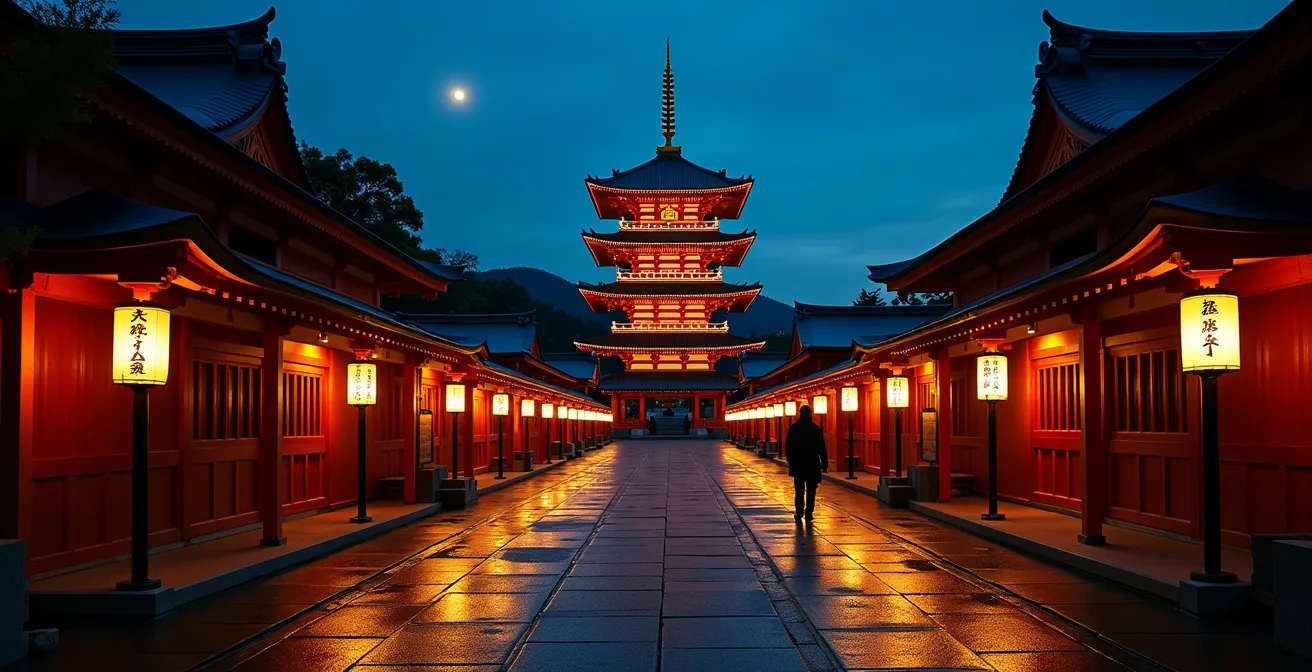
This stark contrast between day and night is what makes an evening visit so magical. You can walk the same paths you walked hours earlier, but they feel entirely different—hallowed and intimate. This shift is beautifully captured by local guides. As the official tourism guide from THE KANZASHI TOKYO ASAKUSA notes:
At night, with the commercial stalls of Nakamise-dori shuttered, the temple transitions from a tourist marketplace back to a place of serene worship.
– THE KANZASHI TOKYO ASAKUSA, Official Asakusa Tourism Guide
Visiting at night is like seeing the temple’s soul. It’s an experience that connects not to the commercial energy of modern Tokyo, but to the centuries of quiet prayers that have soaked into its very foundations. This is the perfect mindset to have when considering the deeper meaning of a fortune, good or bad.
Kaminarimon: What Does the Giant Red Lantern Actually Symbolize?
The first major landmark any visitor to Senso-ji encounters is the Kaminarimon, or “Thunder Gate.” Dominating this gate is a colossal red paper lantern, four meters tall and weighing 700kg, making it one of the most iconic symbols of Tokyo. For many, it’s simply a spectacular photo opportunity. Yet, to see it only as a decoration is to miss its powerful story of gratitude, destruction, and rebirth—a story that echoes the very cycle of luck and misfortune embodied by the omikuji.
The lantern is more than just a symbol of the temple; it’s a symbol of personal faith and corporate gratitude. The gate itself was destroyed by fire in 1865 and stood in ruins for nearly a century. It was not the government or a religious body that rebuilt it, but a businessman. In 1960, Konosuke Matsushita, the founder of Matsushita Electric (now Panasonic), was suffering from an illness. He prayed for recovery at Senso-ji, and when his prayers were answered, he showed his gratitude by donating the funds to rebuild the gate and its magnificent lantern. The name “Matsushita Electric” is subtly inscribed on the lantern’s base.
A Modern Act of Ancient Faith: The Matsushita Donation
The story of Konosuke Matsushita’s donation perfectly illustrates the living nature of faith at Senso-ji. The lantern’s existence is a direct result of a prayer for good fortune being answered. This act, blending modern corporate success with ancient spiritual practice, demonstrates that the temple is not just a historical relic but a place where acts of devotion continue to shape its physical form. It stands as a powerful reminder that out of personal hardship (illness) can come a monumental symbol of hope and gratitude for an entire city.
So, as you stand before the Kaminarimon, remember that this icon of Tokyo is not just a relic of the past but a testament to a personal bargain with fate that turned out well. It is a monument born from a moment of desperation that transformed into an act of immense generosity—a powerful parallel to the journey of turning a “bad” fortune into a positive action.
Kappabashi: How to Walk From the Temple to the Plastic Food Capital?
Just a short walk from the spiritual heart of Senso-ji lies a district dedicated to a different kind of devotion: the art of cooking. Kappabashi Kitchen Town is a nearly one-kilometer-long street lined with wholesale shops catering to every conceivable restaurant need, from giant soup pots and chef’s knives to the famous sampuru—the hyper-realistic plastic food models you see in restaurant windows across Japan. Venturing from the temple to this culinary haven is like peeling back another layer of Asakusa’s identity, moving from the spiritual to the practical.
While you can simply follow a map, the walk itself can be a small pilgrimage. By taking the quieter backstreets, you trade the tourist crowds of Nakamise for a glimpse into local life. You’ll pass small workshops, traditional homes, and Showa-era storefronts that feel a world away from the bustle of the temple. The journey becomes a transition, preparing you for the shift in focus from the sacred to the secular, from praying for fortune to equipping oneself for business.
The best route isn’t always the most direct. Following a path that highlights the contrast between these two worlds makes the arrival in Kappabashi all the more striking. The sudden appearance of a giant chef’s head on a building or a shop window filled with glistening plastic sushi signals your arrival in a new territory.
A Themed Walk from Senso-ji to Kappabashi
- Begin by exiting Senso-ji Temple through the west side, near the iconic Five-story Pagoda.
- Instead of heading to the main road, walk along the quiet backstreets that run parallel to Nakamise-dori. This offers a more authentic atmosphere of old Tokyo.
- Look for the giant chef’s head statue atop the Niimi building; this is the unofficial landmark signaling the start of Kappabashi. Turn left here.
- Along the way, keep an eye out for old Showa-era shopfronts selling traditional crafts, a beautiful contrast to the modern kitchenware to come.
- Find the corner where you can capture a photo with a unique angle: a traditional storefront in the foreground with the modern Tokyo Skytree in the background.
- Your official entry into Kappabashi is often marked by the corner knife shops, which are a gateway to this paradise for chefs and food lovers.
This short walk is a microcosm of the Tokyo experience: the seamless blending of ancient tradition and modern commerce, of spiritual devotion and practical craft. It’s a reminder that even in the shadow of a great temple, life, business, and the need for a good kitchen knife go on.
Why Just Taking Photos Misses the Point of Temple Visits?
In the age of social media, it’s easy for a visit to a place like Senso-ji to become a checklist of photo opportunities: a selfie with the Kaminarimon, a shot of the pagoda, a picture of your food. While these images make for great memories, an obsession with capturing the moment can prevent you from actually *experiencing* it. The true essence of a temple visit is not a visual transaction but a sensory and spiritual one. It’s about participation, not just observation.
This is where drawing an omikuji, especially a “bad” one, becomes so significant. It forces you out of the passive role of a photographer and into the active role of a participant in a ritual. You must perform an action: tie the slip, say a prayer, reflect on the fortune’s advice. This act of participation engages you with the temple’s purpose on a much deeper level. You are no longer just a tourist looking at a beautiful building; you are a person interacting with a living tradition. This idea is central to understanding Japanese spirituality: it’s something you *do*.
To cultivate this deeper connection, try engaging all your senses during your visit. Instead of looking for the next photo spot, pause and consciously notice the world around you. This simple exercise can transform a superficial sightseeing trip into a profound and personal experience.
An Exercise in Sensory Temple Engagement
- Sound: Close your eyes and listen. Can you distinguish the clink of coins being tossed into the offering box from the deep, resonant tone of the temple bell?
- Smell: Inhale deeply near the giant incense burner (jokoro). Notice how the rich, woody scent of purifying smoke is believed to heal and cleanse.
- Touch: At the chozuya (purification fountain), feel the cool, cleansing water on your hands. Notice the weight and texture of the bamboo ladle.
- Sight: Look beyond the obvious landmarks. Observe the interplay of light and shadow from the paper lanterns on the ancient wooden beams and stone pathways.
- Practice: Participate in a small way. Bow respectfully at the gate, offer a small coin at the main hall, or simply put your hands together in a moment of quiet reflection.
When you focus on the full sensory experience, the temple ceases to be a backdrop for your photos and becomes a space for personal connection. The value of your visit is no longer measured in “likes,” but in the quiet, internal shift that occurs when you allow yourself to be fully present.
Omamori Rules: Can You Buy Charms for Different Religions?
After engaging with the omikuji, many visitors are drawn to the stalls selling omamori, or protective amulets. These small, beautifully decorated brocade bags contain a prayer and are dedicated to providing specific types of luck, such as traffic safety, academic success, or finding love. For travelers from different cultural backgrounds, a common question arises: is it okay to buy these charms if you don’t follow Shinto or Buddhist beliefs? Will charms from different temples conflict with each other?
The answer reveals the wonderfully pragmatic and inclusive nature of Japanese folk religion. The idea of charms “canceling each other out” is a Western misconception. In Japan, it’s perfectly common to collect omamori from various temples and shrines, with the belief that they work together to offer a layered sphere of protection. More importantly, the purchase of an omamori is seen less as a strict religious act and more as a gesture of setting a positive intention. You don’t need to be a Buddhist to wish for a safe journey or a successful career.
Senso-ji itself encourages visitors to select charms based on their current life needs and goals, not their religious affiliation. This transforms the act of buying a charm from a superstitious purchase into a mindful practice of goal-setting. By choosing an omamori for “business prosperity,” you are not just buying a trinket; you are solidifying your own intention to focus on your career. The charm becomes a tangible, physical reminder of that personal goal. It’s a tool for focus, powered by your own intention.
Therefore, the only “rule” for buying an omamori is to choose one that resonates with your personal aspirations. The power of the charm comes not from blind faith in a deity you may not worship, but from the focused personal intention you invest in it. It’s another beautiful example of how spiritual practice at Senso-ji is deeply personal and universally accessible.
Key Takeaways
- Drawing ‘bad luck’ at Senso-ji is not a curse, but a rare chance for deeper ritual participation.
- The temple experience is multi-layered, from the commercial energy of Nakamise to the serene spirituality of a night visit.
- Authentic engagement (tasting local food, listening to a guide, using all senses) offers more value than passive observation (just taking photos).
East or West Tokyo: Where Should You Base Your Stay?
A visitor’s experience of Senso-ji—and indeed, their entire perception of luck and ritual—is often colored by a much larger decision: where to stay in the vast metropolis of Tokyo. The city is often divided into two distinct personalities: the traditional, historic East (where Asakusa and Senso-ji are located) and the modern, bustling West (home to hotspots like Shibuya and Shinjuku). Choosing where to base your stay fundamentally shapes the rhythm and texture of your trip.
Staying in West Tokyo immerses you in the Japan of popular imagination: a neon-drenched world of giant video screens, endless shopping, and nightlife that thrums until the first train at dawn. It’s exciting, contemporary, and convenient, with major transport hubs like the JR Yamanote Line connecting you easily to the rest of the city. However, it can also feel overwhelming, crowded, and expensive.
In contrast, basing yourself in East Tokyo, near Asakusa or Ueno, is a choice for a different kind of travel. Here, the days start early with the quiet hum of local life and the ringing of temple bells. The nights are peaceful, best spent in small, local izakaya rather than sprawling nightclubs. While it may have fewer major train lines, it offers a more relaxed pace, larger and more affordable hotel rooms, and a tangible connection to the city’s history. It’s a place where you can experience the magic of Senso-ji at night simply by taking a short stroll from your hotel.
This table summarizes the core differences in atmosphere and practicality to help you decide which side of Tokyo aligns with your travel style.
| Aspect | East Tokyo (Asakusa/Ueno) | West Tokyo (Shibuya/Shinjuku) |
|---|---|---|
| Morning Routine | Early rising, quiet mornings at temples | Late nights, vibrant after 10 AM |
| Evening Vibe | Peaceful after 9 PM, local izakaya | Comes alive after dark, endless nightlife |
| Cultural Feel | Traditional, historic temples, old Tokyo | Modern, neon lights, contemporary Japan |
| Transportation | Fewer lines, no direct JR in Asakusa | Major hub, excellent JR Yamanote Line access |
| Hotel Pricing | Generally more affordable, often larger rooms | Premium prices for smaller spaces |
For the superstitious traveler, or anyone seeking the kind of deep, reflective experience this guide has explored, staying in East Tokyo is the logical choice. It positions you not as a temporary visitor to the city’s history, but as a temporary resident within it, allowing the spirit of old Tokyo to seep into your journey from morning to night.
Frequently Asked Questions about Omikuji and Omamori
I got a bad fortune! Can I just draw another omikuji until I get a good one?
While there’s no rule explicitly forbidding it, redrawing is generally seen as ignoring the divine advice you’ve been given. The fortune, whether good or bad, is considered guidance. The respectful approach is to accept the message, tie up the bad fortune, and perhaps try again on a different day or at another temple entirely, having reflected on the first one.
Is it true that Senso-ji gives out more bad fortunes than other temples?
Yes, and this is intentional. Senso-ji is proud to maintain the original, 1,000-year-old fortune ratio established by the great priest Ryogen. This means there is a 30% probability of drawing bad fortune (kyō). While many other temples have artificially reduced the number of bad fortunes to please tourists, Senso-ji upholds this tradition as a mark of its historical authenticity.
What is the actual meaning behind tying the bad fortune slips to the wires?
This is a beautiful piece of Japanese wordplay and ritual. The act of tying the slip physically leaves the bad luck “behind” at the temple instead of it following you home. Furthermore, the Japanese word for pine tree, *matsu*, is a homophone for the verb “to wait” (*matsu*). So, by tying the fortune, you are making the bad luck “wait” at the temple, where it will eventually be collected by priests and purified in a sacred fire ceremony called *otakiage*.
Will buying omamori charms from a Buddhist temple and a Shinto shrine cancel each other out?
No, this is a common misconception. In Japan’s syncretic spiritual landscape, it is very common to carry multiple omamori from various temples and shrines. Each is believed to offer its own specific protection, and they are thought to work in harmony together, not against each other.
How should I properly dispose of an old omamori from last year?
An omamori’s power is generally considered to last for one year. After that, you should not simply throw it away. The proper method is to return it to a temple—it doesn’t have to be the one you bought it from. The temple will collect it and respectfully burn it in a purification ceremony (otakiage), releasing its accumulated energy and thanking it for its protection.