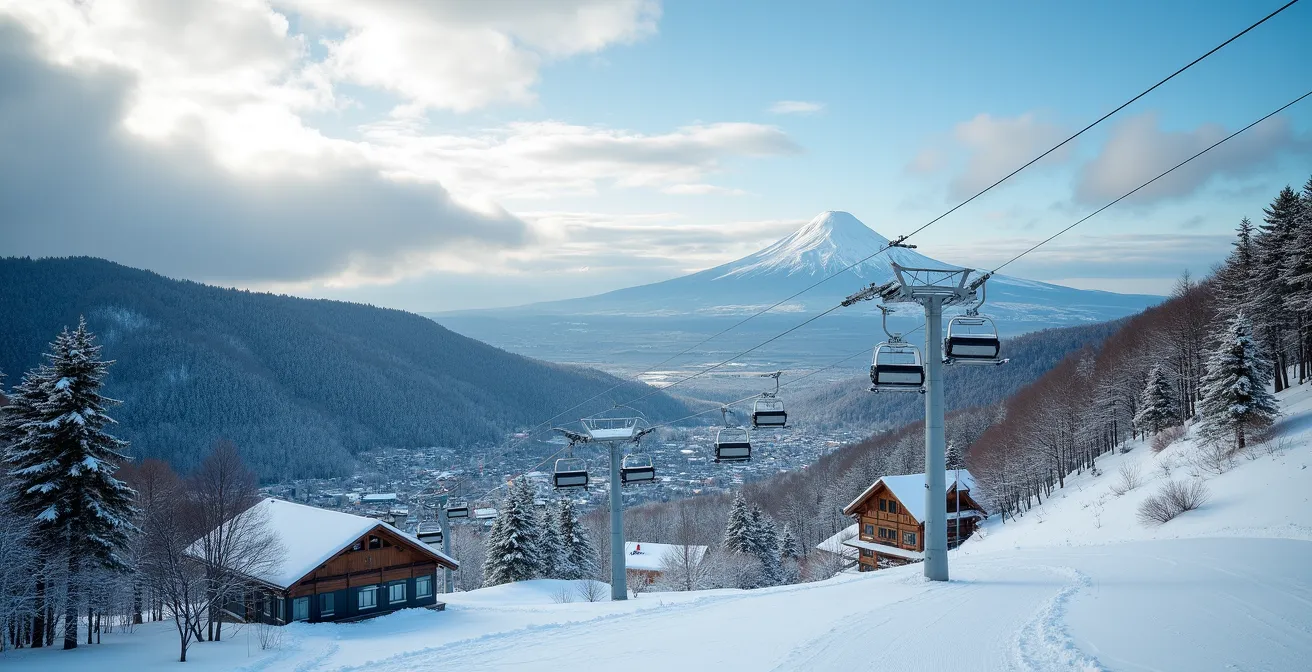
Choosing between Niseko and Rusutsu is less about “nightlife vs. quiet” and more a technical decision about snow type, risk tolerance, and recovery strategy.
- Niseko offers vast, varied terrain and extensive backcountry access, but this comes with higher crowds and significant, often underestimated, risks.
- Rusutsu provides world-class tree skiing and a more contained, powder-focused experience, with logistics and recovery options integrated into the resort.
Recommendation: Your choice depends on your priority. If you seek varied terrain and are prepared for rigorous risk management, consider Niseko. If your goal is maximizing deep powder tree runs with seamless logistics, Rusutsu is the superior choice.
As a ski instructor based in Sapporo, the question I hear most often from visiting skiers is “Niseko or Rusutsu?”. The internet is full of answers focusing on crowds and restaurants, but for an intermediate or advanced skier, that’s missing the point. This isn’t a lifestyle choice; it’s a technical one. Your decision impacts everything from the quality of your turns to your personal safety and how effectively your body recovers for the next day of deep powder.
Many guides will tell you Niseko is the international hub and Rusutsu is the quiet family resort. While there’s truth to that, it’s a surface-level analysis. The real difference lies in the character of the terrain, the management of backcountry access, and the logistical realities of a multi-day trip chasing storms. Forget the simple pros and cons lists. The key isn’t about which resort is ‘better,’ but about which resort is the right tool for the specific job you want to accomplish on the mountain.
This guide is designed to walk you through a professional’s decision-making framework. We’ll analyze the science behind the legendary ‘Japow’, discuss the critical logistics of gear transport, and confront the serious, often-ignored risks of Niseko’s backcountry. We will then dive into the science of recovery, from onsen etiquette to the specific mineral properties of the water, because your performance on day five depends on your actions after the lifts close on day one. By the end, you’ll be able to make a choice not as a tourist, but as an informed winter sports enthusiast.
To help you navigate this expert analysis, this article breaks down the core components of a strategic Hokkaido ski trip decision. The following sections will guide you through snow science, logistics, risk management, and recovery protocols.
Contents: A Professional’s Comparison of Niseko and Rusutsu
- Why Is Hokkaido’s ‘Japow’ Different From European Snow?
- How to Transport Skis on Trains Without Stress or Damage
- The Backcountry Mistake That Endangers Tourists in Niseko
- When to Book Your Trip for the Deepest Powder in February?
- Onsen After Skiing: How to Recover Your Muscles the Local Way
- Head Hot, Body Cold: How to Regulate Your Temperature in Winter Baths?
- How Butter and Corn Became Staples in Sapporo Ramen?
- Sulfur or Iron: Which Water Type Heals Muscle Pain Best?
Why Is Hokkaido’s ‘Japow’ Different From European Snow?
Understanding the Niseko versus Rusutsu debate starts with the snow itself. The term ‘Japow’ isn’t just marketing; it’s a specific meteorological phenomenon. The key difference from the snow you might find in the Alps or even the Rockies lies in its incredibly low moisture content. Cold, dry air blasts from the Siberian landmass, travels across the relatively warm Sea of Japan, and picks up significant moisture. When this air mass hits the mountains of Hokkaido, it dumps that moisture as snow with a unique crystalline structure. It is exceptionally light and dry.
This isn’t just a feeling; it’s measurable. Scientific analysis shows that some of the lightest powder in the world falls here. For instance, while Utah’s famous powder might have around 7% water, measurements in Japan reveal snow with as little as 4% water content. This low density is what creates the famous “bottomless” sensation and the face shots that skiers travel the globe for. The Japan Weather Association explains this “sea-effect snow” process is optimized when temperatures are between -5°C and -8°C, which preserves the delicate dendritic crystal shapes, making the snowpack feel exceptionally light and buoyant under your skis.
Both Niseko and Rusutsu benefit from this phenomenon, but their specific locations give the snow a slightly different character. Rusutsu, being slightly further from the coast, often gets snow that is just a fraction lighter and colder. It’s a subtle distinction, but one that advanced skiers can feel, particularly on deep days. This fundamental quality of the snow is the primary reason skiers make the pilgrimage to Hokkaido, and it’s the foundation upon which all other resort decisions are built.
How to Transport Skis on Trains Without Stress or Damage
Once you’ve decided to chase Japow, the next challenge is logistics. Moving bulky ski equipment through Japan’s famously efficient, but often crowded, public transport system can be intimidating. On JR (Japan Rail) trains, especially the Shinkansen (bullet train), there are specific rules and limited space for oversized luggage. Simply showing up with an unbagged pair of skis is not an option and is a common mistake for first-time visitors. A durable, padded ski bag is non-negotiable for train travel to protect both your gear and fellow passengers.
The image below captures a familiar scene for skiers in Japan: preparing for a train journey. Notice the dedicated ski bags and the organised approach, which is essential for a smooth transit.
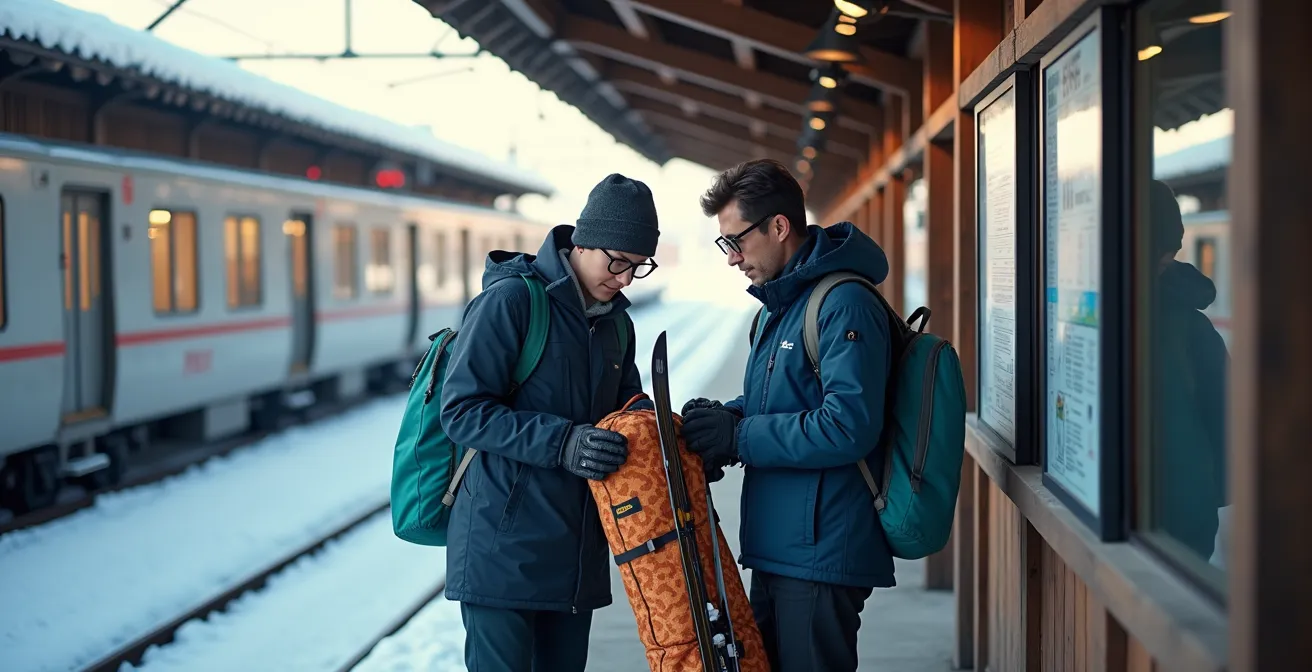
However, the real pro-tip that I give all my clients is to bypass the problem entirely. Japan’s ‘takkyubin’ (luggage delivery service) is incredibly reliable, efficient, and surprisingly affordable. You can send your ski bag directly from the airport (or your Tokyo hotel) to your accommodation in Niseko or Rusutsu. It typically arrives the next day, allowing you to travel on the train with only a small backpack. This service, offered by companies like Yamato (the ‘black cat’ logo) and Sagawa, completely removes the stress of navigating stations with heavy gear and is the standard practice for local skiers.
The Backcountry Mistake That Endangers Tourists in Niseko
This is where my perspective as a safety-focused instructor becomes critical. Niseko’s “gate” system is famous, but it’s also widely misunderstood. Many foreign skiers see an open gate and assume it signifies “safe, lift-accessed backcountry.” This is a dangerous misconception. As the Niseko Avalanche Institute states, this couldn’t be further from the truth.
Niseko’s gates are access points to uncontrolled, hazardous terrain, not ‘lift-served backcountry’. A gate being ‘open’ is not a guarantee of safety, but an acknowledgement of personal responsibility.
– Niseko Avalanche Institute, Official Niseko Avalanche Information
The number one mistake is entering this terrain without the proper training, equipment (transceiver, shovel, probe), and knowledge of the local snowpack. The snow in Hokkaido, while incredible to ski, can have persistent weak layers that lead to unpredictable avalanches. Assuming that following other tracks makes it safe is a fatal error in judgment. A rescue operation is not only dangerous for the rescue teams but also expensive for you. According to the official Niseko Rules, rescue operations carry a minimum charge of ¥100,000, and that’s just the starting point.
In contrast, Rusutsu’s appeal for many is its incredible in-bounds tree skiing. While it also has backcountry access, the resort is renowned for the vast, challenging, and powder-filled glades that are all within the resort’s patrolled boundaries. For an advanced skier looking to push their limits in deep snow without the objective hazards of avalanche terrain, Rusutsu offers a more straightforward, lower-risk proposition. The choice here is about your personal risk management and skill set. If you are a trained and equipped backcountry enthusiast, Niseko’s gates offer a world of opportunity. If not, you are taking a serious gamble.
When to Book Your Trip for the Deepest Powder in February?
Timing your trip is crucial for maximizing your chances of experiencing peak ‘Japow’. While snow is possible from December to March, the golden window is undeniably late January through mid-February. This is when the Siberian weather patterns are most consistent, delivering storm after storm of light, dry snow. However, this is also peak season, meaning peak crowds and prices. Booking well in advance is not just a suggestion; it’s a necessity.
For a trip during this prime-time powder window, you should be looking to secure your accommodation and flights at least six months in advance, if not more. Waiting for last-minute deals during this period is a recipe for disappointment. For those with more flexibility, late February offers a strategic advantage: the snow base is at its deepest, the chance of powder days is still very high, but the holiday crowds have thinned out. This can be the sweet spot for a balance of excellent conditions and a slightly more relaxed atmosphere.
The following table, based on years of snowfall data, provides a strategic overview to help you plan. Note how crowd levels and booking timelines directly correlate with the prime snowfall periods.
This data, summarized from a seasonal analysis of Niseko’s conditions, is a critical tool for your planning.
| Period | Snow Conditions | Crowd Level | Booking Strategy |
|---|---|---|---|
| Early Dec | Low base, quiet slopes | Very Low | Last-minute deals possible |
| Jan 15-Feb 15 | Peak Japow (10-15m annual average) | Peak crowds | Book 6+ months ahead |
| Late Feb | Stable base, high powder chance | Moderate | Book 3-4 months ahead |
| March | Bluebird days, spring skiing | Low | Flexible booking possible |
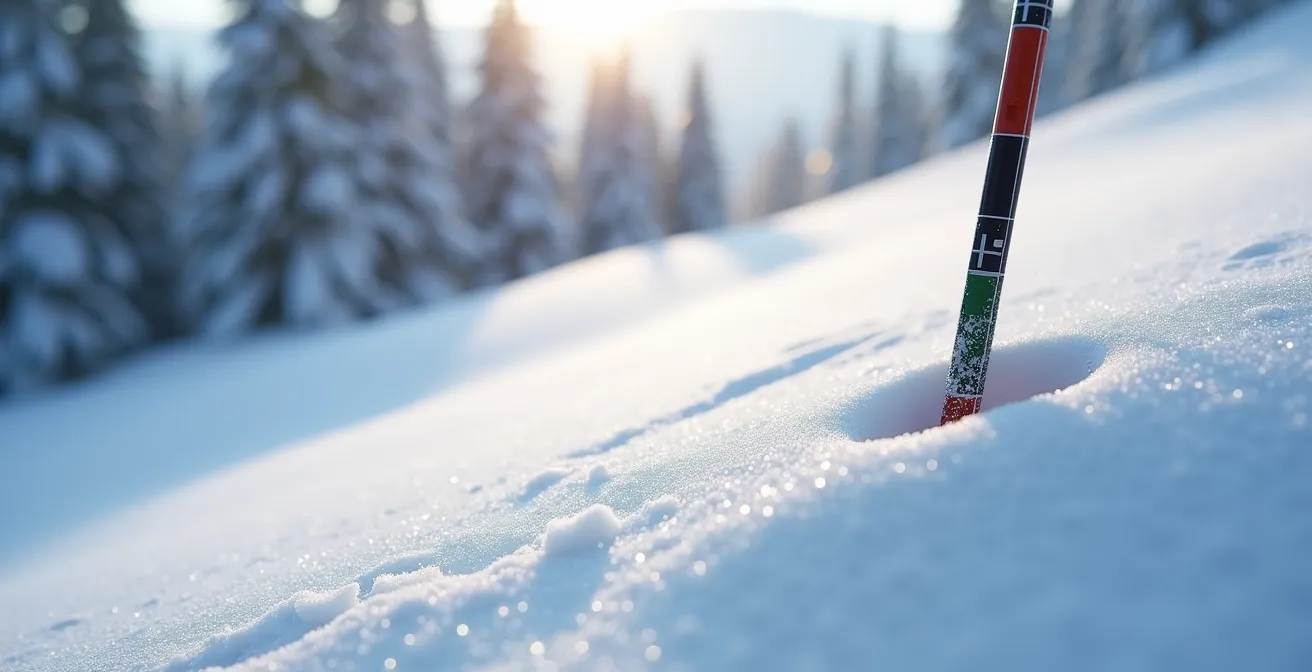
Visualizing the reward for this careful planning is important. The goal is to find yourself in snow so deep that every turn is an explosion of white, as shown in the image below.
Onsen After Skiing: How to Recover Your Muscles the Local Way
Skiing deep powder is incredibly demanding on the body. Your quads, glutes, and core work overtime. Effective recovery is not a luxury; it’s essential for being able to ski day after day. In Hokkaido, the ultimate recovery tool is the onsen (hot spring). This is far more than just a hot tub; it’s a cultural institution and a powerful form of hydrotherapy. As one international skier noted after a trip hitting both resorts:
After days of skiing both Niseko and Rusutsu, the onsen became our nightly ritual. The contrast between the freezing air and hot water while snow fell around us was pure magic – better than any sports massage for tired legs.
– International Skier
To get the most out of the experience, both culturally and physiologically, you must follow the local etiquette. It’s not just about rules; it’s a process designed for hygiene and respect. Rushing in without washing is the biggest faux pas a foreigner can make. The process is a ritual that prepares your body for the therapeutic heat. For skiers, alternating between the hot onsen water and a cold plunge (or even a roll in the snow if you’re brave) is a fantastic way to flush lactic acid from tired muscles through vasodilation and vasoconstriction.
Action Plan: Onsen Etiquette for Maximum Recovery
- Wash Thoroughly: Before entering any bath, use the provided washing stations. Sit on the small stool and scrub completely with soap and water, then rinse all soap off. This is the most important step.
- Acclimatize with ‘Kakeyu’: Use the buckets to scoop hot water from the bath and pour it over your lower body, starting with your feet, to help your body adjust to the temperature.
- Enter Slowly: Never jump or splash. Enter the bath slowly and quietly, immersing yourself gradually. The goal is relaxation, not recreation.
- Alternate Hot and Cold: For optimal muscle recovery, spend 5-10 minutes in the hot bath, followed by a 30-60 second cold plunge or shower. Repeat 2-3 times.
- Use the ‘Towel on Head’ Trick: In outdoor baths (rotenburo), especially when it’s snowing, placing a small, cold, damp towel on your head helps regulate your body temperature and prevents you from feeling light-headed.
Head Hot, Body Cold: How to Regulate Your Temperature in Winter Baths?
The magic of a winter onsen, especially an outdoor ‘rotenburo’, lies in the extreme temperature differential—your body submerged in 40°C water while your head is exposed to sub-zero air. While invigorating, this can also pose a physiological challenge. The feeling of being “too hot” can come on quickly and is a sign your body is struggling to regulate its core temperature. This is where a specific Japanese technique called ‘hanshin-yoku’, or half-body bathing, is extremely useful. Instead of full immersion, you sit in the water only up to your waist or solar plexus. This allows your heart and lungs to remain above the hot water, reducing the strain on your cardiovascular system and allowing for longer, safer, and more effective bathing sessions.
This method is particularly effective in outdoor winter onsens where the temperature difference between the air and water can easily exceed 40°C. It prevents the light-headedness that can occur from overheating. As an instructor, I always teach my clients to be aware of their body’s signals. Relaxation can quickly turn to distress if you ignore the early warning signs of overheating. Recognizing these is a crucial safety skill for anyone using an onsen, especially after a physically demanding day on the slopes.
Pay close attention to these subtle signs of overheating:
- A tingling sensation in your nose, fingers, or toes.
- A noticeable increase in heart rate that doesn’t feel like relaxation.
- Feeling dizzy or light-headed, especially when you shift position or stand up.
- Sweating excessively from your face and scalp despite the cold air.
- A feeling of pressure behind your eyes or in your temples.
If you experience any of these, it’s time to get out of the hot water, sit on the edge for a few minutes, drink some cool water, and let your body temperature stabilize. Pushing through it is not only unsafe but defeats the restorative purpose of the onsen.
How Butter and Corn Became Staples in Sapporo Ramen?
Recovery isn’t just about what you do after skiing; it’s also about how you refuel. In Hokkaido, the post-skiing meal is as much a part of the culture as the onsen. While you can find world-class sushi, the quintessential Hokkaido recovery meal is a steaming bowl of Sapporo-style ramen. Specifically, Miso Ramen topped with a pat of butter and a generous scoop of sweet corn. To an outsider, this combination might seem odd, but from a physiological standpoint, it’s genius.
Skiing in sub-zero temperatures burns a massive number of calories. Your body needs to replenish its glycogen stores and repair muscle tissue. The ramen provides everything you need in one bowl. The rich, miso-based broth rehydrates and replaces lost salts. The noodles provide carbohydrates for energy. The chashu pork offers protein for muscle repair. And the butter and corn? They are the high-energy additions born from Hokkaido’s agricultural heritage. As one writer aptly put it:
The butter and corn ramen is the perfect high-calorie recovery meal for skiers burning thousands of calories in Hokkaido’s cold.
– Colorado Saram
The butter adds much-needed fat and calories, creating a richer, more satisfying broth that helps you feel warm from the inside out. The corn provides a touch of sweetness and texture, but also more carbohydrates. This isn’t just a quirky local dish; it’s a perfectly engineered piece of caloric recovery fuel. Whether you’re in Niseko or Rusutsu, seeking out an authentic Sapporo ramen shop is a delicious and highly effective way to prepare your body for another day of deep powder.
Key takeaways
- Your choice between Niseko and Rusutsu should be a technical decision based on snow science, risk tolerance, and recovery needs, not just nightlife.
- Niseko’s backcountry “gates” lead to uncontrolled, hazardous terrain requiring expert-level preparation; Rusutsu offers world-class, low-risk tree skiing within its boundaries.
- Effective recovery is a critical part of a Hokkaido ski trip, involving onsen hydrotherapy and strategic refueling with local foods like Sapporo ramen.
Sulfur or Iron: Which Water Type Heals Muscle Pain Best?
The final, and perhaps most nuanced, element of your decision matrix is the science of onsen recovery itself. Just as not all powder is the same, not all hot spring water is the same. The therapeutic benefits of an onsen are derived from its specific mineral content, which varies dramatically by location. This is a key differentiator between the onsen options available around Niseko and Rusutsu. Understanding which water type best suits your recovery needs can be the final piece of the puzzle in choosing your home base.
The primary minerals found in Hokkaido onsens that are relevant to skiers are sulfur, iron, and sodium chloride. Each has a different primary benefit. Sulfur springs, often identifiable by their distinct “egg” smell, are excellent for joint pain and skin conditions. Iron springs, which can give the water a reddish tint, are believed to improve circulation and help with fatigue. Sodium chloride springs feel salty and are fantastic for muscle relaxation and, crucially, for helping the body retain heat after you get out of the bath. For a skier with sore muscles and general fatigue, both iron and sodium chloride springs are highly effective recovery tools.
This is where location matters. The Westin Rusutsu Resort, for example, features onsen facilities with mineral-rich water, including some with properties beneficial for fatigue recovery. The wider Niseko area, being a larger volcanic region, offers a huge variety of onsen types, but you may have to travel outside your hotel to find a specific mineral composition. Many resort hotels feature “simple springs” which are relaxing but have lower mineral content. The following table breaks down the options, based on an analysis of onsen types in the region.
| Mineral Type | Identifying Features | Primary Benefits | Common Locations |
|---|---|---|---|
| Sulfur Springs | Egg-like smell, milky water | Skin conditions, joint pain | Various Niseko area onsens |
| Iron Springs | Metallic tang, reddish tint | Circulation, fatigue recovery | Selected Rusutsu area baths |
| Sodium Chloride | Salty taste, clear water | Muscle relaxation, warmth retention | Coastal area onsens |
| Simple Springs | No distinct smell or color | General relaxation, stress relief | Most resort hotel onsens |
Choosing your resort can therefore also be a choice about your preferred method of recovery. Do you want the convenience of a specific mineral bath in your hotel (often a feature at Rusutsu), or the variety and adventure of exploring different onsens in the Niseko United area?
Now you have the framework a professional uses to evaluate these resorts. The next step is to apply it to your own priorities, risk tolerance, and trip goals to make a confident, informed decision for your ultimate Hokkaido adventure.