The efficiency of your Golden Route trip depends less on your itinerary and more on your logistical strategy.
- A 7-day Japan Rail Pass is rarely cost-effective for a one-way Tokyo-Kyoto-Osaka trip after the recent price hikes; single tickets are usually cheaper.
- Shipping your main luggage between cities is a non-negotiable strategy to save hours and eliminate physical strain.
- Grouping Tokyo activities by subway line and choosing your accommodation based on your ‘itinerary center of gravity’ minimizes daily travel time.
Recommendation: Treat your trip plan like a project. Calculate the time-value of every decision, from which Shinkansen to take to whether a stopover is worth the detour.
Planning a trip along Japan’s “Golden Route”—the classic path connecting Tokyo, Kyoto, and Osaka—can feel overwhelming. Most guides present you with an endless checklist of temples, shrines, and neon-lit streets. They tell you what to see, but they rarely explain how to see it without succumbing to exhaustion, crowded trains, and the constant burden of your own luggage. The common advice is to get a Japan Rail Pass, book a hotel in a popular area, and simply follow the crowds. But this approach often leads to what we can call logistical friction: the accumulated stress of inefficient travel that drains your time, energy, and budget.
The core problem is treating a Japan trip as a mere sightseeing tour rather than a complex logistical operation. With an estimated 33 million visitors expected in Japan for 2024, simply showing up is no longer a viable strategy. But what if the key to a successful trip wasn’t a better itinerary, but a smarter operational plan? What if you could engineer the friction out of your travel, making every transition smooth and every hour count? This guide is built on that principle. We won’t just give you a list of places; we will provide a strategic framework for making the critical decisions that define your experience.
This is your logistics-first manual for the Golden Route. We’ll deconstruct the key operational choices you’ll face, from the macro-level decisions about route direction and rail passes to the micro-level tactics of luggage forwarding and neighborhood navigation. By adopting a planner’s mindset, you can transform a potentially stressful journey into a seamless, efficient, and ultimately more enjoyable adventure.
To navigate this complex logistical puzzle, this guide is structured around the core decisions you’ll need to make. Explore the sections below to build an efficient and stress-free Golden Route experience, from your starting point to your final day in Tokyo.
Summary: Japan’s Golden Route: A Logistics-First Guide to Maximizing Your Time
- East to West or West to East: Does It Matter Where You Start?
- JR Pass vs Single Tickets: Which Is Cheaper for a One-Way Golden Route?
- Carry or Ship: Why You Should Forward Luggage Between Tokyo and Kyoto?
- Hakone or Himeji: Which Stopover Adds the Most Value to the Route?
- Temple Burnout: How to Pace Yourself on the Golden Route?
- Nozomi, Hikari, or Kodama: Which Train Saves You Time vs Money?
- How to Group Tokyo Neighborhoods to Save 3 Hours Daily?
- East or West Tokyo: Where Should You Base Your Stay?
East to West or West to East: Does It Matter Where You Start?
The first strategic decision is your direction of travel. While it may seem trivial, the choice between starting in Tokyo (East) and ending in the Kansai region (West), or vice versa, has a significant impact on your trip’s pacing, budget, and overall narrative feel. This isn’t just about geography; it’s about setting the tone for your entire journey. Do you want your trip to build to an energetic urban climax in Tokyo, or wind down in the serene, temple-filled atmosphere of Kyoto? With 60% of all Japan visitors making Kyoto a priority, structuring your trip around it is key.
The most practical factor is your arrival airport. If you fly into Osaka’s Kansai International Airport (KIX), a West-to-East route is the logical choice. If you land at Tokyo’s Narita (NRT) or Haneda (HND), an East-to-West route minimizes initial travel. Another critical consideration is open-jaw flights (flying into one city and out of another). These can often be comparable in price to round-trip tickets and eliminate the need to backtrack, saving you both a full day of travel and the cost of a long-distance Shinkansen ticket. This is a core principle of eliminating logistical friction.
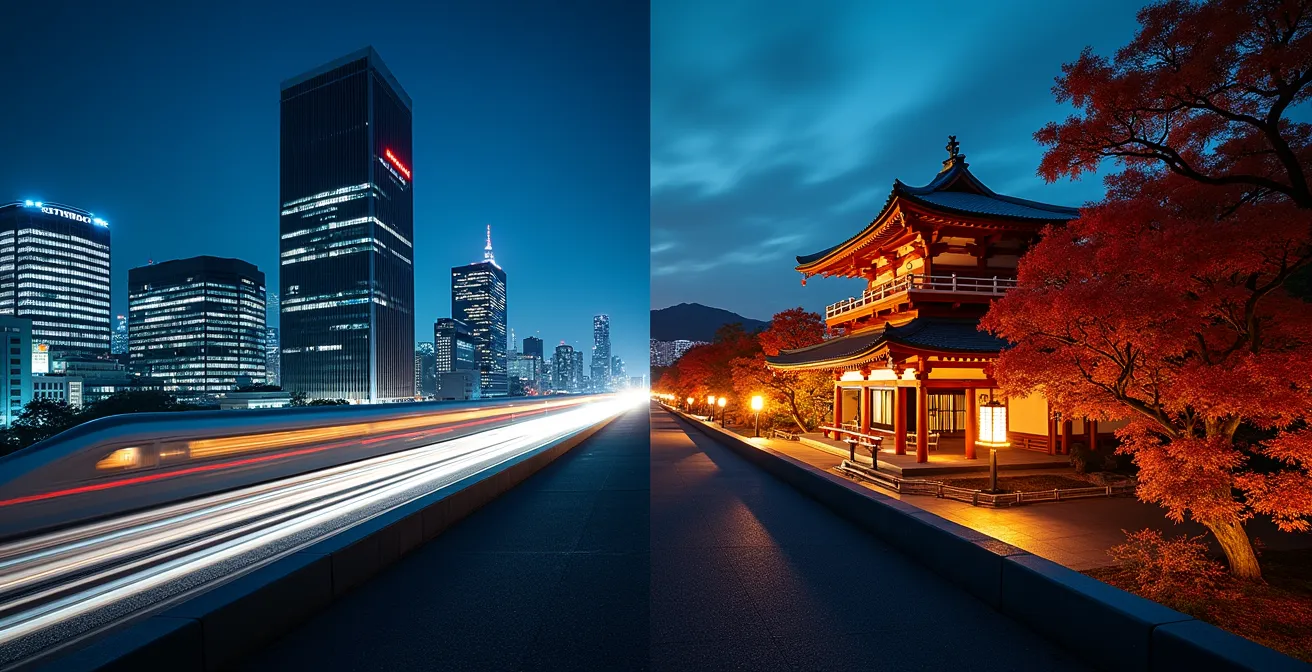
As the image suggests, the contrast is stark. Starting in Tokyo immerses you immediately in Japan’s hyper-modernity, while starting in the Kansai region allows for a gentler cultural immersion. For travelers seeking an alternative path, the Hokuriku Arch Pass offers a 7-day route between Tokyo and Kyoto via the less-traveled Sea of Japan coast. While slower, it presents a unique directional choice that diverges from the standard path. Ultimately, the “right” direction is the one that best aligns with your flight logistics and desired experiential arc.
JR Pass vs Single Tickets: Which Is Cheaper for a One-Way Golden Route?
The Japan Rail Pass was once a default purchase for any visitor. However, a significant price increase in October 2023 has fundamentally changed its value proposition. For a standard 7-day, one-way Golden Route trip (Tokyo → Kyoto → Osaka), the JR Pass is now rarely the most cost-effective option. The decision is no longer about convenience, but about a cold, hard calculation of your planned long-distance travel. A simple round trip between Tokyo and Kyoto is not enough to justify the pass’s cost.
To break even on the new 7-day pass, a recent JR Pass pricing analysis reveals that a traveler would need to complete an extensive route, such as Tokyo-Kyoto-Hiroshima-Kanazawa-Tokyo, all within one week. For most first-time visitors focusing on the core Golden Route, purchasing single tickets for each Shinkansen leg is substantially cheaper. This approach also provides access to the fastest train, the Nozomi, which is not fully covered by the standard JR Pass and requires a supplementary fee.
The following table breaks down the costs, making the financial trade-off clear. The data highlights the price difference and, more importantly, the time cost associated with using JR Pass-compliant trains like the Hikari versus the faster Nozomi.
| Route Segment | Single Ticket Cost | Included in 7-Day JR Pass | Time Difference |
|---|---|---|---|
| Tokyo to Kyoto (Hikari) | ¥13,000 | Yes | +20 min vs Nozomi |
| Tokyo to Kyoto (Nozomi) | ¥13,080 | No (supplement needed) | Fastest option |
| Tokyo to Osaka | ¥13,500 | Yes (Hikari) | +30 min vs Nozomi |
| 7-Day JR Pass | N/A | ¥50,000 total | Unlimited travel |
| Break-even calculation | Requires 2+ long-distance round trips or extensive regional travel | ||
While the financial case for single tickets is strong, there are alternative passes to consider. The Osaka-Tokyo Hokuriku Arch Pass, for example, connects the three main cities via a northern route through Nagano and Kanazawa. It is cheaper than a 7-day JR Pass but significantly slower. The decision ultimately comes down to your specific itinerary. If your plan is a straightforward, one-way journey along the Tokaido Shinkansen line, single tickets offer the best combination of cost and speed.
Carry or Ship: Why You Should Forward Luggage Between Tokyo and Kyoto?
One of the most significant sources of logistical friction for travelers in Japan is luggage. Navigating packed train stations, crowded subway cars, and stair-only exits with a large suitcase is not just an inconvenience; it’s a major drain on your time and physical energy. While coin lockers are an option, the most powerful strategy for a seamless trip is using Japan’s incredibly efficient luggage forwarding service, known as takyubin.
For a modest fee (typically around ¥2,000-¥3,000 per bag), you can ship your main suitcase from your hotel in Tokyo directly to your hotel in Kyoto or Osaka, where it will be waiting for you upon your arrival the next day. This simple action completely transforms your travel day. Instead of wrestling with bags, you can travel with only a small daypack, allowing you to easily make a stopover in a place like Hakone or simply navigate the Shinkansen transfer with ease. Most hotel front desks can arrange the service for you, handling all the paperwork.

The relief and freedom this provides cannot be overstated. It turns a stressful travel day into an enjoyable part of your journey. You can explore a mid-point destination unencumbered or simply enjoy the train ride without worrying about overhead storage space. Think of it as an investment in your time and well-being. The few thousand yen spent on shipping your luggage buys you back hours of hassle-free travel and eliminates a primary source of travel fatigue. From a logistical standpoint, it is one of the highest-value decisions you can make.
Hakone or Himeji: Which Stopover Adds the Most Value to the Route?
A one-way trip between Tokyo and Kyoto is the perfect opportunity to add a stopover, breaking up the journey and adding another dimension to your Japan experience. The two classic choices are Hakone, famous for its hot springs and views of Mount Fuji, and Himeji, home to Japan’s most magnificent original castle. The decision between them is a matter of logistical efficiency and personal interest: nature and relaxation versus history and architecture.
Himeji is logistically simpler. The castle is a short walk from Himeji Station, a direct stop on the Tokaido Shinkansen line. You can store your daypack in a station locker, visit the castle for a few hours, and be back on a train to Kyoto or Osaka. It’s an efficient half-day addition. Hakone, on the other hand, requires a larger time investment. From the Shinkansen, you must transfer at Odawara Station to local transport, and exploring the area’s “loop” of trains, cable cars, and boats typically requires an overnight stay to be worthwhile. As an alternative, Kanazawa, now more accessible with the Hokuriku Shinkansen extended to Tsuruga in 2024, offers a third option focused on arts and culture.
To make a strategic choice, the following decision matrix outlines the key factors for each location. It clarifies the trade-offs in travel time, primary attractions, and ideal visitor type.
| Factor | Hakone | Himeji | Alternative: Kanazawa |
|---|---|---|---|
| Travel Time from Shinkansen | 45 min via Odawara | Direct station access | Direct via Hokuriku Shinkansen |
| Main Attraction | Hot springs & Mt Fuji views | Japan’s best original castle | Kenrokuen Garden & samurai district |
| Best For | Nature & relaxation seekers | History & architecture buffs | Arts & culture enthusiasts |
| Typical Time Needed | Overnight recommended | Half day sufficient | Full day or overnight |
| Luggage Storage | Limited at stations | Coin lockers at station | Station facilities available |
Your choice should be guided by your overall itinerary’s “asset allocation” of time. If your schedule is tight, Himeji offers a high-impact historical experience with minimal logistical overhead. If you have a night to spare and crave a break from the urban intensity, Hakone provides a restorative natural escape. The growing trend of travelers moving beyond the traditional route, with the JNTO actively promoting lesser-known regional destinations, also makes a compelling case for considering a more unique stopover like Kanazawa to avoid crowds and experience a different facet of Japan.
Temple Burnout: How to Pace Yourself on the Golden Route?
Kyoto alone has over 1,600 temples. For the first-time visitor, the temptation is to create a long checklist and see as many as possible. This approach inevitably leads to “temple burnout”—a state of fatigue where the profound beauty of each site blurs into a repetitive sequence of wooden halls and stone gardens. The key to avoiding this is not to see more, but to see more strategically. Pacing is an active, not passive, process.
A powerful tactic is the “One of Each” Rule. Instead of visiting five similar Zen gardens, plan to experience one of each major type of attraction. For example, combine a visit to a classic temple like Kiyomizu-dera with the vibrant red gates of Fushimi Inari Taisha and the serene bamboo groves of Arashiyama. This creates variety and makes each experience more memorable. According to a travel guide, it’s effective to visit Tofukuji for Buddhist gardens and Fushimi Inari for its thousands of torii gates to ensure variety. Additionally, you should actively alternate these cultural visits with modern experiences, like exploring the Nishiki Market or relaxing in a contemporary cafe in the Higashiyama district. This practice of strategic sequencing maintains your energy and appreciation.
Timing your visits is also crucial. Arriving at a popular temple right at its 8:00 AM opening time allows you to experience it in relative peace before the tour buses arrive. The late afternoon “golden hour” offers not only beautiful light for photos but also a more tranquil atmosphere as crowds begin to thin. Limiting yourself to a maximum of two or three major sites per day is a hard but necessary rule for maintaining stamina and truly absorbing what you are seeing.
Action Plan: Auditing Your Itinerary for ‘Temple Burnout’
- Identify Core Experiences: List all the temples/shrines on your itinerary. Are they all serving the same purpose (e.g., all Zen gardens)?
- Apply the “One of Each” Rule: For each category of site (temple, shrine, garden, castle), select only your top priority. Diversify the list to include different types of experiences.
- Inject Contrast: For every temple visit, schedule a contrasting modern activity immediately before or after (e.g., shopping, a food market, a scenic train ride like the Sagano Railway).
- Analyze Timing: Shift your most important visits to either early morning (8-9 AM) or late afternoon (post-3 PM) to avoid peak crowds and capture the best light.
- Implement a Hard Limit: Redraw your daily plan with a strict maximum of three major cultural sites. This forces prioritization and creates a more sustainable pace.
Ultimately, remember that you don’t have to see everything on your first visit. Data shows that a significant number of visitors return to Japan, suggesting that a first trip is often a foundation for future exploration. Pacing yourself ensures your first experience is a positive one.
Nozomi, Hikari, or Kodama: Which Train Saves You Time vs Money?
When traveling on the Tokaido Shinkansen line, not all bullet trains are created equal. You will have three choices: the Nozomi, the Hikari, and the Kodama. While they travel on the same tracks, they differ significantly in speed, price, and the number of stops they make. Choosing the right one is a classic logistical problem of balancing time against money, and the optimal choice depends on your specific circumstances.
The Nozomi is the fastest service, stopping only at major cities. It’s the workhorse of the line but, as mentioned, requires a supplement if using a JR Pass. The Hikari is the next fastest, making a few more stops and is fully covered by the JR Pass. The Kodama is the slowest, all-stations service, also covered by the pass. For a traveler paying with single tickets, the price difference between the Nozomi and Hikari is negligible (around ¥80), making the Nozomi the clear winner for its 20-minute time savings on a Tokyo-Kyoto run.
However, the slowest train can sometimes be the smartest choice. During peak seasons like Golden Week or New Year, when reserved seats on the Nozomi and Hikari are sold out, the Kodama’s unreserved cars often have availability. Furthermore, a special discount ticket called the Platt Kodama can offer significant savings if booked at least a day in advance, making it the cheapest option if you are willing to trade speed for a lower cost. This is a perfect example of applying a “time-value calculation” to your trip.
The following table provides a clear overview of the trade-offs, factoring in a key piece of data: the Shinkansen’s legendary punctuality. With an average delay of less than a minute, you can rely on these schedules with near-perfect confidence.
| Train Type | Travel Time | Cost (Unreserved) | JR Pass Valid | Frequency |
|---|---|---|---|---|
| Nozomi | 2 hours 15 minutes | ¥13,080 | No (supplement required) | Up to 13 per hour |
| Hikari | 2 hours 30 minutes | ¥13,000 | Yes | 2 per hour |
| Kodama | 4 hours | ¥13,000 | Yes | 2 per hour |
How to Group Tokyo Neighborhoods to Save 3 Hours Daily?
Tokyo is not a single city; it’s a sprawling collection of distinct districts, each with its own character and attractions. The most common mistake first-time visitors make is “crisscross travel”—zig-zagging across the metropolis to tick off sights, wasting hours on the subway. A logistical approach to exploring Tokyo can save you up to three hours of travel time per day. The key is to stop thinking in terms of individual attractions and start thinking in terms of subway lines and walkable zones.
The Subway Line Anchoring Method is a simple but effective strategy. Dedicate entire days to neighborhoods connected by a single, efficient subway line. For example, you can plan a “Ginza Line Day” that seamlessly connects Asakusa (Senso-ji Temple), Ueno (museums and park), Ginza (upscale shopping), and Shibuya (Scramble Crossing) with minimal transfers. The popular JR Yamanote Line, a loop line usable with the JR Pass, is another excellent anchor for a day’s exploration, connecting hubs like Shinjuku, Shibuya, and Tokyo Station.
Another powerful tactic is identifying walkable triangles. Many of Tokyo’s most interesting areas are clustered together. The triangle formed by Shibuya, Harajuku, and Omotesando is a perfect example. Each point is only a 15-20 minute walk from the others, and the walk itself is part of the experience, taking you through trendy backstreets and stylish avenues. Planning your day around this walkable zone eliminates multiple subway trips. Finally, pay attention to station exits. Large stations like Shinjuku can have over 200 exits; using the one closest to your destination, as indicated on Google Maps, can easily save you 10 minutes of underground navigation per trip.
Key Takeaways
- For a one-way Golden Route, single Shinkansen tickets are almost always more economical and flexible than a 7-day JR Pass post-price hike.
- Luggage forwarding (takyubin) is a high-value strategic tool, not a luxury. It eliminates the single biggest source of logistical friction on travel days.
- Pace your cultural sightseeing by applying the “One of Each” rule and a hard limit of 2-3 major sites per day to prevent “temple burnout.”
East or West Tokyo: Where Should You Base Your Stay?
Your final major logistical decision is where to establish your base of operations in Tokyo. With a staggering 3,135,600 international travelers arriving in June 2024 alone, accommodation availability is tight, making a strategic location choice more critical than ever. The city can be broadly divided into East (Asakusa, Ueno) and West (Shinjuku, Shibuya). The East offers a more traditional atmosphere, slightly lower accommodation prices, and excellent access from Narita Airport. The West is the heart of modern Tokyo, boasting unparalleled dining, nightlife, and shopping density.
Instead of choosing based on vibe alone, a logistics-first approach uses the Itinerary Center of Gravity Method. First, list your top 5-7 must-see attractions and plot them on a subway map. Your ideal base is the station that lies at the geographic center of these points, minimizing your average daily travel time. This ensures you are not consistently commuting from one edge of the city to the other. Consider major “connector hubs” like Shinjuku, Shibuya, or Tokyo Station, which offer access to multiple JR and subway lines, providing maximum flexibility.
Shinagawa Station is another strategic option, especially for travelers prioritizing efficiency. With its own Shinkansen platforms, it offers a direct and less congested departure point for your journey to Kyoto or Osaka. Proximity to a 24/7 convenience store (konbini) is another non-negotiable factor for a logistician; having one within a two-minute walk is essential for early morning breakfasts or late-night supplies. Choosing your base is the anchor for your entire Tokyo experience. A well-placed hotel doesn’t just save you time; it reduces decision fatigue and makes your exploration feel effortless.
By applying these logistical principles—from choosing your route direction to selecting your Tokyo base—you move beyond the role of a tourist and become the efficient project manager of your own journey. The goal is to spend your precious time experiencing Japan, not navigating its complexities. To put these strategies into practice, the next logical step is to map out your own itinerary and apply these filters to every decision you make.