
The success of a 10-day Japan trip depends less on the destinations you choose and more on the logistical framework you build.
- Prioritizing reduced “travel velocity” by minimizing hotel changes is more crucial than seeing an extra city.
- Identifying and booking your trip’s one “logistical linchpin” (e.g., peak season hotel) first simplifies all other decisions.
Recommendation: Instead of a linear point-to-point race, adopt a “hub-and-spoke” model from a base city and consider open-jaw flights to eliminate backtracking entirely.
Staring at a map of Japan can be paralyzing for the first-time planner. The sheer length of the country, stretching from the snowy landscapes of Hokkaido to the subtropical islands of Okinawa, presents a daunting question for a 10-day trip: North or South? East or West? The temptation is to follow the well-trodden “Golden Route” of Tokyo, Kyoto, and Osaka, cramming every waking moment with sightseeing to justify the long flight. This approach, however, often leads to a common, yet rarely discussed, outcome: travel burnout.
The conventional wisdom of creating a packed checklist of sights ignores the most critical resource of your trip: your own energy. A frantic race from one city to the next transforms a dream vacation into a grueling logistical exercise. But what if the key to an unforgettable journey wasn’t about seeing more, but about experiencing more deeply? The secret lies not in the destinations themselves, but in the architecture of your itinerary. It’s about managing your travel velocity, building in resilience, and making strategic decisions that prioritize flow over franticness.
This guide will not give you a one-size-fits-all schedule. Instead, it will provide you with the architectural principles to design a personalized and sustainable 10-day itinerary. We will deconstruct the common pitfalls of Japanese travel planning and provide a framework for making intelligent choices about pacing, booking order, transportation, and home bases, empowering you to build a trip that is both exhilarating and restorative.
For those who prefer a visual format, the following video offers an inspiring glimpse into the accessibility and modern marvels of Tokyo, showcasing just one of the many facets you can explore when your itinerary is well-architected.
To help you navigate these strategic decisions, this article is structured around the core logistical questions every planner faces. The following summary outlines the key architectural principles we will cover, from managing your energy to choosing the right tools for your journey.
Summary: The Principles of Smart Japan Itinerary Design
- Burnout Prevention: How Often Should You Schedule a ‘Do Nothing’ Day?
- Check-in/Check-out: Why Changing Hotels Every Night Is a Mistake?
- Base City: How to Use Osaka as a Hub to See Kyoto and Nara?
- Typhoon Season: How to Plan an Itinerary That Is Weather-Proof?
- Flights or Hotels: In What Order Should You Book Your Trip Elements?
- East to West or West to East: Does It Matter Where You Start?
- Nozomi, Hikari, or Kodama: Which Train Saves You Time vs Money?
- Google Maps or Navitime: Which App Saves You From Getting Lost?
Burnout Prevention: How Often Should You Schedule a ‘Do Nothing’ Day?
The greatest enemy of an ambitious 10-day itinerary is not a lack of time, but a deficit of energy. Travel burnout is a state of physical and mental exhaustion caused by the relentless pressure of constant movement, decision-making, and sightseeing. The solution is counter-intuitive: planning to do nothing. A scheduled “recharge day” is not a wasted day; it’s a strategic investment in the quality of your entire trip. This concept is gaining traction globally, with a recent report noting that 85% of travelers in India focus more on sleep during their trips, highlighting a growing trend towards “sleepcations” and rest-focused travel.
For a 10-day trip, a good rule of thumb is to schedule at least one full ‘do nothing’ day around the midpoint (Day 5 or 6). This day is not for catching up on a missed temple; it’s for sleeping in, enjoying a long coffee at a local cafe, wandering a quiet neighborhood without a map, or simply reading a book in a park. This deliberate pause allows your mind and body to recover from the sensory overload of travel, making you more present and engaged for the second half of your journey. It also provides a crucial buffer, a flexible day you can use to revisit a favorite spot or recover if you feel unwell.
Action Plan: Travel Burnout Prevention
- Pacing: For a 10-day trip, aim for no more than 3-4 different accommodation locations to minimize the fatigue of constant movement.
- Downtime: Schedule one intentional ‘recharge day’ with no sightseeing or travel plans.
- Routine: Create a small daily ritual, like a morning coffee or an evening walk, to provide a sense of stability.
- Boundaries: Limit social obligations and don’t feel pressured to say yes to every opportunity. Prioritize your own need for rest.
- Wellness: Actively manage your physical health by prioritizing sleep, staying hydrated, and seeking out balanced meals.
Ultimately, treating your energy as a finite resource is the cornerstone of a successful itinerary. By architecting moments of intentional rest, you ensure the memories you make are of joy and discovery, not exhaustion.
Check-in/Check-out: Why Changing Hotels Every Night Is a Mistake?
One of the most common architectural flaws in a novice itinerary is an excessively high “travel velocity”—the speed and frequency of moving between accommodations. The logic seems sound: to see a new place, you must sleep in it. In practice, this creates a grueling cycle of packing, checking out, traveling, checking in, and unpacking. Each hotel change consumes a minimum of 3-4 hours of your day, not including the mental energy of navigating a new location. This constant churn is a primary driver of travel fatigue.
The alternative is the hub-and-spoke model. This strategy involves choosing a well-located city as a “base” for several nights and taking day trips to surrounding areas. You trade a few hours of commute on day-trip days for the immense benefit of unpacking once, establishing a temporary “home,” and eliminating the daily stress of relocation. This model transforms your hotel from a mere luggage drop to a stable anchor for your explorations.
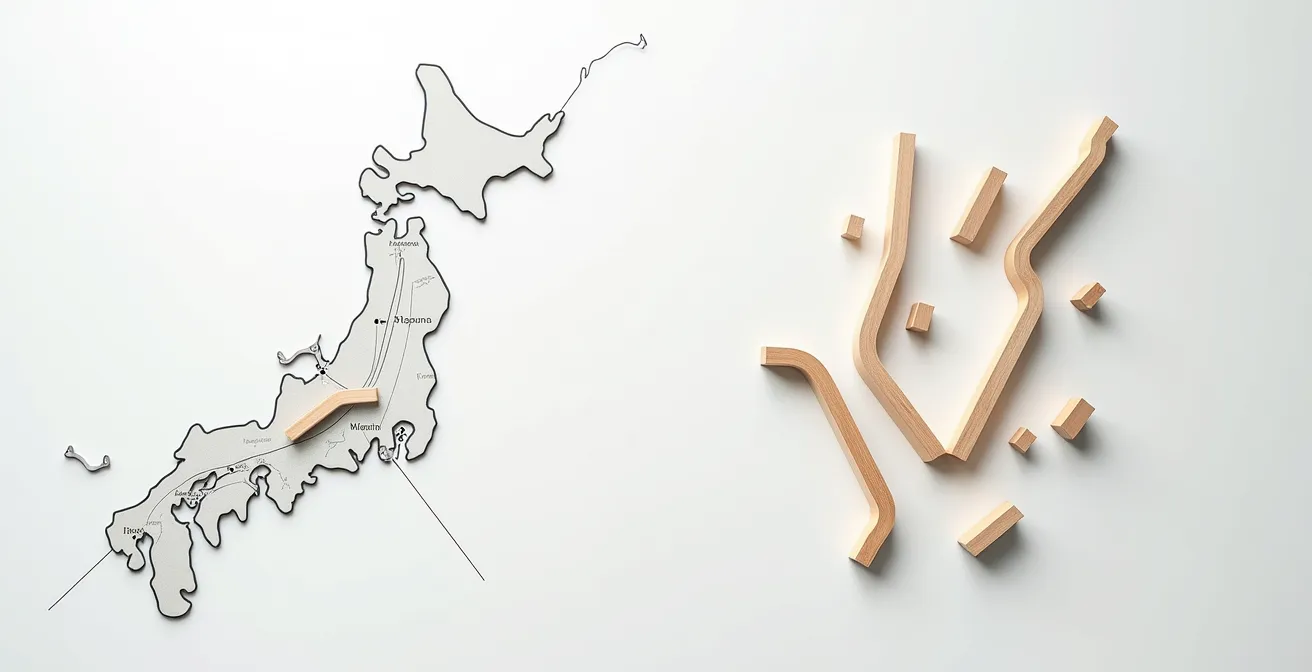
As the visual comparison shows, the point-to-point model creates a chaotic, time-consuming path, whereas the hub-and-spoke model is organized and efficient. As one traveler’s experience in Latin America demonstrated, even a month-long stay in one city couldn’t overcome the exhaustion from previous constant hotel changes, proving that moving too fast is a leading cause of severe travel burnout. For a 10-day Japan trip, this means choosing 2 or 3 base hotels at most, rather than 7 or 8.
Base City: How to Use Osaka as a Hub to See Kyoto and Nara?
The Kansai region, home to Kyoto, Osaka, and Nara, is a perfect candidate for the hub-and-spoke model. Indecisive planners often get stuck on whether to base themselves in historic Kyoto or vibrant Osaka. While Kyoto offers immediate access to iconic temples, an architect’s analysis often points to Osaka as the more strategic and cost-effective hub for exploring the wider region. Osaka’s superior transport links and more affordable accommodation make it a powerful logistical choice.
From major hubs in Osaka like Umeda or Namba, both Kyoto and Nara are accessible via direct train in under an hour. This allows you to spend a full day exploring Kyoto’s shrines or Nara’s deer park and return to Osaka for its unparalleled food scene and nightlife, which are far more extensive than Kyoto’s quieter evenings. The financial savings on accommodation in Osaka can be significant, often outweighing the daily cost of train tickets. This frees up budget for other experiences. The table below, inspired by insights from travel experts at the travel blog Girl Eat World, breaks down the strategic trade-offs.
| Criteria | Osaka as Base | Kyoto as Base |
|---|---|---|
| Average Hotel Cost | Lower (budget-friendly) | Higher (premium pricing) |
| Access to Nara | Direct trains (45 min) | Requires transfer (1 hour) |
| Access to Kansai Airport | Direct from Namba | Longer journey |
| Nightlife Options | Extensive (Dotonbori) | Limited (quieter evenings) |
| Food Scene | Street food paradise | Traditional kaiseki |
| Morning Temple Access | Requires early commute | Walk to temples at dawn |
The one key disadvantage of an Osaka base is missing the magic of Kyoto’s temples at dawn before the crowds arrive. A hybrid strategy can solve this: spend 7 nights in Osaka as your main hub, but book 2-3 nights in Kyoto to immerse yourself in its unique atmosphere. This balances logistical efficiency with cultural immersion.
Typhoon Season: How to Plan an Itinerary That Is Weather-Proof?
A rigid itinerary is a fragile one, especially in a country subject to dynamic weather events like typhoons, which are most common from August to October. Architecting a weather-proof or “resilient” itinerary isn’t about avoiding rain; it’s about having a robust structure that can adapt to disruptions without derailing your entire trip. The key is to build in flexibility and a portfolio of indoor alternatives for every location.
For each city on your itinerary, pre-identify three compelling indoor activities. This could include world-class museums (like the Tokyo National Museum), sprawling underground shopping arcades (like those in Osaka or Sapporo), unique themed cafes, or cultural experiences like a tea ceremony or cooking class. When a typhoon warning is issued or heavy rain begins, you don’t panic; you simply pivot to your “Plan B” list. This proactive approach turns a potential disaster into a different kind of adventure.

Furthermore, structuring your plan with a ‘do nothing’ day, as discussed earlier, provides a critical buffer. This flexible day can be swapped with a planned outdoor day that is rained out. Instead of losing a day of exploration, you simply shift your rest day. This ensures you don’t lose precious time. A rainy day in Japan can have its own unique beauty, transforming a modern city into a neon-lit, reflective wonderland or lending a moody, atmospheric quality to an ancient temple garden. A resilient itinerary allows you to appreciate this, rather than resent it.
Flights or Hotels: In What Order Should You Book Your Trip Elements?
The booking sequence is a critical architectural decision that can make or break a trip, especially during peak seasons like cherry blossom or autumn foliage. The common mistake is to book in a fixed order (e.g., always flights first). The strategic approach is to first identify your trip’s “logistical linchpin”—the single most critical, least-flexible, or scarcest element—and secure it before anything else.
What constitutes the linchpin varies by trip. If your visit is centered around a specific event like the Gion Matsuri in Kyoto or the Sapporo Snow Festival, the festival tickets and nearby accommodation are your linchpin. If you’re traveling during cherry blossom season, a reasonably priced hotel in Kyoto becomes the linchpin, as they sell out months in advance. As a case study from the 2024 season showed, travelers who booked their Kyoto hotels first were successful, while those who prioritized flights often found hotels were sold out, forcing costly and time-consuming commutes from Osaka.
This table outlines the booking priority based on different itinerary types, providing a clear framework for your own planning.
| Trip Type | Booking Priority Order | Rationale |
|---|---|---|
| Classic Golden Route | 1. Flights 2. Kyoto Hotels 3. JR Pass 4. Other Hotels |
Kyoto hotels book fastest during peak seasons |
| Festival-Focused | 1. Festival Tickets 2. Nearby Hotels 3. Flights 4. Transport |
Festival dates are fixed and non-negotiable |
| Remote Island Trip | 1. Island Ferry/Flight 2. Island Accommodation 3. International Flights |
Limited island access determines entire schedule |
| Flexible Explorer | 1. Refundable Hotels 2. Flight Deals 3. Adjust Hotels 4. Activities |
Hold ideal itinerary while hunting best prices |
By identifying your linchpin, you remove the biggest logistical hurdle first. All other bookings, which are typically more flexible or abundant (like flights or train passes), can then be arranged around this fixed, critical element.
East to West or West to East: Does It Matter Where You Start?
The classic “Golden Route” itinerary raises a common question for planners: is it better to start in Tokyo (East) and travel west to Kyoto, or start in Kyoto/Osaka (West) and travel east? Traditionally, this choice involved complex calculations to avoid a long, “wasted” travel day returning to your departure airport. However, a modern flight booking strategy, the open-jaw ticket, renders this debate largely obsolete. An open-jaw flight allows you to fly into one city (e.g., Tokyo’s Narita or Haneda) and out of another (e.g., Osaka’s Kansai International), creating a one-way land journey.
This approach is the ultimate architectural solution. It completely eliminates backtracking, saving significant time and money. An analysis of 2024 travel patterns revealed that open-jaw flights save an average of 4 hours of return travel time and are often priced similarly to standard round-trip tickets. This liberates your decision from logistics and allows you to base it on experience and personal preference.
With logistics solved, the choice becomes about the narrative of your trip. Do you want to dive headfirst into the high-energy, futuristic metropolis of Tokyo and end with the serene, traditional atmosphere of Kyoto? Or do you prefer to ease into Japan’s cultural heart first and finish with a bang in Tokyo for last-minute shopping and an easy departure? As the Bon Traveler Editorial Team notes:
Starting in Tokyo allows for an immediate high-energy start, while ending there allows for last-minute souvenir shopping and easy airport access. Ending in Kansai offers a more relaxed, traditional end to the trip.
– Bon Traveler Editorial Team, The Ultimate 10 Days in Japan Itinerary For First Timers
By leveraging an open-jaw ticket, you transform a logistical problem into a creative choice about the story you want your journey to tell.
Nozomi, Hikari, or Kodama: Which Train Saves You Time vs Money?
The Shinkansen, or bullet train, is the backbone of any multi-city Japan itinerary. However, not all bullet trains are created equal. Understanding the difference between the main train types on the popular Tokaido Shinkansen line (connecting Tokyo, Kyoto, and Osaka) is a crucial micro-architectural decision that balances time, cost, and convenience. The three key services are the Nozomi, Hikari, and Kodama.
The Nozomi is the fastest, making the fewest stops. The Hikari is the second-fastest, stopping at a few more major stations. The Kodama is the slowest, all-stations service. The most critical distinction for many travelers is that the Japan Rail (JR) Pass, a popular cost-saving ticket for foreign tourists, is valid on the Hikari and Kodama trains but not on the Nozomi. This creates a direct trade-off: is the time saved on the Nozomi worth the cost of a separate ticket?
This comparative table, drawing on data from sources like travel guides like Japan Specialist, clarifies the choice for the key Tokyo-Kyoto route.
| Train Type | Tokyo-Kyoto Time | JR Pass Valid | Best For |
|---|---|---|---|
| Nozomi | 2h 15min | No | Time-crunched trips, business travelers |
| Hikari | 2h 45min | Yes | Balance of speed and JR Pass compatibility |
| Kodama | 3h 40min | Yes | Short hops between smaller stations, guaranteed seats |
For most 10-day itineraries using a JR Pass, the Hikari offers the best balance. The 30-minute time difference compared to the Nozomi is a small price to pay for the significant cost savings of the pass. The Kodama is generally too slow for long-distance travel but can be a quiet, uncrowded option for short trips between smaller towns. A final tip for any Shinkansen journey from Tokyo to Kyoto: book Seat E for a chance at the iconic view of Mount Fuji on a clear day.
Key Takeaways
- Itinerary success is measured by energy and enjoyment, not a checklist. Prioritize flow and rest.
- Adopt a “hub-and-spoke” model with 2-3 base hotels instead of changing locations daily to reduce travel friction.
- Identify your trip’s “logistical linchpin” (e.g., peak season hotel) and book it first to simplify all other planning.
Google Maps or Navitime: Which App Saves You From Getting Lost?
In the intricate web of Japan’s public transportation, a reliable navigation app is not a luxury; it’s an essential tool. While most international travelers default to Google Maps, seasoned Japan travelers and residents often rely on local champions like Navitime for Japan Travel or Jorudan. The optimal strategy is not to choose one over the other, but to use a “stack” of apps, leveraging each for its specific strengths.
Google Maps is unparalleled for walking directions, discovering nearby points of interest, and its user-friendly interface. It’s your go-to for navigating from the train station to your hotel or finding a nearby cafe. However, its weakness lies in the complexity of Japan’s train system. It often lacks crucial details like platform numbers, specific train lines (e.g., local vs. express), and, most importantly, compatibility with the Japan Rail Pass.
This is where Navitime shines. It is an itinerary architect’s dream, designed specifically for the intricacies of Japanese transit. Its key features include:
- JR Pass Filtering: You can filter routes to show only those covered by your JR Pass, a massive money-saving feature.
- Platform Numbers: It tells you which platform to go to, saving precious minutes and stress in massive stations like Shinjuku or Tokyo Station.
- Precise Timetables: It provides hyper-accurate schedules, including first and last train times.
A smart navigation strategy uses both: Navitime to plan the train journey from Station A to B, and Google Maps to handle the walking portion at either end. For food, apps like Tabelog or Gurunavi offer more reliable local ratings than Google’s. Always pre-download offline maps for key areas as a backup against signal loss.
Now that you are equipped with the architectural principles for a resilient and rewarding journey, the final step is to begin sketching your own unique plan. Start by identifying your linchpin element and build your trip’s structure around that solid foundation.