
The Japan Rail Pass is no longer a default purchase but a niche financial tool for high-velocity itineraries.
- A 7-day pass (¥50,000) requires at least 3-4 long-distance city trips to break even.
- Regional passes often provide superior value for itineraries focused on one area (e.g., Kansai).
Recommendation: Calculate your exact Shinkansen fares first; only buy the national pass if your pre-calculated costs exceed the pass price.
For years, the Japan Rail Pass was an automatic purchase for most tourists, a golden ticket to unlimited, hassle-free travel across the country. That paradigm shifted dramatically with the dramatic price hike in October 2023 that saw costs increase by nearly 70%. The central question for any budget-conscious traveler is no longer “Should I get a JR Pass?” but rather, “Under what specific circumstances does the JR Pass present a positive return on investment?”
Many analyses offer a simple “yes” or “no,” but this approach misses the mark. The new JR Pass should not be viewed as a simple ticket, but as a specialized financial instrument. Its value is unlocked only under conditions of high-velocity travel—frequent, long-distance journeys undertaken in a condensed timeframe. Viewing the pass through this lens requires a shift from emotional decision-making to objective, mathematical calculation.
This analysis will dissect the pass’s value proposition from a financial perspective. We will calculate the precise break-even points, weigh the pass against more cost-effective alternatives like single tickets and regional passes, and evaluate the tangible cost of associated risks like losing the physical pass. The goal is to equip you with the data needed to perform your own cost-benefit analysis and determine if this significant investment aligns with your specific travel strategy.
This guide provides a structured financial breakdown to help you make an informed, data-driven decision. We will explore the mathematical justification for the pass, compare it to key alternatives, and analyze the strategic factors that maximize its value.
Summary: A Financial Breakdown of the Modern JR Pass
- How Many Cities Must You Visit to Justify the New 7-Day Pass Price?
- JR East or Kansai Wide: Which Regional Pass Save You More Money?
- Online vs. Agency: Where to Buy Your Exchange Order Before Departure?
- The Lost Pass Nightmare: Why You Can’t Replace a Stolen JR Pass?
- When to Activate Your Pass to Maximize the Validity Period?
- JR Pass vs Single Tickets: Which Is Cheaper for a One-Way Golden Route?
- Standard or Green: Is the Legroom Worth the Upgrade Price?
- Suica or Pasmo: Which IC Card Works Best for Tokyo Travel?
How Many Cities Must You Visit to Justify the New 7-Day Pass Price?
The core of the JR Pass decision is a simple mathematical equation: will the total cost of your individual Shinkansen tickets exceed the price of the pass? With the 7-day pass now priced at ¥50,000, the bar for achieving this break-even point is significantly higher. It is no longer a tool for casual exploration but one reserved for itineraries with high movement frequency and long distances.
General rules of thumb are insufficient; a concrete calculation is necessary. The value is not derived from the number of days you use it, but from the cumulative cost of the long-haul train journeys you take within its validity period. A single Tokyo to Kyoto round trip (approx. ¥28,000) does not come close to justifying the cost. The pass only begins to offer financial value when you add at least one or two more major inter-city legs to your journey.
To determine profitability, you must map out your intended long-distance travel. The following table provides a clear quantitative baseline for the level of travel intensity required to make the pass financially viable.
| Pass Duration | Current Price (¥) | Break-Even Distance | Minimum Cities Needed |
|---|---|---|---|
| 7-day | 50,000 | Tokyo→Kyoto→Osaka→Hiroshima | 3-4 major cities |
| 14-day | 80,000 | 5+ cities across regions | 5-6 major cities |
| 21-day | 100,000 | Extensive multi-region travel | 7+ major cities |
As the data shows, a 7-day pass generally requires a minimum of three to four major city destinations to approach its break-even point. This assumes a high-velocity itinerary, such as traveling from Tokyo to Kyoto, then to Hiroshima, and returning towards Osaka within a single week. Anything less intensive than this almost guarantees that purchasing single tickets will be the more economical choice.
JR East or Kansai Wide: Which Regional Pass Save You More Money?
For travelers whose itineraries are concentrated within a single geographic area, regional rail passes have emerged as the clear financial winners in the post-price-hike landscape. These passes offer unlimited travel within a specified zone—like Tohoku, Kansai, or Hokkaido—for a fraction of the cost of the national pass. This makes them the default optimal choice for itineraries that do not involve cross-country travel.
The value proposition is stark. If your trip is focused on exploring the cultural triangle of Kyoto, Osaka, and Nara, a national pass would be an unjustifiable expense. A dedicated regional pass, however, provides significant savings while covering the necessary routes.
Case Study: Regional Pass vs National Pass Comparison
Analysis shows that for travelers staying within specific regions like Kansai or Tohoku, regional passes offer significantly better value. A 5-day Kansai Area Pass costs just ¥10,000 compared to the ¥50,000 national 7-day pass, making it ideal for Osaka-Kyoto-Nara itineraries. This represents a saving of ¥40,000 for travelers who correctly identify their geographical focus.
For more complex, multi-region itineraries that fall short of justifying a national pass, an advanced strategy known as “pass stacking” can be employed. This involves purchasing two or more consecutive regional passes to create a custom, cost-effective route across the country.

This strategy requires careful planning of activation dates and an understanding of each pass’s coverage area but can yield substantial savings over the national pass for trips longer than a week. The key is to map your itinerary by region first, rather than by a national overview.
Online vs. Agency: Where to Buy Your Exchange Order Before Departure?
The decision of where to purchase your JR Pass Exchange Order involves weighing factors of cost, convenience, and flexibility. The current economic climate further complicates this choice. As noted by travel analysts, the strong position of currencies like the US dollar against the yen adds pressure to optimize every aspect of travel spending.
With the dollar-yen exchange rate also at an all time high ($1 = ¥156, May 2024), there’s a lot of hype around visiting Japan while it’s ‘cheap’
– Where and Wander Travel Research, JR Pass Worth Analysis 2024
In this context, choosing the right purchase channel is a key financial decision. There are three primary avenues: the official JR website, authorized online travel agencies (like Klook), and other third-party vendors. Each comes with a distinct set of trade-offs.
The official website offers the convenience of digital delivery and online seat reservations, a new perk of the pass. However, it often has the strictest cancellation policies. Third-party agencies, conversely, may offer more flexible cancellation terms and occasional discounts, but typically require physical delivery of an exchange voucher and only allow for in-person seat reservations once in Japan. The following table breaks down these critical differences.
| Purchase Method | Price | Delivery Time | Cancellation Policy | Seat Reservation |
|---|---|---|---|---|
| Official JR Website | Base price | Digital (instant) | Strict dates | Online booking available |
| Klook | Same or less | 2-7 days shipping | Flexible | In-person only |
| JRailPass.com | Base price | 2 days worldwide | Up to activation | In-person only |
Your choice should align with your priorities. If the ability to book seats online before arrival is paramount, the official site is the only option. If you value flexible cancellation policies and are willing to wait for a physical voucher, an authorized agency might be more suitable. Always compare the final price, including any shipping or service fees, before making a purchase.
The Lost Pass Nightmare: Why You Can’t Replace a Stolen JR Pass?
One of the most significant and often overlooked financial risks associated with the physical Japan Rail Pass is its irreplaceability. Unlike a credit card or digital ticket, a lost or stolen JR Pass is a total financial loss. The Japan Railways Group policy is explicit: no replacements or refunds are issued under any circumstances. If you lose your ¥50,000 7-day pass on day two, you have effectively lost the remaining value with no recourse.
This unforgiving policy transforms the pass from a simple ticket into a high-value asset that must be protected with the same diligence as cash or a passport. The risk is not hypothetical; in the chaos of travel, misplacing a small paper ticket is a genuine possibility. This elevates the importance of both preventative measures and having a backup plan. Fortunately, modern digital alternatives offer a way to mitigate this specific risk.
After nearly losing my JR Pass in Kyoto, I switched to using the SmartEX app for my remaining Shinkansen trips. The digital tickets tied to my account meant I could never ‘lose’ them, and I could modify reservations instantly on my phone. The peace of mind was worth more than any potential savings.
– Traveler’s Experience, The Never-Ending Voyage
The existence of such digital platforms means that travelers are no longer solely dependent on the physical pass. For those concerned about the risk of loss, purchasing single tickets via an app like SmartEX provides a secure, albeit potentially more expensive, alternative. Protecting your investment is paramount, and a clear protocol is essential.
Action Plan: Preventing and Recovering from a Lost Pass
- Before travel: Photograph your pass and exchange order as a digital backup for your records.
- Daily practice: Store the pass separately from your passport, ideally in a secure money belt or hotel safe.
- If lost/stolen: Report the loss immediately to the nearest Koban (police box) to obtain a police report.
- Insurance contact: Contact your travel insurance provider within 24 hours to begin the claim process, if your policy covers such losses.
- Emergency option: Immediately switch to purchasing individual Shinkansen tickets for the remainder of your trip via the SmartEX app or at station kiosks.
When to Activate Your Pass to Maximize the Validity Period?
The Japan Rail Pass operates on consecutive calendar days, not 24-hour periods. This means that activating a 7-day pass at 8 PM on a Monday uses up a full day, with the pass expiring at midnight on the following Sunday. This rigid structure makes the timing of your activation a critical financial decision. A poorly timed activation can easily waste a full day of value, which, based on the new price, is a significant loss.
From a purely financial standpoint, with each day of the 7-day pass effectively costing ¥7,143, wasting a day is equivalent to throwing away a substantial amount of money. The optimal strategy is to align the pass’s activation with the start of your long-distance, high-cost travel, not with your arrival in Japan. For travelers spending their first few days exploring a single city like Tokyo, it is almost always more cost-effective to use a local transport card (like a Suica or Pasmo) and delay the JR Pass activation.
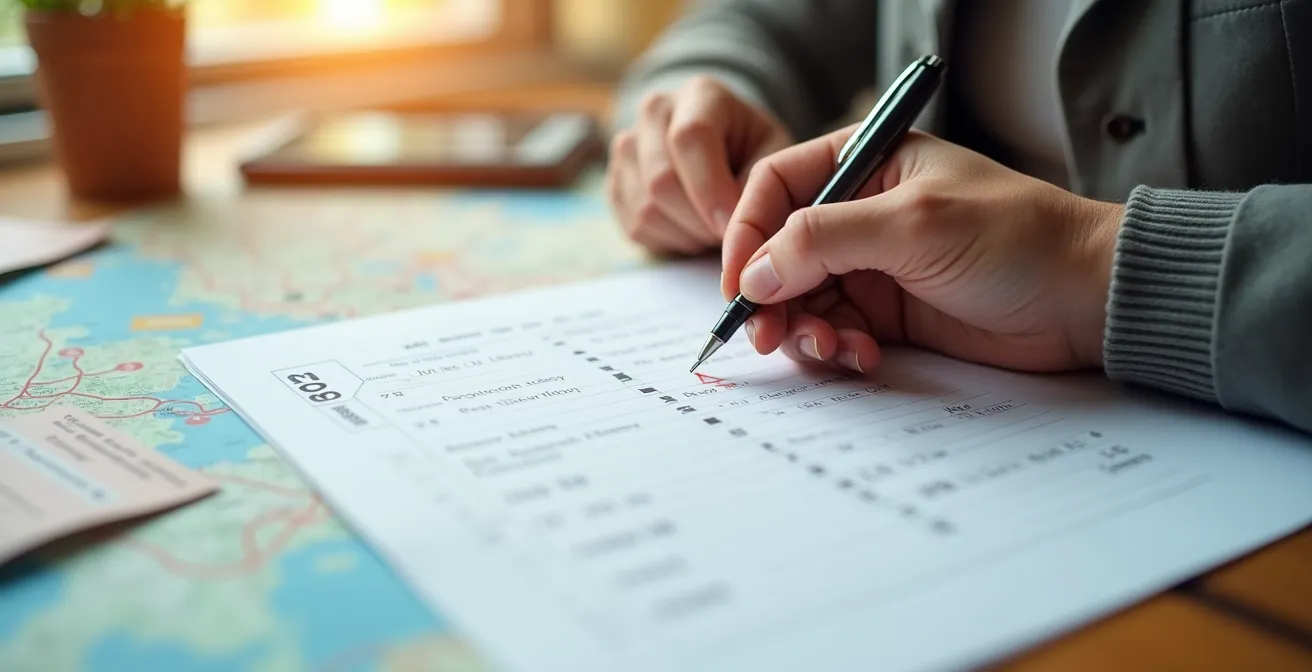
This “Day Zero” activation strategy involves exchanging your voucher upon arrival but specifying a future start date for the pass. This allows you to perfectly synchronize the 7, 14, or 21-day validity window with the most expensive legs of your journey, ensuring every yen of the pass’s cost is put to work.
Case Study: Day Zero Activation Strategy Success
A traveler arriving at Narita exchanged their voucher immediately but set the activation for 4 days later. They used a Tokyo Metro pass for city exploration, then activated the JR Pass for their Tokyo-Kyoto-Hiroshima-Osaka circuit. This strategy maximized expensive long-distance travel within the 7-day window and saved an estimated ¥15,000 compared to activating the pass on their day of arrival.
JR Pass vs Single Tickets: Which Is Cheaper for a One-Way Golden Route?
The “Golden Route”—a one-way or simple round-trip journey between Tokyo and the Kansai region (Kyoto/Osaka)—is one of the most common itineraries for first-time visitors to Japan. In the era of the new pricing, the math is unequivocal: the national JR Pass is not a cost-effective option for this type of trip. Purchasing single Shinkansen tickets is almost always the cheaper and more logical choice.
The fundamental issue is the high break-even threshold of the pass. As a financial analysis from SourceTable confirms, the pass is built for volume, requiring at least three long-distance Shinkansen trips to reach the break-even point of ¥50,000. A simple Tokyo-to-Kyoto trip represents only one such journey, falling far short of this mark. Even a round trip does not typically meet the required cost threshold.
When analyzing the options for a single journey, such as from Tokyo to Osaka, the cost disparity becomes even clearer. The speed and comfort of the Shinkansen come at a premium, but that premium is still significantly lower than the cost of an underutilized national pass. Other modes of transport, like overnight buses or low-cost carriers (LCCs), offer even greater savings for the most budget-conscious travelers, albeit with a trade-off in comfort and time.
| Travel Method | Cost (¥) | Travel Time | Pros | Cons |
|---|---|---|---|---|
| Shinkansen (single) | 13,870 | 2.5 hours | Fastest, comfortable | Expensive for one-way |
| JR Pass (7-day) | 50,000 | 2.5 hours | Unlimited travel | Not worth for single route |
| Overnight Bus | 5,000-8,000 | 8 hours | Saves hotel night | Less comfortable |
| LCC Flight | 6,000-12,000 | 1 hour + transfers | Quick flight time | Airport transfers add time/cost |
The data clearly indicates that for a simple point-A-to-point-B journey, even on the flagship Shinkansen route, the 7-day pass is over three times more expensive than a single ticket. The pass is a tool designed for a multi-city, high-velocity circuit, not for a linear path.
Standard or Green: Is the Legroom Worth the Upgrade Price?
The Green Car, Japan Rail’s first-class equivalent, offers wider seats, more legroom, and a quieter atmosphere. The decision to upgrade from a Standard Pass to a Green Pass is another financial calculation, but one where the return on investment is measured in comfort and risk mitigation rather than direct cost savings. Historically a significant luxury, the dynamic has shifted slightly with the new pricing structure.
The relative price gap between standard and Green Pass has narrowed post-hike, making it a more logical upgrade for those seeking guaranteed comfort during peak seasons
– Travel Caffeine Analysis Team, JR Pass 2025 Review
This narrowing gap means the premium for the Green Pass is proportionally smaller than it once was. However, its true value becomes most apparent during Japan’s peak travel seasons—such as Golden Week, Obon, and the New Year holidays. During these times, securing reserved seats in Standard cars can be extremely difficult, and unreserved cars often exceed 100% capacity. The Green Car, in this context, becomes a tool for mitigating the risk of travel disruption.
The upgrade is not merely about legroom; it’s about guaranteeing a seat, ensuring a less crowded environment, and reducing the stress of competing for limited space. For families with children, elderly travelers, or anyone to whom a calm journey is a high priority, the premium can be a very justifiable expense.
Case Study: Green Pass Value During Golden Week
During Golden Week 2024, a family of four found the Green Pass invaluable. While standard cars were packed with 120% occupancy, Green Cars maintained 60-70% occupancy. The ability to secure seats without hours of queuing and the quieter atmosphere with young children justified the 40% premium, especially when standard reserved seats were sold out weeks in advance. The value was in the certainty and quality of the travel experience, not just the physical space.
Therefore, the decision to upgrade should be based on your travel dates and personal tolerance for crowding. During off-peak seasons, the Standard Pass is perfectly adequate. During peak seasons, the Green Pass can be considered a strategic investment in a smooth and predictable travel experience.
Key takeaways
- The JR Pass break-even point is now significantly higher, requiring intensive, multi-city travel to be profitable.
- Regional passes are the new default, offering superior value for most single-region itineraries.
- Strategic activation is crucial; aligning the pass with long-distance travel days maximizes its cost-per-day value.
Suica or Pasmo: Which IC Card Works Best for Tokyo Travel?
While the JR Pass debate centers on long-distance travel, day-to-day transport within cities like Tokyo relies on a different system: rechargeable IC cards. The two most prominent cards in Tokyo are the Suica (issued by JR East) and the Pasmo (issued by non-JR lines). For the traveler, the distinction between them is almost entirely academic. Due to a nationwide interoperability agreement, they function identically and can be used interchangeably on virtually all trains, subways, and buses in Tokyo and across Japan’s major cities.
The choice of which card to get often comes down to which one is being sold at the first ticket machine you encounter. Both cards require a ¥500 refundable deposit and can be loaded with cash at any station. They are not discount cards but provide immense convenience, allowing you to tap-and-go without needing to calculate fares or buy individual paper tickets for each local journey. For budget planning, it’s useful to know that typical daily spending on local transport using IC cards ranges from ¥1,500-2,000 in a major city like Tokyo.
For tourists, special versions like the “Welcome Suica” or “Pasmo Passport” are available, which do not require a deposit but expire after 28 days. An even more convenient option for those with modern smartphones is to add a digital Suica or Pasmo card directly to Apple Pay or Google Pay, eliminating the need for a physical card entirely. This allows for instant recharges via your phone, a significant advantage.
Here is a simple guide to getting and using an IC card:
- At the airport: Purchase a “Welcome Suica” (for tourists) at a JR East Travel Service Center or a standard Pasmo from a subway ticket machine.
- Digital Option: For maximum convenience, add a Suica or Pasmo card directly to your iPhone Wallet or Google Pay.
- Initial charge: Load your card with an initial ¥3,000-5,000, which should cover the first few days of local travel.
- Recharge locations: Top up your card at any train station ticket machine or at most convenience stores (konbini).
- Multi-use: Use the card not just for transport, but also at vending machines, coin lockers, convenience stores, and many restaurants displaying the IC card logo.
Your next step is clear: map your complete Japan itinerary, calculate the individual ticket costs using an online fare calculator, and only then make a final, data-backed decision on whether the Japan Rail Pass is a sound investment for your specific journey.