Most travelers dismiss a four-hour tea ceremony as too long, but the real value isn’t the time it takes—it’s how the ritual transforms your perception of it.
- A long ceremony is not just about drinking tea; it’s an immersive narrative where every object and gesture has a purpose, from the imperfect bowl to the sequence of tasting.
- Shorter, 45-minute experiences are authentic introductions, but the full, formal ceremony offers a rare chance to step outside of time and into a state of pure presence.
Recommendation: If you seek a profound cultural and mindful experience rather than just another photo op, a long ceremony is one of the most rewarding investments of your travel time in Japan.
The modern traveler’s itinerary in Japan is often a frantic puzzle of train schedules, temple-hopping, and neon-lit nights. In this context, the idea of dedicating a full four hours to a single activity—the formal tea ceremony, or chaji—can seem like an extravagance. Many guides suggest the shorter, 45-minute versions are more than enough. They are right, in a way. You will taste matcha, see the tools, and get a feel for the process. But this perspective misses the fundamental point of the ceremony itself.
The question isn’t whether four hours is too long. The real question is whether you are willing to experience a different kind of time altogether. While a short ceremony is a demonstration, a long ceremony is an immersion. It’s a structured journey designed to quiet the mind and heighten the senses. Recent studies show that 38% of international travelers express interest in the tea ceremony, yet few understand that its purpose extends far beyond a simple beverage tasting.
This guide moves past the typical advice. It explores the ‘why’ behind the ‘how’—the deep, narrative purpose woven into every gesture, object, and moment of silence. We will unpack the choreography of the ritual, the philosophy of imperfection that defines its beauty, and the architectural secrets that prepare you for the experience. By the end, you won’t see it as four hours lost from your schedule, but as a gateway to a deeper understanding of Japanese culture and, perhaps, of yourself.
To help you decide if this profound experience is right for you, this article breaks down the essential elements of the ceremony, from its core principles to the practical details of participation. Follow along as we explore what truly happens when you step into the quiet world of the teahouse.
Summary: A Traveler’s Guide to the Formal Tea Ceremony
- Why Is the Tea Ceremony About More Than Just Drinking Tea?
- How to Receive the Bowl Without Offending the Host?
- Kimono or Casual: What to Wear to Avoid Leg Numbness on Tatami?
- Tourist Trap vs. Authentic Teahouse: How to Spot the Difference?
- When to Eat the Wagashi Sweet During the Ritual Sequence?
- Wabi-Sabi: How Imperfection Redefines Beauty for Visitors
- Machiya Design: Why Are the Entrances So Narrow and Long?
- How to Experience Zen Silence in Kyoto’s Crowded Temples
Why Is the Tea Ceremony About More Than Just Drinking Tea?
At its heart, the Japanese tea ceremony, or chado (“The Way of Tea”), is a spiritual practice disguised as a social gathering. It is an art form where the simple act of preparing and serving a bowl of tea becomes a vehicle for achieving a deeper state of being. As one cultural study aptly puts it, “The purpose of the Japanese tea ceremony is to create bonding between the host and guest and also gain inner peace.” This is not about quenching thirst; it is about cultivating a connection—with the host, with the other guests, with the season, and with the present moment.
This philosophy is built upon four key principles that transform the experience from a mere tasting into a form of moving meditation. These principles are:
- Harmony (wa): This represents the creation of unity and flow between the host, guests, the tea utensils, and the natural surroundings. It’s the feeling of cohesion where everything belongs.
- Respect (kei): This is the genuine consideration shown to all things and people. You show respect not only to the host but also to the tea bowl in your hands and the other guests sharing the space.
- Purity (sei): This refers to both physical and spiritual cleanliness. The ritual of washing hands at a stone basin before entering the teahouse is a physical act that symbolizes the cleansing of the mind from the worries of the outside world.
- Tranquility (jaku): This is the ultimate goal—a state of serene calm and inner peace that arises when the other three principles are in harmony. It is in this tranquility that the qualitative experience of time truly reveals itself.
In a four-hour ceremony, these principles are not just discussed; they are experienced. The extended duration allows the mind to slow down, letting go of the rush of tourism and settling into the deliberate, unhurried pace set by the host. It’s in this space that a simple bowl of tea becomes a profound encounter.
How to Receive the Bowl Without Offending the Host?
The etiquette of the tea ceremony can seem daunting, but it is not a rigid test of your knowledge. Rather, it is a shared choreography designed to enhance focus and show mutual respect. The most significant of these gestures is the way you receive, hold, and drink from the tea bowl (chawan). Each movement is imbued with meaning and contributes to the harmony of the moment. This is not about memorizing rules, but about participating in a silent dialogue of appreciation.
When the host presents the bowl, it is an offering. Your response should reflect your gratitude. The traditional protocol is a beautiful, deliberate sequence:
- The host will place the bowl on the tatami mat in front of you. The “front” of the bowl, often its most decorative side, will be facing you.
- Pick it up with your right hand and place it gently into the palm of your left hand, supporting it from underneath.
- As a sign of humility and respect, you then use your right hand to turn the bowl clockwise approximately 90 degrees. This ensures you do not drink from its decorative front, reserving that view for the host and other guests.
- Lift the bowl to drink, taking a few quiet sips until it is finished. The final sip may be slightly louder to indicate you are done.
- After drinking, wipe the rim where your lips touched with your right fingers, and then turn the bowl counter-clockwise back to its original position before placing it back on the mat.
This “choreography of presence” transforms a simple action into a mindful practice. Holding the bowl with both hands conveys that you treasure it. Turning it shows you are considerate. These are not empty gestures; they are the physical language of respect and presence. A comprehensive guide to tea ceremony etiquette confirms that this process is central to the guest’s role.
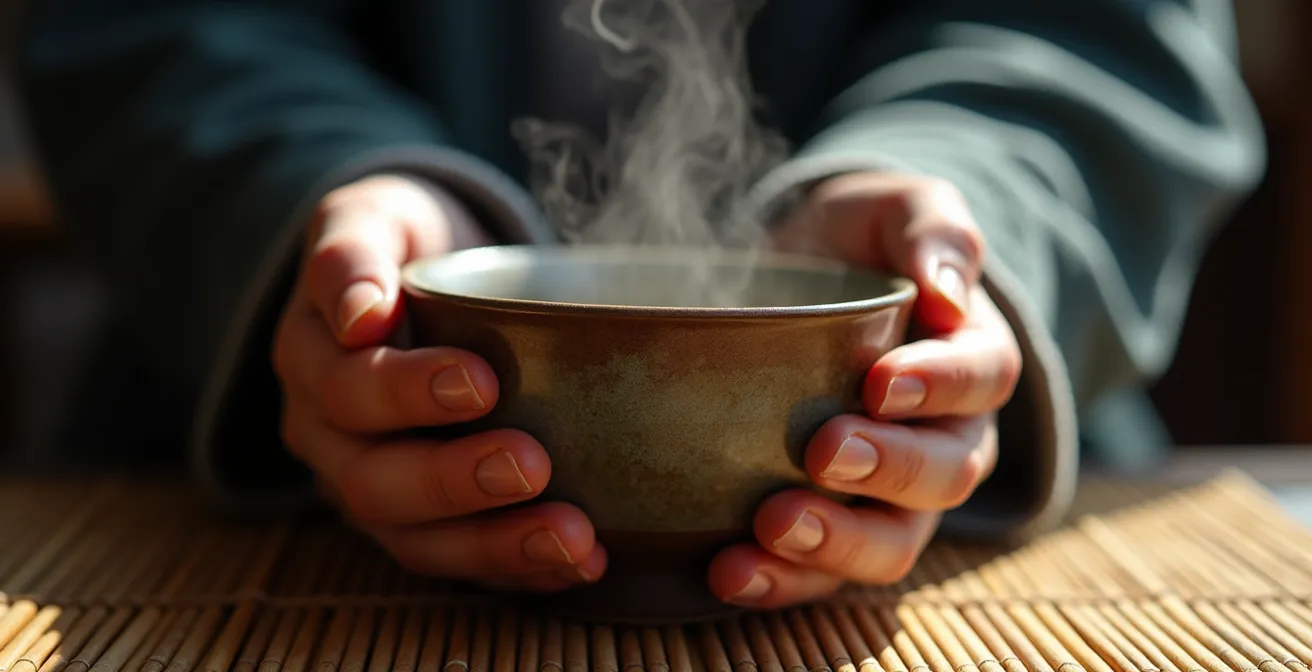
As you can see, the focus is on a gentle and stable grip, cradling the bowl as something precious. This simple, focused action helps ground you in the moment, making the taste of the tea itself a more vivid experience.
Kimono or Casual: What to Wear to Avoid Leg Numbness on Tatami?
The question of what to wear to a tea ceremony is rooted in practicality and respect, not strict fashion rules. While you might see images of participants in elegant kimonos, this is not a requirement for guests, especially foreign visitors. The primary goal is to be comfortable and modest. You should opt for loose-fitting clothing that allows you to sit comfortably on the floor. Tight jeans, short skirts, or revealing tops are best avoided, as they are impractical for kneeling and can detract from the serene atmosphere.
A more pressing concern for many travelers is the traditional sitting position, seiza, which involves kneeling with your legs folded underneath you. For those unaccustomed to it, this can lead to numbness and discomfort, especially during a longer ceremony. While some purists maintain this posture for hours, many teahouses that welcome travelers are very accommodating. They may provide small stools for guests or allow you to shift to a more comfortable cross-legged position. It is far better to discreetly adjust your posture than to be distracted by physical pain. The host’s desire is for you to be present, not to endure an ordeal.
One non-negotiable aspect of attire is footwear. You will be required to remove your shoes before entering the tearoom. For this reason, it is essential to wear or bring a pair of clean, white socks. This is a matter of hygiene and respect for the pristine tatami mats. By preparing for these simple practicalities, you free yourself to focus on the ceremony itself, rather than on your own discomfort.
Checklist for Ceremony Attire and Comfort
- Choose modest, loose-fitting clothes that allow for flexibility while sitting on the floor.
- Bring a pair of clean, white socks to change into upon arrival.
- Remove watches, large rings, or bracelets that could accidentally scratch the delicate tea utensils.
- Avoid wearing strong perfumes or colognes, as they interfere with the subtle aroma of the tea and incense.
- If you are concerned about kneeling, quietly inquire if small stools or alternative seating positions are available.
Tourist Trap vs. Authentic Teahouse: How to Spot the Difference?
Many travelers fear that the more accessible tea ceremonies are inauthentic “tourist traps.” This concern often stems from a misunderstanding of the different types of ceremonies available. Authenticity is not a simple binary; it’s a spectrum. The two primary forms are chakai (an informal gathering) and chaji (a full, formal ceremony). A chakai is a shorter, more educational demonstration, often lasting around 45 minutes and including sweets and tea. A chaji is the four-hour immersive experience that includes a multi-course kaiseki meal.
A chakai is not a “trap”; it is an authentic introduction to the Way of Tea, designed to be accessible. It is a genuine cultural offering. The idea that only the longest, most formal event is “real” is a misconception. However, if you are seeking the deep, transformative experience discussed in this guide, you should look for a chaji. The key is to align the experience with your expectations. Do you want a beautiful introduction or a profound immersion?
The following table, based on information from tea ceremony experts, breaks down the key differences to help you choose wisely. For instance, providers like Kimono Tea Ceremony Maikoya, which has earned over 3,000 five-star reviews, specialize in making these experiences accessible and understandable for visitors, proving that popularity does not negate authenticity.
| Aspect | Chakai (Informal) | Chaji (Formal) |
|---|---|---|
| Duration | 45 minutes | Up to 4 hours |
| Meal Included | Light sweets only | Full kaiseki course meal |
| Training Required | Basic introduction | Years of practice |
| Tourist Accessibility | Widely available | Limited, requires advance booking |
| Authenticity Level | Educational demonstration | Traditional full experience |
To find an authentic experience, look for teahouses that are transparent about what they offer. A reputable venue will clearly state the duration, what is included (meal or just sweets), and the style of the ceremony. Look for small group sizes, traditional settings (like a proper teahouse or temple), and hosts who are passionate about sharing the philosophy, not just rushing through the steps.
When to Eat the Wagashi Sweet During the Ritual Sequence?
In the tea ceremony, nothing is accidental. Every element is part of a carefully constructed sensory journey. This is perfectly illustrated by the timing of the wagashi, the small, artistic Japanese sweet served during the ritual. For many first-time participants, the instinct is to save the sweet to enjoy with the tea, as one might do with a biscuit and coffee. However, in the tea ceremony, the rule is clear: the sweet is meant to be entirely consumed before the tea is served.
This “sensory sequencing” serves both a practical and a philosophical purpose. Practically, the delicate, often subtle sweetness of the wagashi coats the palate, preparing it for the complex, bitter notes of the high-quality matcha. The sweetness balances the astringency of the tea, creating a more harmonious and pleasant taste experience. Eating them together would muddle both flavors, diminishing the appreciation of each.
Philosophically, this sequence is another tool for cultivating presence. You are guided to focus on one sense at a time. First, you appreciate the wagashi, which is a work of art in itself, often reflecting the current season in its shape and color. You take a moment to admire it visually. Then, you focus on its taste and texture as you eat it. Only once that experience is complete does your focus shift to the aroma, warmth, and flavor of the tea. This separation of experiences prevents the mind from multitasking and deepens your engagement with each element of the ceremony. It’s a lesson in doing one thing at a time, with complete attention.
Wabi-Sabi: How Imperfection Redefines Beauty for Visitors
To fully grasp the soul of the tea ceremony, one must understand the aesthetic philosophy of wabi-sabi. This worldview is centered on the acceptance of transience and imperfection. It is the beauty of things that are modest, humble, and unconventional. In the teahouse, you will not find glittering gold or flawless symmetry. Instead, you will find beauty in a rustic, slightly misshapen tea bowl, in the patina of an aged bamboo scoop, or in a crack repaired with golden lacquer (kintsugi).
This is the “narrative of objects” in action. A perfectly smooth, mass-produced bowl tells no story. But a bowl with an uneven glaze, a slight warp in its form, and the mark of the artist’s hand speaks of its creation and its history. It is unique and irreplaceable. The Portland Japanese Garden’s tea master beautifully captures this spirit by quoting the 15th-century master Shuko: “The moon is not pleasing unless partly obscured by a cloud.” Wabi-sabi finds beauty not in sterile perfection, but in the character that comes from natural processes, age, and even damage.
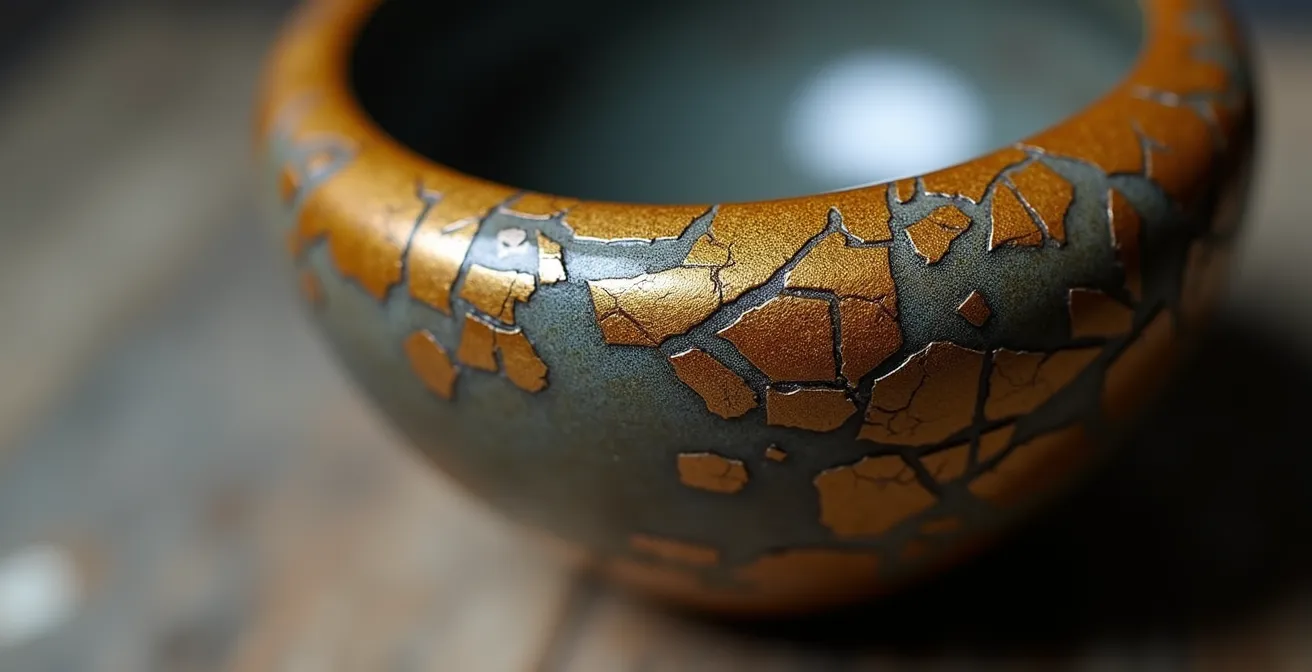
This embrace of imperfection is profoundly liberating for the guest. It creates an atmosphere free of judgment. As tea master Azumi Uchitani explains, “The beauty of Wabi Sabi is born from our inner world… In a space of acceptance, where there is no judgment.” You are not expected to be perfect. Your potential clumsiness as a first-timer is accepted. The ceremony is not a performance; it is a shared moment of authentic being. In a world obsessed with flawless images and curated perfection, the teahouse offers a sanctuary where the authentic, the flawed, and the human are celebrated as beautiful.
Machiya Design: Why Are the Entrances So Narrow and Long?
The experience of a tea ceremony begins long before you taste the tea. It starts the moment you approach the teahouse. The architecture and garden path are not merely decorative; they are the first tools used to guide you from the mundane world into the spiritual space of the ceremony. This is the concept of the “threshold of perception,” a deliberate physical transition designed to trigger a mental one.
The path leading to the teahouse, known as the roji or “dewy ground,” is intentionally kept simple and tranquil. It is often a winding path of uneven stones, forcing you to slow down and watch your step. This simple act of focused walking helps to quiet the mind. Along the path, you will find a stone basin (tsukubai) where you pause to wash your hands and rinse your mouth, a ritual of purification that cleanses both body and spirit before entering.
The entrance to the tearoom itself, the nijiriguchi, is often strikingly small and low—so low that one must bow or crawl to enter. This is not a design flaw. As noted by experts at Japan Guide, who offer details on traditional architecture, this feature is symbolic. By forcing everyone, regardless of their social status—from the humblest commoner to the most powerful samurai—to bow deeply upon entering, the door acts as a great equalizer. It is a physical act of humility, stripping away ego and rank at the threshold. It signals that inside this space, all are simply fellow human beings sharing a moment of peace. The long, narrow design of the entire structure serves to create a feeling of separation, a tunnel-like passage from the outer world to the inner sanctum.
Key Takeaways
- The value of a long tea ceremony is not its duration but its ability to create a state of deep, mindful presence, transforming your perception of time.
- Every element, from the way you hold the bowl to the order in which you eat the sweet, is a deliberate part of a “sensory choreography” designed to focus the mind.
- Authenticity is a spectrum; a shorter 45-minute chakai is a genuine introduction, while a 4-hour chaji is a profound immersion. The right choice depends on your travel goals.
How to Experience Zen Silence in Kyoto’s Crowded Temples
After exploring the depth and richness of a formal chaji, the question remains: is it for you? A traditional tea ceremony can last anywhere from 30 minutes for a demonstration to over four hours for a full-course experience. If your itinerary is tight or the idea of a long, silent ritual feels intimidating, a four-hour commitment might not be the best fit. And that is perfectly fine. The spirit of the Way of Tea—mindfulness, presence, and appreciation for simple beauty—is not confined to the formal teahouse.
The goal is not to tick “tea ceremony” off a list, but to find a moment of genuine connection and tranquility. If a long ceremony doesn’t align with your travel style, you can seek out that “Zen silence” in other ways, even amidst the crowds of popular cities like Kyoto. The key is to trade spectacle for substance and to look for smaller, quieter pockets of calm. Here are some alternatives that capture the essence of the tea ceremony without the lengthy time commitment:
- Visit a temple’s sub-temple (tatchu): Major temples often have smaller, less-visited sub-temples on their grounds with beautiful gardens that are much quieter.
- Attend an abbreviated tea demonstration: Many temples and gardens offer 30-minute tea services where you can enjoy matcha and a sweet in a beautiful setting.
- Practice walking meditation: Instead of rushing through a temple garden, walk slowly and deliberately along its stone paths, paying attention to the sounds, sights, and smells.
- Book an outdoor tea ceremony (nodate): Some places offer tea service in an open-air garden setting, which can feel less formal and more relaxed.
Ultimately, the choice between a 45-minute taste and a 4-hour immersion is a personal one. The long ceremony offers a rare and profound opportunity to step out of the relentless flow of time and into a space of deep peace. It is not an activity to be consumed, but an experience to be absorbed.
Whether you choose the path of deep immersion or a shorter moment of mindful appreciation, approach it not as an obligation, but as an invitation. An invitation to slow down, to be present, and to discover the profound beauty hidden in the simplest of moments. That is the true Way of Tea.