In summary:
- The chozuya ritual is a symbolic act of purification required before entering the sacred space of a shrine.
- Use a single ladle of water to cleanse your left hand, then your right hand, then your mouth (indirectly), and finally the ladle’s handle.
- Never touch the ladle directly to your lips or drink the water; it is for rinsing only.
- The entire sequence is a demonstration of mindfulness and respect for the kami and fellow visitors.
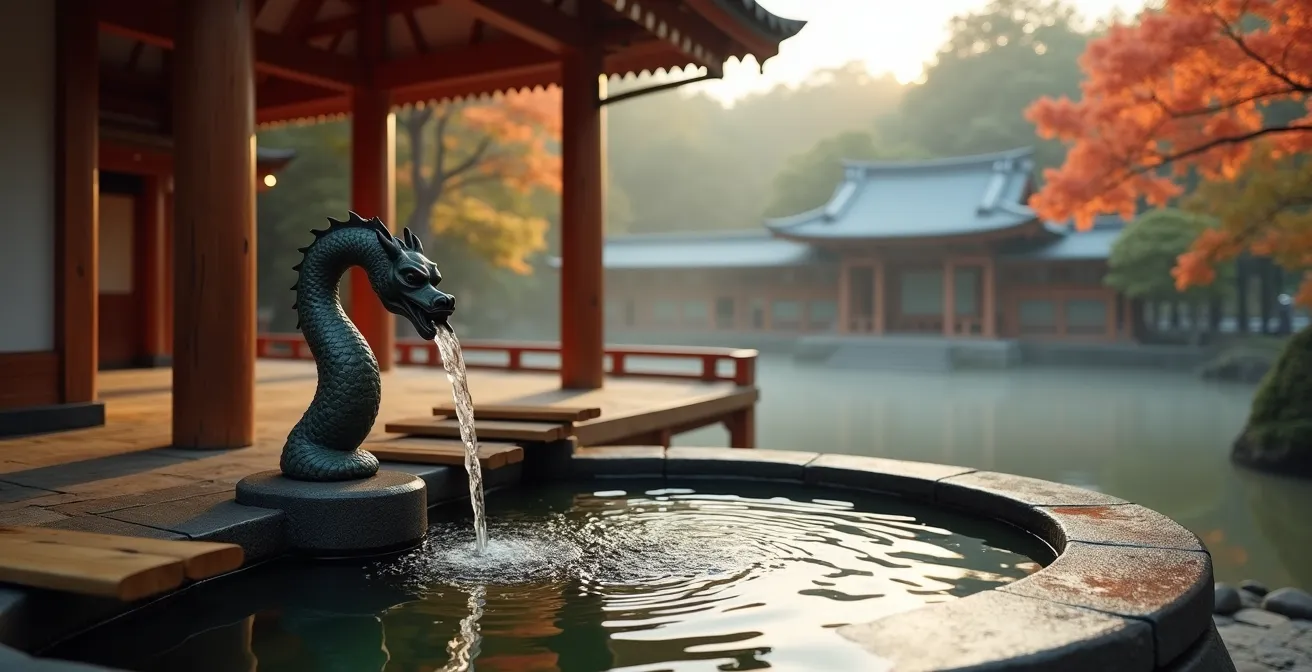
You approach the entrance to a beautiful Shinto shrine. Before the grand torii gate stands an elegant stone basin with flowing water and bamboo ladles—the chozuya. It’s that moment of hesitation familiar to many visitors: you know you’re supposed to do *something*, but the exact sequence is a mystery. The fear of looking clumsy or, worse, disrespectful, can be a small but significant barrier to fully immersing yourself in the spiritual atmosphere.
Many guides simply list the mechanical steps, treating it like a mandatory hand-washing procedure. But this approach misses the entire point. With Japan welcoming a record number of visitors, understanding the deeper meaning behind these traditions has never been more important. This ritual isn’t just about physical cleanliness; it’s a profound, non-verbal act that prepares your mind and spirit to enter a sacred space. It is a form of ritual hygiene, a silent language of respect.
This guide moves beyond a simple list of actions. We will explore the “why” behind each gesture, transforming the ritual from an awkward obligation into a meaningful act of mindfulness. By understanding the purpose of each step, you will not only perform the purification correctly but will do so with the confidence and reverence it deserves, starting your shrine visit with the right intention.
To help you master this essential piece of etiquette, this article breaks down the entire process. Explore the sections below to understand each component of the shrine visit, from purification to prayer.
Summary: How to Perform the Chozuya Purification Ritual Correctly
- Why Must You Cleanse Before Entering the Sacred Grounds?
- Left, Right, Mouth, Handle: Memorizing the Order of Cleansing
- How to Perform the Ritual Without Touching the Ladle to Your Lips?
- The Drinking Mistake: Why Chozuya Water Is Not for Hydration?
- Is It Rude to Enter the Shrine Without stopping at the Chozuya?
- Why You Should Avoid Walking in the Center of the Torii Path?
- Long Soak or Repeated Dips: What Is the Best Method for Circulation?
- What to Do at a Shrine: The 2-Bow 2-Clap 1-Bow Rule Explained
Why Must You Cleanse Before Entering the Sacred Grounds?
The act of cleansing at the chozuya is far more than a simple matter of hygiene; it is a vital symbolic transition. This ritual, known as temizu, marks your passage from the profane, everyday world (kegare) into the sacred realm of the kami (hare). It is the first step in preparing your mind and spirit for an encounter with the divine. The water washes away not just physical dust but also the spiritual impurities accumulated in daily life. With 25.1 million international visitors to Japan in 2023, observing this tradition correctly shows deep respect for the culture.
This practice is rooted in the Shinto myth of the god Izanagi, who purified himself in a river after returning from the underworld. This original act of purification, called misogi, is the ancestor of the modern-day chozuya ritual. The water symbolizes a spiritual rebirth, allowing you to approach the gods in a state of purity.

The importance of this ritual hygiene was highlighted during the COVID-19 pandemic. As a safety precaution, many shrines temporarily removed the shared ladles, causing concern that the custom itself was at risk. It underscores that this act is a shared, communal practice, where consideration for others is paramount. Cleansing is not just for you; it maintains the sanctity of the space for everyone who follows.
Left, Right, Mouth, Handle: Memorizing the Order of Cleansing
The sequence of the temizu ritual is precise, designed to be completed with a single scoop of water. This efficiency is itself a form of mindfulness. The goal is to perform a complete purification without wasting the sacred water or needing to re-scoop. Memorizing the four key steps transforms the process from a fumbling effort into a graceful, meditative act. The order follows a specific logic: cleansing the hand that receives, then the hand that acts, followed by the mouth which speaks, and finally purifying the tool used.
As the Kami Shrine’s educational materials explain, this simple act holds profound meaning: “With a single scoop of water, we wash away the dust of the world and prepare the soul to meet the divine.” It is a physical prayer that precedes the verbal one. Each step is deliberate and carries symbolic weight, making the order essential to the ritual’s integrity. Follow the sequence below to perform it correctly.
Action Plan: The Four-Step Purification Sequence
- Take the Ladle: With your right hand, take a ladle (hishaku) and scoop a full measure of fresh water from the basin.
- Cleanse the Left Hand: Tilt the ladle to pour about a third of the water over your left hand, cleansing the hand that will receive.
- Cleanse the Right Hand: Transfer the ladle to your clean left hand and pour another third of the water over your right hand.
- Cleanse the Mouth: Pour the remaining water into your cupped left hand. Bring your hand to your mouth to rinse it quietly. Spit the water out discreetly on the stones below, never back into the basin.
- Cleanse the Handle: Finally, tilt the ladle vertically, allowing the remaining water to flow down and cleanse the handle before returning it to its resting place for the next person.
This entire sequence demonstrates respect, efficiency, and consideration. By cleansing the handle last, you ensure the tool is pure for the next visitor, completing the communal aspect of the ritual.
How to Perform the Ritual Without Touching the Ladle to Your Lips?
One of the most common points of confusion—and a critical rule of hygiene—is the mouth-rinsing step. It is imperative to never touch the ladle directly to your lips. The chozuya is a public space, and this rule is a fundamental form of sanitation that shows consideration for all other worshippers. The act is symbolic, and proper technique ensures it remains a pure and respectful practice. So, how is it done correctly?
The proper method is to use your hand as an intermediary vessel. After cleansing both hands, you pour a small amount of water from the ladle into your cupped left hand. From your hand, you then bring the water to your mouth to rinse. This prevents any direct contact between your mouth and the shared ladle, preserving its cleanliness for everyone.
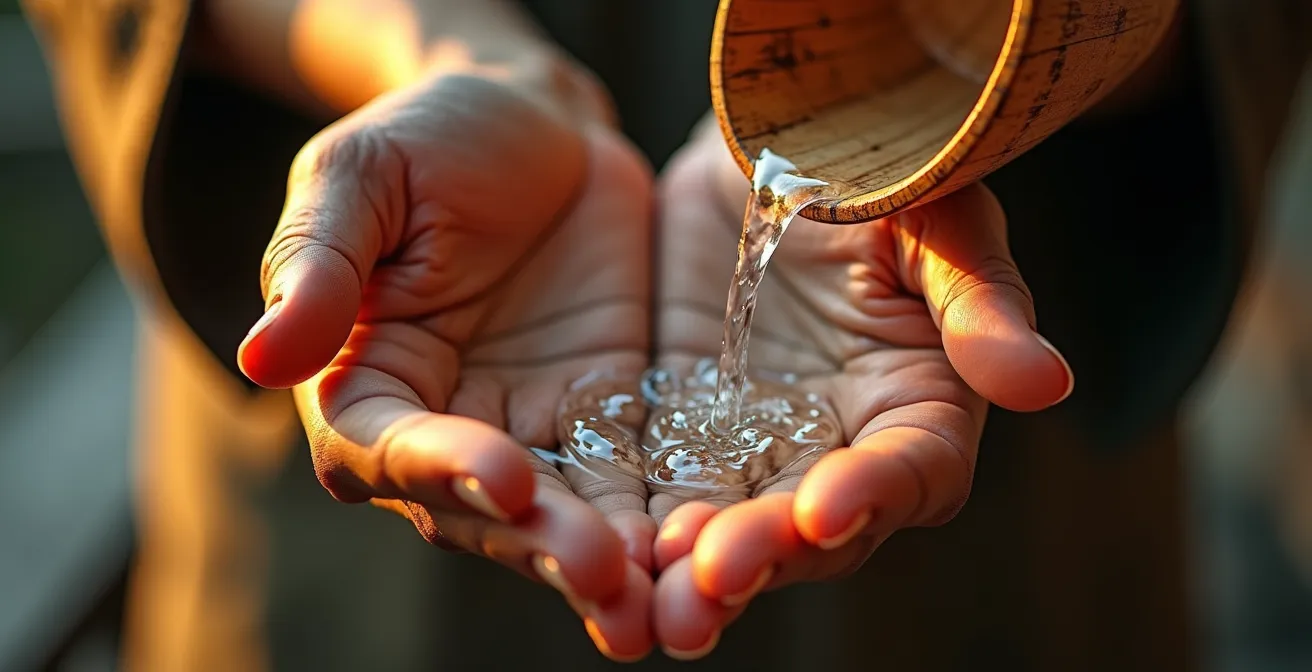
For visitors who are uncomfortable with this step, there is a widely accepted alternative. The spiritual significance lies in the intention. Therefore, simply bringing your wet fingers to your lips without actually rinsing is a perfectly acceptable and common modification. This gesture still completes the symbolic act of purifying the mouth. The rise of hanachōzu—floating flowers in the basin, which began in 2017 and grew during the pandemic—further illustrates how these rituals can adapt while keeping their spiritual core.
The Drinking Mistake: Why Chozuya Water Is Not for Hydration?
A frequent and significant mistake made by visitors is drinking the water from the chozuya. This water is strictly for purification, not for quenching thirst. Swallowing the water is considered improper and goes against the ritual’s purpose. The act is about rinsing away impurities, not ingesting them. This misunderstanding often stems from a simple cultural and communication gap; a 2023 survey noted that 22.5% of foreign tourists reported struggling with communication in Japan, which can lead to misinterpreting rituals.
The water at a chozuya is often fresh spring or well water, but its primary function is symbolic. You are meant to discreetly spit the water out onto the gravel or drainage area around the basin, never back into the main basin itself. This action completes the symbolic removal of spiritual “dust” from your mouth, the source of words. Drinking it would be akin to swallowing the impurities you are meant to be casting out.
This highlights a core principle of many Shinto rituals. As writer Donny Kimball astutely observes in his guide to shrine etiquette, the focus is on the process and intent, not necessarily the literal outcome.
The temizuya is a ritualized purification. Following the proper procedure is more important than ensuring your hands are actually clean.
– Donny Kimball, How to Visit a Shrine: A Simple Guide to Proper Etiquette
This is a crucial insight. The chozuya is not a drinking fountain or a sink. It is a ritual tool, and using it correctly means respecting its purpose as a station for symbolic cleansing only.
Is It Rude to Enter the Shrine Without stopping at the Chozuya?
Ideally, every visitor should perform the purification ritual at the chozuya before proceeding into the main shrine grounds. Skipping it can be seen as neglecting a fundamental step of showing respect. It is akin to entering someone’s home without taking off your shoes. However, Shintoism is also a practical and often flexible faith, and there are situations where stopping is not feasible. For instance, in popular shrines during peak season, where it’s reported that 32% of foreign tourists experienced congestion, the chozuya area might be extremely crowded.
In such cases, or if a chozuya is not present or out of service, the intention to purify oneself is what matters most. There are accepted alternatives. You can symbolically purify yourself using a small amount of water from a personal water bottle poured over your hands. Even using wet wipes for your hands is considered an acceptable modern adaptation. If none of these are available, simply pausing for a moment of quiet reflection before entering can serve as a mental purification.
Furthermore, it is important to note that if you visit a restroom within the shrine grounds after you have already purified, it is considered respectful to return to the chozuya to purify yourself again. This act resets your spiritual cleanliness before you re-engage with the sacred areas of the shrine. While skipping the initial purification is discouraged, the tradition provides practical ways to maintain respect even when circumstances are not ideal.
Why You Should Avoid Walking in the Center of the Torii Path?
Just as the chozuya ritual is the first act of purification, how you approach the shrine is the first gesture of reverence. The path leading from the torii gate to the main hall is called the sando, or the “visiting path.” You may notice that many local worshippers consciously walk along the sides of this path rather than down the middle. This is not a coincidence; it is a deeply ingrained sign of respect. The center of the sando is reserved for the kami to pass through.
Walking directly in the center is considered disrespectful, as it places you in the deity’s path. By stepping to the side, you demonstrate humility and acknowledge that you are a guest in a divine space. This simple act of “silent language” immediately signals your understanding and reverence for the shrine’s sanctity. As the Live Japan editorial team puts it, the gate itself is a clear marker of this transition.
The torii marks the sanctity of the shrine, marking that you are about to enter a sacred area. It actively separates the regular world from the realm of the kami.
– Live Japan Editorial Team, Visiting a Japanese Shinto Shrine – Everything You Need to Know
This etiquette extends to passing through the torii gate itself. It is customary to bow once before passing through the gate and to avoid the very center. Upon leaving the shrine, many turn back towards the main hall after passing through the torii and bow once more. These small, deliberate actions frame your visit with a constant state of mindfulness and respect for the sacred space you are entering and leaving.
Long Soak or Repeated Dips: What Is the Best Method for Circulation?
The quick, one-ladle purification at a shrine’s chozuya is often confused with a more intense purification ritual called misogi. While both involve water, their purpose, duration, and practice are vastly different. The chozuya ritual is a brief, symbolic cleansing for all visitors, while misogi is a deep, full-body immersion typically undertaken by priests or devoted practitioners on special occasions.
Misogi involves standing under a cold waterfall or immersing oneself in the ocean, often while chanting prayers for an extended period. For instance, at the Tsubaki Grand Shrine, misogi is performed on the 11th day of each month, even in winter. This “long soak” is a powerful ascetic practice aimed at achieving a profound state of spiritual purity through endurance. In contrast, the “repeated dips” at a chozuya—or more accurately, the sequential cleansing with a single ladle—is a standardized, accessible ritual for daily worship.
The following table clarifies the key differences between these two important Shinto water purification practices.
| Aspect | Chozuya (Quick Dip) | Misogi (Long Soak) |
|---|---|---|
| Duration | 30-60 seconds | Several minutes to hours |
| Location | Shrine entrance basin | Natural waterfall or ocean |
| Frequency | Every shrine visit | Special occasions only |
| Who Performs | All visitors | Priests and devoted practitioners |
| Water Amount | One ladleful | Full body immersion |
For a visitor, understanding this distinction is crucial. Your role at a shrine is to perform the brief chozuya ritual. Misogi is a separate, advanced practice you are not expected to perform. Conflating the two can lead to misunderstanding the simple, elegant purpose of the temizu purification.
Key Takeaways
- The chozuya is not a sink; it is a place for symbolic purification to show respect before entering a sacred space.
- The entire ritual should be completed with a single ladle of water in a specific sequence: left hand, right hand, mouth (indirectly), and handle.
- Observing proper etiquette, such as not walking in the center of the path and knowing the prayer sequence, transforms a visit into a meaningful cultural experience.
What to Do at a Shrine: The 2-Bow 2-Clap 1-Bow Rule Explained
After purifying yourself at the chozuya and approaching the main hall (haiden), you arrive at the final step: offering your prayer to the kami. This also follows a standardized ritual, most commonly known as ni-rei, ni-hakushu, ichi-rei, or “two bows, two claps, one bow.” This sequence is the formal method for getting the attention of the kami, making your prayer, and then expressing gratitude.
First, if you wish, you can gently toss a coin into the large offertory box (saisen-bako). Five-yen coins are considered lucky because “go-en” (five yen) is a homophone for “good fortune” or “good connections.” If there is a large bell or gong (suzu), you can ring it two or three times to announce your presence to the gods. Then, the core ritual begins: bow deeply twice, clap your hands twice (with your right hand slightly lower than your left to show respect), make your prayer silently in your heart, and then bow deeply one final time.
It’s important to know that while this is the standard, some famous shrines have their own unique variations. For example, a source on prayer customs notes that prominent shrines like Izumo Taisha use a “2-bow, 4-clap, 1-bow” pattern. Being aware of these local traditions is a mark of a knowledgeable visitor. If you are unsure, observing others first is always a wise and respectful choice. This final act completes your communication with the kami, a process that began with the first drop of water at the chozuya.
By understanding the meaning behind each gesture, from the chozuya to the final bow, your visit to a Shinto shrine becomes more than just sightseeing. It transforms into a respectful dialogue with a tradition that has been practiced for centuries. Embrace these steps not as rules, but as a way to connect more deeply with the spirit of the place.
Frequently Asked Questions on How to Purify Your Hands at the Chozuya Without Looking Clumsy
Why must I never touch the ladle directly to my lips?
You should not touch the ladle directly to your lips as a traditional form of public sanitation showing consideration for others. The ladle is a shared object, and this practice ensures it remains clean for all worshippers.
How do I rinse my mouth without direct contact?
To rinse your mouth without direct contact, pour a small amount of water from the ladle into your cupped left hand to create a small pool. Then, bring your hand to your mouth for rinsing.
Is it acceptable to skip the mouth rinsing step?
Yes, it is perfectly acceptable to skip the actual rinsing. Simply touching your lips with your wet hand is a common and respectful alternative, as the act is primarily symbolic.