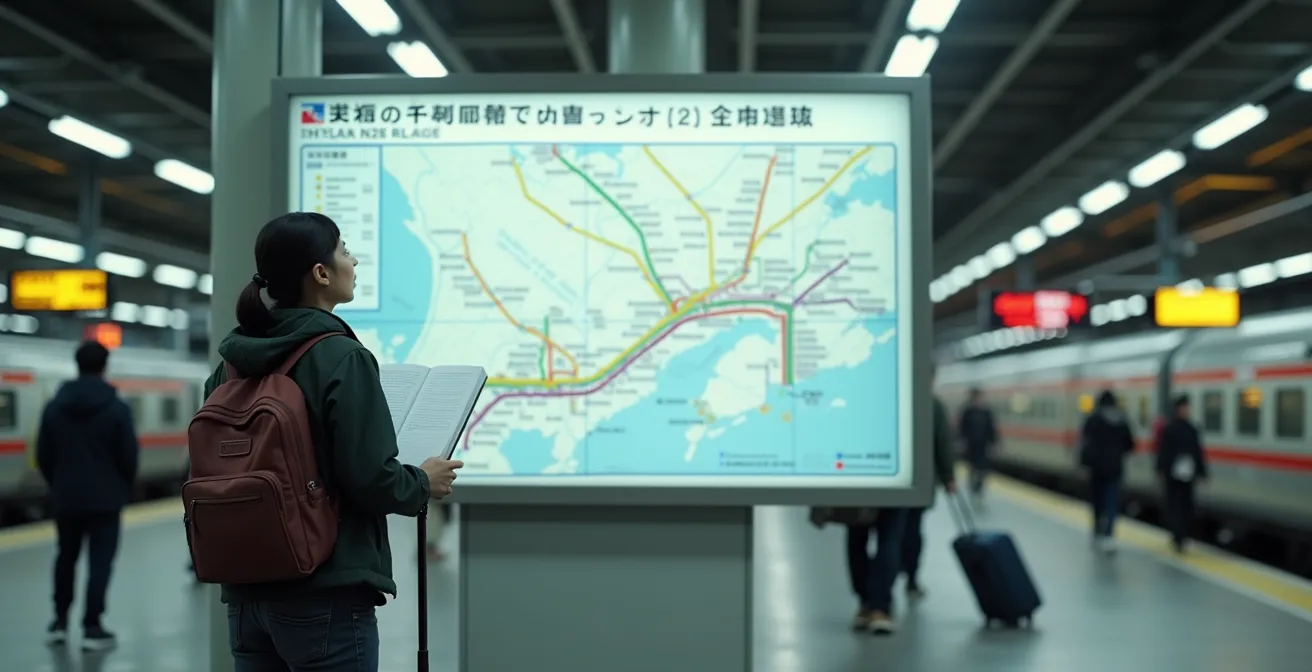
Planning a 14-day Japan trip feels complex, but the key isn’t a rigid schedule; it’s mastering the core logistics of travel flow, timing, and packing.
- Follow the classic “Golden Route” (Tokyo to Kyoto) for a streamlined flow and simplified luggage management.
- Book flights and hotels 3-6 months in advance to avoid peak pricing, especially during popular seasons like cherry blossom.
Recommendation: Focus on packing light using the “one-hand rule” and understanding local etiquette—these two factors will have the biggest impact on your daily travel experience and reduce stress significantly.
Staring at a map of Japan can evoke a powerful mix of excitement and anxiety. The allure of ancient temples, futuristic cityscapes, and incredible food is undeniable. But for a first-time visitor, so is the logistical challenge: a complex train system, a language barrier, and a culture with its own unique set of social rules. The sheer volume of information can quickly lead to planning paralysis, leaving you wondering where to even begin. For many, 14 days feels like the perfect duration for a first visit, offering enough time to experience the highlights without feeling rushed, but planning those two weeks is crucial.
The common advice is often a simple checklist: see Tokyo and Kyoto, buy a Japan Rail Pass, and pack for four seasons. While these are valid starting points, they barely scratch the surface of what makes a trip seamless. Following a generic to-do list often leads to a “cookie-cutter” experience, moving from one crowded spot to the next without truly appreciating the journey. You might find yourself struggling with an oversized suitcase on a packed subway or committing a cultural faux pas without realizing it.
This guide offers a different approach. The secret to a stress-free Japan trip isn’t a more detailed checklist, but a deeper understanding of the logistical ‘operating system’ that governs travel in the country. Instead of just telling you *what* to do, we’ll explain the *why* behind each recommendation—from route planning and booking timelines to packing strategies and social etiquette. By mastering these foundational concepts, you can move beyond simple tourism and create a journey that flows logically, feels intuitive, and replaces anxiety with confident exploration.
This article is structured to build your confidence step by step. We will deconstruct the ideal first-timer’s route, reveal the best strategies for booking and budgeting, and provide practical frameworks for packing, staying connected, and navigating cultural norms. Let’s begin building your perfect 14-day journey.
Summary: A Practical Guide to Japan’s Travel Logistics
- Tokyo to Kyoto: Why Following the Classic Route Is Best for Beginners?
- How to Book Your Trip Sequence to Save 20% on peak Fares
- Cherry Blossoms or Fall Foliage: Which Season Offers Better Value?
- The Overpacking Mistake That Ruins Train Travel for Tourists
- Pocket Wi-Fi vs. eSIM: Which Keeps You Connected for Less?
- How Many Cities Must You Visit to Justify the New 7-Day Pass Price?
- Why Being Loud in Public Is the Ultimate Taboo in Japan?
- 7 Days or 14:How Queueing Like a Local Saves You Time at Train Stations
Tokyo to Kyoto: Why Following the Classic Route Is Best for Beginners?
For your first trip to Japan, the temptation to venture off the beaten path is strong. However, there’s a reason the “Golden Route”—a linear path typically covering Tokyo, Hakone, Kyoto, and sometimes Osaka or Hiroshima—is the top choice for over 80% of first-time visitors. It’s not about a lack of imagination; it’s about superior logistical flow. This route is built around the Tokaido Shinkansen (bullet train) line, creating a seamless, one-directional journey that minimizes travel friction and maximizes your time for exploration.
The alternative, a “hub-and-spoke” model where you base yourself in one city and take multiple day trips, often creates more problems than it solves. It means backtracking on train routes, managing luggage for every single outing, and experiencing other cities only at a surface level. The Golden Route, by contrast, is designed for deep immersion. You travel from one city to the next, forwarding your main luggage ahead and exploring each destination fully before moving on. This sequential approach dramatically reduces the mental load of daily planning.
Think of it as a well-designed story with a clear beginning, middle, and end. You start in the hyper-modern metropolis of Tokyo, transition through the natural beauty of Hakone, and arrive in the ancient cultural heart of Kyoto. This progression provides a rich narrative and a deep appreciation for Japan’s diversity. For a beginner, this built-in structure is an invaluable asset, allowing you to focus on the experience rather than the complicated logistics of getting from A to B and back again.
| Aspect | Linear Path (Golden Route) | Hub-and-Spoke Model |
|---|---|---|
| Luggage Management | Forward once per city change | Daily round trips with luggage |
| Cultural Immersion | Deep exploration of each city | Surface-level day trips only |
| Transportation Cost | Optimized with JR Pass | Higher due to repeated routes |
| Mental Load | Lower – sequential planning | Higher – daily logistics |
How to Book Your Trip Sequence to Save 20% on Peak Fares
Once you’ve committed to the Golden Route, timing your bookings is the single biggest factor in managing your budget. The prices for flights and accommodation in Japan are highly sensitive to demand, and booking with a clear strategy can easily save you hundreds of dollars. The key is to work backward from your travel dates, establishing a clear timeline for each major purchase. A strategic booking window of three to six months in advance is the sweet spot for securing the best value.
Start by setting up price alerts for your international flights around six months out. A clever tactic is to search for “open-jaw” tickets—flying into one airport (like Osaka’s KIX) and out of another (like Tokyo’s NRT). This aligns perfectly with the linear nature of the Golden Route and eliminates the cost and time of backtracking. Once you see a price dip of 15-20% below the average, it’s time to book. Following this, about three months before your trip, reserve your ‘anchor’ hotels in Tokyo and Kyoto. Opt for bookings with free cancellation to maintain flexibility.

As your trip gets closer, the focus shifts to ground transport and experiences. Two months out is the time to calculate whether a Japan Rail Pass is cost-effective for your specific itinerary. With recent price changes, it’s no longer an automatic choice. The pass now costs about $563 for 14 days of travel, so you must price out individual routes to see if you’ll break even. Finally, in the month leading up to your departure, book your specific Shinkansen seats and lock in any high-demand restaurant or museum reservations. This structured approach turns a daunting task into a manageable process.
Cherry Blossoms or Fall Foliage: Which Season Offers Better Value?
The two most iconic times to visit Japan are during the cherry blossom (sakura) season in spring and the fall foliage (koyo) season in autumn. Both offer breathtaking natural beauty, but they provide vastly different experiences in terms of cost, crowds, and overall value. While the sakura season is heavily romanticized, it comes with significant drawbacks. The bloom is fleeting, lasting only a week or two, which concentrates an enormous number of tourists into a very short timeframe. This results in extreme crowd density and massive price inflation for hotels and flights.
For the value-conscious traveler, the fall foliage season in November offers a much better proposition. The colors are just as spectacular, but the season is longer and more spread out, typically lasting three to four weeks. This disperses the crowds, making popular sites more enjoyable. Hotel prices, while still elevated, are considerably lower than during the sakura peak. One traveler who visited in November 2023 noted that while early fall can be rainy, by October the weather clears up, leading into a beautiful and comfortable leaf-peeping season, as detailed in a comprehensive guide to autumn in Japan.
However, the absolute best value can be found in the “shoulder seasons”—specifically May (after Golden Week) and early December. During these times, the weather is often pleasant, crowds are at a minimum, and you can book accommodations at their base rates. You may miss the iconic pink or red leaves, but you gain a more relaxed, authentic, and affordable travel experience. The choice ultimately depends on your priorities: are you willing to pay a premium for a classic (but crowded) experience, or do you prefer maximizing value and comfort?
This comparative table helps illustrate the trade-offs between Japan’s most popular travel seasons.
| Factor | Cherry Blossom (April) | Fall Foliage (November) | Shoulder Season (May/Dec) |
|---|---|---|---|
| Crowd Density | Extreme (9/10) | High (7/10) | Low (3/10) |
| Hotel Price Inflation | +40-60% | +25-35% | Base rates |
| Weather Predictability | Fleeting (1-2 weeks) | Extended (3-4 weeks) | Stable |
| Booking Flexibility | Very Low | Moderate | High |
| Overall Value Score | 5/10 | 7/10 | 9/10 |
The Overpacking Mistake That Ruins Train Travel for Tourists
In Japan, how you pack is as important as what you pack. The most common mistake first-time visitors make is bringing a large, heavy suitcase, which turns an efficient train system into a personal logistical nightmare. Navigating packed train stations, narrow platforms, and staircases with a bulky bag is incredibly stressful. Furthermore, there’s often no designated space for large luggage on local trains, and even on the Shinkansen, space is limited and may require a reservation.
The solution is to adopt a minimalist mindset and follow the “One-Hand Rule”: if you can’t comfortably carry your luggage with one hand while holding your phone or ticket in the other, it’s too big. A hard-shell, carry-on-sized suitcase paired with a small daypack is the ideal combination. This setup is nimble enough for crowded subways and fits easily into the ubiquitous coin lockers found at every train station. These lockers are your best friend, allowing you to store your bag for the day and explore a new city unencumbered before checking into your hotel.
For city-to-city travel, embrace Japan’s brilliant luggage forwarding service, known as *takkyubin*. For a reasonable fee (typically ¥2000-¥3000), you can send your main suitcase from your hotel in one city directly to your hotel in the next, where it will be waiting for you upon arrival. Simply pack a small overnight bag with essentials for your transit day. This service, often available at hotel front desks and even tourist information centers, is the secret to truly effortless train travel, as noted by seasoned Japan travel experts. It completely liberates you from the burden of luggage and transforms your travel days into part of the adventure.
Pocket Wi-Fi vs. eSIM: Which Keeps You Connected for Less?
Staying connected is non-negotiable for navigating Japan’s cities and train networks. Google Maps will be your constant companion, and having reliable data is crucial for everything from checking train schedules to translating menus. The two most popular options for travelers are renting a pocket Wi-Fi device or purchasing a data-only eSIM. The right choice depends entirely on your travel style, group size, and data consumption habits.
A pocket Wi-Fi is a small, portable modem that creates a personal hotspot. Its primary advantage is the ability to connect multiple devices at once, making it the most cost-effective option for families or groups. You can share a single connection across several phones, tablets, and laptops. However, it means carrying and charging an extra device, and you must stay within its range to remain connected. It also needs to be picked up at the airport upon arrival and returned before departure.

An eSIM (embedded SIM), on the other hand, is a digital SIM that you download directly to your phone. This is the ultimate convenience: no extra hardware to carry or charge, and activation is instant. For a solo traveler, especially a heavy data user, an unlimited data eSIM offers the best combination of performance and simplicity. Budget-conscious backpackers can also find low-cost eSIMs with smaller data caps (e.g., 3GB) that are sufficient for basic navigation and communication. For business travelers or anyone for whom connectivity is mission-critical, a combination of both provides valuable redundancy.
This matrix helps clarify the best choice based on your specific needs.
| User Type | Best Option | Cost (14 days) | Key Benefit |
|---|---|---|---|
| Solo Heavy Data User | eSIM (Unlimited) | ¥4000-5000 | No device to carry |
| Family/Group (3+ devices) | Pocket Wi-Fi | ¥6000-8000 total | Share one connection |
| Budget Backpacker | eSIM (3GB) | ¥2000-3000 | Lowest cost option |
| Business Traveler | Both (redundancy) | ¥8000-10000 | Zero downtime risk |
How Many Cities Must You Visit to Justify the New 7-Day Pass Price?
For years, the Japan Rail (JR) Pass was an automatic purchase for most tourists, offering incredible value and convenience. However, following a major price increase in late 2023, this is no longer the case. The pass’s value proposition has fundamentally changed, and it is now crucial to do a break-even calculation to determine if it’s worth the cost for your specific itinerary. Blindly buying the pass can be a costly mistake.
The general rule of thumb is that the 7-day pass starts to become cost-effective if you are making at least one long-distance, round-trip Shinkansen journey within that week. For example, a simple Tokyo to Kyoto round trip on the Nozomi train (which is not fully covered by the pass) costs nearly as much as the pass itself. Therefore, if your plan includes Tokyo-Kyoto-Hiroshima within seven days, the pass will almost certainly save you money. However, if you are traveling slower, staying within a single region (like Kanto or Kansai), or using a combination of buses and non-JR trains, individual tickets or a regional pass will be far cheaper.
Instead of guessing, use an online JR Pass calculator. These tools allow you to input your exact itinerary, and they will compare the total cost of individual tickets against the price of the pass. As travel experts now advise, it’s essential to consider regional passes or individual tickets as potentially better value options depending on your route. The pass still offers unparalleled flexibility for hop-on, hop-off travel, which can be valuable if your plans are loose. But for a well-planned trip, the numbers must add up.
Your JR Pass Decision Checklist: Is It Worth It?
- Are you traveling to 3+ major cities within 7 days (e.g., Tokyo-Kyoto-Osaka-Hiroshima)? A “Yes” makes the pass more likely to be worthwhile.
- Will you take at least two long-distance Shinkansen rides? This is generally required to reach the break-even point.
- Do you value on-the-spot flexibility over the savings of advance booking? The pass’s main advantage is hop-on convenience.
- Are you staying within one region only (e.g., Kanto or Kansai)? If so, a cheaper regional pass is almost always the better choice.
- Is your itinerary subject to last-minute changes? The pass can act as “flexibility insurance” against changing plans.
Why Being Loud in Public Is the Ultimate Taboo in Japan?
One of the first things visitors notice in Japan is the relative quiet of its public spaces, especially on public transport. For travelers coming from louder cultures, this can be jarring. Understanding the “why” behind this social norm is key to navigating the country respectfully. It’s not simply about being polite; it’s rooted in a core cultural concept known as *wa* (和), which emphasizes group harmony and the importance of not imposing on others.
Public spaces are considered shared environments where one’s actions shouldn’t impose on others – this is the core concept of ‘wa’ (和), or group harmony.
– Japan Cultural Expert, Japan Travel Planning Guide
In the West, public space is often seen as a forum for self-expression. In Japan, it’s a shared resource that must be maintained for everyone’s comfort. Loud conversations, phone calls, or music are seen as an intrusion into the personal space and peace of those around you. This is why you’ll see trains full of people in near silence, with almost everyone either reading, sleeping, or quietly using their phones. Making or taking a phone call on a train is a major social taboo.
This rule, however, is highly situational. The expected volume level changes dramatically depending on the environment. While a temple or a subway car demands near silence, an *izakaya* (a Japanese pub) is a space designed for lively, animated conversation. The key is to develop situational awareness and match the ambient volume of your surroundings. By observing how locals behave in different settings—from a hushed department store to a bustling street market—you can easily adapt and show respect for the principle of *wa*. It’s a small adjustment that demonstrates a deep level of cultural understanding.
Key Takeaways
- Mastering logistics (flow, timing, packing) is more important than a rigid sightseeing checklist for a stress-free first trip to Japan.
- The classic “Golden Route” offers the most efficient logistical flow for beginners, minimizing travel friction and mental load.
- Packing light is not just a suggestion but a necessity; use luggage forwarding services (*takkyubin*) to make train travel effortless.
7 Days or 14:How Queueing Like a Local Saves You Time at Train Stations
Whether your trip is seven days or fourteen, a significant portion of your time will be spent in Japan’s magnificent but massive train stations. The efficiency of this system isn’t just due to the punctuality of the trains; it’s equally dependent on the orderly behavior of the passengers. Mastering a few simple local habits, particularly how to queue, can save you time, reduce stress, and help you blend in like a seasoned traveler.
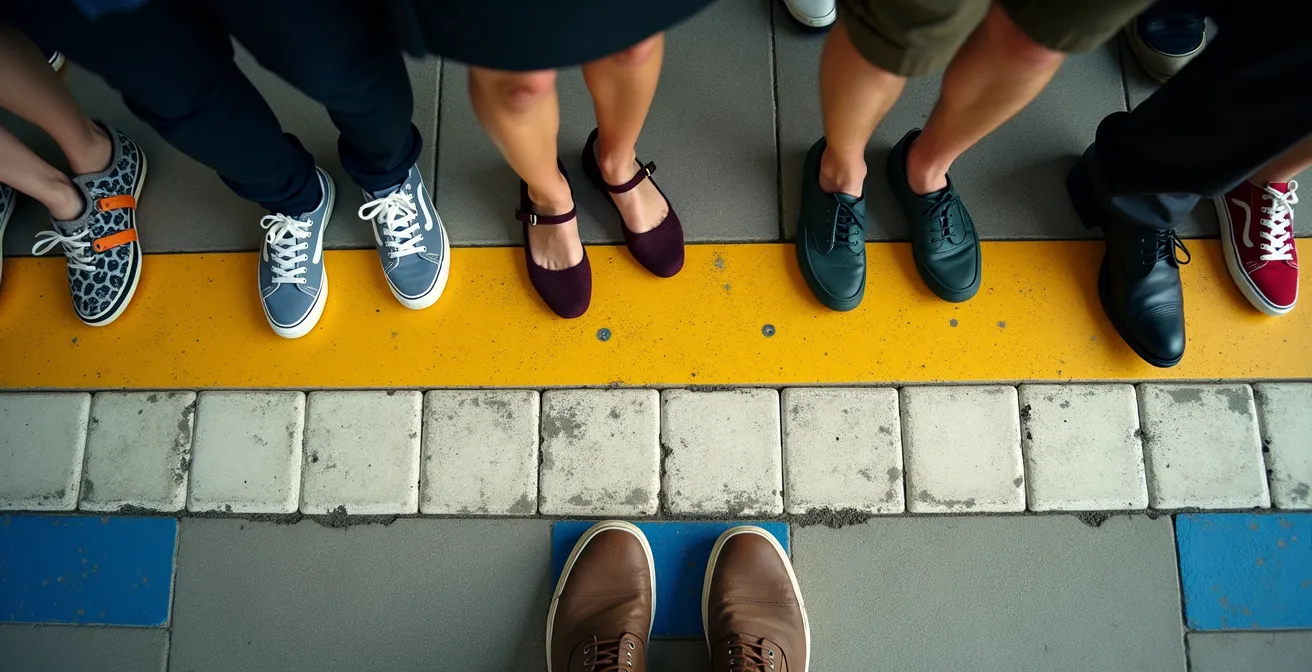
On any train platform, you’ll notice painted lines on the ground indicating precisely where the train doors will open and where to form lines. Passengers form neat, single-file queues on either side of these markings, leaving the central area clear for disembarking passengers. Rushing the door or trying to cut in line is a significant breach of etiquette. The system works because everyone follows it, creating a smooth and rapid flow of people. Simply find your car number, locate the corresponding markings, and take your place in line.
Another crucial piece of spatial awareness is escalator etiquette, which surprisingly varies by region. This small detail can prevent awkward moments in crowded stations. In Tokyo and the surrounding Kanto region, you stand on the left and walk on the right. However, in Osaka, Kyoto, and the Kansai region, the rule is reversed: you stand on the right and walk on the left. When in doubt, simply observe what the person in front of you is doing. These may seem like minor details, but embracing them is part of the cultural experience and contributes to the seamless efficiency that makes Japanese public transport so remarkable.
This regional guide to escalator etiquette is a perfect example of a small detail that makes a big difference.
| Region | Stand Side | Walk Side | Cities Included |
|---|---|---|---|
| Kanto (Eastern) | Left | Right | Tokyo, Yokohama, Chiba |
| Kansai (Western) | Right | Left | Osaka, Kyoto, Kobe |
| Other Regions | Varies | Observe locals | Follow the person ahead |
With these logistical frameworks and cultural insights in hand, you are now fully equipped to build a personalized, stress-free Japan itinerary. You have the tools to choose the right route, book smartly, pack efficiently, and navigate public spaces with respect and confidence. It’s time to start outlining your journey and transform that initial planning anxiety into pure, unadulterated anticipation for the incredible adventure that awaits.