In summary:
- Master the ticket machine by defaulting to the top-left button (usually the most popular dish).
- Eat quickly and leave; the entire process from order to exit should take 5-10 minutes. Lingering disrupts the system.
- Choose soba for sustained energy from complex carbs or udon for a quick, comforting boost.
- Slurping is functional, not just polite: it cools the noodles and aerates the broth to enhance flavor.
- Always return your tray and bowl to the designated counter to complete the efficiency cycle.
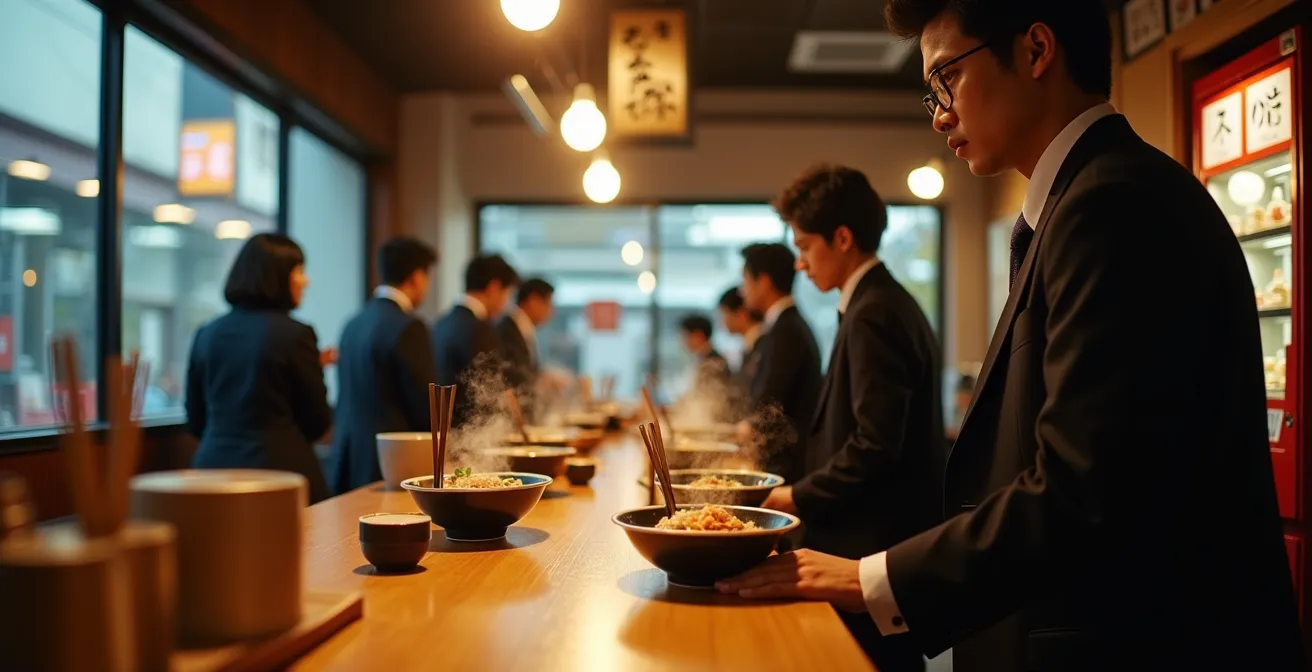
The scent of rich, savory broth hits you first, cutting through the chaotic energy of a Japanese train station. You see a blur of suits—salarymen disappearing behind a small curtain, only to re-emerge minutes later. This is the world of tachigui, the standing noodle bar, a cornerstone of urban Japanese life. For a solo traveler on a budget, it’s the promised land: a meal that’s authentic, lightning-fast, and incredibly cheap. Yet, for the uninitiated, it’s an intimidating puzzle of ticket machines covered in kanji, unwritten rules, and silent, efficient patrons.
Most travel guides offer simple advice: use the machine, don’t linger, slurp your noodles. While true, this advice misses the point. A standing noodle bar isn’t just fast food; it’s a high-efficiency urban ritual, a system perfected over decades to serve the maximum number of people in the minimum amount of time. The goal isn’t just to eat, but to move through the system with the same unspoken understanding as the locals. The key isn’t memorizing phrases, but understanding the efficiency logic that drives every action.
This guide decodes that system. We’ll break down the salaryman’s playbook, transforming you from a hesitant tourist into a confident regular. You’ll learn how to navigate the ticket machine like a pro, understand the functional purpose behind the etiquette, and make smart choices that optimize your meal for speed and value. It’s time to stop observing from the outside and step up to the counter.
This article breaks down the essential tactics for mastering the standing noodle bar experience. Below is a summary of the key skills you’ll acquire, from decoding the menu to understanding the subtle rules of the counter.
Summary: The Salaryman’s Playbook for Noodle Bars
- How to Decipher Kanji on the Ticket Vending Machine?
- Why Lingering at a Standing Bar Is Considered Rude?
- Soba or Udon: Which Noodle Should You Choose for Quick Energy?
- To Slurp or Not: Is It Really Necessary for Taste?
- Where to Return Your Bowl When You Finish Eating?
- When to Join a Line Based on Length and Turnover Speed?
- Fried Chicken or Oden: How to Order Hot Food at the Counter?
- Tonkotsu vs. Miso: Which Ramen Style Define Each Prefecture?
How to Decipher Kanji on the Ticket Vending Machine?
The ticket machine, or kenbaiki, is the first gatekeeper of the standing noodle bar. Faced with a wall of buttons covered in Japanese characters, most travelers freeze. The salaryman’s approach isn’t about literacy; it’s about strategy. The most efficient tactic is to locate the button in the top-left corner. This is almost universally the shop’s standard, most popular, or recommended dish—often a simple kake soba (noodles in broth). It’s the safest, fastest bet if you’re overwhelmed.
Before you even press a button, insert your cash. Most machines take ¥1000 bills and coins. After inserting money, your chosen button will likely light up. Press it, and the machine will dispense your ticket and change. Hand this ticket to the staff behind the counter, and they will begin preparing your meal. If the shop offers both soba and udon, a staff member might ask, “Soba? Udon?” simply state your preference. Some chains, like Fuji Soba, recognize the challenge for foreigners and place menus with pictures and English descriptions near the machine. The pro move is to decide your order before you approach the machine to avoid holding up the line.
Think of the machine not as a menu, but as an order submission terminal. Your goal is to make a decision and execute the transaction in under 30 seconds. This initial act of efficiency sets the tone for the entire experience.
Why Lingering at a Standing Bar Is Considered Rude?
The core concept of a tachigui bar is high throughput. It’s not a restaurant for socializing; it’s a refueling station. The entire system is built on speed, and lingering is considered rude because it breaks this fundamental principle. This pressure for speed is rooted in the economic reality of its primary customers. A 2023 survey revealed that nearly 50% of salarymen spend less than ¥500 on lunch, making these fast, affordable noodle bars an essential part of their daily routine. Time is quite literally money.

As the Tsunagu Japan Editorial Team explains, the reason for this culture of speed is purely functional. In their “Tachigui Soba Guide 2024,” they state:
The reason that tachigui soba is eaten standing up is simply so that it can be consumed quickly. The custom in tachigui soba stalls is to leave as soon as you’re done to free up space for the next customer.
– Tsunagu Japan Editorial Team, Tachigui Soba Guide 2024
When you finish your last bite, you should be preparing to leave. There’s no checking your phone, no casual conversation. Your spot at the counter is a valuable, temporary resource. By vacating it promptly, you show respect for the system, the chef, and the next hungry person waiting behind you. It’s not personal; it’s a shared understanding of efficiency.
Soba or Udon: Which Noodle Should You Choose for Quick Energy?
When the staff asks “Soba? Udon?“, your choice is more than a matter of taste; it’s a functional decision about the kind of energy you need. A seasoned salaryman chooses based on their afternoon schedule. Soba, made from buckwheat flour, is packed with complex carbohydrates, fiber, and Vitamin B. This provides a slow-release, sustained energy that will carry you through several hours of work. Its texture is firmer and has a distinct nutty flavor.
Udon, on the other hand, is a thick, chewy noodle made from wheat flour. It’s comprised of simple carbohydrates that are digested quickly, providing a rapid energy boost. This makes it a perfect comfort food, especially on a cold day, when you need an immediate lift. While soba is the most common noodle found at tachigui spots, especially in the Tokyo region, udon is always a reliable alternative. The price for a basic bowl of either is comparable, usually in the ¥400-600 range.
This table breaks down the key differences to help you make a strategic choice:
| Aspect | Soba (Buckwheat) | Udon (Wheat) |
|---|---|---|
| Main Ingredient | Buckwheat flour | Wheat flour |
| Texture | Firm, nutty | Thick, chewy |
| Energy Type | Complex carbs for sustained energy | Simple carbs for quick boost |
| Health Benefits | High fiber, Vitamin B, low calories | Quick digestion, comfort food |
| Best Season | Summer (served cold) | Winter (served hot) |
| Price Range | ¥400-600 | ¥400-600 |
Ultimately, the choice is yours, but understanding the functional difference between the two noodles is a mark of a savvy diner.
To Slurp or Not: Is It Really Necessary for Taste?
The sound of slurping, or zuru-zuru, is one of the most famous aspects of Japanese noodle etiquette. For foreigners, it can feel awkward or even rude. But in the context of a noodle bar, slurping is not about manners—it’s about physics and flavor. It serves a very practical purpose, a fact that every salaryman understands implicitly. As one Japanese food culture expert notes, the practice is entirely functional.
The slurping sound, called zuru-zuru (ずるずる), actually serves practical purposes: it cools hot noodles, enhances flavor by aerating the broth, and signals appreciation to the chef.
– Japanese Food Culture Expert, Japanese Noodle Etiquette Guide
By slurping, you draw in air along with the noodles and broth. This has two effects: first, it instantly cools the scalding hot noodles enough to eat them quickly without burning your mouth—essential for a fast meal. Second, the aeration releases the aromatic compounds in the broth, much like swirling wine in a glass. This enhances the umami and depth of the flavor. While it also signals enjoyment to the chef, its primary benefits are functional.
Don’t feel pressured to produce a thunderous slurp on your first try. Foreigners are generally given a pass. However, practicing the technique is part of mastering the experience.
Action Plan: How to Practice the Japanese Noodle Slurp
- Use your chopsticks to lift a small, manageable portion of noodles from the bowl.
- Bring the noodles close to your mouth, keeping them supported by the chopsticks.
- Create a light, controlled suction with your mouth to pull the noodles in. The key is to inhale air and noodles simultaneously.
- Start with a gentle slurp to get comfortable with the motion before trying to match the locals.
- If you can’t get the hang of it, don’t worry. Just focus on eating efficiently and enjoying your meal.
Embracing the slurp is embracing the logic of the noodle bar: everything is optimized for the best, quickest possible eating experience.
Where to Return Your Bowl When You Finish Eating?
The final step in the tachigui ritual is “closing the loop.” Just as you began the process by interfacing with a machine, you end it by returning your used items to their proper place. This isn’t like a Western fast-food restaurant where you dump your trash in a bin. Here, the process is about returning the system to its neutral, ready state for the next person. After your final slurp, you are expected to return your tray, bowl, and utensils to a designated return counter or shelf.
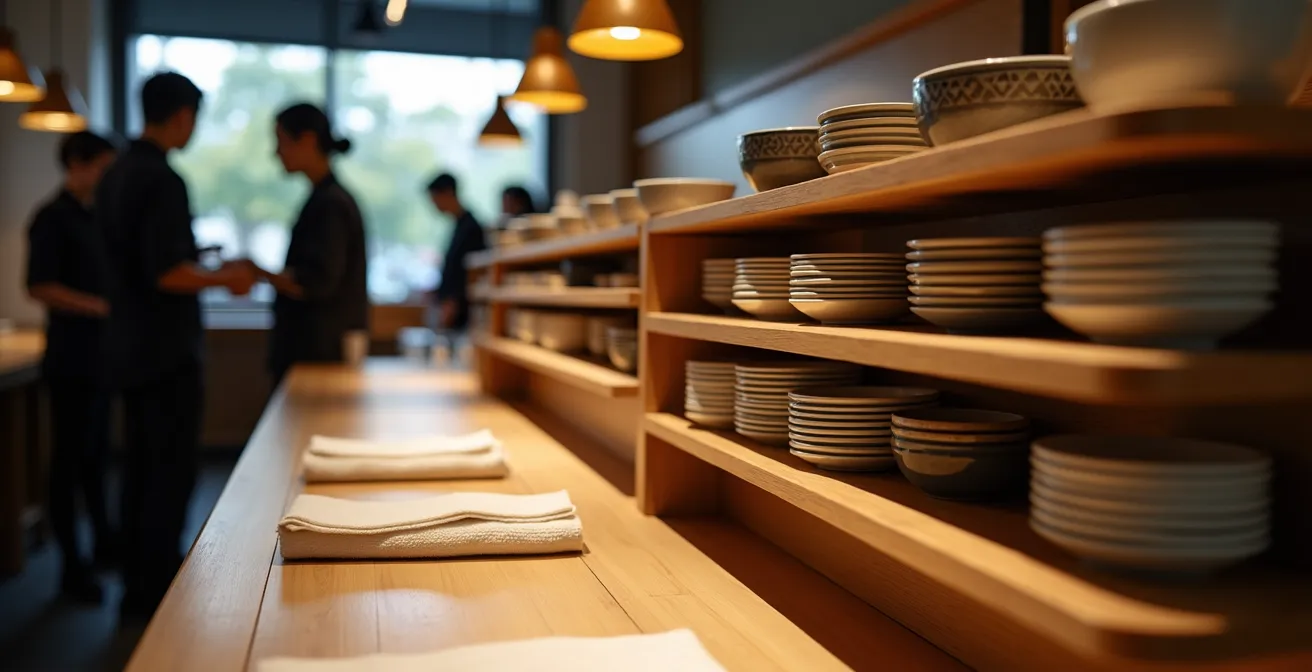
Look for a high counter, often near the kitchen pass-through or the exit. You’ll see other empty bowls and trays stacked there. Place your entire tray on this counter. The staff will take it from there. This act is the final part of your contract with the establishment—you’ve been served quickly, and in return, you help reset the station quickly. In some smaller shops, you might return the bowl directly to the main counter where you ate, but the dedicated return area is more common.
Additionally, it’s good practice to use the damp cloth (zōkin) provided on the counter to give your eating space a quick wipe, especially if you’ve splashed any broth. This small gesture of consideration is the mark of a respectful patron and a seasoned pro. You leave your space as clean as you found it, ready for immediate use. Your role in the high-efficiency system is now complete.
When to Join a Line Based on Length and Turnover Speed?
A line outside a standing noodle bar is a good sign, but for a salaryman, a long line can defeat the purpose of a quick meal. The decision to join a queue is a rapid calculation based on two factors: the number of people and the average turnover time. The key variable is that people typically finish their meals in 5-10 minutes. However, the eating itself is just one part of the process. The total time per person from ordering to leaving is even shorter.
A smart patron uses what can be called the “Two-Minute Rule” for a rough estimate. Here’s how it works:
- Count the number of people in line ahead of you.
- Multiply that number by two minutes. This accounts for time at the vending machine and the short wait for the noodles to be prepared. For example, a line of four people means an approximate 8-minute wait before you’re eating.
- Assess the demographic. A line of solo salarymen will move much faster than a line with tourist groups or families who are unfamiliar with the system.
- Look for bottlenecks. If the line is stalled, it’s often due to someone being confused at the vending machine.
If your estimated wait time exceeds 10 minutes, the “quick meal” advantage is lost. A true pro would immediately pivot and find another nearby shop. In major hubs like Shinjuku or Tokyo Station, there are often multiple tachigui options within a one-minute walk. The goal is efficiency, and that includes efficiently choosing which line to join—or not to join.
Fried Chicken or Oden: How to Order Hot Food at the Counter?
While the vending machine handles the main noodle order, many tachigui shops offer additional hot toppings and side dishes directly at the counter. These are the “upgrades” that turn a basic bowl of noodles into a more substantial meal. The most common additions are various types of tempura, such as kakiage (a mixed fritter of vegetables and sometimes shrimp) or ebi-ten (a single tempura shrimp).
The system is simple: these items are usually displayed in a heated case right on the counter. You simply pick up a small plate, use the provided tongs to select the item you want, and place it in your noodle bowl yourself. The cost of these items is settled one of two ways: some shops have separate, cheaper tickets for toppings on the vending machine, while others operate on an honor system where you tell the staff what you took when you’re leaving. When in doubt, observe what others are doing. The most basic and cheapest dish is kake soba (noodles and broth only), which can cost as little as ¥250-¥400. Adding a piece of tempura is the most common way to create a balanced, satisfying meal.
This table breaks down some of the most popular toppings you’ll encounter:
| Topping | Japanese Name | Description | Typical Price |
|---|---|---|---|
| Basic | Kake Soba | Plain noodles and broth | ¥250-400 |
| Vegetable Mix | Kakiage | Mixed vegetables & shrimp fritter | ¥450-550 |
| Tofu Skin | Kitsune | Sweet fried tofu | ¥400-500 |
| Shrimp | Ebi-ten | Tempura shrimp | ¥500-600 |
| Fish Cake | Chikuwa-ten | Fried fish cake roll | ¥400-500 |
Knowing these options allows you to customize your meal on the fly, optimizing for flavor and fullness just like a local.
Key takeaways
- Speed is Respect: The entire experience, from ordering to leaving, revolves around a 5-10 minute cycle. Your efficiency contributes to the system’s function.
- The Machine is a Gateway: When in doubt, the top-left button is your fail-safe. It’s the quickest path to a standard, satisfying meal.
- Clean-Up is Part of the Process: Returning your tray to the designated counter isn’t optional; it’s the final, crucial step of the ritual.
Tonkotsu vs. Miso: Which Ramen Style Define Each Prefecture?
While ramen has its own vast and complex universe of regional styles like tonkotsu in Fukuoka or miso in Hokkaido, the broth (tsuyu) in tachigui soba shops operates on a different, simpler axis. The primary distinction is not by prefecture, but by a broad regional divide between Kanto (the Tokyo area) and Kansai (the Osaka area). The soup in a typical Tokyo-style standing bar is a bold, dark, and savory concoction. As described in an analysis by Nippon.com, the soup is a simple concoction, consisting mainly of fish stock, dark soy sauce, and mirin, with a pronounced saltiness.
In contrast, the broth in the Kansai region tends to be lighter in color and more delicate in flavor, relying more on the subtle taste of its dashi (kelp and bonito stock) and using a light soy sauce. While you’re unlikely to find rich, fatty tonkotsu at a soba stand, understanding this basic Kanto vs. Kansai broth difference is another layer of insider knowledge. However, the ultimate pro move is learning to customize your order beyond the basics. Once you’re comfortable, you can use specific vocabulary to tailor your bowl exactly to your liking.
Here are a few advanced terms to take your ordering game to the next level:
- ‘Negi-ōme’: A request for a generous extra portion of green onions.
- ‘Tsuyu-nuki’: For noodles without broth, served dry. A rare but valid choice.
- ‘Hiya-atsu’: A connoisseur’s choice, ordering cold noodles to be served in a hot broth. This keeps the noodle texture perfectly firm.
- ‘Ōmori’: The standard request for a large portion of noodles.
- ‘Atsu-mori’: A request for the broth to be extra hot, perfect for a cold winter day.
Mastering this vocabulary is the final step, elevating you from someone who can simply order to someone who can command the counter.
Now you have the complete salaryman’s playbook. You understand the system, the etiquette, and the secret language of the standing noodle bar. The next step is to put this knowledge into practice. Find a bustling station, spot the tell-tale curtain, and step up to the machine with confidence.
Frequently Asked Questions About Japanese Standing Noodle Bars
Should I say anything when leaving?
While not strictly required, it’s a nice gesture to say “Gochisōsama deshita” (Thank you for the meal) to the staff as you leave. It signals appreciation for their hard work.
What if I spill something?
Accidents happen. Use the damp cloth (zōkin) that is always available on the counter to wipe up any spills in your eating area before you leave. It’s part of maintaining the space for the next person.
Is tipping expected?
No, absolutely not. Tipping is not a custom in Japan and can be considered awkward or even rude in some contexts. The price on the ticket is the final price. Paying what is asked is a sign of respect.