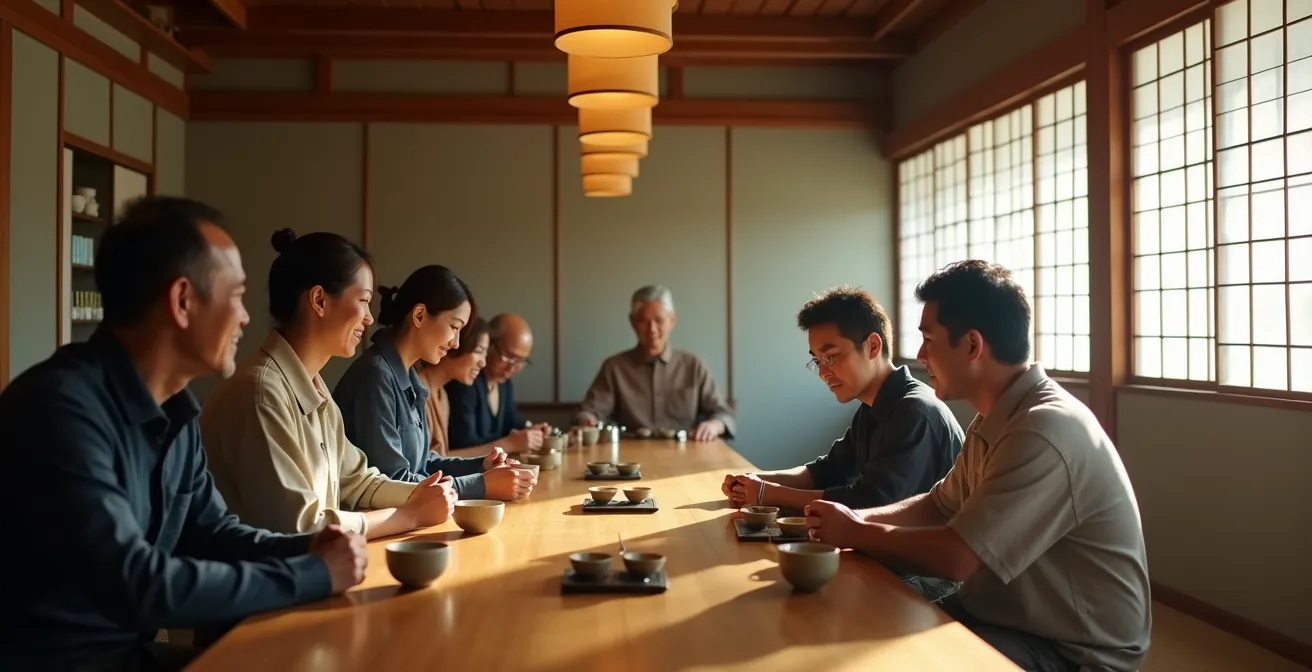
Connecting with locals in Japan is less about language skills and more about understanding the unwritten cultural ‘scripts’ that guide social interactions.
- Recognize and respect social contexts like ‘third places’ and the ‘tatemae’ politeness barrier.
- Use shared hobbies and non-verbal cues as powerful bridges that transcend the language gap.
Recommendation: Focus on showing attentive care and respecting group harmony—this is the true key to being welcomed into their world.
You’re standing in the heart of Tokyo, surrounded by millions, yet you’ve never felt more alone. You’ve seen the temples, tasted the ramen, and navigated the world’s busiest intersection, but every interaction has felt transactional, polite, and distant. This is the classic “tourist bubble,” a frustrating experience for any socially curious traveler wanting to do more than just observe. The common advice—learn a few phrases, go to a bar—often falls short because it misses the fundamental point.
The challenge isn’t a lack of friendly people; it’s a difference in the cultural software running in the background. Genuine connection in Japan doesn’t happen by accident. It’s not about being louder or bolder. Instead, it requires a shift in perspective: from trying to start a conversation to learning how to enter one that’s already happening, governed by unspoken rules. What if the real key wasn’t in what you *say*, but in how you understand the social context?
This guide is designed to act as your cross-cultural coach. We won’t just give you a list of places to go. We’ll deconstruct the cultural scripts—the unspoken rules of engagement—that can turn a polite nod into a shared laugh. By understanding the ‘why’ behind the behavior, you’ll gain the confidence to navigate these social thresholds and build the authentic connections you came here for.
To help you on this journey, this article breaks down the essential cultural insights and practical strategies. Explore the sections below to learn how to read the social landscape, find your tribe, and communicate in a way that fosters true connection.
Summary: A Guide to Moving Beyond Tourism in Japan
- Why Japanese Locals Might Seem Shy and How to Bridge the Gap?
- How to Use Your Hobbies to Meet Like-Minded Japanese People?
- The ‘Tatemae’ Trap: Misreading Politeness as Intimacy
- Guesthouses or Hotels: Which Is Better for Making Local Friends?
- When Is the Best Time to Strike Up a Conversation at an Izakaya?
- How to Simplify Your English Questions to Get Better Answers?
- Why You Never Pour Your Own Sake in a Group Setting?
- Speaking English in Rural Japan: How to Communicate Without Words
Why Japanese Locals Might Seem Shy and How to Bridge the Gap?
What travelers often perceive as shyness in Japan is more accurately a deep-seated cultural respect for social boundaries and a reluctance to impose. In a society that prioritizes group harmony, initiating conversation with a stranger can be seen as a disruption. The key isn’t to be more aggressive in your approach, but to understand and operate within socially accepted contexts. This is where the sociological concept of ‘third places’ becomes incredibly useful. These are neutral, social environments separate from the two primary social environments of home (first place) and work (second place).
In Japan, hobby clubs, local cafes, sports dojos, and community centers function as powerful third places. Within these spaces, the social barriers are naturally lower. People are there by choice, united by a common interest, which provides an implicit permission to interact. For a foreigner, becoming a ‘temporary regular’ at a local coffee shop or joining a weekly activity can be transformative. It shifts your status from a transient tourist to a familiar face, making you part of the local social fabric and dramatically increasing the chances for authentic connection.
Action Plan: Non-Verbal Techniques to Break Barriers
- Master ‘aizuchi’: Use short, interjective phrases like ‘sou desu ne’ (I see) or ‘hai’ (yes) with nods to show you are actively and engagedly listening.
- Learn key gestures: Understand that the ‘X’ made with arms means ‘no’ or ‘forbidden’, and beckoning is done with the palm facing down, not up.
- Practice the Duchenne smile with a bow: Combine a genuine, eye-crinkling smile with a slight, respectful bow. This pairing communicates warmth and respect simultaneously.
- Use ‘communicative objects’: Carry a physical map, a unique postcard from your hometown, or photos on your phone. These act as natural, low-pressure conversation starters.
- Engage in parallel activities: Participate in a festival dance or join a sports club. Shared purpose often precedes conversation and builds a foundation of common experience.
Ultimately, bridging the gap is about demonstrating that you understand and respect the local way of life. It’s an invitation, not a demand, for connection.
How to Use Your Hobbies to Meet Like-Minded Japanese People?
One of the most effective shortcuts to genuine connection in any culture is through shared passions. In Japan, where group activities are a cornerstone of social life, this is especially true. While it might be tempting to guess what hobbies are popular, data provides a clearer picture. It might be surprising that traveling and shopping are the top two hobbies for Japanese consumers, but this insight reveals a culture that values experiences and aesthetics. This opens up countless opportunities for connection in museums, shops, and scenic spots.
Beyond broad trends, niche hobbies create even stronger bonds. Platforms like Meetup.com have become vital for connecting locals and internationals in major cities. A case study of these groups shows that activities with a strong cultural component, such as karate or kendo, are particularly effective. Japanese practitioners are often eager to share these traditions with enthusiastic foreigners, creating an immediate master-student dynamic that bypasses awkward small talk and builds rapport through shared effort and discipline. This principle of ‘low-stakes parallelism’—doing something alongside someone—is a powerful tool for connection.
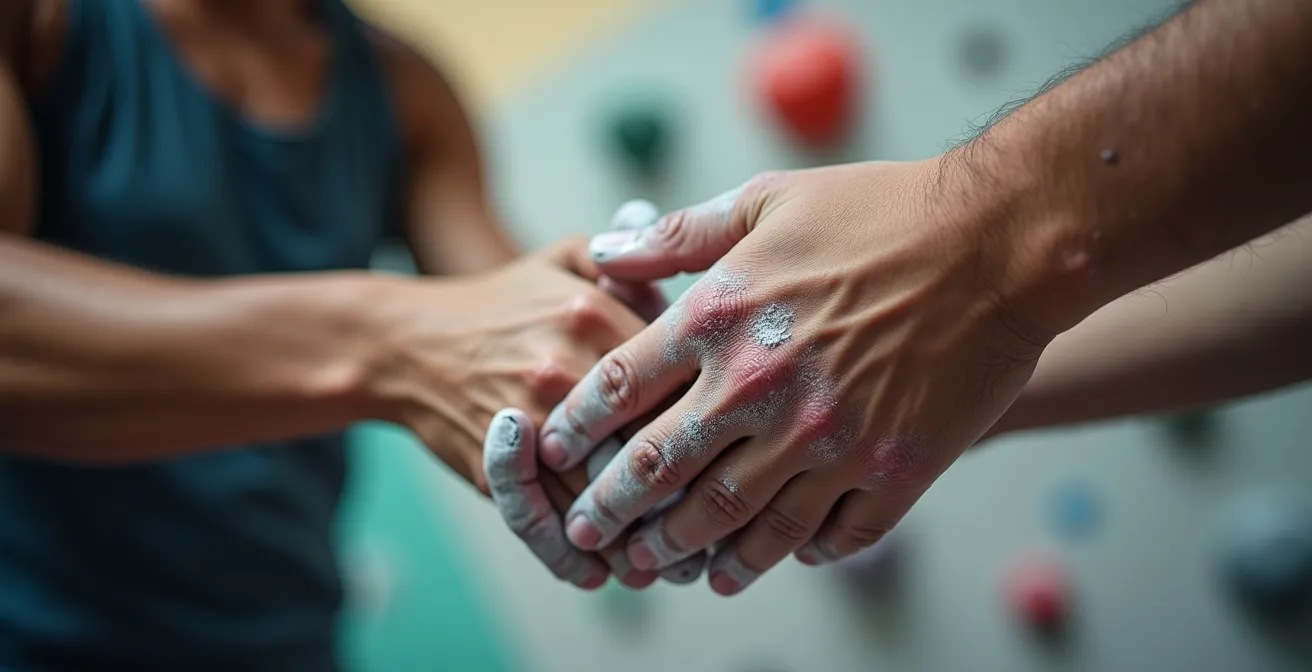
Whether it’s bouldering, photography, or attending a traditional tea ceremony class, your hobby is a key. It’s a non-verbal declaration of who you are and provides an instant common ground. It allows you to meet people not as a ‘foreigner’, but as a ‘fellow climber’, a ‘fellow photographer’, or a ‘fellow student of the art’. This shift in identity is the first step toward being seen as an individual, not a tourist.
So, don’t leave your hobbies at home. Pack them with you, and use them as your passport to communities that are waiting to welcome you.
The ‘Tatemae’ Trap: Misreading Politeness as Intimacy
One of the most significant cultural hurdles for visitors to Japan is navigating the concepts of Tatemae (建前) and Honne (本音). Tatemae refers to the public behavior and opinions one displays to maintain social harmony, while Honne is one’s true thoughts and feelings. For Westerners accustomed to direct communication, Tatemae can feel insincere or confusing, leading to the ‘Tatemae Trap’: misinterpreting extreme politeness and agreeableness as a sign of a deep, personal connection when it is often a social lubricant.
This is especially prevalent in service situations. As cross-cultural expert Sayuri Fujiwara explains, the cultural mindset can be a barrier to connection. She notes on her podcast that the principle of ‘Okyakusama wa kamisama’ (The customer is God) creates a professional distance that can be hard to penetrate:
The customer is always right concept in Japan, known as ‘Okyakusama wa kamisama’ (The customer is God), can be a barrier to authentic connection. The easiest person to talk to first is often the master or chef, but only when they are not busy.
– Sayuri Fujiwara, How to Connect with Locals in Japan podcast
Understanding this distinction is not about becoming cynical; it’s about developing cultural intelligence. Tatemae is not deception; it is a tool of kindness used to ensure that interactions run smoothly and no one loses face. The skill to develop is recognizing the subtle cues that signal a shift from the public self (Tatemae) to the private self (Honne). A quick, high-pitched ‘ii desu ne!’ (that’s nice!) is polite dismissal, whereas a slower, more thoughtful ‘hontou ni omoshiroi to omoimasu’ (I think that’s truly interesting) followed by a question indicates genuine interest.
By respecting the function of Tatemae and learning to listen for the whispers of Honne, you can avoid misunderstandings and build relationships based on a true foundation.
Guesthouses or Hotels: Which Is Better for Making Local Friends?
Your choice of accommodation is one of the most strategic decisions you can make when trying to connect with locals. It sets the stage for the types of interactions you’re likely to have. While large, urban guesthouses are fantastic for meeting other international travelers, they can inadvertently create a ‘foreigner bubble,’ insulating you from the very local culture you came to experience. Conversely, anonymous business hotels offer privacy but few opportunities for spontaneous interaction. A more nuanced approach is required, as shown in a comparative analysis of accommodation types.
| Accommodation Type | Local Interaction Level | Best For | Drawbacks |
|---|---|---|---|
| Urban Guesthouses | Low with locals | Meeting other travelers | Often foreigner bubbles |
| Business Hotel Bars | Moderate | Calm conversations with professionals | Limited to evening hours |
| Minshuku (Family-run) | High | Cultural bridge through hosts | Language barrier possible |
| Rural Guesthouses | High | Novelty factor increases interaction | Limited availability |
| Ryokan (Traditional Inn) | Moderate | Staff connection through appreciation | Formal atmosphere |
The data clearly points towards smaller, family-run establishments as the premier choice for cultural immersion. A Minshuku, or a family-run inn, is designed for high interaction. Sharing meals with the host family transforms your stay from a simple transaction into a cultural exchange. Similarly, guesthouses in rural areas offer a high chance of interaction, as your novelty as a foreign visitor can make you a point of interest and pride for the community.
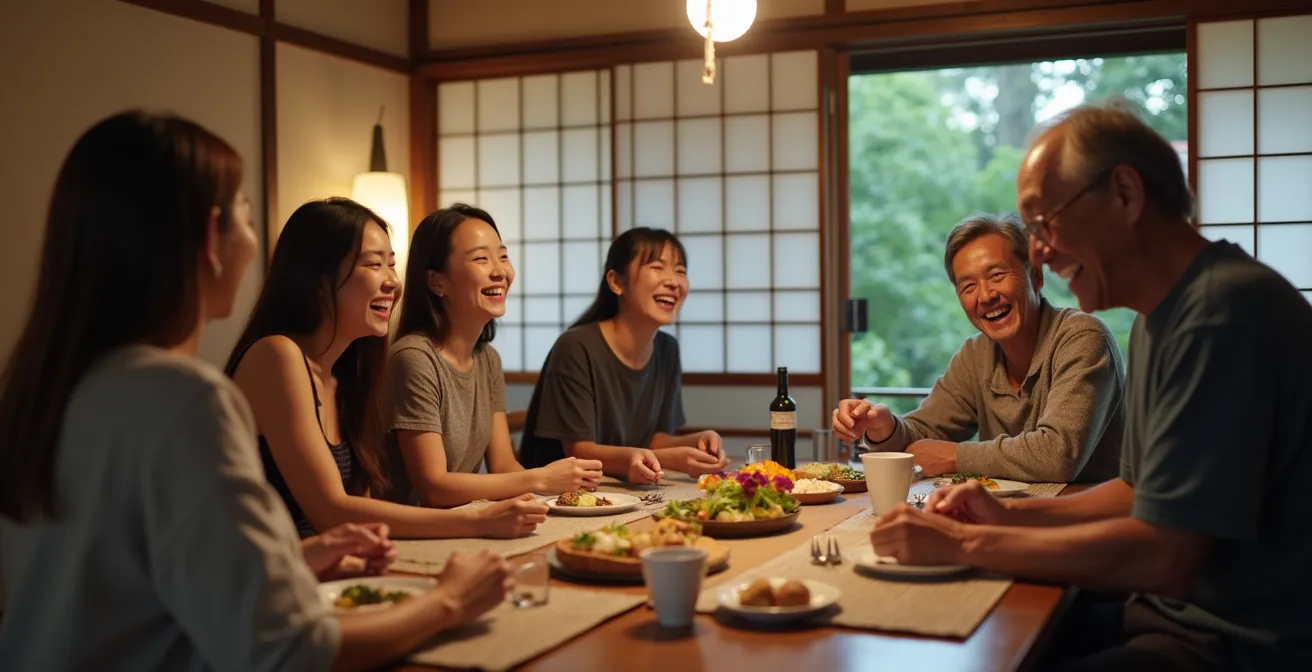
Even in a more formal Ryokan, a deep connection can be forged with the staff by showing genuine appreciation for the intricate service and artistry involved. The key is to choose an environment where the lines between guest and host are blurred, creating opportunities for human connection beyond a simple room key exchange.
Ultimately, to meet locals, you must go where they are, and often, that means choosing a place to sleep that feels more like a home than a hotel.
When Is the Best Time to Strike Up a Conversation at an Izakaya?
The izakaya, Japan’s version of a gastropub, seems like the perfect place to meet locals. However, many travelers find themselves sitting silently, unable to break into the lively conversations around them. The secret to success in an izakaya lies in two things: positioning and timing. Strategically, choosing to sit at the counter (‘kaunta-seki’) is a powerful non-verbal signal. It physically places you in a shared space, open to interaction with both the staff and your neighbors, unlike the more private tables.
Timing, however, is even more critical. There is a golden window of opportunity for conversation that experienced patrons intuitively understand. This moment occurs shortly after the initial rush of ordering, often symbolized by the arrival of the first round of drinks—the ubiquitous ‘toriaezu biru’ (beer for now) moment. In this 15-minute window, the initial pressure is off, but groups have not yet become deeply engrossed in their own private conversations. This is the ideal time for a casual, low-pressure interaction.
The conversation starters you use are just as important as the timing. Instead of generic tourist questions (“Where are you from?”), focus on the shared environment. Complimenting a neighbor’s dish (‘Oishisou desu ne! Sore wa nan desu ka?’ – “That looks delicious! What is it?”) is a natural and appreciated opening. Another effective strategy is to start with the master or chef, but only when they are not busy. Showing genuine interest in their craft can lead to them introducing you to other regulars, effectively giving you a social endorsement.
By combining strategic seating, perfect timing, and context-appropriate conversation starters, the izakaya can transform from an intimidating space into your best opportunity for connection.
How to Simplify Your English Questions to Get Better Answers?
When communication breaks down, it’s easy to assume the issue is a language barrier. But often, it’s a ‘complexity’ barrier. Studies show that less than 30% of Japanese adults feel confident speaking English, and this number is significantly lower in rural areas. This lack of confidence is compounded by a cultural fear of providing incomplete or incorrect information. A complex, multi-part question in English can be overwhelming, causing the listener to shut down not because they don’t understand any of it, but because they can’t guarantee a perfect, comprehensive answer.
The solution is radical simplification. Adopt the ‘Singular Question Method’. Break down your queries into their smallest possible components. Instead of asking, “Excuse me, can you tell me the best way to walk to the castle and how long it might take?”, you should break it into a series of simple, closed questions, often accompanied by gestures or visual aids. First, point to the castle on your map and ask, “Castle?” Once you get a nod, follow up with, “Walk?” with a walking gesture. This reduces the cognitive load on your conversation partner and allows them to answer with a simple ‘yes’, ‘no’, or a pointing gesture.
Using tools is also essential. Have a notepad and pen ready to write down crucial information like bus numbers or times. Use your phone to show a picture of what you’re looking for. This isn’t ‘dumbing down’ your communication; it’s making it more precise and respectful of the other person’s comfort level with English. It’s a form of communicative kindness that shows you are willing to meet them halfway, which often opens the door to more warmth and a greater willingness to help.
Clear, simple communication is an act of respect, and it will be rewarded with far more than just directions to the castle.
Why You Never Pour Your Own Sake in a Group Setting?
One of the most elegant and telling rituals in Japanese social life is the etiquette of pouring sake. To an outsider, the rule ‘never pour your own drink’ might seem like a quaint tradition. But to a local, it’s a physical manifestation of a core cultural value: mutual care and group cohesion. This small act is a constant, flowing ritual that reinforces shared awareness and attentiveness within the group. It is a fundamental cultural script for demonstrating respect and belonging.
When you pour for others, you are demonstrating attentiveness—you are literally looking out for their needs. When you allow others to pour for you, you are showing a graceful acceptance of their care. The correct etiquette is to lift your cup (‘o-shaku’) off the table, holding it with two hands, as someone fills it for you. This two-handed gesture of receiving is a universal sign of respect in Japan. Pouring your own sake, by contrast, sends a message of individualism and a lack of awareness of the group, effectively breaking the delicate web of reciprocity.
This principle of mutual care isn’t just about drinks. It’s a microcosm of how social relationships are built and maintained in Japan. It’s about anticipating the needs of others, acting in a way that benefits the group, and graciously accepting the care that is offered in return. The rules are strictest at the beginning of a formal meal or gathering. As the night progresses and the group moves to a ‘nijikai’ (second party), the atmosphere becomes more informal, but the underlying principle of looking out for one another remains.
By participating in this ritual, you are not just drinking sake; you are speaking a language of respect and care that every Japanese person understands.
Key Takeaways
- Focus on context over content: Understand concepts like ‘third places’ and ‘tatemae’ before you even try to connect. Your environment and cultural awareness are paramount.
- Shared action speaks louder than words: Use hobbies, parallel activities, and non-verbal rituals like sake etiquette as powerful bridges that build rapport without language.
- Reciprocity is the core of connection: Pouring for others, simplifying your questions, and receiving help gracefully are all acts of attentive care that open doors to genuine friendship.
Speaking English in Rural Japan: How to Communicate Without Words
In the bustling cities of Japan, you can often get by with English. But once you venture into the serene countryside, the language barrier can feel like an insurmountable wall. This is where many travelers give up, retreating into silence. However, this is also where the most profound connections can be made, precisely because you are forced to communicate on a more fundamental, human level. The key is to embrace the concept of communicative silence and shared presence.
In rural communities where foreign visitors are still a novelty, your very presence is a conversation starter. But the connection isn’t forged through words. It’s built through small, shared activities. Travelers report powerful moments of connection from simply helping an elderly farmer pick up dropped vegetables, sketching a landscape alongside a local artist, or even just sharing a quiet moment of rest at a roadside vending machine. These shared, silent activities create an authentic bond that transcends language. They demonstrate a willingness to participate in the rhythm of local life, not just observe it.
Your non-verbal toolkit is your primary language here. A genuine smile paired with a respectful bow is a universal signal of goodwill. Using ‘communicative objects’ like a physical map or photos from your hometown can bridge the gap and tell your story without a single word of English. Mastering a few key Japanese gestures, like the hand wave in front of the nose for polite refusal or the palm-down beckoning motion, shows a level of effort and respect that will be deeply appreciated. It communicates that you care enough to learn their way of communicating.
Start your next journey not just as a tourist, but as an observant and respectful guest. The most rewarding connections are waiting for you just beyond the surface, in the quiet moments of shared humanity.