The frustration of seeking tranquility in Kyoto’s crowded temples stems from a tourist’s approach focused on sight alone. This guide reframes your visit through the eyes of a historian and pilgrim, revealing that true silence isn’t found by avoiding people, but by cultivating an “inner temple.” By learning to read architectural narratives, engage all your senses, and understand the meaning behind rituals, you can connect with the profound serenity of these sacred spaces, even amidst the crowds.
To stand before the Golden Pavilion, Kinkaku-ji, is to be caught in a river of humanity. The click of a thousand shutters forms a constant, percussive rhythm, a soundtrack to the very scene you came to escape. For the cultural tourist, Kyoto presents a paradox: you seek the city’s soul, its deep, resonant silence, but you find yourself in a crowd seeking the exact same thing. The common advice—to arrive at dawn or seek out obscure locations—treats the symptom, not the cause. It assumes the problem is external, that the presence of others is the primary barrier to a spiritual moment.
But from a historian’s perspective, this is a fundamental misunderstanding of what a temple is. These are not static museums to be consumed visually. They are living spaces, designed with a profound intentionality to guide the mind from the profane to the sacred. The true obstacle is not the crowd, but the lens through which we view the experience. We arrive as photographers, collectors of images, when we should arrive as pilgrims, participants in a centuries-old conversation between space, spirit, and self. The key to unlocking Kyoto’s Zen silence does not lie in finding an empty temple, but in building a quiet one within yourself.
This guide will not give you a list of “secret” spots. Instead, it will give you a new set of eyes and ears. We will explore how to move beyond merely taking photos, how to read the silent stories told by architecture, and how to understand the deep meaning in simple acts like removing your shoes or bowing. By shifting your awareness, you can transform a frustrating tourist trap into a profound personal pilgrimage, finding stillness not in the absence of people, but in the depth of your own presence.
This article provides a framework for transforming your experience. The following sections will guide you through the practical and philosophical shifts required to find that elusive tranquility, offering a path from sightseeing to soul-seeing.
Summary: Finding the Inner Temple in Kyoto
- Why Just Taking Photos Misses the Point of Temple Visits?
- How to Read Temple Architecture Like a Historian
- The Footwear Error That Disrespects Sacred Wooden Halls
- Kinkaku-ji or Daitoku-ji: Selecting for Gold or Solitude?
- When to Arrive to Catch the Morning Chanting Rituals?
- Why a 15-Degree Bow Is Insufficient for an Apology?
- Torii Gate or Pagoda: How to Instantly Tell Shrines From Temples?
- Is a 4-Hour Tea Ceremony Worth It for Casual Travelers?
Why Just Taking Photos Misses the Point of Temple Visits?
The impulse is almost automatic: you see beauty, you raise your phone. In a Kyoto temple, this translates into a constant hunt for the perfect angle, the ideal light on a mossy stone lantern. Yet, this very act of “capturing” the moment prevents you from truly experiencing it. The focus shifts from being present within the space to producing a representation of it for a future audience. Your mind is on composition, filters, and framing, not on the scent of ancient cypress wood or the feeling of cool air from a bamboo grove. This isn’t just a philosophical idea; it’s a neurological reality. The brain simply operates differently when observing versus when preparing to photograph.
Engaging with a sacred space requires a multi-sensory presence that photography short-circuits. As recent neuroscience research reveals, the act of mindful observation, similar to meditation, encourages a state of sensory synchrony, where the brain is fully immersed in the present environment. The alternative is to perform a kind of “sensory archaeology” yourself, actively cataloging the non-visual information that gives a place its soul. The sound of a single water droplet at a chozubachi (purification basin), the smoky fragrance of incense mingling with damp earth, the texture of a worn wooden railing under your palm—these are the data points of a profound experience. A photograph is a souvenir; a sensory memory is an integration.
To break the cycle, you must consciously choose to be a receiver before a creator. Grant yourself a period of device-free immersion upon entering a new area of the temple. Let your senses, not your camera lens, be the primary aperture through which you experience the space. You may find that after five minutes of genuine presence, the urge to take a dozen photos is replaced by the desire to take one, highly intentional one, or perhaps none at all.
Action Plan: The Sensory Snapshot Technique
- Find a spot in the temple where you feel most peaceful and sit for 2 minutes without any device.
- Close your eyes and consciously catalog 3 distinct sounds around you (e.g., wind in the pines, distant chanting, footsteps on gravel).
- Take 3 deep breaths and identify the unique scents present (e.g., incense, old wood, moss after rain).
- Open your eyes slowly and memorize one specific detail about the quality of the light—how it falls on a surface or filters through leaves.
- Only after this full sensory recording, consider taking a single, intentional photograph that represents the feeling, not just the sight.
The goal is to shift your memory-making from a visual checklist to a holistic, embodied experience. This internal snapshot is far more vivid and lasting than any image stored on a memory card.
How to Read Temple Architecture Like a Historian
A Japanese temple complex is not a random collection of beautiful buildings; it is a meticulously crafted architectural narrative. Each gate, path, and hall is a sentence in a story designed to guide a visitor’s mind from the chaotic outer world to a state of inner stillness. To a tourist, a massive Sanmon gate is an impressive photo opportunity. To a historian, it is a powerful threshold, a physical and psychological barrier that signals the beginning of a sacred journey. Walking through it is an act of commitment.
This progression is the key. The layout intentionally creates a sequence of experiences. You might move from the imposing, public scale of the outer gate, through a carefully composed garden that forces your path to slow and meander, and finally into the dark, intimate interior of the main hall (Hondo). This isn’t poor planning; it’s a form of spatial therapy. The architecture systematically quiets the mind by creating increasingly personal and contemplative spaces. The path itself becomes a meditation, with each turn revealing a new, controlled vista and hiding the distractions left behind. Noticing this deliberate design is the first step in participating in it.
Case Study: The Spiritual Journey of Nanzen-ji’s Architecture
The renowned Nanzen-ji Temple complex demonstrates this spiritual narrative perfectly. Visitors first encounter the massive, historic Sanmon Gate, one of the most famous in Japan. Passing through this imposing structure, you leave the city behind. The path then leads you through expansive grounds and sub-temples, with gardens dotted with Buddha statues and carefully framed views. This journey forces a slowing of pace and a shift in focus. By the time you reach the main hall or the serene abbot’s quarters (Hojo), your mind has been prepared by the journey. The architecture has created a progression from the grand and public to the quiet and sacred, naturally encouraging a state of contemplation long before you sit down to meditate.
This concept of a designed journey is visible in the way pathways curve rather than run straight, forcing you to be mindful of each step. The framing of views through gates and windows is also intentional, presenting the natural world as a perfectly composed painting. This is the temple’s silent sermon.
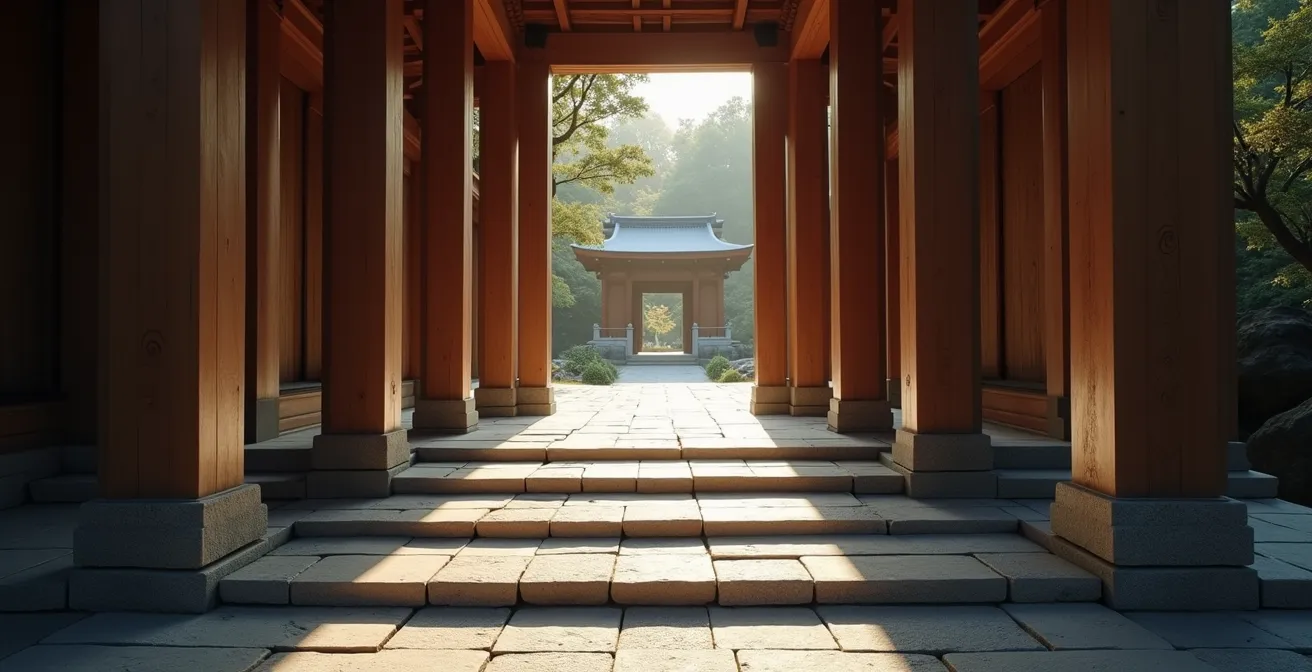
As this image illustrates, the journey through a temple is a journey through layers of meaning. Each threshold is an invitation to leave something behind and become more present. By reading this architectural language, you are no longer just a spectator; you become an active participant in the temple’s primary function: the cultivation of peace.
Next time you visit, try to identify this narrative. Ask yourself: What is this gate telling me? Why does this path curve? How does the light change as I move deeper into the complex? This active questioning transforms the visit from a passive stroll into an engaging dialogue with centuries of spiritual design.
The Footwear Error That Disrespects Sacred Wooden Halls
At the entrance to any temple’s main hall, you will find a genkan—a small, lowered area where shoes are to be removed. For many visitors, this is a simple logistical step, often rushed. Shoes are hastily kicked off, socks are mismatched, and the focus is on getting inside quickly. This, from a cultural and spiritual perspective, is a significant error. The act of removing your shoes is not about cleanliness alone; it is a mindful transition, a ritual of shedding the outside world—its dirt, its noise, its hurried pace—before stepping onto sacred ground.
The polished wooden floors of a temple hall, often hundreds of years old, are not just floorboards. They are a tactile link to history, smoothed by the passage of millions of pilgrims, monks, and devotees. To step on them with socks is one thing; to do so mindfully is another. The sensation of the cool, ancient wood underfoot is a powerful sensory anchor to the present moment. It connects you physically to the generations who have walked the same path. Rushing this moment or treating it as an inconvenience is like skipping the first chapter of a book; you miss the context and the setup for everything that follows.
Case Study: Taizo-in Temple’s Mindful Transition Practice
At Taizo-in, a tranquil sub-temple within the larger Myoshin-ji complex, Deputy Head Priest Daiko Matsuyama actively teaches visitors this concept. He explains that removing one’s shoes is a conscious ritual of leaving the concerns of daily life at the door. The temple’s 400-year-old wooden floors have been polished to a soft gleam by the soles and feet of countless visitors. He encourages guests to feel this connection. Many participants report that this simple, guided act of going barefoot and feeling the floor immediately shifts their mental state from that of a “tourist” looking at things to a “pilgrim” feeling a part of the space.
This practice, known as sokkan, or feeling with the soles of your feet, is a form of walking meditation. It demands slowness and awareness. You notice the slight give of a centuries-old board, the subtle temperature changes in the room, and the texture of the wood grain. It grounds you in your body and in the history of the building in a way that looking at a statue from a distance never can. The footwear error isn’t just about disrespect; it’s a missed opportunity for one of the most profound and direct connections a temple has to offer.
Therefore, approach the genkan not as a hassle, but as the temple’s first gift. Pause, breathe, and remove your shoes with intention. As your bare or sock-clad feet touch the wood, let it be the moment your pilgrimage truly begins.
Kinkaku-ji or Daitoku-ji: Selecting for Gold or Solitude?
The choice between Kyoto’s temples often boils down to a fundamental conflict: spectacle versus solitude. Kinkaku-ji, the Golden Pavilion, is the epitome of spectacle. Its shimmering reflection in the mirror pond is an iconic image of Japan, a magnet for visitors from around the world. Daitoku-ji, by contrast, is a sprawling, walled complex of over twenty sub-temples, a place known not for a single dazzling sight but for its profound, understated Zen atmosphere. Choosing between them is choosing the kind of experience you want.
Kinkaku-ji promises a singular, breathtaking visual reward. However, this reward comes at a cost: crowds. With over 2.7 million visitors annually at popular temples, the experience can feel more like a queue for a photo op than a spiritual visit. The path is a fixed, one-way loop, designed for efficient crowd management. Contemplation is difficult when you are being gently but firmly moved along by the flow of people behind you. Daitoku-ji offers the opposite. There is no single “money shot.” Instead, its beauty is distributed across numerous gardens, tea houses, and halls, each hidden behind its own wall, requiring a separate entrance fee and a conscious decision to enter. This structure naturally filters out the casual tourist, leaving a quiet space for those seeking the aesthetic of absence—the beauty found in empty spaces, subtle textures, and the sound of the wind.
The table below breaks down this choice. It highlights that while some temples are built for mass admiration, others are designed for personal reflection. The best choice depends entirely on your goal. Are you there to see something unforgettable, or to feel something unforgettable?
| Aspect | Kinkaku-ji (Golden Pavilion) | Daitoku-ji Complex |
|---|---|---|
| Annual Visitors | Over 5 million | Under 500,000 |
| Best Time | Opening (9am) or closing (5pm) | Any time, especially afternoons |
| Experience Type | Visual spectacle, photography | Contemplation, multiple gardens |
| Entrance Fee | 400 yen (single temple) | 400-600 yen per sub-temple |
| Meditation Quality | Difficult due to crowds | Excellent in quieter sub-temples |
| Photography | Iconic but crowded shots | Intimate garden compositions |
Ultimately, a balanced itinerary might include both. Visit Kinkaku-ji at the least crowded time possible to appreciate its sheer beauty, but then retreat to a quiet sub-temple at Daitoku-ji to find the deep, resonant silence that is the true heart of Kyoto’s Zen tradition.
When to Arrive to Catch the Morning Chanting Rituals?
For many, the most profound auditory experience in Kyoto is the sound of morning chanting (called o-kyo or gongyo). This is not a performance for tourists but a living practice, the daily spiritual work of the monastic community. To witness it is to be given a rare glimpse into the rhythmic heart of the temple. The deep, resonant vibrations of the sutras, the percussive strike of the wooden fish, and the clear ring of the bell create an atmosphere of intense focus and serenity. However, attending requires planning and, above all, respect.
Most morning services begin very early, typically around 6:00 a.m. It is crucial to arrive at least 15 minutes beforehand. This is not only to find the location (which can be difficult in a large, dark complex) but to show respect. Arriving late and disrupting the service is a serious breach of etiquette. Upon arrival, you will likely be guided by a monk or temple staff to a designated area for visitors, usually at the back or side of the hall. The posture should be one of quiet observation. Sit respectfully, remain absolutely silent, and under no circumstances should you ever take photos or make recordings. This is a moment of communal prayer, not a concert.
The experience is powerful. The air, thick with the scent of morning incense, seems to vibrate with the collective voices. It’s a form of sensory immersion that transcends simple hearing, allowing you to feel the devotion that has sustained the temple for centuries. This is the ultimate antidote to the noisy, visual-first approach of tourism.
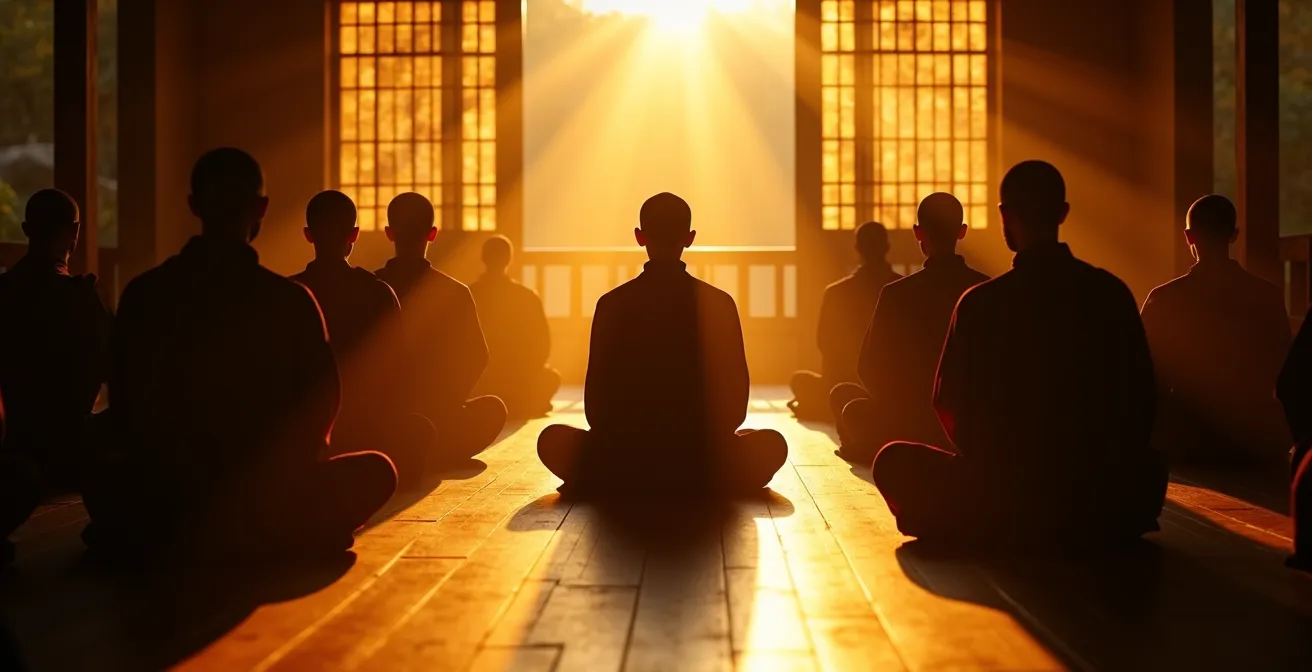
As the dawn light begins to filter through the paper screens, illuminating the monks in silhouette, you are not just a spectator but a silent witness to an ancient, unbroken tradition. Below are some temples in Kyoto that welcome respectful visitors to their morning services. Always check their official websites before visiting, as schedules can change.
- Chion-in Temple: 6:00 a.m. daily. A massive-scale service with over 70 monks in one of Kyoto’s largest temple halls. Visitors are welcome to observe from the back.
- Nanzen-ji Temple: 6:00 a.m. on the 2nd and 4th Sundays of the month. Offers free ‘Gyo-ten Zazen’ (dawn Zen meditation) sessions.
- Enkoji Temple: 6:00 a.m. every Sunday. A smaller, more intimate setting that often includes a simple breakfast after the meditation session.
Participating in this way, even as a silent observer, fundamentally changes your relationship with the temple. You have shared a moment of its inner life, experiencing it not as a monument, but as a living, breathing spiritual home.
Why a 15-Degree Bow Is Insufficient for an Apology?
In the West, a bow can feel like an antiquated or overly formal gesture. In Japan, and particularly within the sacred context of a temple, it is a rich and nuanced form of communication. The angle of a bow conveys precise levels of respect, gratitude, or apology. A casual 15-degree bow, or eshaku, is the equivalent of a nod between colleagues. Using it in a temple, especially when passing an altar or addressing a monk, is akin to offering a curt “hey” in a cathedral—it’s not offensive, but it shows a lack of understanding.
The proper gesture in a Zen temple is the gassho: placing the palms together at chest height, with fingertips pointing upwards. This is not a gesture of supplication, but one of recognition. As explained at temples like Jusho-in, it symbolizes the unity of the self and the other, acknowledging the shared Buddha-nature in all things. The gassho is then combined with a bow. A 30-degree bow (keirei) is the standard for showing respect when entering a temple hall or passing a sacred object. A deeper, 45-degree bow (saikeirei) is reserved for moments of deep reverence, such as when standing directly before the main Buddha statue.
The error is not just in the angle, but in the intention. A rushed, shallow bow is a gesture devoid of meaning. A slow, mindful bow, holding the position for a moment at its deepest point, transforms the physical act into a mental one. It is an act of humility, a moment to quiet the ego and acknowledge something greater than oneself. Visitors who adopt this practice often report feeling a natural shift in their mindset; the respectful posture makes them more receptive to the temple’s peaceful atmosphere.
Your Action Plan: The Three Levels of Temple Bowing
- 15-degree bow (Eshaku): A casual nod for informal greetings. Avoid using this as your primary bow within temple grounds.
- 30-degree bow (Keirei): The standard bow of respect. Use this when entering or leaving temple halls, and when passing in front of altars.
- 45-degree bow (Saikeirei): The bow of deep reverence. Reserve this for moments of prayer or when directly addressing the main object of worship.
- Always maintain the gassho (palms together) position during the bow, keeping your back straight and bending from the hips.
- Pause for a full second at the deepest point of the bow before rising slowly and mindfully. Do not rush the movement.
By learning and using the correct bow, you are no longer just looking at a culture; you are respectfully engaging with it. This small adjustment is a powerful signal, both to others and to yourself, that you are entering a space that requires a different kind of presence.
Torii Gate or Pagoda: How to Instantly Tell Shrines From Temples?
To the untrained eye, the sacred sites of Japan can blur into a single aesthetic of graceful roofs and serene gardens. Yet, there is a fundamental distinction between a Shinto shrine (jinja) and a Buddhist temple (tera). They belong to two different, though often intertwined, religious traditions, and their architecture and atmosphere reflect their distinct philosophies. Knowing how to instantly identify which you are in is crucial for understanding the space and behaving appropriately.
The most immediate giveaway is the entrance. If you pass through a Torii gate—typically a simple structure of two upright posts and two horizontal crossbars, often painted a vibrant vermillion—you are entering a Shinto shrine. A Torii marks the transition from the mundane world to the sacred space of the kami, or Shinto deities. Conversely, if you enter through a larger, more complex Sanmon gate, often a two-story wooden structure with tiled roofs and guardian statues, you are in a Buddhist temple. These gates are the grand entrances to the realm of Buddhist teaching.
Once inside, your other senses can confirm your location. This is where “sensory archaeology” becomes a practical tool. A Buddhist temple is often characterized by the rich, sweet scent of burning incense (o-senko). The dominant sounds might be the rhythmic chanting of sutras or the deep gong of a large bell. The silence here is austere and contemplative. In contrast, a Shinto shrine often smells of earth, moss, and camphor wood. The sounds are those of nature—the rustling of leaves in sacred trees, the cawing of crows (often considered messengers of the kami). The silence is alive and connected to the natural world. The worship style also differs: at a shrine, you clap twice to get the kami’s attention; at a temple, prayer is silent and often accompanied by an incense offering.
This comparative guide provides a quick reference for identifying these key differences, allowing you to attune your senses to the specific environment you’ve entered.
| Feature | Shinto Shrine | Buddhist Temple |
|---|---|---|
| Entry Marker | Torii gate (usually vermillion) | Sanmon gate (wooden, often two-story) |
| Primary Scent | Camphor wood, moss, earth | Incense (sandalwood), aged wood |
| Sound | Rustling leaves, crows, nature | Bells, chanting, wooden clappers |
| Type of Silence | Alive, natural, connected to kami | Deep, austere, contemplative |
| Worship Style | Clap twice, bow twice | Quiet prayer, incense offering |
| Architecture | Raised floors, natural wood | Pagodas, Buddha statues, gardens |
Recognizing these differences enriches your experience immeasurably. You begin to appreciate not just the beauty of a site, but its unique spiritual personality, allowing you to engage with it on its own terms.
Key Takeaways
- True silence in Kyoto is an internal state, not an external condition; it’s achieved by shifting from a tourist’s gaze to a pilgrim’s awareness.
- Engage all senses—sound, smell, touch—to experience a temple’s history and atmosphere, a practice called “sensory archaeology” that photography often prevents.
- Respectful interaction through proper bowing and mindful transitions (like removing shoes) is not just etiquette, but a technique for quieting the ego and connecting with the sacred space.
Is a 4-Hour Tea Ceremony Worth It for Casual Travelers?
The Japanese tea ceremony, or chanoyu, is often presented to tourists in an abbreviated, 45-minute format: a bowl of whisked matcha and a sweet in a pleasant setting. It’s an enjoyable taste of the culture. But the question arises: is the full, formal 4-hour ceremony, known as a chaji, worth the significant investment of time and money for a casual traveler? For those seeking the deep Zen experience this guide advocates for, the answer is a resounding yes. A chaji is not about drinking tea; it is a meticulously choreographed meditation on time, presence, and the beauty of imperfection (wabi-sabi).
The extended duration is the point. Unlike a short tasting, a 4-hour ceremony forces you to surrender to its rhythm. It typically includes a multi-course kaiseki meal, a period of meditation in the garden, and the serving of both thick tea (koicha) and thin tea (usucha). This slow, deliberate progression recalibrates your internal clock. The hustle of your travel itinerary dissolves. You are left with nothing but the present moment: the sound of water boiling in the iron kettle, the precise, graceful movements of the host, the feel of the ceramic bowl in your hands. At Shunkoin Temple, for example, the deputy abbot notes that even the most skeptical visitors emerge from a chaji transformed, having gained a profound, embodied understanding of Zen philosophy that no book could provide.
Of course, a 4-hour commitment isn’t feasible for everyone. The key is to choose an experience that aligns with your level of interest and available time. A 90-minute abbreviated ceremony (chakai) offers a deeper dive than a simple teahouse visit, while still fitting into a busy schedule. The table below offers a guide to help you decide.
| Option | Duration | Experience | Best For | Cost |
|---|---|---|---|---|
| Full Chaji | 4 hours | Kaiseki meal, garden time, both teas | Deep cultural immersion seekers | 10,000-15,000 yen |
| Abbreviated Chakai | 90 minutes | Sweet and usucha tea only | Interested but time-limited visitors | 3,000-5,000 yen |
| Temple Teahouse | 45 minutes | Casual matcha and sweet in garden setting | First-timers wanting authentic taste | 1,000-2,000 yen |
For the traveler truly seeking to find silence in Kyoto, the chaji is not a detour from the journey—it is a destination in itself. It is a rare opportunity to experience the very essence of Zen, where the simple act of preparing and receiving tea becomes a gateway to profound stillness.