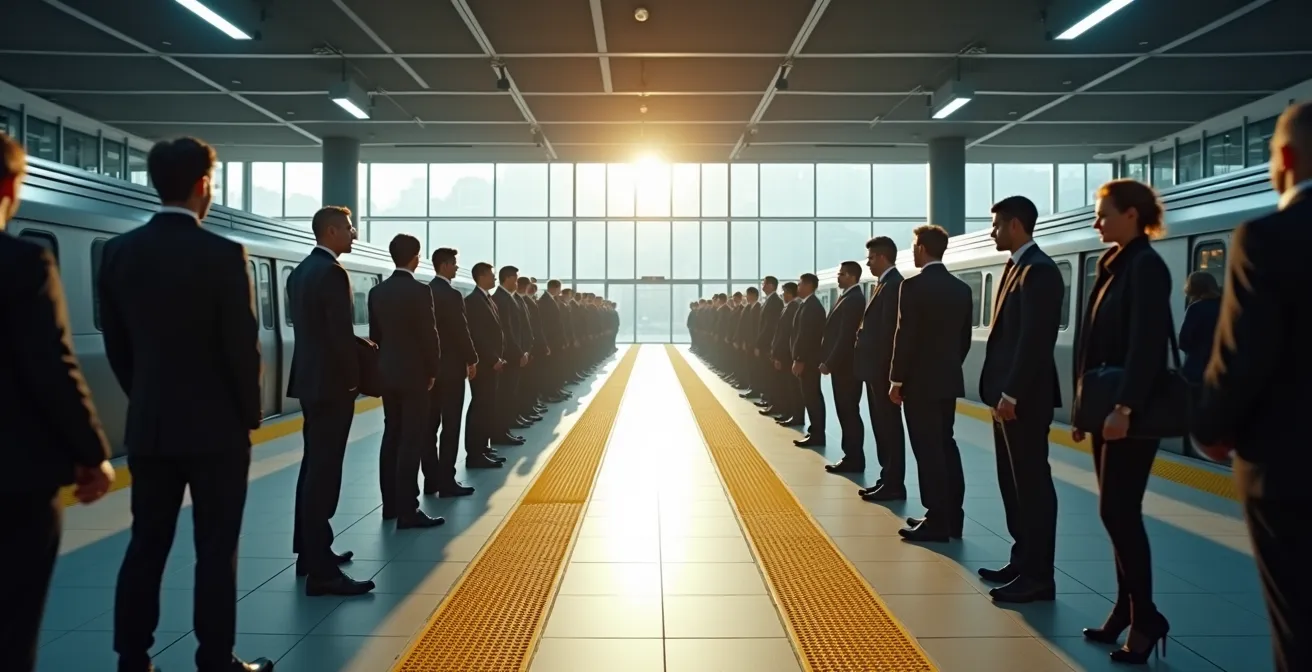
Mastering Tokyo’s queues isn’t about politeness; it’s a strategic system for efficiency.
- Precise platform markings, split-boarding formations, and off-peak lunch times are all components of a high-speed social choreography.
- Understanding the underlying logic of crowd flow transforms your commute from a stressful ordeal into a seamless, predictable process.
Recommendation: Observe queue dynamics as a system to be navigated, not an obstacle to be endured. By adapting to the unspoken rules, you actively save time and reduce stress.
The first encounter with a Tokyo train station during rush hour is a sensory overload. A torrent of commuters floods the platforms, a seemingly chaotic human river. To the overwhelmed visitor, the instinct is to brace for impact, to push or be pushed. The common advice—”be patient,” “wait your turn”—feels inadequate, a platitude against a tidal wave. Many believe the legendary orderliness of Japanese queues is a simple matter of cultural politeness, a quiet display of consideration.
But what if this perspective is fundamentally wrong? What if the serene lines, the precise formations, and the silent cooperation are not just about manners, but about something far more pragmatic: systemic efficiency? This isn’t just politeness; it’s a highly evolved, unspoken social choreography designed to move millions of people with minimal friction and maximum speed. It’s a form of crowd engineering, refined over decades.
The key to saving time and eliminating stress is not to simply endure the crowd, but to understand its internal logic. By viewing the queue as a dynamic system, you shift from a passive victim to a strategic participant. You start to see the patterns, anticipate the movements, and leverage the rules to your advantage. This guide decodes that system, transforming you into a crowd flow analyst of your own commute.
This article breaks down the unwritten rules of this social choreography. We will explore the science behind platform markings, the fluid dynamics of boarding and alighting, and the temporal strategies that savvy locals use to bypass the worst of the congestion, both in stations and out.
Summary: Decoding Tokyo’s Queueing System for Peak Efficiency
- Why You Must Line Up Exactly on the Platform Number Markings?
- How Letting Passengers Off First Speeds Up Your Departure?
- Name Sheet or Line: Deciphering the Waiting System at Cafes
- The Line-Cutting Taboo: How Locals React to Queue Jumpers?
- When to Eat Lunch to Avoid the 12 PM Salaryman Rush?
- When to Line Up on the Platform for Non-Reserved Seats?
- Taxi or Subway: When Is the Cab Fare Worth the Cost in Tokyo?
- When to Join a Line Based on Length and Turnover Speed?
Why You Must Line Up Exactly on the Platform Number Markings?
The painted lines and symbols on a Tokyo platform are not mere suggestions; they are precision instruments in a city-wide logistical machine. For an overwhelmed commuter, they can seem arbitrary, but for a crowd analyst, they are the foundation of Japan’s legendary punctuality. The entire system is engineered for minimal dwell time at stations. Indeed, the efficiency is such that the Japanese Tokaido Shinkansen achieved an average delay of just 1.6 minutes per train, a feat impossible without flawless boarding. Standing exactly on your designated marking ensures you are perfectly aligned with the train door when it arrives.
This precision is a multi-layered system. As demonstrated at Tokyo Station, which handles a staggering number of passengers daily, platforms are a tapestry of symbols. Different trains are designated by shapes (triangles, circles) and car numbers, allowing multiple routes to share a single platform without causing confusion. Drivers are trained to stop within centimeters of their mark, a practice known as “T-stop” precision. When you align with the floor marking, you become a predictable element in this complex equation, contributing to the smooth, rapid flow of thousands of people.
Deviating from these markings, even by a foot, introduces chaos. It forces a micro-correction from everyone behind you, creating a ripple of inefficiency that slows the entire boarding process. To master this is to take the first step from being part of the problem to becoming part of the solution.
Your Action Plan: 3-Step Platform Queuing Strategy
- Identify & Locate: Check your car number on your ticket or the overhead display, then find the corresponding number or symbol (triangle, circle) painted on the platform floor.
- Form & Align: Join or form a queue directly behind the floor marking. Maintain the indicated formation, which is typically single or double file.
- Verify & Confirm: When multiple train services use the same platform, double-check the electronic display to ensure you are queuing at the marker that matches your specific train’s symbol or departure time.
How Letting Passengers Off First Speeds Up Your Departure?
Observing passengers boarding a Tokyo train is like watching a perfectly synchronized maneuver. As the train doors open, the queue splits, forming two neat lines on either side of the doors. This creates a wide, unobstructed channel for alighting passengers to exit swiftly. This isn’t just a polite gesture; it’s a principle of crowd flow dynamics. Preventing a bottleneck at the doorway is the single most effective way to reduce a train’s time at the platform. The system operates like a zipper: once the flow of exiting passengers ceases, the two waiting lines merge seamlessly and quickly into the car.
This dedication to systemic efficiency is a hallmark of Japanese rail operations. A famous example, though related to cleaning, is Japan’s famous ‘Seven-Minute Miracle’ for the Shinkansen, where an entire train is cleaned and readied for its next journey in just seven minutes. This mindset—that every second saved contributes to the whole—is the same one that governs the boarding process. By waiting patiently for a few moments, every single passenger, including you, departs faster. The collective time saved far outweighs the individual’s perceived gain from rushing the door.
The visual below captures this elegant choreography in action. It’s not a standoff; it’s a cooperative solution to a shared logistical problem.
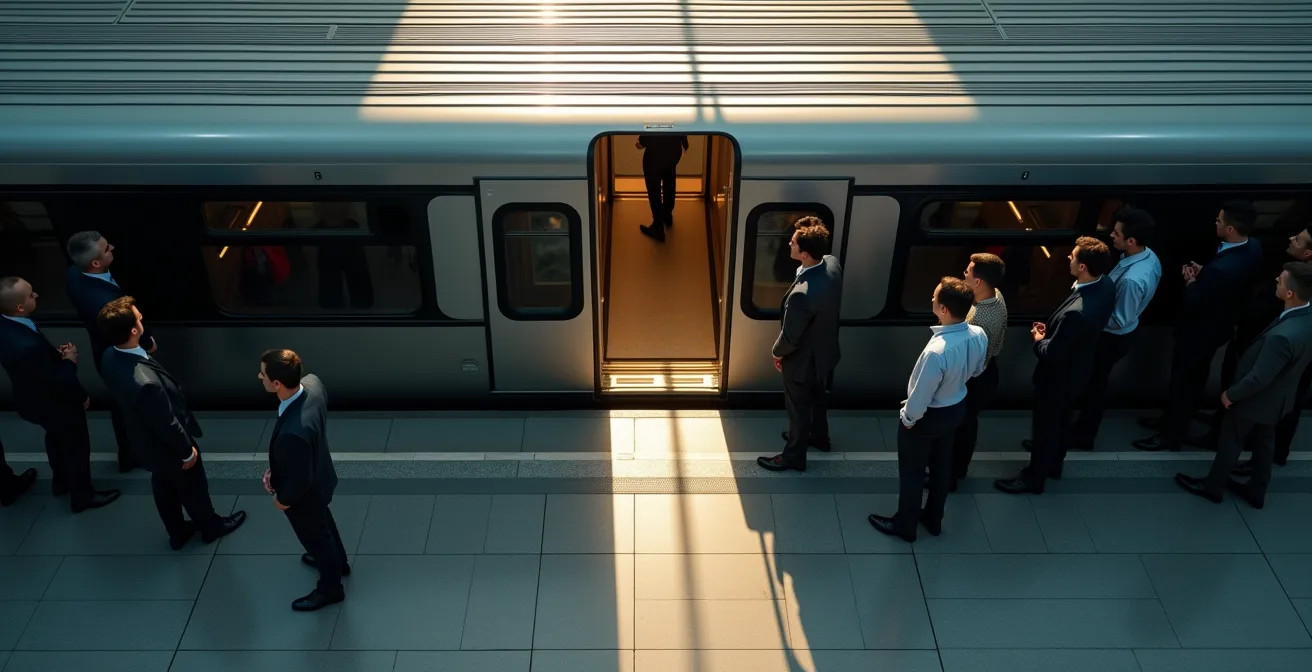
Resisting this flow is counterproductive. Attempting to board before the exit channel is clear creates a human traffic jam, delaying everyone. By embracing the “exit-first” principle, you are not just being courteous; you are making a strategic choice to expedite your own journey. It is the physical embodiment of prioritizing system-wide efficiency over individual impatience.
Name Sheet or Line: Deciphering the Waiting System at Cafes
The strategic thinking of queueing extends beyond the train platform and into every aspect of Tokyo life, especially dining. Arriving at a popular restaurant to find a crowd outside can be daunting, but deciphering the waiting system is straightforward once you know what to look for. Tokyo establishments primarily use two systems: a physical line (列, *retsu*) or a name sheet (記名帳, *kimeichou*). The choice is not random and often correlates with the type of restaurant and its expected customer turnover.
A physical line is common at high-turnover spots like ramen shops or fast-food counters. Here, the queue itself is the reservation system. It’s a transparent, first-come-first-served method where you can visually gauge your wait time. Conversely, sit-down establishments like family restaurants or upscale cafes, where patrons linger longer, favor a name sheet. This is typically a clipboard on a podium near the entrance. You write your name, the number of people in your party, and then you are free to wait nearby without having to stand in a formal line. This system acknowledges a longer wait and provides a more relaxed experience.
Understanding which system is in use is your first strategic move. A quick scan of the entrance will tell you everything you need to know. Is there a defined queue leading from the door? Or do you see a small podium and people milling about? The following table breaks down what to expect.
| Restaurant Type | System Used | Average Wait Time | Visual Indicator |
|---|---|---|---|
| Ramen Shops | Physical Line | 5-15 minutes | Queue outside entrance |
| Family Restaurants | Name Sheet | 15-30 minutes | Podium/clipboard near entrance |
| Fast Food | Physical Line | 2-5 minutes | Counter ordering queue |
| Upscale Cafes | Name Sheet | 20-40 minutes | Reception desk with list |
The Line-Cutting Taboo: How Locals React to Queue Jumpers?
The integrity of the queue is sacred in Tokyo. Cutting in line is one of the most significant social taboos, and the reaction to it reveals the core of the city’s crowd management philosophy. The enforcement mechanism is not loud confrontation or official intervention, but something far more subtle and powerful: the collective gaze. A queue jumper will rarely be shouted at. Instead, they will feel the weight of dozens of silent, disapproving stares. This passive, unified social pressure is usually enough to make the offender realize their mistake and retreat to the back of the line.
This system’s resilience is most evident under extreme pressure. At Shinjuku Station, one of the world’s busiest transport hubs, congestion rates can reach a staggering 136% of capacity during peak hours. Despite this intense crush of humanity, observational studies show that incidents of queue jumping are virtually non-existent. The social contract holds firm precisely because every individual understands that adherence to the rules is the only thing preventing total gridlock. This collective understanding gives the unspoken rules their immense power.
The Time Out Tokyo editorial team captured this sentiment perfectly, noting that it’s more than just a habit; it’s an appreciation for the emergent order of the system.
The Japanese just love queuing, but it is more than that. There’s a beauty in the order. No matter what time it is, there are very few line jumpers, complainers or people breaking rank.
– Time Out Tokyo Editorial Team, Time Out Tokyo Guide to Queuing
For the commuter, understanding this taboo means recognizing that your place in line is part of a shared, fragile ecosystem. Respecting it is not just about avoiding embarrassment; it is an active participation in the social choreography that makes the city function. Attempting to game the system is futile and marks you as someone who doesn’t understand the fundamental principles of the flow.
When to Eat Lunch to Avoid the 12 PM Salaryman Rush?
A key aspect of crowd flow analysis is understanding temporal patterns. In Tokyo, the lunch hour is not a fluid, two-hour window; it is a concentrated, high-intensity event. The vast majority of office workers (known as “salarymen”) take their lunch break with clockwork precision. As a result, the period between 12:00 and 13:00 transforms every restaurant district into a sea of queues. Research shows that this rigid 12:00-13:00 window sees 85% of office workers heading out to eat, creating peak congestion.
The strategic commuter, therefore, applies a temporal strategy. Shifting your lunch break by just 15-30 minutes can be the difference between a leisurely meal and a frustrating 40-minute wait. The most effective approach is to eat either early or late.
- The Early Window (11:15-11:45): At this time, restaurants are just beginning to fill. You will be seated almost immediately, enjoy faster service, and finish your meal just as the main rush begins.
- The Late Window (13:15 onwards): By 13:15, the peak wave has crested. Queues have dissipated, and restaurants are returning to a calmer state. This is the ideal time for a relaxed, unhurried meal.
During the peak of the rush (12:00-12:45), your only efficient options are grab-and-go from a convenience store (*konbini*) or finding a standing soba bar, which are designed for extremely high turnover. Attempting a sit-down meal at this time is a strategic error that will cost you significant time. By simply adjusting your internal clock, you can sidestep the single most congested period of the day outside of the train station.
When to Line Up on the Platform for Non-Reserved Seats?
Securing a non-reserved seat on a crowded Shinkansen or limited express train is the ultimate test of a commuter’s strategic timing. It’s not about luck; it’s a calculated decision based on the time of day, the day of the week, and your position on the platform. The goal is to arrive early enough to be at the front of the queue, but not so early that you waste precious time. Locals operate with an internal clock honed by experience.
A good rule of thumb is the 15/10/5 timing strategy. This means adjusting your arrival time based on anticipated demand:
- 15 minutes early: This is your standard for weekend mornings (7-10 AM) or weekday peak hours (7-9 AM, 5-7 PM). It typically guarantees you a spot near the front of the non-reserved car queue.
- 10 minutes early: Sufficient for most weekday, off-peak travel.
- 5 minutes early: Only advisable for mid-afternoon weekday trains (1-4 PM) when demand is at its lowest.
During peak national holidays like Golden Week or Obon, all bets are off. Arriving 20-30 minutes early is often necessary. An analysis of passenger flow during Golden Week 2024 at Tokyo Station showed that passengers who arrived 20 minutes before departure for non-reserved cars secured seats 95% of the time, while those arriving with only 5 minutes to spare faced standing-room only. Another pro-tip is to target the non-reserved cars at the very front or back of the train (typically cars 1-3 or the last two), as they are furthest from the main platform escalators and fill up last.
Key Takeaways
- Platform markings are not guides but precision tools for a high-speed logistical system; exact alignment is crucial for efficiency.
- The act of letting passengers off first is a core principle of crowd flow dynamics, a zipper-like maneuver that reduces bottlenecks and speeds up departures for everyone.
- A successful temporal strategy—shifting lunch by 30 minutes or arriving on the platform 15 minutes early—is just as important as physical positioning for navigating Tokyo’s crowds.
Taxi or Subway: When Is the Cab Fare Worth the Cost in Tokyo?
The final layer of a commuter’s strategy involves knowing when to opt out of the train system altogether. While Tokyo’s subway is a marvel of efficiency and affordability, there are specific scenarios where a taxi is not a luxury, but the most logical and time-effective choice. The decision hinges on a cost-benefit analysis that weighs the taxi fare against factors like time, convenience, luggage, and the number of passengers. The subway is almost always cheaper, but its cost is not just monetary; it’s also paid in walking, navigating stairs, and exposure to crowds.
A taxi becomes the superior option in four key situations. First, after the last train (typically around midnight), it is your only option. The 20% late-night surcharge is a small price to pay for getting home. Second, when traveling with heavy luggage, strollers, or mobility challenges, a taxi eliminates the grueling task of hauling items up and down multiple flights of stairs in vast station complexes. Third, if your final destination is a 10+ minute walk from the nearest station, the door-to-door time of a taxi can often be equal to or even less than the combined subway and walking time. Finally, for a group of 3-4 people traveling a short distance, the cost per person for a taxi can be surprisingly competitive with individual train fares.
The following analysis, based on common short-distance routes, shows how the costs and benefits stack up. While the subway remains the budget champion, the time saved by a taxi can be significant, especially when you factor in the “last mile” walk from the station.
| Scenario | Distance | Subway Cost (3 people) | Taxi Cost | Time Saved |
|---|---|---|---|---|
| Shibuya to Roppongi | 3km | ¥510 | ¥1,200 | 10 min |
| Tokyo to Ginza | 2km | ¥510 | ¥900 | 15 min |
| Shinjuku to Harajuku | 2.5km | ¥480 | ¥1,000 | 12 min |
| After midnight surcharge | Any | Not available | +20% | N/A |
When to Join a Line Based on Length and Turnover Speed?
Once you’ve mastered the basic mechanics of queueing, the next level of strategy is learning which lines to join and which to avoid. A long line isn’t always a slow line. The key is to become a quick analyst of a queue’s turnover speed. Before committing, take a moment to observe the nature of the transactions taking place. This brief assessment will tell you far more than the mere number of people waiting.
Several factors influence a queue’s velocity. A line for simple ticket purchases at an automated machine will move significantly faster than a line at a staffed information counter where complex queries can take several minutes per person. Look for the type of interaction. Is it a quick, repetitive task or a detailed, consultative one? A strategic commuter develops an eye for these patterns.
Here are key indicators to assess before joining any queue in a station:
- Transaction Type: A queue for simple ticket purchases (2-3 min/person) moves much faster than one for information requests or JR Pass exchanges (5-10 min/person).
- Automated vs. Staffed: Automated ticket machines are typically at least 50% faster than staffed counters for standard transactions.
- Express or Specialized Lines: Always look for “express” lines dedicated to specific, quick tasks like topping up an IC card, which can take as little as 30 seconds per person.
- Peak Patterns: Be aware that during peak hours (8-9 AM and 5-7 PM), wait times can easily double or triple compared to the off-peak norm.
Finally, it’s crucial to set a mental bailout point. If you’ve been in a line for five minutes and have seen zero movement, it’s often more efficient to cut your losses and seek an alternative. This could mean trying a different entrance, a different bank of machines, or even walking to a nearby, smaller station. Don’t fall for the sunk cost fallacy; your time is the most valuable asset.
By shifting your mindset from that of a passive queuer to an active crowd flow analyst, you can transform your experience of navigating Tokyo. Start observing the flow, identifying the patterns, and making conscious, strategic decisions. Your commute will become not just faster, but immeasurably less stressful.