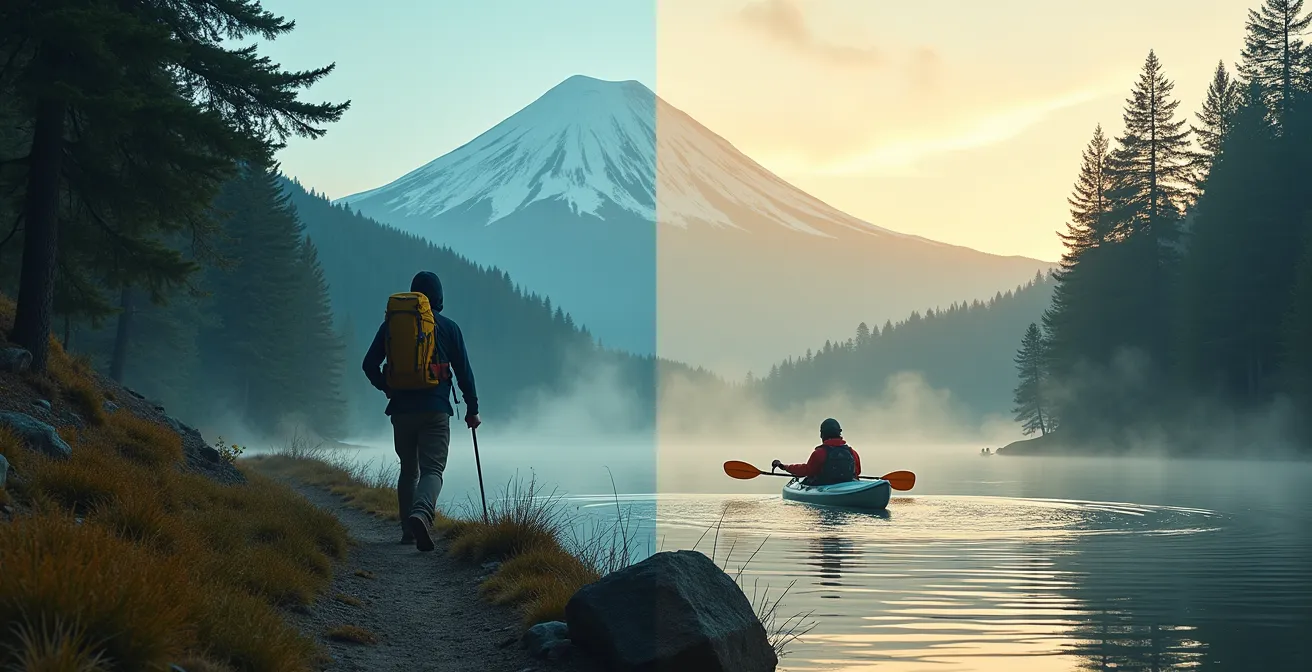
The best Japanese outdoor adventure isn’t about choosing between hiking or kayaking—it’s about mastering the local logistics.
- Success hinges on understanding Japan-specifics like the ‘bell vs. spray’ bear debate and the cost-efficiency of ‘tebura’ (empty-handed) gear rentals.
- Proper planning, from insurance that covers helicopter rescue to choosing a trail based on logistical support, is non-negotiable.
Recommendation: Use this guide to build a trip based on logistical intelligence, not just scenic beauty.
You’ve done it. You’ve seen the neon glow of Shinjuku, navigated the serene temple paths of Kyoto, and eaten more ramen than you thought humanly possible. But now, the endless green mountains and rugged coastlines visible from your Shinkansen window are calling. For active travelers, Japan’s true second act lies beyond the cities, in its wild, untamed nature. The question isn’t *if* you should escape the urban loop, but *how*.
Many guides will give you a simple choice: hiking or kayaking. They’ll talk about the beauty of the Japanese Alps or the allure of Okinawa’s blue waters. But this simplifies the reality. The real challenge, and the key to an incredible trip, isn’t picking an activity; it’s navigating the specific logistical hurdles that Japan presents. This isn’t just about packing boots or a paddle; it’s about understanding a different approach to the outdoors.
What if the most important decision isn’t your destination, but your preparation? This guide is built on that principle of logistical intelligence. We’re going to bypass the generic advice and tackle the real-world questions you should be asking—questions about bear encounters, gear rental strategies, insurance clauses, and even the cultural philosophy behind how you experience nature. We’ll explore the practicalities that turn a good idea into an unforgettable, and safe, adventure.
This guide is structured to answer the critical logistical questions that arise when planning an outdoor adventure in Japan. From safety and gear to insurance and trail selection, each section provides the practical knowledge needed to explore Japan’s natural landscapes with confidence.
Summary: Hiking or Kayaking: Which Outdoor Activity Fits a 2-Week Trip?
- Bell or Spray: How to Protect Yourself From Bears in Japanese Forests?
- Rent or Bring: Is It Worth Hauling Camping Gear to Japan?
- Shinrin-Yoku: How Does Japanese Forest Bathing Differ From Hiking?
- Guide or Solo: Do You Need a Translator for Rural Activities?
- Does Your Insurance Cover Helicopter Rescue in the Japanese Alps?
- Park or Campsite: Can You Pitch a Tent Anywhere in Japan?
- How Okinawa’s Subtropical Climate Affects Your Packing List
- Yoshida or Fujinomiya: Which Trail Is Safer for Beginners?
Bell or Spray: How to Protect Yourself From Bears in Japanese Forests?
Alright team, let’s talk bears. Yes, Japan has them—specifically, the Ussuri brown bear in Hokkaido and the Asiatic black bear across Honshu and Shikoku. Ignoring this fact is not an option. The debate among travelers often centers on bells versus spray, but the real answer is about situational awareness and local etiquette. In most of Honshu’s popular hiking areas, making noise is the primary and most accepted deterrent. This is where the iconic Japanese bear bell, or ‘kuma-suzu’, comes in. Its constant jingle is designed to alert bears to your presence long before you surprise them, which is the cause of most negative encounters.
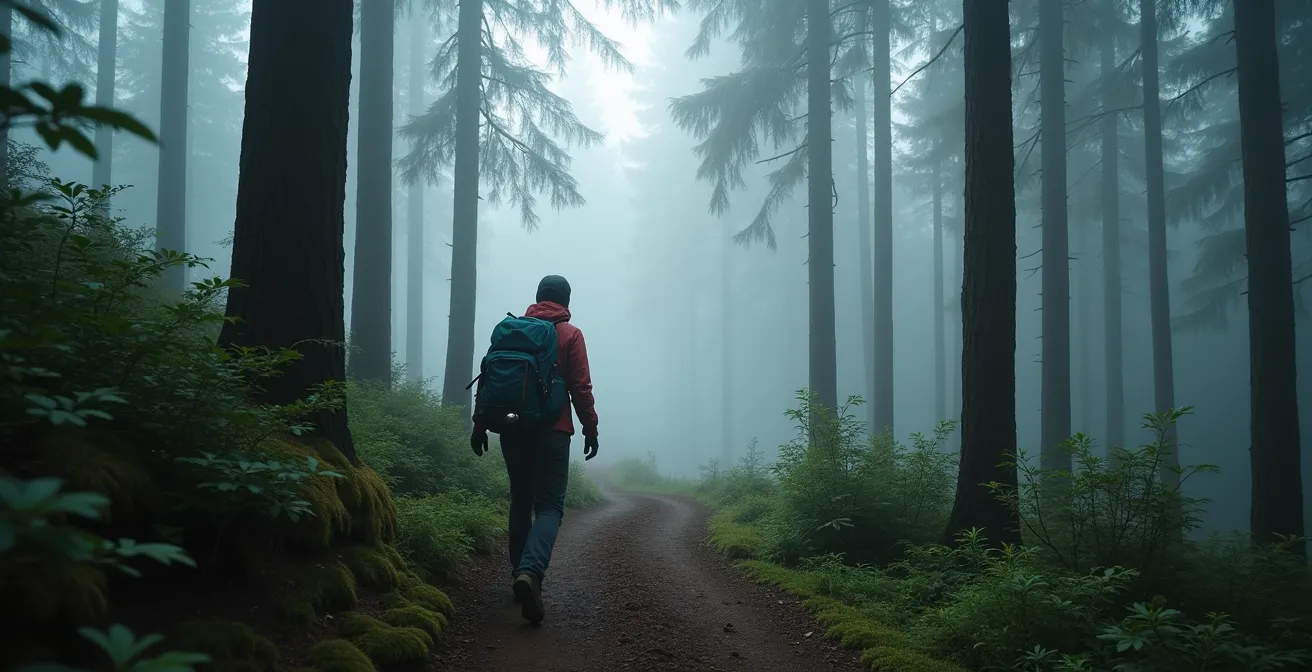
However, the strategy shifts in more remote regions. In Hokkaido, where the brown bears are larger and more assertive, carrying bear spray is not just recommended, it’s essential. It’s legal to purchase and carry in Japan, though you must declare it if flying domestically. The key is to check local advisories before you even set foot on the trail. Many prefectures post recent bear sightings online, giving you real-time intelligence. The core principle is to prevent an encounter in the first place through noise, traveling in groups, and avoiding activity at dawn and dusk when bears are most active.
Rent or Bring: Is It Worth Hauling Camping Gear to Japan?
As an active traveler, your gear is personal. But hauling a 2-person tent, sleeping bags, and a cooking set across the Pacific is a serious commitment, both in baggage fees and logistical hassle. Here’s where embracing the Japanese ‘tebura’ (empty-handed) mindset becomes a game-changer. Japan has a surprisingly robust and efficient network of outdoor gear rental services, designed for this exact purpose. For a multi-day hike or camping trip, renting is almost always the smarter financial and practical decision.
Companies like Yamarent offer complete, high-quality camping kits that can be reserved online and delivered to your hotel or picked up from convenient city locations like Shinjuku. This not only saves you from lugging heavy bags through train stations but also ensures you have gear appropriate for local conditions. To put it in perspective, a single extra checked bag on an international flight can cost more than a 3-day full gear rental. The following comparison, based on data from outdoor gear analyses, breaks down the costs clearly.
| Option | Cost | Pros | Cons |
|---|---|---|---|
| Extra Checked Bag | $150-200 | Use your own gear | Heavy to carry, airline restrictions |
| Yamarent 3-day rental | ¥8,000-12,000 ($55-85) | No transport hassle, local pickup | Not personalized fit |
| Hybrid Strategy | $75 + rental fees | Best of both: personal boots, rented tent | Still need one checked bag |
The best strategy is often a hybrid one: bring your personal, broken-in hiking boots and clothing, but rent the bulky items like tents, sleeping bags, and trekking poles. This gives you the comfort of your own essential gear while leveraging the convenience and cost-effectiveness of the local rental market.
Shinrin-Yoku: How Does Japanese Forest Bathing Differ From Hiking?
On your itinerary, you might see “hiking” and “shinrin-yoku” and assume they’re interchangeable. This is a fundamental misunderstanding of a core Japanese cultural practice. Hiking is a goal-oriented physical activity; you aim to reach a summit, complete a loop, or cover a certain distance. It’s about conquest and achievement. Shinrin-yoku, or forest bathing, is the exact opposite. It has no goal, no destination, and no measure of performance. It is the art of simply *being* in the forest and consciously connecting with it through all five senses.
Developed in the 1980s, shinrin-yoku is a cornerstone of preventative healthcare in Japan, with studies confirming its ability to reduce stress, lower blood pressure, and boost the immune system. While a hike might have you checking your GPS and pace, a forest bathing session encourages you to slow down, turn off your phone, and engage with your surroundings. It’s not about the trail, but about the texture of moss on a tree, the specific notes in the smell of damp earth, and the sound of wind filtering through cedar leaves. It’s a form of sensory immersion, not physical exertion.
Your Action Plan: 5-Senses Forest Bathing Practice Guide
- Focus on hearing: Isolate individual sounds like wind versus bird calls.
- Focus on smell: Identify the notes of cedar and damp earth.
- Focus on touch: Feel bark textures and moss softness with bare hands.
- Focus on sight: Observe light filtering through the canopy without a goal.
- Focus on taste: Breathe deeply to “taste” the quality of the forest air, as detailed in guides on the practice of shinrin-yoku.
You can practice shinrin-yoku on any quiet forest path. The key is to shift your mindset from “doing” to “being.” Instead of hiking *through* the forest, you are allowing the forest to come *to you*. It’s a profound way to connect with Japanese nature on a deeper, more meditative level.
Guide or Solo: Do You Need a Translator for Rural Activities?
The freedom of a solo adventure is tempting, but in rural Japan, it comes with a significant challenge: the language barrier. While you can navigate Tokyo with a few key phrases and a translation app, the situation changes dramatically at a remote trailhead. Trail signs, weather warnings, and bus schedules are often only in Japanese. This is what I call the “Trailhead Test”: standing at the start of your hike, can you confidently understand all the critical safety information around you?
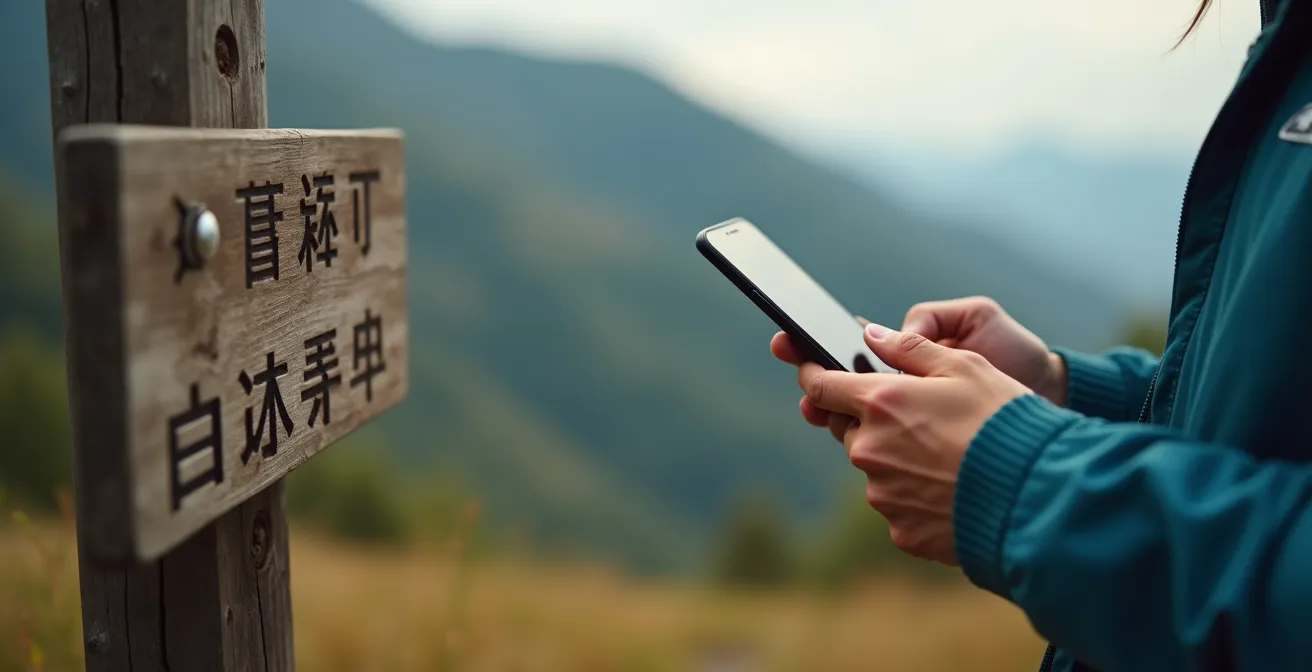
Your decision to hire a guide or go solo should be a calculated one based on an honest self-assessment. According to experts in Japanese adventure travel, you should ask yourself a few key questions. Can you read basic kanji for “danger” (危険), “prohibited” (禁止), or “beware of bears” (熊出没注意)? Will your chosen trail have reliable cell coverage for translation apps, or should you have offline maps downloaded? Most importantly, in an emergency, could you communicate your location and basic medical needs to a local rescuer? If the answer to any of these is “no,” hiring a guide isn’t a sign of weakness—it’s a mark of a smart, prepared adventurer.
Does Your Insurance Cover Helicopter Rescue in the Japanese Alps?
This is not a question you want to be asking while clinging to a mountainside with a sprained ankle. Standard travel insurance is great for lost luggage and flight cancellations, but it often falls critically short when it comes to mountain adventures. The most dangerous assumption you can make is that “medical evacuation” covers you. In many policies, “evacuation” only applies *after* you’ve been found and brought to a medical facility. The costly part, the helicopter search and rescue operation, may not be included.
You must scrutinize your policy for a specific clause: “Search and Rescue” (SAR) coverage. This is the term that ensures the costs of finding you are covered, which can easily run into tens ofthousands of dollars. Furthermore, in Japan, initiating a rescue operation is often tied to a formal document called a ‘Tozan Keikaku-sho’ (Climbing Itinerary Plan). This plan, submitted at the trailhead or online, details your route and expected return time. If you don’t check in by the designated time, this document is what triggers the alarm. Without it, you’re just a missing person, and the response can be significantly delayed.
Park or Campsite: Can You Pitch a Tent Anywhere in Japan?
The romantic image of “wild camping”—finding a secluded spot and pitching your tent—doesn’t really align with the rules and culture in Japan. While not strictly illegal everywhere, camping outside of designated areas is generally frowned upon and can be considered trespassing on private or municipal land. The concept of public access is different from what you might be used to in North America or parts of Europe. The simple answer is no, you cannot pitch a tent anywhere.
The good news is that Japan has an extensive and well-maintained network of designated campsites. These range from luxurious “glamping” resorts to very basic, and often free, municipal campsites. These sites offer the safety of a designated area and usually provide essential facilities like water and restrooms. For travelers looking to camp, embracing these designated sites is the way to go. It’s a system built on respect for nature and property. As experts on local camping culture note:
Watch out for ‘tebura plans’ (tebura meaning ’empty-handed’) as those will include all the necessary gear and equipment for a comfortable stay.
– Guidable Japan, Basics on Camping in Japan
This again highlights the convenience-oriented nature of Japanese outdoor activities. Rather than fighting the system, the smart traveler learns to use it. Researching and booking a spot in a designated municipal or private campsite is the correct and respectful way to camp in Japan.
How Okinawa’s Subtropical Climate Affects Your Packing List
If your adventure takes you south to the turquoise waters of Okinawa, your packing list needs a complete overhaul. Swapping the alpine environment of Honshu for a subtropical one means facing a new set of challenges: intense sun, extreme humidity, and unique local wildlife. This is especially true for water-based activities like sea kayaking. Thinking you can use the same gear you’d use for a mountain hike is a recipe for discomfort and potential danger.
The number one rule for an Okinawan adventure is to ditch cotton. In the oppressive humidity, cotton fabrics soak up sweat and never dry, leaving you feeling damp and chilled, even in the heat. Instead, your entire wardrobe should consist of synthetic quick-dry fabrics. For kayaking, a rash guard or stinger suit is non-negotiable, not just for sun protection but also for shielding you from jellyfish, which are common in these waters. Other essentials include:
- Polarized sunglasses: Crucial for cutting glare and spotting shallow reefs while kayaking.
- Japanese-brand insect repellent: Local pests are often unimpressed by foreign formulas. Buy it when you arrive.
- Waterproof everything: Use dry bags for all electronics and spare clothing. The air itself feels wet.
- A flexible itinerary: This is typhoon territory. Always have a backup plan and be prepared for travel delays, especially from late summer to early autumn.
Packing for Okinawa isn’t about preparing for cold; it’s about managing moisture, sun, and sea creatures. A smart packing list is your first line of defense against the elements.
Key takeaways
- Bear safety in Japan is about noise and regional awareness; the “bell vs. spray” debate depends entirely on if you’re in Honshu or Hokkaido.
- Renting heavy camping gear in Japan is almost always smarter and more cost-effective than hauling your own across the globe.
- Before any mountain activity, you must verify your travel insurance specifically includes “Search and Rescue” coverage, not just “Medical Evacuation.”
Yoshida or Fujinomiya: Which Trail Is Safer for Beginners?
When it comes to climbing Mount Fuji, beginners often ask which trail is “safer.” The common answer involves comparing trail lengths and elevation gains. But this misses the point. In Japan, safety is inextricably linked to logistics. The Yoshida Trail, despite being longer, is widely considered the safer and more beginner-friendly option precisely because of its superior logistical support. It has more mountain huts, more emergency facilities, and crucially, better access to services like gear rental right at the trailhead.
Mount Fuji Trail Safety Comparison
This is perfectly illustrated by the operations of gear rental services. Yamarent, a major provider, operates rental stations at both the Yoshida (5th station) and Fujinomiya trailheads. However, the Yoshida station’s location and longer operating hours allow climbers to rent gear just before their ascent and return it immediately after, without any extra travel. This convenience factor—the ability to get the right gear at the last possible moment and not have to worry about it afterward—is a massive logistical advantage. It makes the Yoshida trail more forgiving for beginners who may have misjudged their gear needs. It proves that the “safer” trail isn’t just about the path itself, but the ecosystem of support built around it.
This is the ultimate application of the logistical intelligence we’ve been discussing. A seasoned adventure planner doesn’t just look at a map; they look at the entire support system. Choosing the Yoshida trail isn’t just choosing a path; it’s choosing an infrastructure designed for success and safety. It’s the final, and perhaps most important, lesson in planning a smart Japanese outdoor adventure.
You now have the adventure coordinator’s playbook. You understand that the best trip is built not just on beautiful destinations, but on smart decisions. It’s time to stop dreaming about the mountains and seas of Japan and start planning your intelligent, unforgettable adventure.
Frequently Asked Questions about Hiking or Kayaking: Which Outdoor Activity Fits a 2-Week Trip?
What specific insurance term should I look for in my policy?
Look for ‘Search and Rescue’ coverage specifically, not just ‘Medical Evacuation’ which often doesn’t cover the search phase of a rescue operation. A report on mountain casualties in Japan highlights the critical importance of this distinction.
What is a Tozan Keikaku-sho and why is it critical?
It’s a Climbing Itinerary Plan that must be submitted at trailheads or online. This document triggers rescue operations if you don’t return on time.
Does Japan offer specialized mountaineering insurance?
Yes, the Japan Mountaineering & Sport Climbing Association (JMSCA) offers specialized insurance as a supplement for serious mountaineers.