
In summary:
- The Glico Man isn’t just a photo op; it’s your central anchor point for navigating Dotonbori’s chaos.
- Mastering local “social codes” (escalator etiquette, avoiding touts) is key to a smooth experience.
- Plan your visit strategically: weekdays are less crowded, and a food plan saves time and stress.
- From river cruises to Ferris wheels, different vantage points offer unique photographic perspectives of the district.
The moment you step into Dotonbori, it hits you: a tidal wave of light, sound, and smell. Giant mechanical crabs wave their claws, octopus-shaped signs glow menacingly, and a river of people pulls you along the canal. It’s pure sensory overload. For photographers and night owls, this is the playground you’ve dreamed of, but it can quickly become overwhelming. Most guides tell you to “see the Glico Man sign,” take a photo, and move on. That’s a rookie mistake. They treat the sign as a destination on a checklist.
But what if the key to this neon labyrinth wasn’t just seeing the sign, but using it? The real secret is that the Glico Running Man is your navigational North Star. He’s not just an advertisement; he’s the anchor point from which you can decode the entire district’s hidden rhythms. This guide isn’t about just looking at the lights; it’s about learning to read them. It’s a street-smart manual for turning sensory chaos into a perfectly orchestrated night out.
We’ll break down the experience, using the Glico Man as our landmark. We’ll cover the best ways to see the district, decipher the unwritten social rules that separate locals from tourists, and conquer the culinary gauntlet that is Osaka’s soul food scene. Get ready to stop being a spectator and start owning the night.
Summary: Glico Man Sign: Why Is This Runner the Symbol of Osaka?
- Boat or Walk: Is the Tombori River Cruise Worth the Ticket?
- Yellow Wheel: Is the Oval Ferris Wheel Scary or Scenic?
- Ebisu Bridge: Why Do Young Locals Gather Here at Night?
- Tout or Scout: How to Avoid Aggressive Touts in Dotonbori?
- Weekend or Weekday: When Is the Best Time to Walk Dotonbori?
- Right vs Left: Why Does Osaka Stand on the Wrong Side of the Escalator?
- Sumimasen! When Is It Okay to Shout for the Waiter?
- Takoyaki or Okonomiyaki: Which Kansai Soul Food Should You Try First?
Boat or Walk: Is the Tombori River Cruise Worth the Ticket?
So, you want that classic shot of the Glico Man from the water. The Tombori River Cruise seems like the obvious choice. It’s a 20-minute loop that puts you right in the heart of the neon spectacle. But is it worth the price of admission? According to the official pricing, a ticket costs 2,000 yen ($13) for adults, with discounts for students. For that, you get a guided tour (mostly in Japanese, but with energetic vibes) and a unique, low-angle perspective of the glowing billboards.
Walking the Tombori River Walk is free and gives you more control over your shots, but the cruise offers a different kind of magic. You escape the crush of the crowds on the pavement and see the entire district as a flowing panorama. For photographers, the real value isn’t just the ride, but the timing. Booking an early evening slot lets you capture the “golden hour” transition as the sky darkens and the signs ignite one by one. If you have the Have Fun in Kansai Pass, you can even get free admission after 5 PM, making it a no-brainer.
The verdict? If you’re a first-timer or a photographer looking for that postcard-perfect water-level shot without fighting for space on a bridge, the cruise is a solid investment. It’s a quick, efficient way to soak in the atmosphere. For seasoned visitors, a walk might suffice, but you’ll miss the unique feeling of floating through a canyon of light.
Yellow Wheel: Is the Oval Ferris Wheel Scary or Scenic?
Look up from the canal, and you’ll see it: a bizarre, oval-shaped Ferris wheel bolted to the side of a Don Quijote discount store. This is the Ebisu Tower Ferris Wheel, a testament to Japan’s incredible use of urban space. Your first question is probably: is it a gimmick or a genuinely good view? The answer is, it’s a bit of both, in the best way possible. At 77 meters high, it doesn’t give you a sprawling city panorama like a traditional skyscraper observatory. Instead, it offers something more valuable for a Dotonbori explorer: an intimate, mid-level perspective.
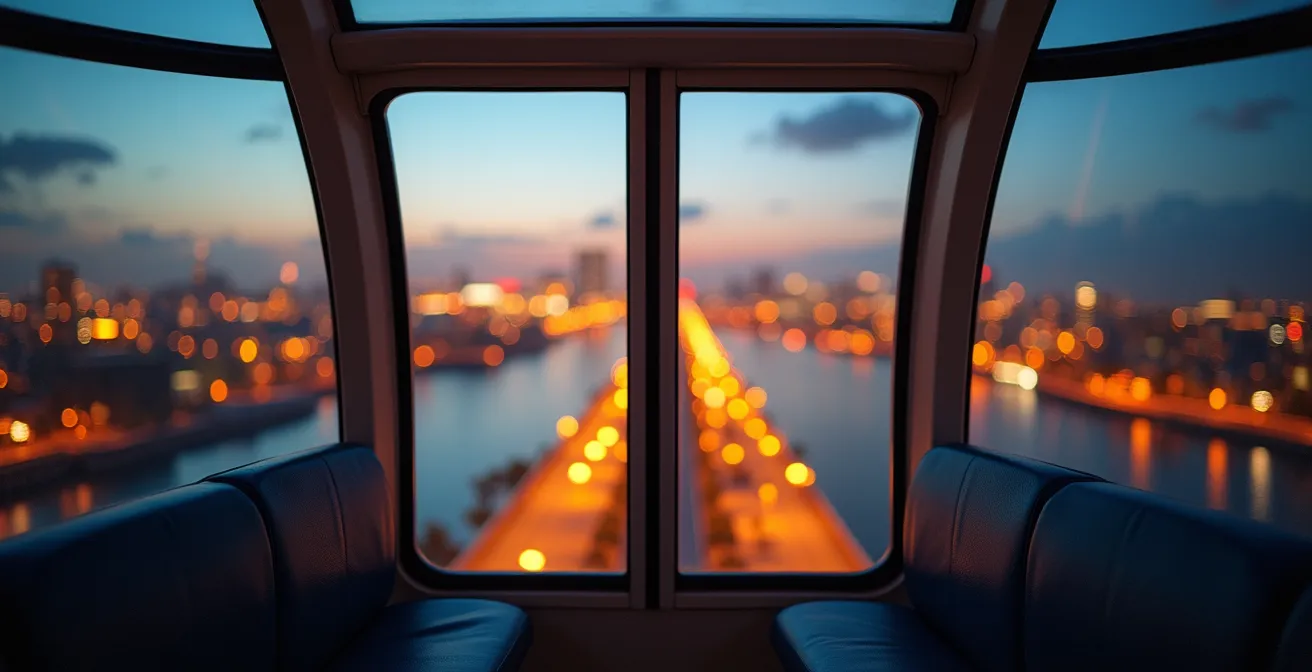
The 15-minute ride in a 4-person gondola feels like you’re in a ‘floating observation deck’ hovering directly above the action. You’re close enough to see the patterns in the crowds on Ebisu Bridge and get eye-level with the tops of the famous billboards. For photographers, this is a unique angle that’s impossible to get otherwise. It’s less about a sweeping landscape and more about framing the chaos from a clean, quiet space above it all. It’s not particularly scary; the movement is slow and smooth. Think scenic, not terrifying. It’s your chance to pause and appreciate the beautiful madness of Dotonbori from a privileged vantage point.
Ebisu Bridge: Why Do Young Locals Gather Here at Night?
Ebisu Bridge is the main artery of Dotonbori. It connects the Shinsaibashi shopping district to the neon-drenched entertainment zone, and it’s the unofficial stage for the Glico Man. At night, it transforms from a simple crossing into a buzzing social hub, packed with tourists taking photos, couples on dates, and groups of young locals just… hanging out. Why here? Simple: it’s the most recognizable and convenient meeting point in southern Osaka. It’s the city’s living room, where everyone comes to see and be seen.
This social function is so ingrained that the bridge has earned some colorful nicknames. As one source points out, it’s not just a bridge, but a social landmark.
Due to the familiarity of the Glico Man, Ebisubashi makes for a convenient gathering point, hence its nicknames, nanpa-bashi, mostly used by foreigners, and hikkake-bashi (‘the pulling bridge’), mostly used by native Japanese
– Wikipedia contributors, Dōtonbori Wikipedia entry
This history as a “picking-up” spot has evolved, but the core function remains: it’s a place for connection. It’s free, central, and offers the best view in town. For a night owl or photographer, the bridge isn’t just a path; it’s the main event. It’s where you capture the human energy of Dotonbori, with the Glico Man serving as the perfect, unwavering backdrop to the constantly shifting social drama below.
Tout or Scout: How to Avoid Aggressive Touts in Dotonbori?
Dotonbori’s energy is electric, but it has a dark side: the aggressive touts, or “kyacchi,” trying to lure you into overpriced and sometimes sketchy bars and clubs. They’re especially prevalent in the back alleys off the main strip. Navigating this is a crucial part of mastering the Dotonbori nightlife. The key is to project confidence and know how to say “no” like a local. Touts are scouts for uncertainty; they target people who look lost or hesitant.
Local guides warn that the biggest red flags are establishments with unclear pricing systems or menus where Japanese and English prices don’t match up. If someone is being overly aggressive to get you inside, it’s almost always a sign to walk away. Your best defense is a strong offense, not with aggression, but with decisive body language and a few key phrases. This isn’t about being rude; it’s about speaking the unspoken language of the street.
Your Anti-Tout Confidence Toolkit
- Use a firm ‘Kekko desu’ (No thank you) with a slight bow to politely decline.
- Say ‘Isogashii desu’ (I’m busy) while continuing to walk without breaking stride.
- Execute a firm sideways hand wave at chest level—the Japanese gesture for ‘no’.
- Break eye contact immediately and look at your phone or ahead toward your destination.
- Walk with purpose; know where you’re going, even if you’re just pretending.
- If you feel pressured, duck into any convenience store (konbini) as a safe, neutral space.
By using this toolkit, you shift from being a target to just another person in the crowd, allowing you to enjoy the atmosphere without the hassle.
Weekend or Weekday: When Is the Best Time to Walk Dotonbori?
Timing your visit to Dotonbori can make or break your experience. Do you want the full-throttle, shoulder-to-shoulder sensory assault, or would you prefer a little more breathing room? With Osaka tourism booming—recent statistics show 14.58 million international visitors in 2024, a figure 18% above pre-pandemic levels—the district is more crowded than ever. This makes your choice of day critical.
Friday and Saturday nights are absolute peak chaos. The bridges are packed, restaurant queues snake down the street, and the energy is at a fever pitch. This is fantastic if you want to experience Dotonbori in its most frenetic, vibrant state. For photographers, the sheer density of people can create incredible long-exposure shots filled with motion blur. However, it can also be incredibly stressful to navigate.
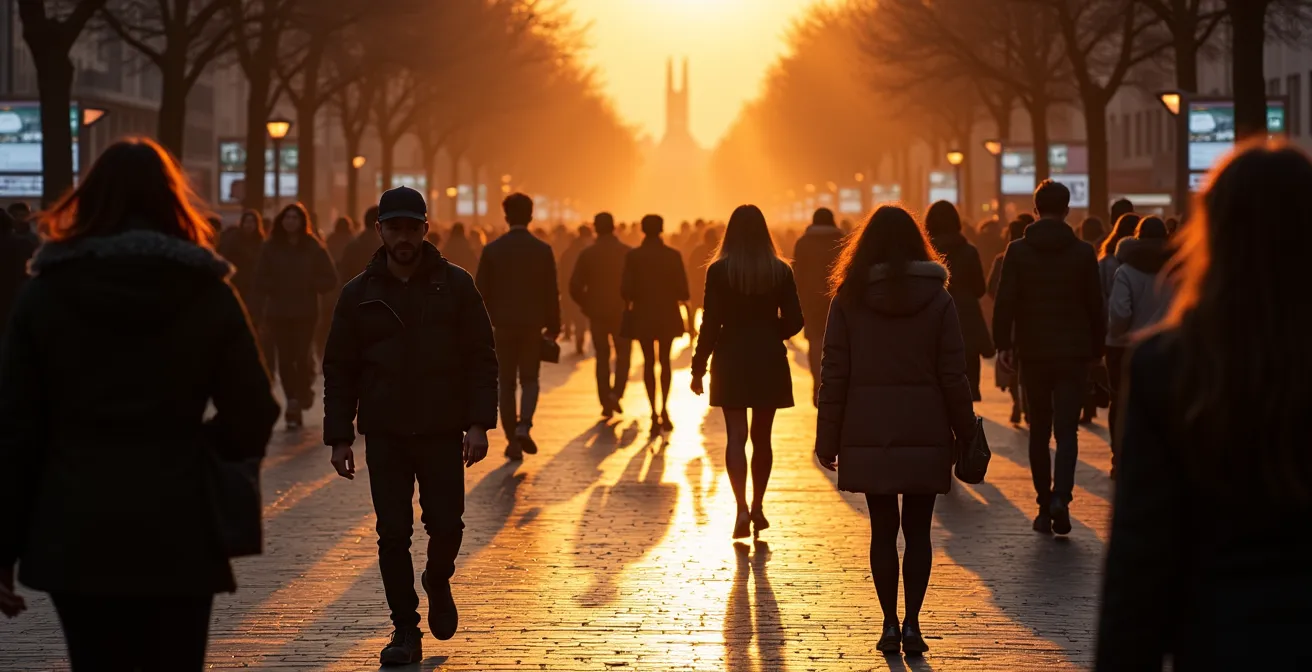
For a more manageable experience, aim for a weekday evening (Monday to Thursday). The lights are just as bright, the food is just as good, but the crowds are noticeably thinner. You’ll have more space to set up a tripod, you won’t have to fight for a spot on Ebisu Bridge, and you’ll get into restaurants faster. The sweet spot for photographers is often a Tuesday or Wednesday right at twilight, a period locals call the “magic hour.” You get the beautiful transition from daylight to neon glow, with a crowd that adds energy without being overwhelming.
Right vs Left: Why Does Osaka Stand on the Wrong Side of the Escalator?
As you navigate the subways and department stores around Dotonbori, you’ll notice a peculiar social code that screams “Osaka.” Everywhere else in Japan, people stand on the left side of the escalator to let others pass on the right. In Osaka, they do the opposite: stand on the right, walk on the left. To an outsider, it seems like a bizarre act of rebellion. To an Osakan, it’s a deeply ingrained part of their identity.
This isn’t a random quirk; it has historical roots. During the economic boom of the late 1960s, Hankyu Umeda Station—a major Osaka hub—began a campaign encouraging riders to stand on the right, influenced by the British practice. This was further solidified during the 1970 Osaka World Expo, where international crowds and logistical needs cemented the “stand on the right” rule across the city and surrounding Kansai region. It became a symbol of Osaka’s global-facing, merchant-centric culture, distinct from the bureaucratic capital, Tokyo.
This regional pride is no joke. It’s a subtle but powerful statement of identity. As a spokesperson for a railroad association once passionately declared to The Japan Times, “We won’t stand for this. It’s what sets us apart from the rest of Japan.” Observing this simple rule is one of the easiest ways to blend in and show respect. It’s a small detail that signals you’ve moved beyond being a tourist and are starting to understand the local rhythm.
Sumimasen! When Is It Okay to Shout for the Waiter?
You’re sitting in a packed izakaya, your beer is empty, and you want to order another plate of takoyaki. What do you do? In many Western cultures, shouting across the room would be the height of rudeness. But here in the boisterous eateries of Osaka, a loud, clear “Sumimasen!” (Excuse me!) is not only acceptable—it’s expected. This is another one of those vital social codes that can feel counterintuitive.
The appropriateness of yelling for service depends entirely on the environment. In a loud, bustling, informal setting like a street-side ramen stand or a crowded izakaya, raising your voice is the only way to get attention. The staff is busy, the room is noisy, and a polite but firm call is part of the flow. Think of it as a tool, not an insult. The word “Sumimasen” itself is incredibly versatile, meaning anything from “Excuse me” to “Sorry” to “Thank you,” making it the perfect, all-purpose phrase.
However, this rule does not apply everywhere. In a quiet, upscale restaurant or a formal kaiseki establishment, shouting would be a major faux pas. In these places, you should first look for a call button on the table—a common feature in Japanese restaurants. If there isn’t one, your best bet is to make eye contact with a staff member and give a slight hand gesture or a quiet nod. Matching your volume and approach to the restaurant’s atmosphere is a key skill for any nightlife navigator.
Key takeaways
- The Glico Man is your central landmark; use it to orient yourself in Dotonbori’s sensory chaos.
- Mastering local social codes—like standing on the right on escalators and knowing when to shout “Sumimasen!”—is essential for blending in.
- Be strategic about timing (weekdays are calmer) and your food choices (takoyaki for snacking, okonomiyaki for a meal) to maximize your night.
Takoyaki or Okonomiyaki: Which Kansai Soul Food Should You Try First?
You can’t leave Dotonbori without tackling its culinary gauntlet. The two reigning champions of Kansai soul food are takoyaki (grilled octopus balls) and okonomiyaki (a savory pancake). For a first-timer, the choice can be paralyzing. Here’s the street-smart way to decide: it’s not about which is “better,” but which fits your strategy for the night. Are you looking for a quick fuel-up while you explore, or are you ready for a sit-down dining experience?
Takoyaki is the ultimate street snack. It’s fast, cheap, and designed to be eaten on the move. You’ll see dozens of stalls with long queues—a reliable sign of quality. Grabbing a boat of piping hot takoyaki lets you continue soaking in the neon spectacle without missing a beat. Okonomiyaki, on the other hand, is a meal. It’s an event. You’ll duck into a cozy side-street restaurant, sit down at a table (often with a grill built-in), and enjoy a slower-paced, more social dining experience. If you’re with a group, sharing a giant okonomiyaki is a classic Osaka bonding moment.
To help you make the call, here’s a quick decision matrix based on what you’re looking for.
| Factor | Takoyaki | Okonomiyaki |
|---|---|---|
| Eating Style | Walking snack, eaten standing | Sit-down meal at table |
| Time Investment | 5-10 minutes | 30-45 minutes |
| Price Range | ¥300-600 ($2-4) | ¥800-1500 ($5-10) |
| Best Location | Street stalls in Dotonbori | Side-street restaurants |
| Social Factor | Quick solo snack | Group dining experience |
The pro move? Do both. Start with takoyaki as an appetizer while you walk the main strip around 6 PM. Then, once you’ve had your fill of the crowds, escape to a quieter side street around 8 PM for the main event: a delicious, sizzling okonomiyaki.
Now you’re armed with more than just a camera. You have the codes, the strategies, and the confidence to dive into Dotonbori headfirst. So when you find yourself standing on Ebisu Bridge, don’t just take the picture—start navigating. Your adventure in Osaka’s neon heart has just begun.
Frequently Asked Questions About Glico Man Sign: Why Is This Runner the Symbol of Osaka?
When is it appropriate to call ‘Sumimasen!’ loudly?
In bustling izakayas, street-side ramen stands, and casual takoyaki stalls, a clear ‘Sumimasen!’ is expected and normal. The louder the environment, the more acceptable it is to raise your voice.
What about quiet, formal restaurants?
In upscale or quiet establishments, look for a call button on your table first. If none exists, make eye contact with staff and use a gentle hand gesture rather than calling out.
What does ‘Sumimasen’ actually mean?
It’s a versatile word that can mean ‘Excuse me,’ ‘Sorry,’ or even ‘Thank you’ depending on context. This flexibility makes it the perfect all-purpose phrase for getting attention politely.