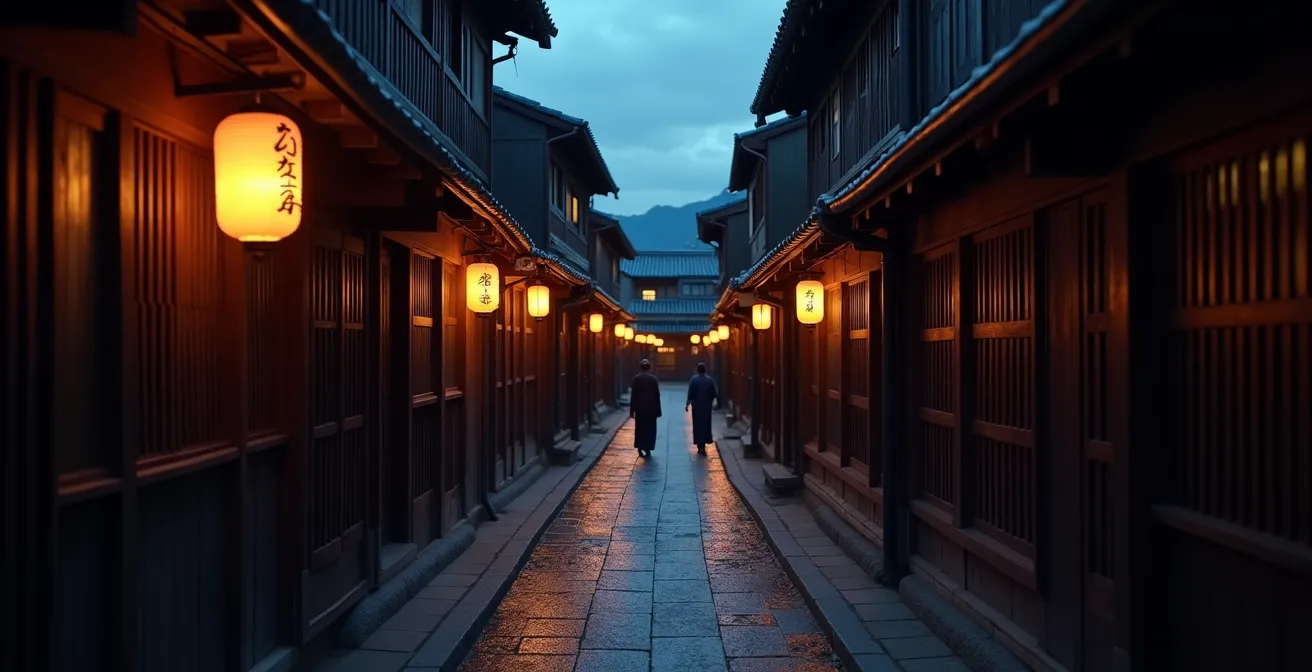
The new signs in Gion aren’t just about banning photos; they are a community’s last resort to reclaim human dignity from tourists treating entertainers like wildlife.
- The ban targets specific private residential roads as a response to years of escalating harassment, not a blanket prohibition on all photography.
- Respectful observation, not aggressive photography, is the only acceptable way to experience Gion’s culture.
Recommendation: Learn to distinguish between public thoroughfares and private alleys, and adopt a “zero-contact, three-meter” rule when you see an entertainer.
You arrive in Gion, camera in hand, ready to capture the ethereal beauty of Kyoto’s famed geisha district. But instead of ancient wooden facades, the first thing you see is a new, stark sign: “Private Road. Do Not Enter. Fine up to ¥10,000.” The confusion is immediate. Is photography now illegal? Can you still see a maiko? The travel blogs offer conflicting advice, and the air is thick with uncertainty. Many visitors simply want a beautiful memory, a stunning photograph that captures the magic of Japan. They see the entertainers, known as geiko and maiko, as living art, a core part of the cultural experience.
But let’s be perfectly clear: this is where the fundamental misunderstanding lies. The recent photography bans are not an attack on art or tourism. They are a desperate, necessary defense of human dignity. From the perspective of those who live and work here, the issue was never about photography; it was about the relentless harassment that came with it. For years, this historic district has been treated less like a living neighborhood and more like a human safari, where entertainers are chased, grabbed, and swarmed by crowds. The signs you see are not a simple restriction; they are a community drawing a hard line to reclaim its private space and protect its people from dehumanizing behavior.
This is not a guide to finding loopholes. This is an explanation of the new reality in Gion, written from a local’s perspective. It will clarify precisely where you can and cannot go, why these rules became essential, and most importantly, how to behave respectfully. Understanding the difference between a public street and a private life is the first step to truly experiencing the soul of this unique district, not just capturing its surface.
To navigate this new landscape, it’s essential to understand the rules, the history, and the etiquette that now govern Gion. This guide breaks down everything you need to know to be a respectful visitor, not a problem.
Summary: Navigating the Gion Photography Ban and Local Etiquette
- No Photos: Why Geisha Harassment Led to Bans in Gion?
- Don’t Touch: How to Behave If You See a Geisha on the Street?
- Machiya Design: Why Are the Entrances So Narrow and Long?
- Real or Fake: How to Tell a Genuine Maiko From a Tourist in Costume?
- Geiko or Maiko: How to Tell the Difference by Their Hair?
- Dusk in Gion: Why Is the Lantern Lighting Time the Best for Walking?
- Ichigen-san: Can Regular Tourists Eat at a Gion Tea House?
- When to Return a Bow from Shop Staff (and When Not To)?
No Photos: Why Geisha Harassment Led to Bans in Gion?
The photography ban in Gion did not appear overnight. It is the direct result of years of escalating tourist misbehavior that local residents and council members refer to as “geisha paparazzi.” The problem reached a tipping point, forcing the community to take drastic measures to protect the safety and privacy of its residents, particularly the geiko and maiko. Photographing entertainers without their consent has been outlawed, and the rule stems from a history of deeply problematic tourist actions. The situation became so severe that it was no longer a matter of annoyance, but of public order and safety.
The behavior went far beyond simply taking a picture from a distance. In a series of incidents that gained media attention, travelers were seen pulling at an entertainer’s delicate kimono, chasing them down alleys, yanking out their valuable hair ornaments (kanzashi), and even flicking cigarette butts at them. This is not tourism; it is assault. These actions treat highly trained artists as props, stripping them of their basic right to move freely and safely in their own neighborhood. This is the “why” behind the ban: it’s a firewall against harassment.
Case Study: The 2024 Private Road Ban
In response, the Gion Southside District Council took decisive action. As of May 2024, the first of several “No Entry” signs was installed. According to reports on the new rules, one sign at Kosode Koji alley reads in clear English and Chinese, “Private Road Do Not Enter Fine up to ¥10,000.” The Japanese text is even more specific, stating that both entry and photography by tourists are prohibited. The council has made it clear this is the start of a wider effort to cordon off the narrow, private residential roads where entertainers live and commute, while leaving main public thoroughfares accessible.
The financial penalty is a deterrent, but the core message is about respect. The fine of ¥10,000 (approximately $68 USD) is imposed for unauthorized entry or photography on these clearly marked private streets. It’s a small price for the authorities to charge for the violation of a person’s dignity, but it’s a start. The goal is to re-educate visitors that Gion is a living neighborhood, not a theme park where the inhabitants are part of the attraction.
Don’t Touch: How to Behave If You See a Geisha on the Street?
The most important rule when encountering a geiko or maiko is simple and absolute: do not touch. This extends to their clothing, their hair, their accessories, and their person. Beyond being a gross violation of personal space, physical contact can cause significant damage. These are not costumes; they are priceless, handcrafted works of art.
A formal kimono, obi (sash), and accessories are often bespoke heirlooms passed down through the okiya (geisha house). An analysis of their attire highlights why physical contact is strictly forbidden, as a full ensemble can be worth tens of thousands of dollars. A snagged thread, a smudge of dirt, or a pulled ornament can lead to costly and time-consuming repairs. Respecting this boundary is a matter of both personal decency and financial prudence.
To ensure you are behaving correctly, follow the “Three-Meter Rule” protocol without exception. It’s not just about not touching; it’s about not encroaching on their space at all.
- Create distance: As soon as you see an entertainer approaching, step to the side of the path to give them a wide, clear berth.
- Maintain a 3-meter (10-foot) gap: Do not approach them for any reason. This distance should be maintained at all times.
- Do not obstruct their path: Geiko and maiko are almost always on their way to an appointment. Stopping in front of them, walking slowly to get a photo, or blocking their way is disruptive and unprofessional.
- Keep hands to yourself: Avoid any gestures toward them. Simply keep your hands at your sides.
- Avert your gaze: If eye contact happens, a slight, respectful nod is appropriate, but then you should look away. Do not stare.
- Do not follow: Once they have passed, continue on your way. Never turn and follow them down the street.
This image of a wide, clear street illustrates the correct way to behave, giving entertainers ample space to walk without obstruction.
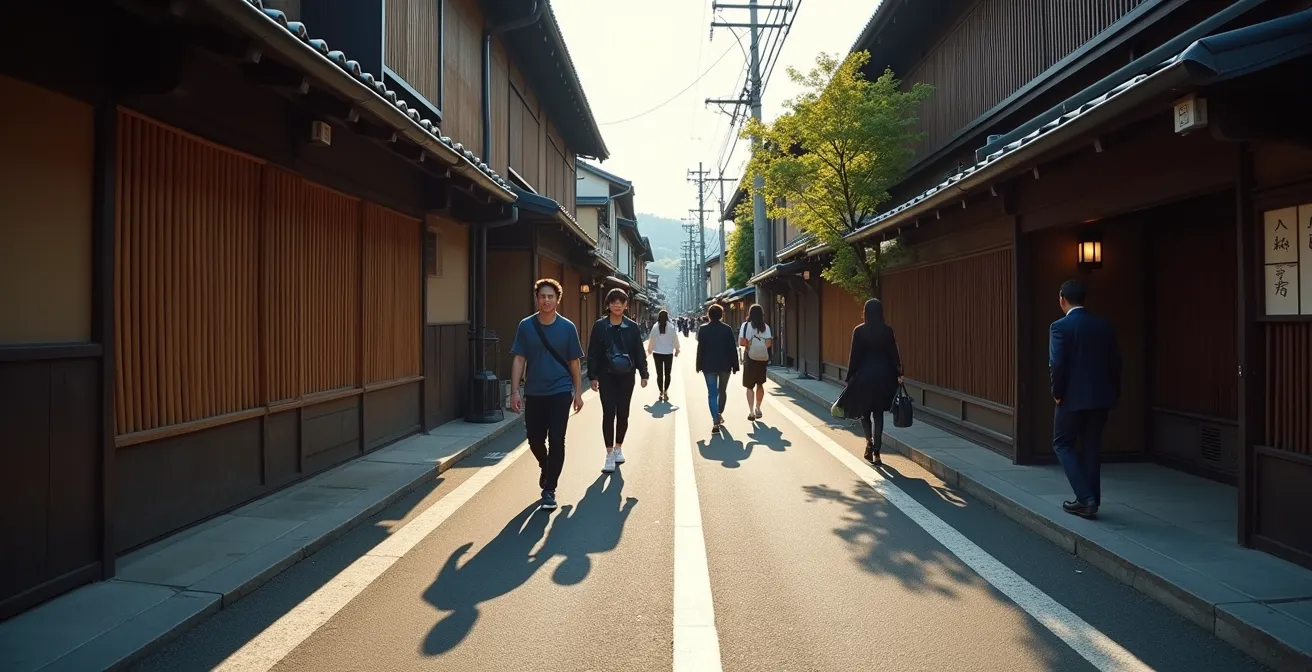
These rules might seem strict, but they are essential for coexistence. Entertainers are working professionals, not public figures posing for photos. By giving them space, you show that you see them as people, not just as a picture to be taken.
Machiya Design: Why Are the Entrances So Narrow and Long?
To truly grasp Gion’s emphasis on privacy, one only needs to look at its traditional architecture. The iconic wooden townhouses, known as machiya, are designed as private sanctuaries. Their distinctive long, narrow entrances—often called “eel beds” (unagi no nedoko)—are a direct architectural response to a historical tax system based on street frontage. But their function goes far beyond tax evasion; they create a crucial buffer between the public world of the street and the private life within.
When you look at a machiya, you are seeing a physical manifestation of the inside/outside (uchi-soto) cultural concept. The entrance corridor (genkan) and the intricate wooden lattices (koshi) are designed to obscure the view from the street, allowing light and air to pass through while shielding the inhabitants from prying eyes. This design philosophy underscores that these buildings are homes and workplaces, not open-plan displays for tourists to peer into.
This deep-seated value of privacy is woven into the very fabric of the district, which contains over 20 private roads (shidō) now restricted to tourists. These are not grand avenues; they are small, residential alleys that serve as the primary access to homes and okiya. The new photography ban on these specific roads is simply a modern enforcement of a centuries-old architectural and cultural principle: the protection of private space.
The perspective from within a machiya, looking out through its narrow, deep entrance, reveals its true purpose as a protective barrier.
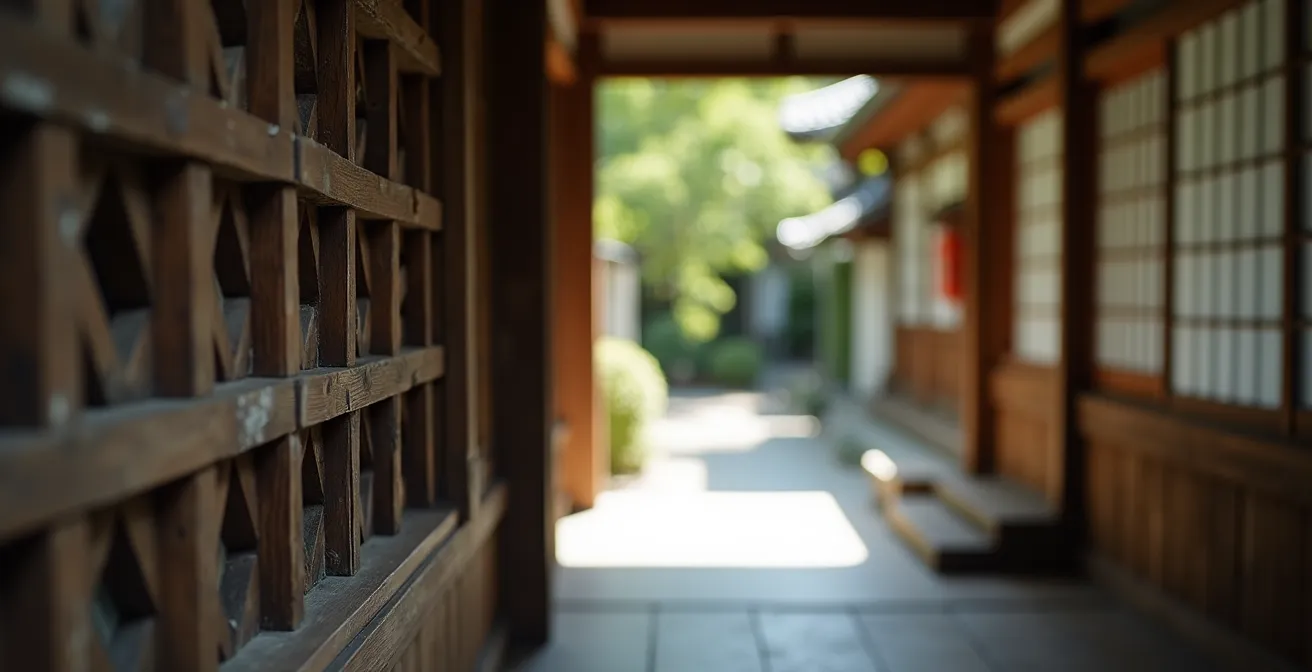
When you see a closed shoji screen or a noren curtain hanging in a doorway, the message is clear: this is a private boundary. The current conflict arises when visitors ignore these subtle (and now, not-so-subtle) cues. Understanding that the architecture is built to create seclusion is key to respecting the district as a living neighborhood.
Real or Fake: How to Tell a Genuine Maiko From a Tourist in Costume?
Part of the chaos in Gion stems from the inability of many visitors to distinguish between a working maiko and a tourist participating in a “maiko henshin” (maiko transformation) experience. The latter are happy to pose for photos, often stopping and smiling for cameras. Mistaking them for the real thing creates confusion and reinforces the expectation that all maiko are available for photoshoots. Learning to tell the difference is a crucial skill for any respectful observer.
A genuine maiko is a professional apprentice on her way to or from an engagement. Her movements are purposeful, efficient, and discreet. She is a private citizen at work, not a performer for the public on the street. Tourists in costume, on the other hand, are there for leisure and the experience of dressing up. Their behavior is entirely different. By learning a few key indicators, you can shift from being a potential “geisha hunter” to an informed cultural observer.
This simple checklist can help you identify authentic maiko and ensure you are behaving appropriately, reserving your photography for those who have consented (i.e., tourists in costume) or, better yet, for the architecture and atmosphere of the district itself.
Checklist: 5 Behavioral Indicators of an Authentic Maiko
- Observe walking pace: Genuine maiko and geiko move with purposeful efficiency. They walk quickly and do not stop for casual photos or interactions with tourists. They have a destination.
- Check the time and location: Real entertainers are most commonly seen in the evening, typically between 5:30 PM and 7:00 PM, as they head to their first appointments in the ochaya (tea house) areas.
- Look for professional companions: They often walk with other geiko or staff from their okiya (geisha house). It is rare to see them wandering alone for leisure during work hours.
- Notice their gaze: A working maiko will typically keep her eyes modestly lowered or looking straight ahead. She actively avoids making direct eye contact with tourists.
- Assess their reaction to cameras: A real maiko will deliberately ignore or avoid cameras. If a camera is pushed toward her, she may subtly shield her face or turn away. She will never pose.
By using these points of observation, you transform your experience. Instead of just trying to “get the shot,” you are actively engaging with the culture in a more meaningful and respectful way. This practice of observational respect is the foundation of modern tourism in sensitive cultural areas like Gion.
Geiko or Maiko: How to Tell the Difference by Their Hair?
For those dedicated to observational respect, learning to distinguish between a maiko (apprentice) and a geiko (fully-fledged geisha) adds another layer of appreciation. The differences are subtle but distinct, and the most telling clues are often found in their hair and accessories. This knowledge allows you to understand the status and experience of the entertainer you might see from a respectful distance.
The most immediate difference is the hair itself. A maiko, typically between 15 and 20 years old, styles her own natural hair into elaborate, traditional arrangements. This is a painstaking daily process. A geiko, on the other hand, wears a specialized wig called a katsura for her engagements. This is not only more practical but also signifies her senior status.
The Kanzashi Calendar: A Mark of Authenticity
A definitive way to identify an authentic maiko is by her kanzashi (hair ornaments). Maiko change their kanzashi every month to reflect the season: plum blossoms in February, cherry blossoms in April, weeping wisteria in May, and maple leaves in November. A tourist in a henshin costume will wear generic, non-seasonal ornaments. Noticing the correct seasonal flower in a maiko’s hair is a sign you are seeing a true professional, one who has trained for years to perfect her art, which is often showcased during events like the Miyako Odori spring dances.
Beyond hair, other visual cues can help you tell the difference. This table provides a quick guide to the key distinctions in their appearance.
| Feature | Maiko (Apprentice) | Geiko (Full Professional) |
|---|---|---|
| Hair | Own hair in elaborate styles | Simpler wig (katsura) |
| Hair ornaments | Elaborate, seasonal kanzashi | Minimal, subtle ornaments |
| Collar color | Red and white patterned | Plain white |
| Obi (belt) style | Long trailing darari obi | Shorter, simpler obi |
| Makeup | More dramatic, pink accents | More subtle, refined |
| Age range | 16-20 years old | 20+ years old |
Dusk in Gion: Why Is the Lantern Lighting Time the Best for Walking?
If you are a photographer, the desire to capture Gion’s beauty is understandable. The solution is not to abandon your camera, but to shift your focus. Instead of hunting for people, focus on the place. The best time for this is at dusk, as the sun sets and the paper lanterns (chochin) begin to glow, casting a warm, magical light on the dark wooden buildings.
This period, often called the “blue hour,” offers a unique atmosphere that is quintessentially Kyoto. The streets are quieter, the light is soft, and the district feels more intimate. It is during this time that you have the best chance of seeing a geiko or maiko, but the goal should be to appreciate the moment, not to capture it aggressively. As one travel photography expert advises:
For the best opportunities to see Geisha visit after dark and wander along Hanami-koji Dori or Shirakawa Canal to soak up the calm evening vibe.
– Travel photography expert, The Wandering Lens – Kyoto Photography Guide
This approach transforms photography from an act of “taking” to an act of “making.” You are making a beautiful image of the environment, not taking a photo of a non-consenting person. To do this ethically and effectively in low light, a few technical considerations are key:
- Arrive early: Get to public thoroughfares like Hanami-koji main street or the Shirakawa Canal area about 30 minutes before sunset to find a good vantage point.
- Use a high ISO: Set your camera to a high ISO (3200-6400) and use a wide aperture lens (e.g., f/1.8) to capture enough light without using a disruptive flash. Flash photography is strictly forbidden.
- Use a telephoto lens: A 70-200mm lens allows you to capture details from a respectful distance without intruding.
- Focus on the atmosphere: Photograph the lanterns, the reflections in the canal, the textures of the wooden machiya, and the silhouettes of the willow trees. These are the elements that create Gion’s magic.
By embracing this mindset, you can leave with stunning photographs that celebrate Gion’s beauty while upholding the dignity of its residents. It’s about capturing the soul of the place, not just a fleeting image of a person within it.
Ichigen-san: Can Regular Tourists Eat at a Gion Tea House?
Another common source of tourist frustration is the exclusive nature of the ochaya (tea houses) where geiko and maiko entertain. You cannot simply walk into one. Most operate on a strict rule of “ichigen-san okotowari,” which translates to “no first-time customers.” Entry is granted only through an introduction from an established and trusted patron, who also acts as a financial guarantor.
This system is not meant to be exclusionary for its own sake; it is built on generations of trust. Ochaya are not public restaurants. They are highly private venues where important business and social relationships are cultivated. The hostesses (okami-san) are responsible for ensuring the discretion and comfort of their clients. An unknown guest represents a risk to that delicate ecosystem. Therefore, walking up to an ochaya and trying to get a reservation is not only futile but also a sign of cultural misunderstanding.
However, this does not mean experiencing geisha entertainment is impossible for a tourist. There are legitimate, respectful channels available that bridge this cultural gap.
| Option | Accessibility | Price Range | Authenticity Level | Booking Method |
|---|---|---|---|---|
| Traditional Ochaya | Invitation only | ¥50,000+ | 100% Authentic | Through established patron |
| Gion Corner Show | Open to public | ¥3,150 | Cultural demonstration | Direct purchase |
| Hotel Concierge Arrangement | Hotel guests only | ¥30,000-50,000 | Semi-private experience | Through luxury hotel |
| Gion Hatanaka | Reservation required | ¥15,000-25,000 | Tourist-friendly authentic | Online/phone booking |
For visitors without connections, the most viable path to an authentic experience is through a high-end service that can act as the required introduction. As a case study in alternative access shows, luxury hotels like the Ritz-Carlton Kyoto and Park Hyatt can arrange special dinner experiences for their guests. The hotel’s concierge leverages their established relationships to secure a booking, effectively vouching for you. While expensive, this is a legitimate way to participate in the culture without violating its core principles of trust and introduction.
Key takeaways
- The Gion photo ban is a targeted response to harassment on private residential roads, not a city-wide ban.
- Treating geiko and maiko with human dignity—maintaining distance, not touching, and not obstructing their path—is non-negotiable.
- The most rewarding way to experience Gion is through respectful observation and appreciating the atmosphere, not aggressive photo-hunting.
When to Return a Bow from Shop Staff (and When Not To)?
Respect in Gion extends beyond interactions with entertainers. It permeates everyday courtesies, and one of the most visible is bowing. As a visitor, navigating when and how to return a bow from shop staff can be confusing, but understanding the nuance demonstrates a deeper level of cultural awareness. It shows you are a guest who is paying attention.
A simple rule is to offer a slight acknowledgment for almost any bow you receive, but the depth and formality can vary. It’s not about perfect execution, but about returning the gesture of respect. Here’s a simple guide for common situations in Gion:
- Upon entering a shop: You’ll be greeted with “irasshaimase!” (welcome). A simple, slight nod of the head is a sufficient return.
- During browsing: If staff checks on you, a bow is not necessary. A simple “daijoubu desu” (I’m okay) or a smile is fine.
- After a purchase: The staff will bow to thank you. It is polite to return this with a slightly deeper nod (about 15 degrees).
- In high-end establishments: In a formal setting like a fine lacquerware shop or art gallery, mirroring the staff’s deeper, more formal bow is a sign of respect.
- At convenience stores: A quick head nod is perfectly appropriate for the fast-paced, less formal environment.
The act of bowing in a commercial context is more than just a transaction. It’s an acknowledgment of shared space. This is especially true in a district like Gion, where space is precious and tradition is paramount.
In a district where space and privacy are precious, frame the return bow not just as a transactional courtesy, but as a non-verbal acknowledgment of the staff and a ‘thank you’ for being welcomed into their space.
– Cultural etiquette expert, Luxury Japan Travel
Ultimately, a returned bow is a small, quiet gesture that speaks volumes. It says you recognize you are a visitor in someone else’s community, and you appreciate the welcome. It’s a final, crucial piece of the puzzle to being a truly respectful tourist in Gion.
Before you raise your camera or step into an alley in Gion, stop and think. Ask yourself if you are there to appreciate a culture or to consume it. The future of tourism in this historic district depends on your answer. Commit these rules to memory, and understand that your respect is not optional; it is the price of admission to our neighborhood.