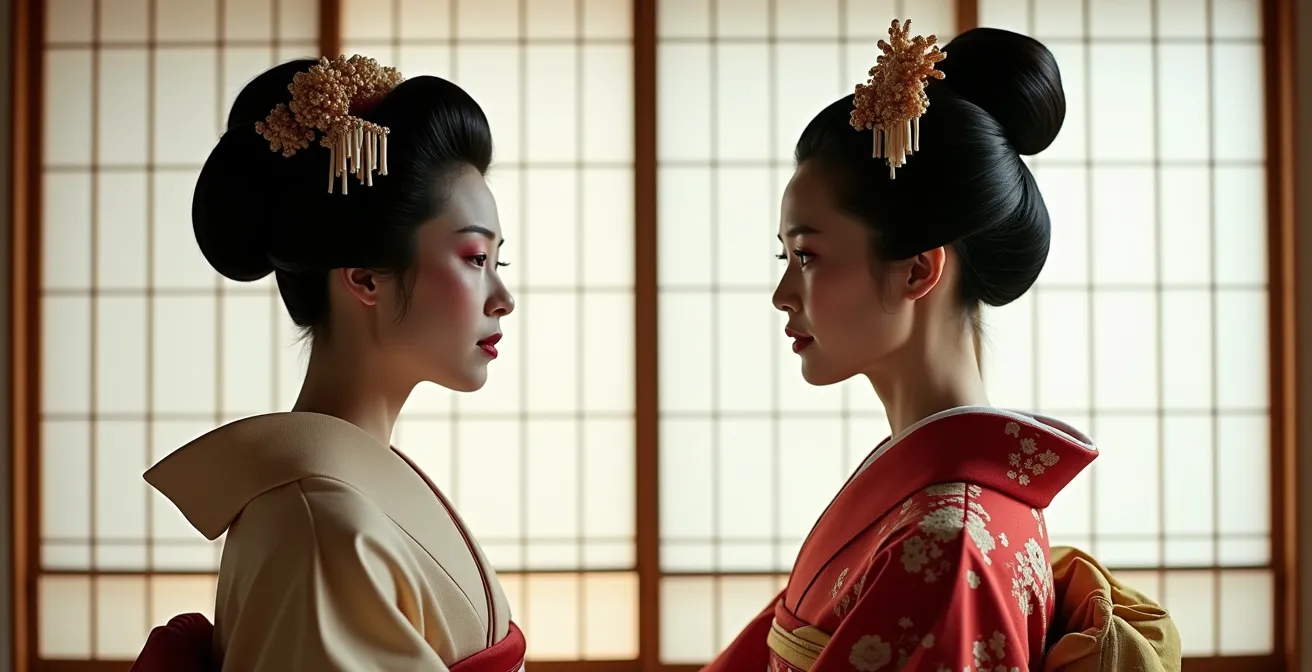
Distinguishing a maiko from a geiko is not about a simple visual checklist, but about reading a rich symbolic language of artistic mastery and status.
- A maiko’s vibrant, elaborate appearance signifies her apprenticeship, with every detail, from a trailing obi to partially painted lips, marking her journey.
- A geiko’s subdued elegance reflects her maturity and mastery as a full-fledged artist, whose reputation is built on skill rather than ornament.
Recommendation: To truly appreciate this cultural art form, learn to look beyond the costume and recognize the signs of an artist’s progression and the deep-rooted traditions they represent.
A graceful figure glides through a narrow alley in Kyoto’s Gion district. Dressed in an ornate silk kimono, her face a mask of white with striking red lips, she is the image of traditional Japan. For many visitors, this fleeting encounter is a precious memory, yet it often comes with a question: was that a geiko or a maiko? The common answer often involves a simple list of visual cues: the collar, the shoes, the hairstyle. While these observations are correct, they only scratch the surface of a far more profound story.
Relying on a mere visual checklist reduces these highly skilled artists to a set of aesthetic traits. It overlooks the very essence of their world, the karyukai (“the flower and willow world”), where every single detail is a deliberate and meaningful symbol. This world is not defined by costume, but by a rigorous hierarchy of artistic progression. The difference between a maiko (an apprentice) and a geiko (a master artist) is a narrative told through fabric, makeup, and manner, a story of years of dedication and discipline.
This guide moves beyond the superficial to decode that narrative. Instead of just listing what is different, we will explore *why* it is different. We will examine how an artist’s journey from apprentice to master is visually chronicled in her appearance. This is not about identifying a costume; it’s about understanding a living embodiment of art, where a woman’s appearance is the public expression of her status, skill, and journey within a centuries-old tradition.
By exploring the economics, skills, and hidden etiquette of their world, you will learn to see not just a beautiful image, but to read the story of the artist behind the makeup. This article will guide you through the intricate details that define their roles, correct common misconceptions, and offer a deeper respect for these custodians of Japanese traditional arts.
Summary: Geiko vs Maiko – Unveiling the Artistry
- How Much Does It Cost to Hire a Geiko for an Evening?
- More Than Looks: What Skills Must a Geiko Master Before Debuting?
- Why Does a Geiko’s Kimono Cost More Than a Luxury Car?
- Is There an Age Limit for Being a Geiko?
- Geisha vs Courtesan: Why the ‘Memoirs of a Geisha’ Image Is Wrong?
- Real or Fake: How to Tell a Genuine Maiko From a Tourist in Costume?
- Kimono or Casual: What to Wear to Avoid Leg Numbness on Tatami?
- Entering the Hidden World of Referral-Only Ryotei Restaurants
How Much Does It Cost to Hire a Geiko for an Evening?
Engaging the services of a geiko for an evening is an exclusive experience, and its cost reflects the immense skill, time, and tradition involved. The price is not for a simple performance but for a private cultural immersion. The final bill for an ozashiki (a traditional banquet with a geiko) is a composite of several factors: the geiko’s time, the meal itself, drinks, and the venue fee for the teahouse (ochaya). In Kyoto, the heartland of geiko culture, the expense can be considerable. For instance, a private ozashiki dinner in Kyoto today costs between ¥40,000 and ¥60,000 per person, and often much more.
This high price point maintains the exclusivity and prestige of the artistic hierarchy. It ensures that the clients are patrons who genuinely value the arts and understand the dedication required to master them. The cost acts as a gatekeeper, preserving the integrity of the karyukai. However, the world of geiko is not entirely impenetrable for those with a more modest budget. Recognizing the growing international interest, more accessible options have emerged. These include private tea ceremonies, which can cost around $300 per person, or group events. Public performances, such as those at Gion Corner theater or during the seasonal Miyako Odori dance festival, offer a glimpse into this world for a fraction of the cost of a private dinner, allowing a wider audience to appreciate the artistry without the commitment of a full banquet.
More Than Looks: What Skills Must a Geiko Master Before Debuting?
The transition from a young girl to a maiko and finally to a geiko is a long and arduous journey of artistic and social education. This is not a path one can simply choose as an adult; it traditionally begins in the mid-teens, after completing compulsory education. The formal training, or apprenticeship, is a deep, multi-year commitment. For example, the official maiko apprenticeship in Kyoto typically lasts for five to six years. This extended period is necessary to absorb the vast repertoire of skills required to become a true artist and entertainer.
The training begins with a minarai phase, where the apprentice learns by observing her “older sisters” (senior maiko and geiko) at engagements, absorbing the nuances of conversation and entertainment without participating directly. The core of her education is the mastery of traditional arts. This includes learning to play the shamisen, a three-stringed instrument; singing various styles of traditional songs; and, most importantly, performing traditional dance, such as the highly refined Kyo-mai style of Kyoto. As one expert notes, this is a continuous learning process:
The reason that the training takes so long is, geisha dance to different themes and songs almost every month as seasons and festivals pass by.
– Yoko Beverly Hills, Differences between Maiko, Geisha and Geiko
Beyond performance arts, a maiko must cultivate impeccable social skills. She learns the art of conversation, how to engage guests from all walks of life, and the subtle skill of hosting traditional parlor games known as ozashiki asobi. This comprehensive training ensures that by the time she becomes a geiko, she is not just a performer, but a sophisticated hostess and a custodian of culture, a true living artwork.
Why Does a Geiko’s Kimono Cost More Than a Luxury Car?
The kimono worn by a maiko or geiko is far more than a costume; it is a masterpiece of craftsmanship and a significant financial asset. Each one is a unique, tailor-made creation of the highest quality silk, often hand-painted and embroidered by master artisans. These are not garments available in any store. A formal kimono, complete with its obi (sash) and undergarments, can easily reach prices equivalent to a luxury car, with some of the most exquisite pieces valued at hundreds of thousands of dollars. This immense value comes from the rarity of the materials, the generations of skill poured into its creation, and its status as a piece of wearable art.
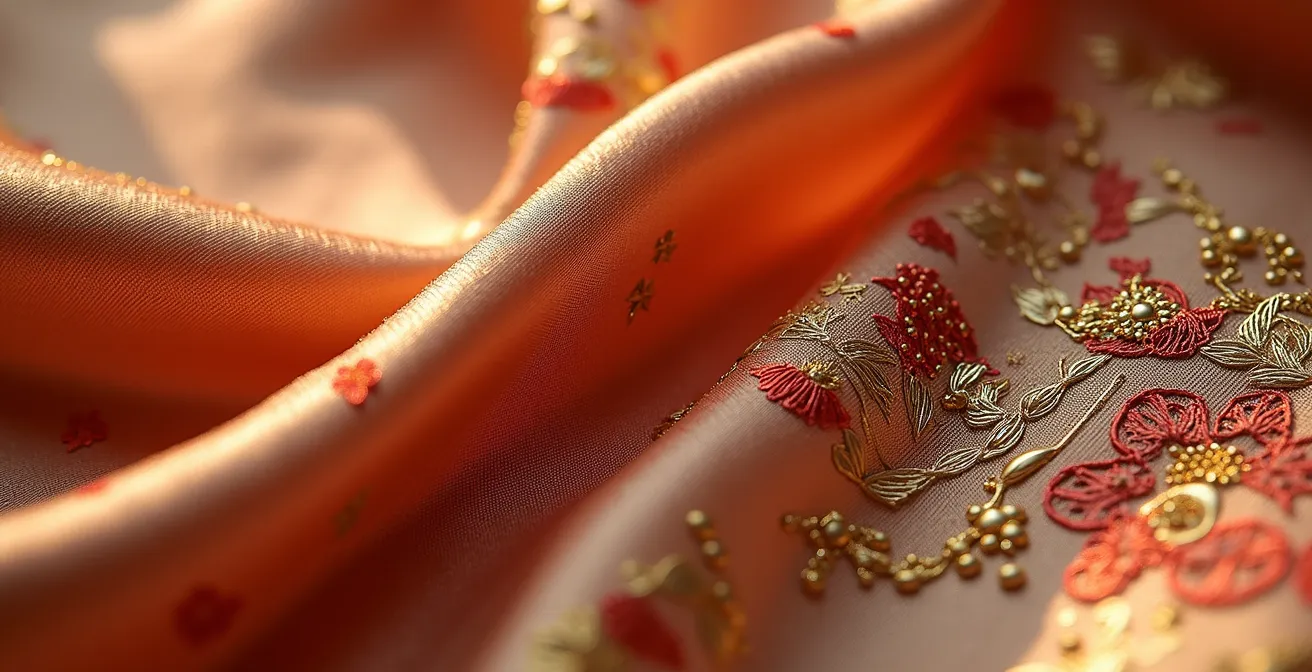
The economics behind these kimonos are fascinating. An individual maiko or geiko does not personally own these priceless garments. Instead, they belong to the okiya (the geisha house she is affiliated with). The okiya functions as a business, investing in these kimonos as long-term assets. A single kimono may be worn by different geiko over several decades, making it a symbol of the house’s heritage and prosperity. The appearance of the artist directly reflects the status of her okiya. A maiko’s elaborate outfit, particularly in winter with its heavy silk layers, long obi, and jacket, can weigh as much as 15 kilos, a physical burden that symbolizes the weight of the tradition she carries.
Is There an Age Limit for Being a Geiko?
Unlike many performance arts that favor youth, the world of the geiko values maturity and experience. There is no upper age limit to being a geiko; in fact, an artist’s prestige often grows with age. The journey begins young, with girls typically entering an okiya around age 15. The turning point in their career is the erikae ceremony (“turning of the collar”), which marks their graduation from maiko to geiko. A key indicator of this transition is age; maiko typically become geiko around age 20, after completing their rigorous apprenticeship.
Once a woman becomes a geiko, her career can continue for as long as she desires and is able to perform. Some of the most respected geiko in Japan have been active in their 80s and even 90s. As they age, their role may shift. While a younger geiko might be celebrated for her beauty and lively dancing, an older, more experienced geiko is revered for her profound musical skill, her mastery of conversation, and the depth of her artistic knowledge. Her value increases as her experience deepens, embodying the symbolic progression from blooming flower to deeply rooted tree.
Furthermore, retirement from performing at banquets does not mean leaving the karyukai. Many former geiko transition into powerful and respected roles within the community. They may become teachers, passing down their skills to the next generation of maiko. Others may open their own teahouses or restaurants. A highly successful geiko might eventually become an okasan (“mother”) of an okiya, managing the careers and lives of the artists under her care. This “second act” ensures that their lifetime of accumulated wisdom remains a cornerstone of their world.
Geisha vs Courtesan: Why the ‘Memoirs of a Geisha’ Image Is Wrong?
One of the most persistent and damaging misconceptions, particularly in the West, is the confusion of geisha with courtesans. This error was significantly amplified by fictional works like “Memoirs of a Geisha,” which blurred the lines between artistic entertainment and sexual services for narrative effect. Historically and culturally, the two roles are fundamentally distinct. Geisha originated in the 18th century as professional entertainers—initially men—specializing in music, dance, and witty conversation to enliven banquets. Their purpose was to entertain through art, in stark contrast to the yujô (courtesans) of the pleasure quarters, whose profession was sexual in nature.
The confusion often stems from practices like mizuage, a historical coming-of-age ceremony for apprentices that, in some contexts outside the authentic geisha world, involved the selling of a girl’s virginity. However, within the legitimate karyukai, this was not the standard. The practice was more commonly associated with courtesans or those on the fringes of the profession. This distinction was legally codified after World War II. As one historical source clarifies, any association with paid sexual encounters was definitively severed when the practice became illegal in the post-war period after the introduction of prostitution laws. Today, geiko are strictly artists and entertainers.
To mistake a geiko for a courtesan is to misunderstand her very identity. Her value lies in her artistic mastery, her intellect, and her role as a keeper of tradition. She sells her skill, not her body. She is an artist, a hostess, and a businesswoman operating within a complex and dignified social structure. The romanticized and often inaccurate portrayal in fiction does a great disservice to the real women who dedicate their lives to this demanding and respected profession.
Real or Fake: How to Tell a Genuine Maiko From a Tourist in Costume?
In tourist-heavy districts like Gion, it’s common to see people dressed in kimono. However, the vast majority are tourists participating in a “maiko transformation” experience. While fun, this creates confusion and can lead to inappropriate behavior towards genuine maiko, who are professionals on their way to work. Learning to spot the subtle but clear differences is a mark of a respectful and informed observer. A real maiko’s appearance is not just a costume but a carefully coded uniform that follows strict rules impossible for a tourist rental to replicate.
The details tell the whole story. For instance, a real maiko styles her own natural hair in a complex arrangement, which necessitates leaving a small band of unpainted skin at the hairline to prevent the wax from damaging her scalp. A tourist in costume will almost always wear a full wig, which has a hard, unnatural hairline. Similarly, a first-year maiko only paints her lower lip red, a symbol of her junior status. A tourist will typically have both lips painted. These are just a few of the many indicators of authenticity that an informed visitor can learn to recognize.
Observing their deportment is another key. Maiko undergo years of training in graceful movement (shosa). The way they walk, hold their hands, and bow is elegant and precise, a stark contrast to the often awkward gait of a tourist unaccustomed to wearing traditional clogs (okobo). Furthermore, real maiko have a work schedule. Seeing someone in full maiko regalia in the middle of the day is a strong sign they are a tourist, as maiko typically begin their appointments in the late afternoon and evening. It’s also crucial to be respectful; photography of maiko in private streets in Gion is now prohibited, and tourists face fines of up to $160 USD for doing so without permission.
Checklist: Identifying an Authentic Maiko
- Check the collar: A real maiko’s kimono collar (eri) is predominantly red with white and gold embroidery. A geiko’s is solid white.
- Look at the hairline: Real maiko style their own hair, showing a distinct band of unpainted skin at the hairline. Tourists wear full wigs.
- Observe the time of day: Maiko start work in the evening. A maiko seen in full attire around noon is almost certainly a tourist.
- Watch the deportment: Trained, graceful movements (shosa) are the hallmark of a real maiko and are impossible for an untrained person to replicate.
- Notice the lips and ornaments: A first-year maiko has only her lower lip painted and wears dangling floral ornaments (hana-kanzashi).
Kimono or Casual: What to Wear to Avoid Leg Numbness on Tatami?
If you are ever fortunate enough to be invited to an ozashiki, understanding the proper etiquette extends to your attire and posture. These events are held in traditional tatami rooms, where seating is on the floor, not at tables and chairs. Your choice of clothing should reflect respect for the occasion and the artists, while also being practical for sitting on the floor for an extended period. While a kimono is not expected for guests, smart casual attire is the recommended standard. Very short skirts or tight, restrictive jeans can be uncomfortable and are generally considered inappropriate.
One of the most crucial yet often overlooked details is footwear. In Japanese culture, it is a major faux pas to enter a tatami room barefoot. You will be required to remove your shoes at the entrance, so wearing clean, presentable socks is essential. This small gesture shows a great deal of cultural awareness and respect. The primary seating posture is seiza, a formal kneeling position with the tops of the feet flat on the floor. For those not accustomed to it, this can quickly lead to leg numbness. It is perfectly acceptable for foreign guests to adjust their position after a while. However, knowing a few techniques can significantly improve comfort and show your effort to respect tradition.
Practicing the seiza position at home can help. During the event, subtly shifting your weight from one leg to the other every 10-15 minutes can aid circulation. Don’t hesitate to use the small cushion (zabuton) provided; it’s there for comfort, not just decoration. If discomfort becomes significant after about 30 minutes, it is generally acceptable to discreetly ask for a low stool or to shift to a more relaxed cross-legged position, ideally by mirroring the posture of your host or other guests. Your comfort is important, but showing initial respect for tradition is paramount.
Key takeaways
- A maiko’s appearance is deliberately vibrant and complex to attract attention, while a geiko’s is subdued and elegant to signify her established artistic status.
- The immense cost of a geiko’s services and kimono is a direct reflection of years of intensive training in multiple arts and a business model where the okiya invests in them as assets.
- The career of a geiko does not end with youth; it evolves into roles of greater authority and mentorship within the ‘flower and willow world,’ with some performing into their 80s and 90s.
Entering the Hidden World of Referral-Only Ryotei Restaurants
The ultimate expression of the karyukai‘s exclusivity lies in its access model. Traditionally, one cannot simply book a dinner with a geiko at a high-end teahouse (ochaya) or traditional restaurant (ryotei). These establishments operate under a strict, centuries-old rule known as ichigen-san okotowari, which translates to “no first-time customers.” This is not a matter of snobbery but a business practice built entirely on trust and relationships. The ochaya takes full responsibility for the bill, which is sent to the patron days or weeks later. To extend such credit, the house must have complete faith in the guest.
This faith is established through personal introduction. As one source on geisha experiences in Kyoto clearly states, the system is based on vouching:
In order to be entertained at one you must be introduced by an established customer who can vouch for you.
– Gion Maikoya, Kyoto Geisha Shows and Experiences
This referral culture ensures that all guests understand the etiquette, respect the artists, and can be trusted to honor their financial obligations. It creates an intimate and secure environment where the art can flourish without the transactional nature of a typical service industry. For an outsider, this system can seem impenetrable. However, the modern world has created a few small openings. Today, high-end travel agencies and the concierges of luxury hotels in Kyoto can sometimes act as the trusted intermediary. By leveraging their established relationships with the teahouses, they can secure bookings for discerning tourists with a sufficient budget, effectively serving as the “guarantor” for their clients.
This system, while slightly more accessible now, still underscores the fundamental principle of the geiko world: it is a private society where relationships and reputation are the most valuable currency. Access is a privilege earned through trust, not just a service purchased with money. It is a world that protects its artists and preserves its traditions by carefully choosing who it allows to enter.