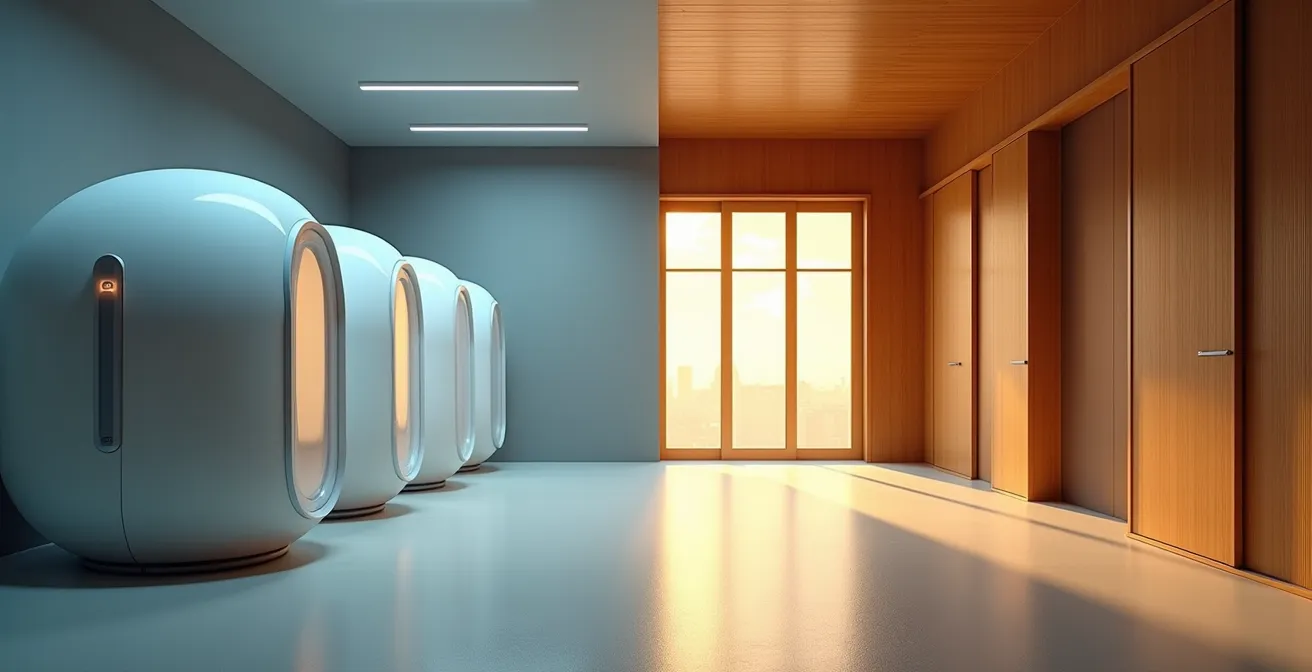
Choosing a unique Japanese stay is less about budget and more about matching your personality to the cultural experience.
- Capsule hotels and manga cafes test your need for personal space in the name of ultimate efficiency.
- Temple stays and ryokans challenge your discipline and social comfort through rigid schedules and communal rituals.
Recommendation: First, decide what you seek: the hyper-efficiency of modern Japan or a deep, structured immersion into its ancient traditions.
The search for accommodation in Japan often presents a familiar crossroads. On one path, there’s the predictable comfort of a Western-style hotel. On the other, a world of lodgings that seem plucked from science fiction or a historical film. You’ve seen the pictures: rows of futuristic sleeping pods, serene monks gliding through wooden halls, and steaming outdoor baths surrounded by snow. These aren’t just quirky novelties; they are living, breathing aspects of Japanese culture, each with its own set of unwritten rules and social contracts.
Many guides will give you a simple list of pros and cons, but they miss the fundamental point. Choosing between a capsule hotel and a temple stay isn’t like picking between a king and a queen bed. It’s a decision about what part of your comfort zone you’re willing to test. Are you seeking the quiet solitude of ancient rituals, or the anonymous buzz of ultra-modern efficiency? Are you prepared for shared spaces, strict schedules, and cultural codes that might feel utterly alien?
This guide isn’t a ranking. It’s a vibe-matching tool. We’ll explore the underlying cultural logic and the psychological fit behind Japan’s most talked-about accommodations. By understanding the intentional discomfort and the unique rewards of each, you can move beyond the stereotypes and find the weird sleep that truly fits your traveler’s soul, turning a simple overnight stay into a memorable part of your journey.
To help you navigate these fascinating choices, this article breaks down the experience of each type of stay. We will delve into the practical realities, cultural etiquette, and the unique atmosphere that defines everything from a minimalist pod to a family-run guesthouse.
Summary: Capsule Hotels or Temple Stays: A Guide to Japan’s Unique Accommodations
- Claustrophobia vs. Cozy: Is a Capsule Hotel Right for You?
- How Early Do You Wake Up for Morning Prayers at a Temple Stay?
- Net Cafe Refugees: Is Sleeping in a Manga Cafe Safe for Tourists?
- Shared Bathrooms: Are You Ready for Communal Bathing in Ryokans?
- Why Couples Should Consider ‘Love Hotels’ for Spacious Luxury?
- Left over Right: How to Wear Your Yukata Without Looking Like a Corpse?
- Hotel or Minpaku: What Is It Like to Stay With a Rural Japanese Family?
- Dinner Times and Curfews: How to Survive Ryokan Schedules?
Claustrophobia vs. Cozy: Is a Capsule Hotel Right for You?
The capsule hotel is perhaps the most iconic symbol of Japanese spatial efficiency. The experience is a direct confrontation with your own need for personal space. For some, the compact, enclosed pod feels like a futuristic, cozy cocoon—a private berth shielded from the world. For others, it’s a one-way ticket to a claustrophobic nightmare. The key is to understand that capsules are not designed for lounging; they are optimized for one purpose: efficient, affordable sleep. You don’t get a room, you get a function.
This minimalist philosophy extends to the entire facility. Luggage is stored in a separate locker, bathing is done in a communal sento-style bathroom, and a common lounge area is provided for eating and socializing. The price reflects this efficiency; capsule hotels typically charge between 3,000 and 5,000 yen per night, making them a fantastic budget option for solo travelers in prime urban locations. The vibe is one of quiet, anonymous respect. Everyone is in their own world, and the cardinal rule is silence. It’s an experience best suited for those who travel light and see their accommodation as a simple, clean, and futuristic launchpad for city exploration, not a destination in itself.
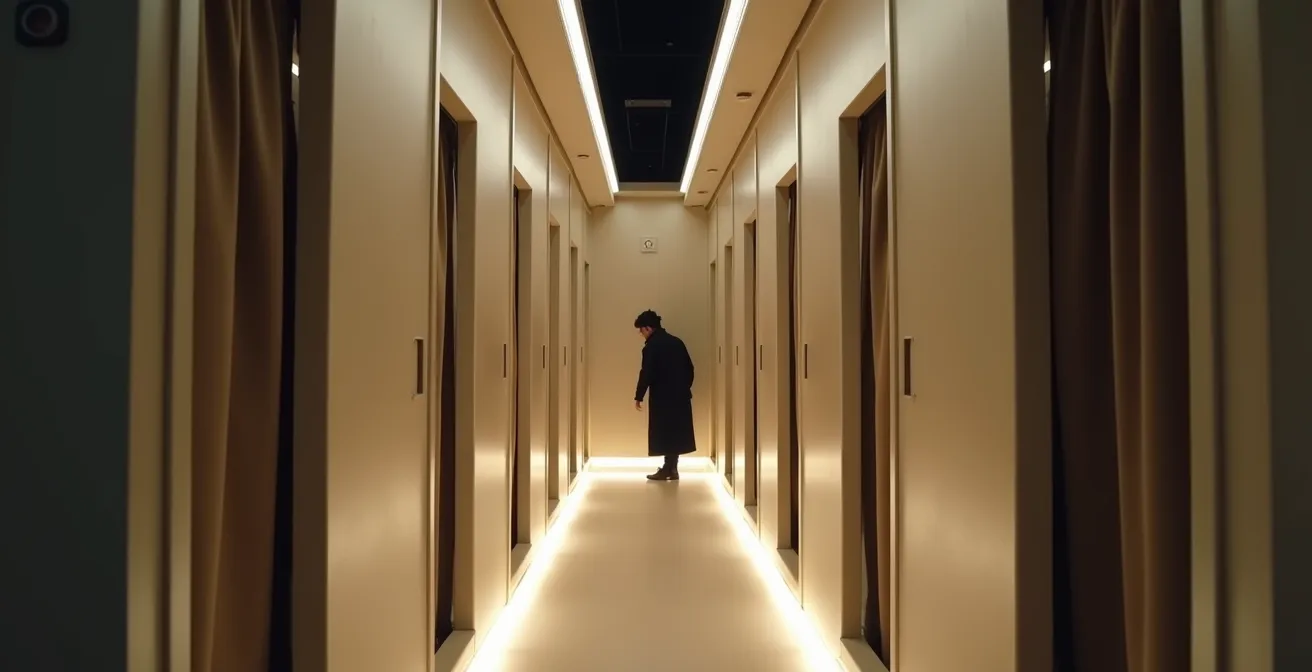
As you can see, the design is sleek and minimalist, prioritizing function over form. The atmosphere is quiet and orderly, a reflection of the social contract required to make such a space work. Adherence to etiquette isn’t just polite; it’s essential for everyone’s comfort. This includes keeping noise to an absolute minimum, consuming food only in designated areas, and respecting the privacy of others by keeping your curtain or door closed.
How Early Do You Wake Up for Morning Prayers at a Temple Stay?
A temple stay, or shukubo, offers a profound shift in pace from the frantic energy of modern Japan. This isn’t just a bed for the night; it’s a temporary entry into a monastic world governed by centuries-old rituals. The central question isn’t about comfort, but about your willingness to surrender to a disciplined routine. The day is structured around the temple’s activities, and the most important of these is the morning service. So, how early do you wake up? Expect a gentle but firm knock on your fusuma (sliding door) before sunrise. An official guide notes that temples typically begin morning prayers around 6:00 AM, with the service lasting 30 to 60 minutes.
The Shukubo Experience: To Participate or Observe?
The level of involvement in temple life can vary. Many temples simply ask guests to sit quietly and observe the morning ceremony, soaking in the resonant sound of chanting and the scent of incense. Others offer a more immersive experience, providing guests with sutra books to follow along and an opportunity to make offerings at the altar. Beyond the morning service, many shukubo also offer guided zazen meditation sessions or the chance to practice shakyo—the meditative art of copying sutras with a traditional brush and ink. The choice of stay dictates your level of participation.
The accommodation itself is traditionally spartan: a simple tatami mat room with a futon, often with shared bathroom facilities. The star of the culinary experience is shojin ryori, a vegetarian Buddhist cuisine that is both healthy and artfully presented. A temple stay is for the traveler seeking stillness, introspection, and a genuine cultural connection, not for those who value a late start and a bustling nightlife.
Net Cafe Refugees: Is Sleeping in a Manga Cafe Safe for Tourists?
Sleeping in a manga kissa (comic book cafe) or net cafe is the grittiest, most uniquely urban accommodation experience in Japan. Originally designed for patrons to read manga or use the internet for a few hours, they evolved into a de facto 24/7 lodging solution. The term “net cafe refugee” even entered the lexicon; during Japan’s economic downturn, the ‘net cafe refugee’ phenomenon emerged when unemployed workers rented private booths by the month as a form of temporary housing. This history gives the manga kissa a very different vibe from a tourist-focused hostel.
For travelers, it’s a surprisingly viable, if not glamorous, option. You rent a small private booth, often equipped with a reclining chair or a flat-cushioned floor, a computer, and headphones. Most cafes offer unlimited free soft drinks and sometimes even soft-serve ice cream. For a small fee, you can use a shower. It’s incredibly cheap and requires no advance booking, making it perfect for a missed-last-train scenario. The question of safety is valid. While generally safe due to a constant staff presence, they are not secure like a hotel. Your booth may not lock, and you are sleeping in a public, albeit partitioned, space.
The key is preparation and awareness. To ensure a safe and comfortable stay, a few precautions are essential:
- Always choose a private, fully-enclosed booth over an open-plan seating area.
- Keep your passport, wallet, and phone on your person at all times, even when sleeping.
- Utilize the coin lockers that most cafes provide for larger bags or luggage.
- Prioritize cafes located near major, well-lit train stations, which tend to be safer and more accustomed to overnight guests.
This option is best for the adventurous, budget-conscious solo traveler who values flexibility over comfort and is looking for a story to tell.
Shared Bathrooms: Are You Ready for Communal Bathing in Ryokans?
Staying in a traditional inn, or ryokan, is often at the top of a traveler’s Japan bucket list. It promises tatami floors, exquisite multi-course kaiseki dinners, and impeccable service. But it also comes with one of the biggest cultural hurdles for many visitors: the communal bath, or onsen (if it uses natural hot spring water). Japan’s onsen culture is vast, with over 27,000 hot spring locations, and it’s a deeply ingrained social ritual. The idea of bathing with strangers, however, can be a source of major anxiety.
The first thing to know is that baths are gender-separated, and there is a strict etiquette of washing thoroughly at a shower station *before* entering the pristine water of the tub. It’s a place for quiet relaxation, not swimming or socializing loudly. For many, overcoming this initial shyness leads to one of the most relaxing and memorable experiences of their trip. The feeling of soaking in a steaming, mineral-rich outdoor bath (a rotenburo) while gazing at a mountain landscape is sublime. However, if the thought is simply too much, you are not out of options. Many ryokans have adapted to the needs of more modest guests.
This table breaks down your options, allowing you to match your privacy needs with the available bath types.
| Bath Type | Privacy Level | Best For | Availability |
|---|---|---|---|
| Public Onsen | Fully communal, gender-separated | Cultural immersion seekers | Standard at all onsen ryokans |
| Kashikiri-buro (Private) | Complete privacy, reservable | Couples, families, shy travelers | Many ryokans offer for hourly rental |
| In-room Onsen | Total privacy in guest room | Luxury seekers, tattoo bearers | Premium ryokans only |
| Rotenburo (Outdoor) | Communal but with nature views | Nature lovers, photographers | Common at mountain/seaside ryokans |
As the table shows, a kashikiri-buro, or private reservable bath, is the perfect compromise. It allows you and your travel companions to experience the onsen in complete privacy for a set period, usually 45-60 minutes. This provides the best of both worlds: cultural experience without the social anxiety.
Why Couples Should Consider ‘Love Hotels’ for Spacious Luxury?
Mention “love hotel” and it conjures images of seedy decor and clandestine meetings. While that is part of their history, in modern Japan, they have evolved into something far more useful for travelers, especially couples. They offer something that is often in short supply in Japanese cities: space, privacy, and surprising luxury at a competitive price. Forget the cramped business hotels; love hotels often feature king-sized beds, huge bathrooms with jacuzzis, extensive room service menus, and entertainment systems that put other hotels to shame.
A Practical and Comfortable Choice for Tourists
Travel experts have noted that love hotels can be a practical alternative for traveling couples. Blending the contact-free efficiency of a capsule hotel with the amenities of a boutique accommodation, they provide a higher level of comfort. The interiors are often plush and creatively themed, offering a fun and memorable experience that goes beyond a standard, sterile hotel room. They are designed for discretion, which translates to a completely seamless, contact-free check-in and check-out process.
The key is understanding their unique pricing system. You can book for a “rest” (kyukei), which is a 2-4 hour slot, or a “stay” (shukuhaku), which is for an overnight period, typically beginning after 10 PM. For tourists, the “stay” option is often cheaper than a comparable business hotel. The check-in process is fully automated: you select your room from an illuminated panel in the lobby, pay at a machine, and head straight to your room. It’s anonymous, efficient, and surprisingly simple. For a couple looking for a spacious, comfortable, and quirky place to crash, a love hotel is an unconventional but brilliant choice.
Left over Right: How to Wear Your Yukata Without Looking Like a Corpse?
One of the most delightful rituals of a ryokan or onsen hotel stay is shedding your street clothes for a yukata, a light cotton kimono. It serves as your all-purpose attire—pajamas, bathrobe, and even your outfit for dinner in the ryokan’s dining hall. Wearing it is simple, but there is one crucial, non-negotiable rule that separates the living from the dead. Getting it wrong is a major cultural faux pas.
The rule is simple but absolute. As the Japanspecialist Travel Guide succinctly puts it:
The left side (side of the heart if you need some memory tool) should be on top of the right side
– Japanspecialist Travel Guide, The Ryokan Etiquette Guide
Wrapping the right side over the left is how the deceased are dressed for burial. While locals will likely be forgiving of a tourist’s mistake, getting this detail right shows respect and an appreciation for the culture. Once you have the wrap correct, you secure the yukata with the obi (belt), tying it in a simple knot at your waist. The yukata is meant to be comfortable and relaxing, a symbol that you have left the stresses of the outside world behind.
Your Yukata-Wearing Action Plan
- Fit Check: Put on the yukata like a bathrobe. The hem should ideally reach your ankles.
- The Golden Rule: Wrap the LEFT side of the yukata over the RIGHT side across your body.
- Secure the Obi: Tie the obi belt around your waist to hold the yukata in place. A simple bow tied at the back or side is common.
- Wear with Confidence: The yukata is appropriate attire anywhere within the ryokan, including to and from the onsen and in the dining hall.
- Venture Out (Optional): In many onsen towns, it is perfectly acceptable to wear your ryokan’s yukata and geta (wooden sandals) for a short evening stroll.
Mastering this simple garment is your first step into the immersive, ritual-driven world of the traditional Japanese inn. It’s a small detail that makes a big difference in feeling like an informed guest rather than a confused tourist.
Hotel or Minpaku: What Is It Like to Stay With a Rural Japanese Family?
For travelers wanting to venture beyond tourist hubs and experience authentic, everyday Japanese life, a minpaku or minshuku stay is an unparalleled opportunity. These are not hotels; they are private homes opened up to guests, offering a window into a world that most visitors never see. They represent the deepest level of cultural immersion, but also the biggest challenge to a traveler’s independence and social comfort.
Understanding Minshuku: Japan’s Traditional B&B
Minshuku are essentially Japanese bed and breakfasts, typically family-run and located in rural or scenic areas. The experience is intimate; you are a guest in someone’s home. Facilities are often simpler than a ryokan—guests might be expected to lay out their own futons and will almost certainly share a bathroom with the family and other guests. The immense reward for this lack of luxury is the connection. You live alongside the owners, sharing home-cooked meals and experiencing a slice of genuine local life. It’s an opportunity for incredible hospitality and authentic cultural exchange.
This level of intimacy requires a degree of social grace. Bringing a small gift (omiyage) from your home country is a wonderful gesture of appreciation. More importantly, learning a few basic Japanese phrases can bridge the communication gap and show immense respect.
- When entering their home for the first time, say “Ojama shimasu” (Excuse me for intruding/disturbing you).
- Before eating, put your hands together and say “Itadakimasu” (I humbly receive this meal).
- After finishing, say “Gochisousama deshita” (Thank you for the meal, it was a feast).
- A simple “Arigato gozaimasu” (Thank you very much), accompanied by a slight bow, goes a long way.
A minpaku stay is not for everyone. It is for the open-minded, flexible traveler who is willing to trade anonymity and luxury for connection and authenticity.
Key Takeaways
- The choice of unique accommodation in Japan is a personality test: it pits your need for efficiency against your desire for immersion.
- Capsule hotels and manga cafes offer ultimate budget-friendly efficiency but demand you sacrifice personal space.
- Temple stays and ryokans provide deep cultural rituals but require you to surrender to strict schedules and communal norms.
Dinner Times and Curfews: How to Survive Ryokan Schedules?
The most common point of friction for Western travelers at a traditional ryokan is not the futon or the shared bath, but the schedule. A ryokan operates like a finely tuned clock, and you are expected to sync your watch to it. This is not a suggestion; it’s a core part of the experience. Ryokans often have curfews, and more importantly, they have rigid, immovable meal times. A travel guide notes that ryokans typically expect guests to arrive for check-in around 3:00 PM and be ready for dinner by 6:00 PM. Missing these windows can be seen as disrespectful and may even mean you forfeit your meal.
This rigidity isn’t arbitrary. It’s dictated by the very essence of the ryokan experience: the onsen and the kaiseki dinner. The philosophy behind this strict timing is deeply practical and cultural.
The Philosophy of the Ryokan Clock
The schedule is built around two pillars. First is the bathing ritual; it is customary to have a relaxing soak in the onsen before dinner to wash away the travel dust and prepare for the meal. Second, and most importantly, is the kaiseki. This is not just a meal; it is a multi-course culinary art form where each dish is prepared to be served at its absolute peak of freshness, temperature, and texture. A 15-minute delay can compromise the integrity of a chef’s painstakingly prepared creation. The schedule exists to ensure you experience this culinary masterpiece exactly as the chef intended.
Surviving the ryokan schedule, then, is about a mental shift. Don’t view it as a prison; see it as a framework designed to deliver the optimal experience. Plan your day to arrive on time, embrace the pre-dinner bath, and be seated for your meal when asked. By surrendering to the ryokan’s rhythm, you are not losing freedom; you are gaining access to the heart of Japanese hospitality, or omotenashi.
Ultimately, the choice of your accommodation in Japan is a choice about the kind of traveler you want to be. Do you want to observe the culture from a comfortable distance, or are you willing to step inside it, even if it means being a little uncomfortable? By embracing the rules, rituals, and schedules, you transform a simple place to sleep into a profound and lasting memory.