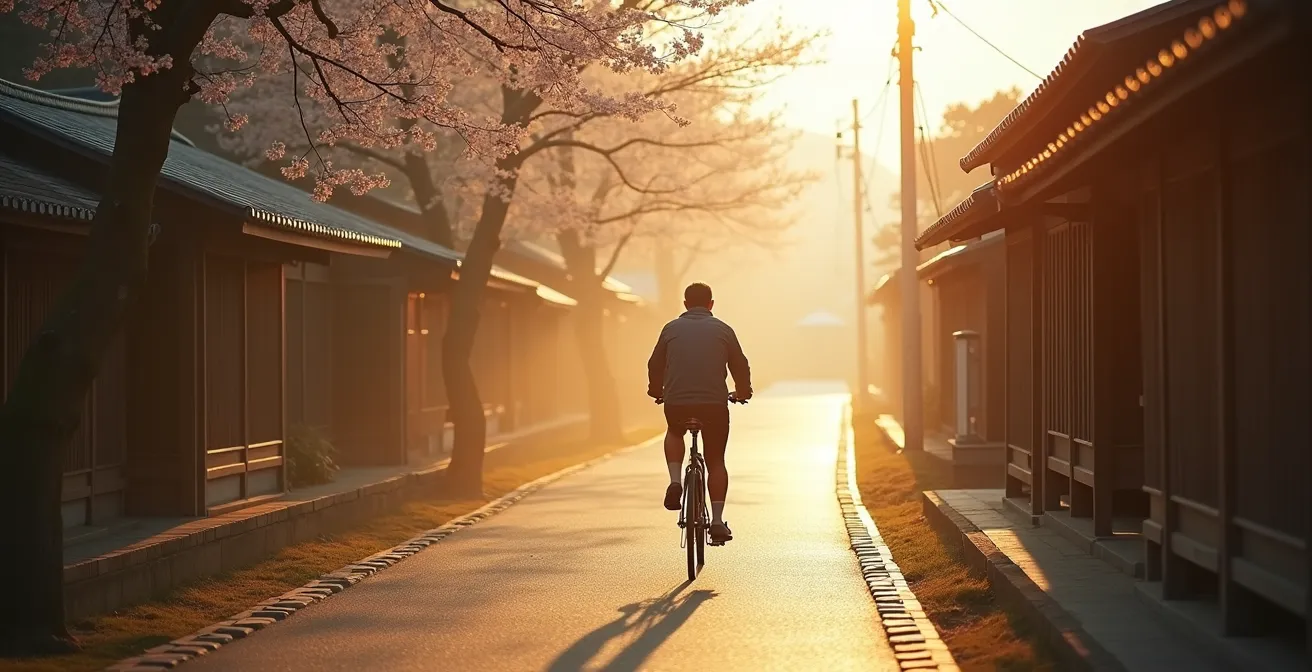
The one-day bus pass isn’t your key to Kyoto; it’s a ticket to the city’s worst traffic jams and most crowded sights.
- Cycling allows you to bypass tour bus schedules, access tranquil temples, and explore residential areas where authentic Kyoto thrives.
- A bike-centric strategy prevents “temple burnout” by turning transit into part of the discovery, not a chore.
Recommendation: Ditch the bus-first mentality and embrace the bicycle as your primary tool for a more profound and respectful visit.
Kyoto. The name itself conjures images of serene Zen gardens, vermilion torii gates, and geishas gliding through lantern-lit alleys. For the history buff, it’s a living museum. Yet, the modern reality often clashes with this dream. The city groans under the weight of its own popularity, with buses packed to capacity and iconic sites feeling more like theme parks than sacred spaces. A staggering record 16.3 million visitors stayed overnight in Kyoto in 2023, and the pressure is palpable.
The common advice is to buy a one-day bus pass and tick off a list of famous temples. This approach, however, is the very source of the problem. It funnels everyone onto the same “Golden Route,” creating bottlenecks and a frustrating, superficial experience. You spend more time waiting in traffic and shuffling through crowds than actually connecting with the city’s profound history and culture. You might see the famous sights, but you won’t truly experience them.
But what if the solution wasn’t about which bus to take, but about avoiding the bus altogether? This guide offers a different perspective, a preservationist’s approach. We will reposition the humble bicycle from a mere alternative to your most powerful strategic tool. It’s about strategic mobility—using two wheels to reclaim an authentic Kyoto, to move at a pace that respects the city’s fragile soul, and to find the tranquility that brought you here in the first place.
This article will guide you through a new way of thinking about your Kyoto itinerary. We will explore how to outsmart the crowds at major landmarks, avoid the dreaded “temple burnout,” discover authentic cuisine, navigate sensitive areas like Gion with respect, and ultimately choose solitude over spectacle. Get ready to see the real Kyoto, one pedal stroke at a time.
Summary: A Practical Guide to Seeing Kyoto Beyond the Crowds
- 6 AM Starts: Why You Must Beat the Tour Buses to Kiyomizu-dera?
- Temple Burnout: How Many Shrines Can You Visit Before They Look the Same?
- Tofu and Zen: Where to Try Monk’s Cuisine Without a Reservation?
- No Photos: Why Geisha Harassment Led to Bans in Gion?
- Beyond Kinkaku-ji: Which Unknown Temples Offer Real Zen?
- Kinkaku-ji or Daitoku-ji: Selecting for Gold or Solitude?
- Temple Burnout: How to Pace Yourself on the Golden Route?
- Public vs. Private Streets: Where Are You Allowed to Take Photos in Gion?
6 AM Starts: Why You Must Beat the Tour Buses to Kiyomizu-dera?
The first rule of strategic tourism in Kyoto is to treat your alarm clock as an ally. Nowhere is this more crucial than at Kiyomizu-dera. The temple, perched on its massive wooden stage, is an unforgettable sight, but sharing it with thousands of people can shatter the magic. The conventional tourist arrives after a leisurely breakfast, joining a slow-moving river of people. You, the strategic traveler, will do the opposite.
The key is understanding the enemy’s schedule: the tour bus. Local tourism observations confirm that the first tour buses begin disgorging passengers around 9 am. However, the temple gates swing open at 6 am. This three-hour window is your golden opportunity. Arriving by 7 am at the latest means you experience the temple as it was meant to be: a place of quiet contemplation, with the morning sun casting long shadows and illuminating the city below.
A bicycle gives you a critical advantage here. Instead of waiting for the first bus of the day, you can cycle to the base of the Higashiyama district and walk up the final ascent. This allows you to arrive on your own schedule, fully independent of public transport timetables. For those traveling from North America, use your jetlag. Your body will be naturally awake early, providing the perfect excuse to get out and explore before the city fully wakes. You can witness the sunrise, take unobstructed photos, and be gone before the first wave of crowds even arrives.
Temple Burnout: How Many Shrines Can You Visit Before They Look the Same?
“Temple burnout” is a real phenomenon in Kyoto. After the third or fourth magnificent hall and manicured garden, a sense of fatigue can set in. The details blur, and the profound history of each location is lost in a whirlwind tour. This feeling is a direct symptom of bus-centric tourism, which treats temples as checklist items to be rushed through before catching the next ride. It prioritizes quantity over quality, leaving you exhausted rather than enlightened.
Adopting a bicycle-first approach fundamentally changes this dynamic. Your mode of transport is no longer a stressful interlude but part of the discovery itself. Cycling between sites, especially along quiet backstreets or the scenic Kamo River path, becomes a moment of reflection. It allows your mind to process what you’ve just seen and to reset before the next experience. The journey becomes as meaningful as the destination.
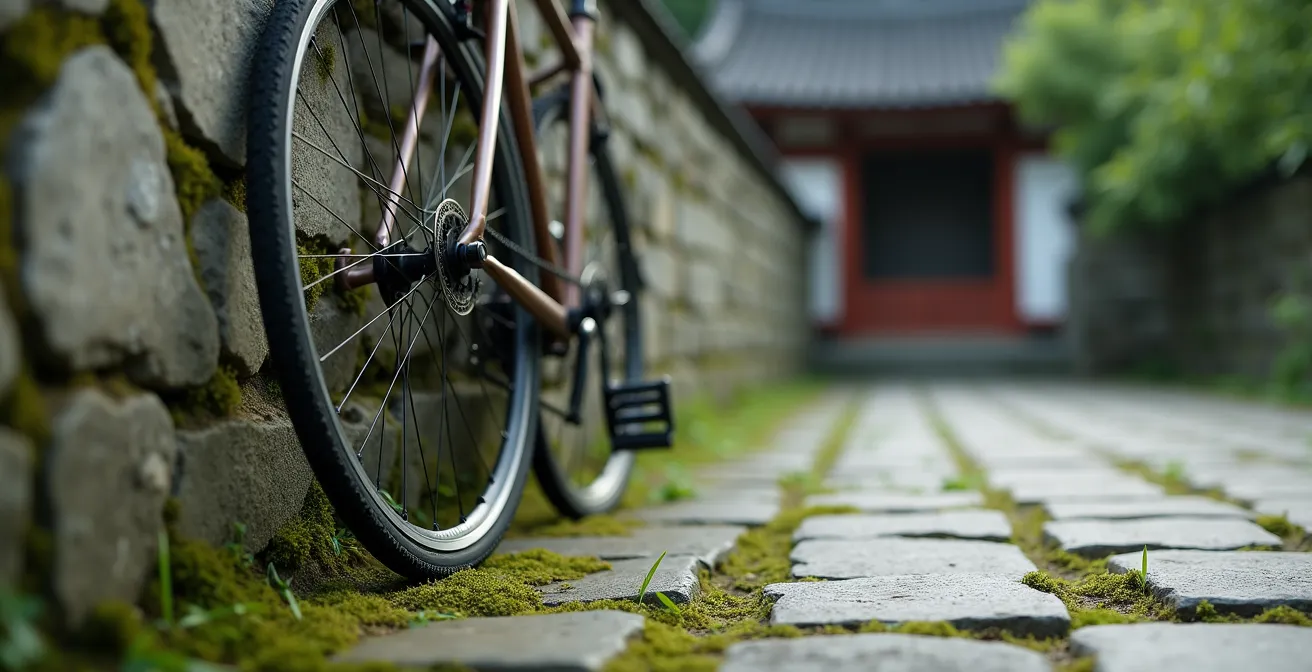
As the image above suggests, the bicycle allows you to see temples not just as grand monuments, but as quiet interludes. It encourages a slower, more deliberate pace. You’re more likely to notice the small, moss-covered shrine in a residential neighborhood or the lone monk sweeping a temple courtyard. This “preservationist pace” transforms your visit from a frantic sprint into a meditative journey.
There’s a certain grace that comes from seeing temples not as destinations, but as resting points along your ride. A chance to slow down, breathe, and truly see.
– The Cyclist’s Perspective
Tofu and Zen: Where to Try Monk’s Cuisine Without a Reservation?
One of Kyoto’s most unique culinary experiences is *shojin ryori*, the traditional vegetarian cuisine of Buddhist monks. It’s elegant, healthy, and deeply connected to the principles of Zen. However, the most famous restaurants offering it are often booked months in advance and are firmly on the tour bus circuit. Trying to secure a spot can be another source of tourist frustration. But with a bicycle, you can trade reservation stress for spontaneous discovery.
The secret is to explore the “veins” of the city, not just the “arteries.” Tour buses are confined to major roads, but a bike allows you to meander through the quiet residential neighborhoods that surround major temple complexes. It’s here, one or two blocks away from the main tourist exits, that you’ll find small, family-run eateries serving incredible shojin ryori to locals. These places often have no English signs, just a simple *noren* curtain over the door, and they are completely inaccessible to large tour groups.
This “bike-and-seek” method turns lunch into an adventure. Instead of having a fixed reservation, you embrace the possibility of what you might find. As one local cafe owner notes, many visitors stick to famous spots by default simply because they don’t know where else to go. A bicycle empowers you to break that pattern and discover the places that are genuinely hoping for more visitors.
Your Action Plan: The Bike-and-Seek Method for Shojin Ryori
- Explore places where tour buses never go—quiet temples, residential streets, and small local shrines.
- Patrol the residential streets surrounding major temple complexes like Daitoku-ji or Nanzen-ji.
- Look for the tell-tale signs of a local eatery: simple noren curtains and hand-written menus.
- Target the 11 am to 1 pm window, when many tour groups are in transit between major sites.
- Focus your search one or two blocks away from the main temple exits, where the crowds thin out instantly.
No Photos: Why Geisha Harassment Led to Bans in Gion?
Gion is the historic heart of Kyoto’s geisha culture, but it has also become the epicenter of the city’s struggle with overtourism. The desire to capture a photo of a *geiko* or *maiko* has led to increasingly aggressive behavior from tourists, turning the district’s narrow alleys into a chaotic and disrespectful media scrum. This isn’t just an inconvenience; it’s a threat to a living culture.
Reports tell of disrespectful tourists crowding streets, hounding apprentice geisha, defiling legendary temples and generally treating the ancient capital like a theme park.
– Tokyo Weekender, Visiting Kyoto in an Age of Overtourism
In response, local authorities have taken the drastic step of banning photography on private streets in Gion, with fines for offenders. This is a desperate measure to protect the women who live and work there. For the thoughtful traveler, this poses a dilemma: how to experience this iconic district without contributing to the problem? The answer, once again, lies in strategic mobility and a preservationist mindset. A bicycle allows you to maintain a respectful distance, to observe the atmosphere of the district without being part of the intrusive throng.
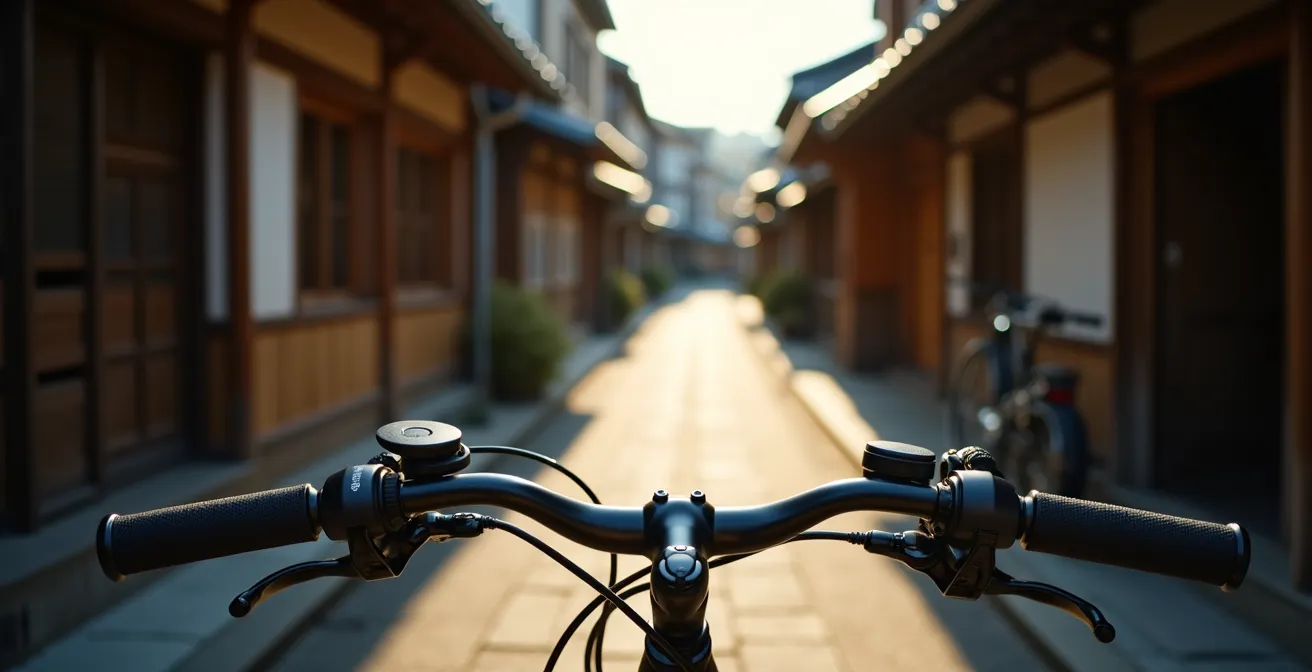
Imagine seeing Gion from this perspective: a quiet, early morning ride before the crowds descend. You can appreciate the architecture and the palpable sense of history without chasing anyone for a photo. The bicycle becomes a tool of respect. It allows you to be a silent observer, passing through without leaving a disruptive wake. It encourages you to see Gion as a neighborhood, not a stage, and its residents as people, not attractions.
Beyond Kinkaku-ji: Which Unknown Temples Offer Real Zen?
Kinkaku-ji, the Golden Pavilion, is arguably Kyoto’s most famous image. It is undeniably beautiful, a jewel box reflected in a tranquil pond. But the experience of visiting it is often anything but tranquil. You are herded along a one-way path, jostling for a spot to take the same photo as everyone else. This is the “Golden Cage”—stunning to look at, but impossible to truly experience. The real Zen of Kyoto lies elsewhere, in the countless smaller temples that are ignored by the tourist masses.
This is where a bicycle becomes your key to unlocking true solitude. While the tour buses queue for Kinkaku-ji, you can be cycling to nearby temples that offer a deeper, more personal connection to Kyoto’s history and aesthetics. These are places where you can actually sit on a tatami mat, gaze upon a garden, and hear nothing but the wind in the trees. You trade the fleeting “wow” factor of gold for the lasting peace of genuine contemplation.
This isn’t about avoiding famous places entirely, but about making conscious choices. A bicycle gives you the flexibility to visit a famous site at an off-peak time, then easily escape to a nearby sanctuary when the crowds become unbearable. You are no longer a prisoner of the Golden Route; you are the master of your own itinerary.
Case Study: The Genkou-an Alternative
As one local guide recommends when friends visit, “Skip the famous spots entirely. While tourists pack Kinkaku-ji, I take friends to Genkou-an. The garden there tells deeper stories about old Kyoto.” This small temple in the city’s northwest is famous for its “Window of Confusion” and “Window of Enlightenment,” offering a profound visual metaphor for Zen philosophy. It is a powerful experience that is simply unavailable amidst the clamor of a major tourist hub. A visit here is possible because it’s a short, pleasant bike ride from the Kinkaku-ji area, but completely off the standard bus tour path. A quick search on a map will reveal dozens of such hidden gems, all accessible with the freedom a bicycle provides.
Kinkaku-ji or Daitoku-ji: Selecting for Gold or Solitude?
The choice between Kinkaku-ji (the Golden Pavilion) and the Daitoku-ji temple complex perfectly illustrates the strategic decision every history buff must make in Kyoto. One offers an immediate, iconic visual payoff. The other offers a sprawling, immersive journey into the world of Zen. Your mode of transport heavily influences which experience is more practical and rewarding.
Kinkaku-ji is built for bus tourism. It has large parking lots and direct routes, and the experience is designed to be consumed quickly. You enter, take the photo, and leave. Daitoku-ji, by contrast, is a vast walled complex containing over twenty sub-temples, many with their own priceless gardens and art. Exploring it properly takes hours, if not a full day. It is fundamentally incompatible with the rigid schedule of a tour bus, which is why it remains an oasis of calm.
A bicycle is the ideal way to explore Daitoku-ji. You can ride to the complex, park your bike, and then spend hours wandering from one sub-temple to another on foot. If you do wish to visit Kinkaku-ji, you can do so as a quick surgical strike early in the morning, then retreat to the solitude of Daitoku-ji for the rest of the day. This flexibility is impossible when you are reliant on bus schedules. The following comparison highlights the trade-offs:
| Temple | Access Method | Visit Duration | Experience Type |
|---|---|---|---|
| Kinkaku-ji | Direct bus routes | 1 hour | Visual payoff, high traffic |
| Daitoku-ji | Bike recommended | Half-day | Multiple sub-temples, solitude |
Temple Burnout: How to Pace Yourself on the Golden Route?
Let’s be realistic: as a first-time visitor or history buff, you will likely want to see some of the famous sites along the so-called “Golden Route” (Kinkaku-ji, Ryoan-ji, etc.). The key is not to avoid it entirely, but to navigate it intelligently to prevent the aforementioned temple burnout. This means having a strategic escape plan, and your bicycle is the ultimate getaway vehicle.
The hybrid approach is often best. Start your day using the bus or subway for a long-haul leg of your journey, for instance, to the Arashiyama district. But once the crowds start to build and the buses become unbearably full, you switch to a pre-located rental bike. Kyoto is a relatively flat city, making it fantastic for cycling, and its grid layout makes it hard to get lost. You can use the bike to hop between the smaller temples in an area, explore at your own pace, and then drop it off near a subway station for your return journey.
Think of your day in segments: energy-draining bus segments versus recharging bike segments. The Kamo River path provides a beautiful and efficient north-south “highway” for cyclists, allowing you to bypass congested city streets entirely. By identifying bike rental locations along the Golden Route, you give yourself “bail-out points.” When a temple is more crowded than you expected, or you simply need a break, you can hop on your bike and retreat to a quiet park or riverside cafe, something a bus pass could never offer. This proactive pacing is the antidote to the passive, draining experience of being herded from one site to the next.
Key Takeaways
- Strategic Timing: Use a bike to visit major sites like Kiyomizu-dera between 6 am and 9 am to avoid tour bus crowds.
- Pacing Over Quantity: Cycling between temples prevents “temple burnout” by turning transit into a relaxing part of the experience.
- Access to Authenticity: A bicycle is the best tool for exploring residential areas to find hidden restaurants and shops inaccessible to tour groups.
Public vs. Private Streets: Where Are You Allowed to Take Photos in Gion?
The photography ban in parts of Gion has created confusion and anxiety for many visitors who want to be respectful. The simple rule is: if you see a sign explicitly forbidding photography, put your camera away. These are typically on the narrower, privately-maintained alleys (*roji*) where geiko and maiko live and work. The main thoroughfares, like Hanamikoji Street, are generally public, but the same principles of respect apply. The core issue is the harassment of residents, not photography itself.
As a cyclist, you have a natural advantage. You are moving at a pace that is less intrusive. You can glide through the district, absorbing the atmosphere without stopping to form a crowd. Your goal should be to photograph the timeless architecture and the serene atmosphere of the neighborhood, not to hunt for a picture of a geisha. The best and most respectful street photography happens when you focus on the place, not the people.
For those seeking that classic “old Japan” aesthetic without the ethical minefield of Gion, a bicycle opens up a world of alternatives. Districts like Kamishichiken (the oldest and quietest of Kyoto’s geisha districts), the streets around the Gekkeikan Okura Sake Museum in Fushimi, or the well-preserved townscape of the Saga-Toriimoto area near Arashiyama offer similar charm with a fraction of the tourists. A bike allows you to easily reach these areas and explore them freely and respectfully. Remember, Kyoto’s grid pattern and network of alleys make it a fantastic city for two-wheeled exploration, allowing for quick and easy shortcuts away from crowded main streets.
Frequently Asked Questions About Navigating Kyoto
Where can I take photos safely in traditional Kyoto?
Consider exploring temples like Tofuku-ji or Otagi Nenbutsu-ji, walking the Philosopher’s Path, or visiting the Arashiyama area beyond the main bamboo grove. These offer similar charm with fewer tourists and less potential for causing disruption.
What areas should cyclists avoid for photography?
You should always avoid taking photos on private alleys (roji) in Gion, especially those with clear ‘No Photography’ signs. Also, be mindful in any narrow residential lane where stopping could block access for residents.
When is the best time for respectful street photography?
Early morning is always best. Hit famous temples right at opening time. The soft morning sun can make even a potentially crowded spot like Kinkaku-ji feel magical and private. One local guide even reported having the entire Golden Pavilion to themselves for almost 30 minutes by arriving at dawn.