In summary:
- Choosing the right seat involves a trade-off between the traditional atmosphere of floor-based box seats and the physical comfort of Western-style chair seats.
- Tickets for popular weekend matches sell out almost instantly; securing them requires a clear strategy and timing your purchase exactly when they go on sale.
- The stadium experience extends beyond the bouts, including unique foods like wrestler’s hot pot (*chanko nabe*) and understanding crowd reactions to major upsets.
- Understanding the Shinto rituals before each match transforms the viewing from a simple sport into a deep cultural event, making you an active participant.
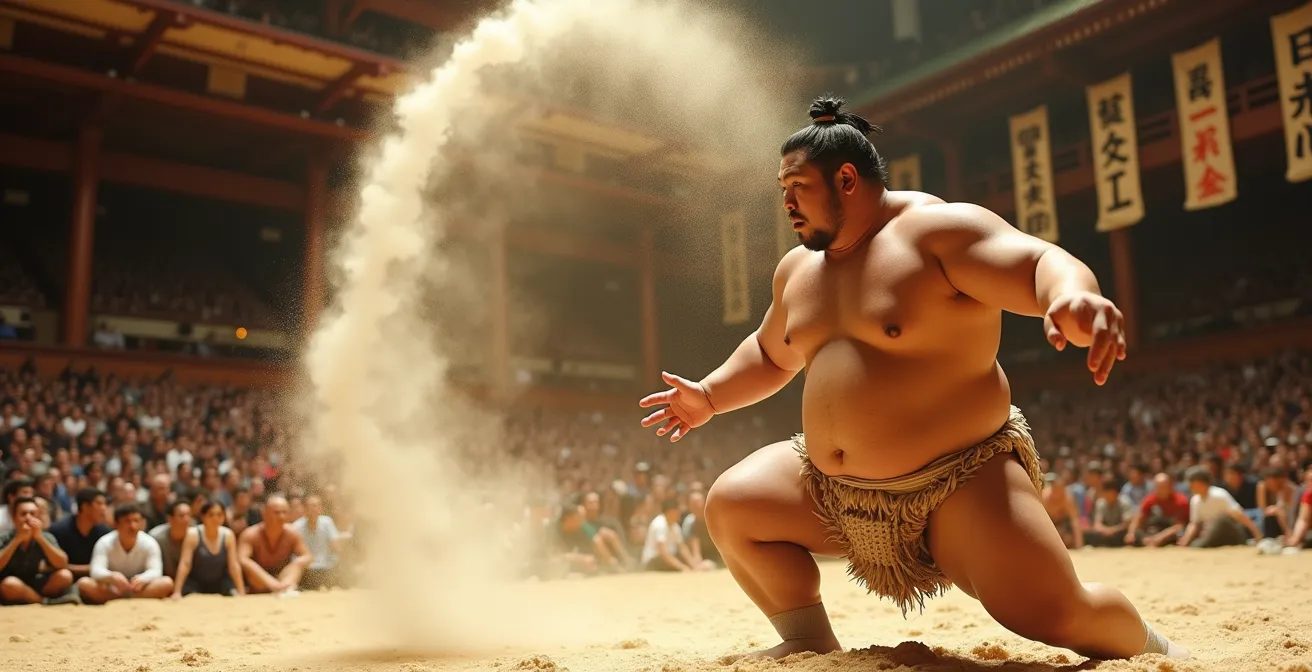
The explosive clash of titans, the roar of the crowd, the scent of purifying salt in the air—attending a sumo tournament, or *basho*, is an unforgettable Japanese experience. For many international visitors, however, the dream is quickly met with a practical dilemma: the seating. The iconic, floor-level box seats promise an authentic, up-close view but threaten hours of leg cramps and discomfort. The alternative, a standard chair seat on the second floor, offers relief but feels distant from the sacred action on the *dohyo* (ring).
Most guides present this as a simple binary choice: tradition versus comfort. But this misses the point. A truly great sumo experience isn’t just about where you sit; it’s about mastering the entire stadium ecosystem. It’s about knowing when to buy your tickets to avoid disappointment, what to eat to feel like a local, and how to read the drama of the bouts to understand why the crowd erupts in a frenzy. This is not just about watching a sport; it’s about participating in a living cultural ritual.
This guide reframes the question. Instead of asking “box seat or chair?”, we’ll explore how to make strategic decisions that guarantee an immersive and comfortable day at the sumo, no matter your ticket. We will break down the ticket-buying frenzy, dive into the stadium’s unique food culture, decode the powerful rituals, and even explore how to witness the wrestlers’ intense training sessions, turning you from a passive tourist into a knowledgeable fan.
To navigate this incredible world, it’s essential to understand each component of the experience. This guide is structured to walk you through every strategic decision, from securing your entry to understanding the soul of the sport. Below is a summary of the key areas we will explore.
Summary: A Strategic Guide to Watching Sumo
- When Do Sumo Tickets Go on Sale and How Fast Do They Sell Out?
- Yakitori and Beer: What Are You Allowed to Eat in Your Seat?
- Yokozuna vs Maegashira: Why Does the Crowd Go Crazy for Certain Bouts?
- Stable Visits: How to Watch Sumo Practice for Free?
- Salt and Stomp: What Do the Pre-Match Rituals Actually Mean?
- When to Join a Line Based on Length and Turnover Speed?
- How to Throw the Coin and Ring the Bell for a Prayer?
- Gion or Awa Odori: Which Summer Festival Is Worth the Crowds?
When Do Sumo Tickets Go on Sale and How Fast Do They Sell Out?
Securing a ticket to a Grand Sumo Tournament is the first, and often most challenging, step. The key to success is timing and preparation. According to Japan Guide’s sumo attendance data, tickets go on sale roughly one month before the start of each tournament and are known to sell out with incredible speed, especially for weekend dates. The most sought-after seats can vanish within minutes, making it a competitive online event.
Your primary decision revolves around the comfort-atmosphere trade-off. Do you opt for the traditional but potentially painful box seats on the first floor, or the comfortable but distant arena seats on the second? The ringside seats, while closest to the action, are not only the most expensive but also carry a genuine risk of a wrestler landing in your lap. For most, the choice is between a box and an arena seat, and this table breaks down the differences.
| Seat Type | Distance from Ring | Price Range | Experience Level |
|---|---|---|---|
| Ringside Seats | Closest to ring | Most expensive | Risk of wrestler impact |
| Box Seats (4 people) | First floor | Mid-range (sold per box) | Traditional floor seating |
| Arena Seats | Second floor | Most affordable | Western-style chairs |
Box seats (*masu-seki*) are sold as a unit, typically for four people, and require you to sit on cushions on the floor. While this offers the most authentic atmosphere, it can be grueling for those unaccustomed to it. Arena seats (*isu-seki*) are standard stadium chairs, guaranteeing physical comfort at the expense of proximity. The best strategy is to honestly assess your group’s physical limits. If sitting on the floor for several hours sounds impossible, the arena seat is the smart choice. If you crave tradition, aim for a box seat but plan to take frequent breaks to stretch your legs in the concourse.
Yakitori and Beer: What Are You Allowed to Eat in Your Seat?
The sumo experience is as much a culinary event as it is a sporting one. Unlike many sterile sports venues, eating and drinking in your seat is not just allowed; it’s an integral part of the day’s festivities. The concourse of the famous Ryogoku Kokugikan in Tokyo buzzes with vendors selling a variety of treats, transforming the stadium into a vibrant marketplace. Bringing your own food and drinks is also permitted, giving you complete freedom.
While you can pack a simple lunch, diving into the stadium’s offerings is a key part of the cultural immersion. The legendary Kokugikan basement is a food-lover’s destination, offering an array of specialties that enhance the experience. The most iconic of these is the *chanko nabe* bento box, a portable version of the hearty, protein-rich stew that wrestlers eat to bulk up. It’s a delicious way to connect with the life of a *rikishi* (wrestler).
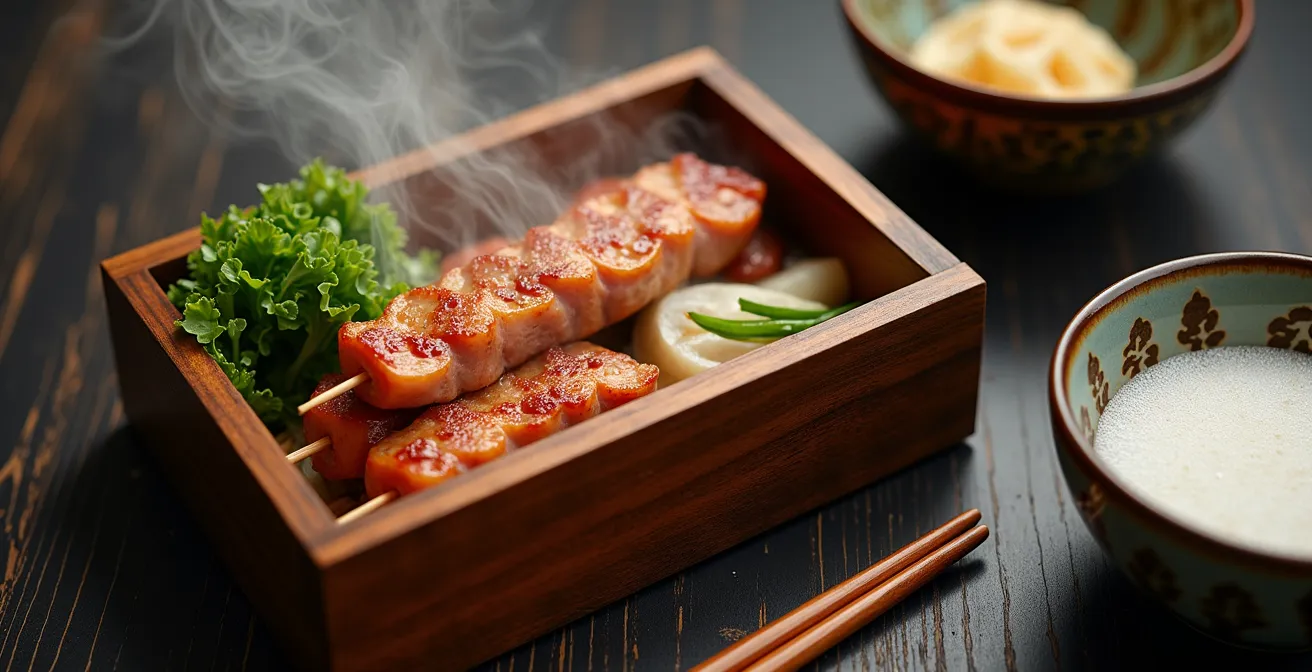
Beyond the signature stew, you’ll find grilled chicken skewers (*yakitori*), various bento boxes, and cold beers, all of which can be enjoyed at your seat. As detailed in a look at the Kokugikan’s food culture, some vendors even offer limited-edition snacks themed after popular wrestlers. With prices for these specialties ranging from ¥500 to ¥3000, you can curate your own sumo feast. The sight of families sharing food in their box seats while cheering on their favorite wrestler is a quintessential part of the stadium ecosystem.
Yokozuna vs Maegashira: Why Does the Crowd Go Crazy for Certain Bouts?
To the untrained eye, a day of sumo can seem like a long series of very short clashes. However, once you understand the intricate ranking system, known as the *banzuke*, the day’s narrative comes alive. The bouts progress from the lowest-ranked wrestlers in the morning to the top-division stars in the late afternoon. This buildup creates a palpable sense of escalating drama. The most electrifying moments often involve a high-stakes matchup between wrestlers of vastly different ranks.
The hierarchy is rigid and unforgiving, with the *yokozuna* (grand champion) sitting at the absolute peak. As the Japan Guide Editorial Team notes in their overview:
At the pinnacle of the sumo hierarchy stands the yokozuna (grand champion). Unlike wrestlers in lower ranks, a yokozuna cannot be demoted, but he will be expected to retire when his performance begins to worsen.
– Japan Guide Editorial Team, Japan Guide’s Sumo Hierarchy Explanation
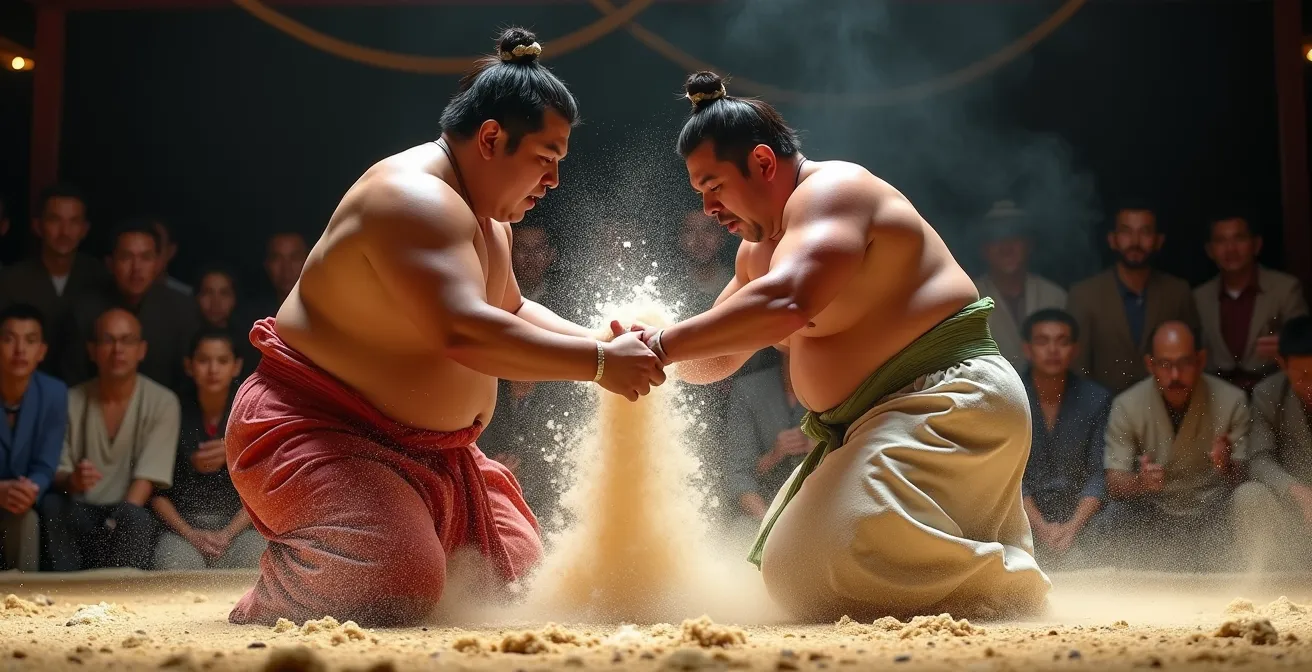
This immense pressure on the *yokozuna* to never fail sets the stage for sumo’s most celebrated event: the *kinboshi*, or “gold star.” A *kinboshi* is awarded when a *maegashira*, the lowest rank in the top division, manages to defeat a *yokozuna*. This is the ultimate David-versus-Goliath upset, a rare and spectacular achievement. When it happens, the stadium erupts. Spectators who were once quietly sipping tea will leap to their feet, and you may even see zabuton cushions flying through the air (an officially prohibited but historically common expression of excitement).
Understanding the Kinboshi Upset Phenomenon
While sumo has over 82 recognized winning techniques, most bouts are won with a handful of core moves. This is where skill and strategy triumph over sheer size. An experienced, lower-ranked wrestler can use balance and leverage to topple a much larger opponent. According to an analysis by USA Sumo, this technical mastery is what makes upsets possible. When a *maegashira* achieves this against a *yokozuna*, they earn a *kinboshi*. It’s not just a win; it’s a giant-slaying feat that pays a permanent salary bonus and earns eternal glory, explaining why it sends the crowd into a frenzy.
Stable Visits: How to Watch Sumo Practice for Free?
While the tournaments are the main event, the heart and soul of sumo lie within the *heya*, or stables, where wrestlers live and train together under the watchful eye of a stable master (*oyakata*). Witnessing their morning practice, or *asageiko*, is a powerful, behind-the-scenes look at the discipline and dedication required to compete. However, the title’s promise of watching “for free” comes with a significant caveat: it is not a casual, drop-in affair. Sumo stables are private, and access is a privilege, not a right.
As one guide on sumo culture explains:
Sumo-beya, the sumo stables, are training centers managed by instructors known as ‘Oyakata’ or ‘Toshiyori’. Here, rikishi live and train in a disciplined environment, honing their skills for their career.
– Good Luck Trip Editorial, A Beginner’s Guide to Sumo
Nearly all stables that allow visitors require you to book in advance, almost always through a guided tour company. These tours handle the complex etiquette and communication required, ensuring your presence is respectful and non-disruptive. The “free” aspect often refers to a different, more informal way of seeing wrestlers: waiting outside the stadium before or after the day’s bouts. This practice, known as *iri-machi* (waiting for entry) and *de-machi* (waiting for exit), allows you to see the top-ranked wrestlers up close and take photos as they arrive or depart. This is a genuinely free and highly recommended way to connect with the stars of the sport without the formalities of a stable visit.
Action Plan: Preparing for a Respectful Stable Visit
- Arrangement Audit: Confirm your booking. Have you gone through an official tour operator? Do not show up unannounced. List all points of contact and confirmation details.
- Etiquette Inventory: Review the rules of observation. Key elements to confirm you understand are: maintaining absolute silence, no photography unless permitted, and proper seating posture (cross-legged, never pointing feet at the ring).
- Behavioral Coherence: Check your planned attire and behavior against the stable’s disciplined atmosphere. Are your clothes modest? Have you silenced your phone completely?
- Emotional Preparedness: Understand that this is a serious training session, not a performance for tourists. The atmosphere will be tense and intense. Assess if this is the right experience for your group.
- Contingency Plan: If a formal visit isn’t feasible, create a plan to experience *iri-machi* or *de-machi* at the stadium instead. Identify the best times (typically early afternoon for arrival) and locations.
Salt and Stomp: What Do the Pre-Match Rituals Actually Mean?
Before the violent, seconds-long clash of bodies, a period of intense, stylized ritual unfolds. Wrestlers throw salt, stomp their feet, and engage in a psychological staredown. To a first-time viewer, this pre-match phase can seem longer than the bout itself. But these are not empty theatrics; they are deeply symbolic acts rooted in centuries of Shinto tradition, transforming the *dohyo* from a sports ring into a sacred space.
The most visible ritual is *shiomaki*, the throwing of salt. This is an act of purification, cleansing the ring of evil spirits before the wrestlers compete. The powerful stomping motion, known as *shiko*, serves a dual purpose: it is a warm-up exercise that builds immense leg and core strength, but it also symbolically drives away any lingering malevolent forces from the sacred ground. These actions link modern sumo directly to its ancient origins as a form of religious ceremony.
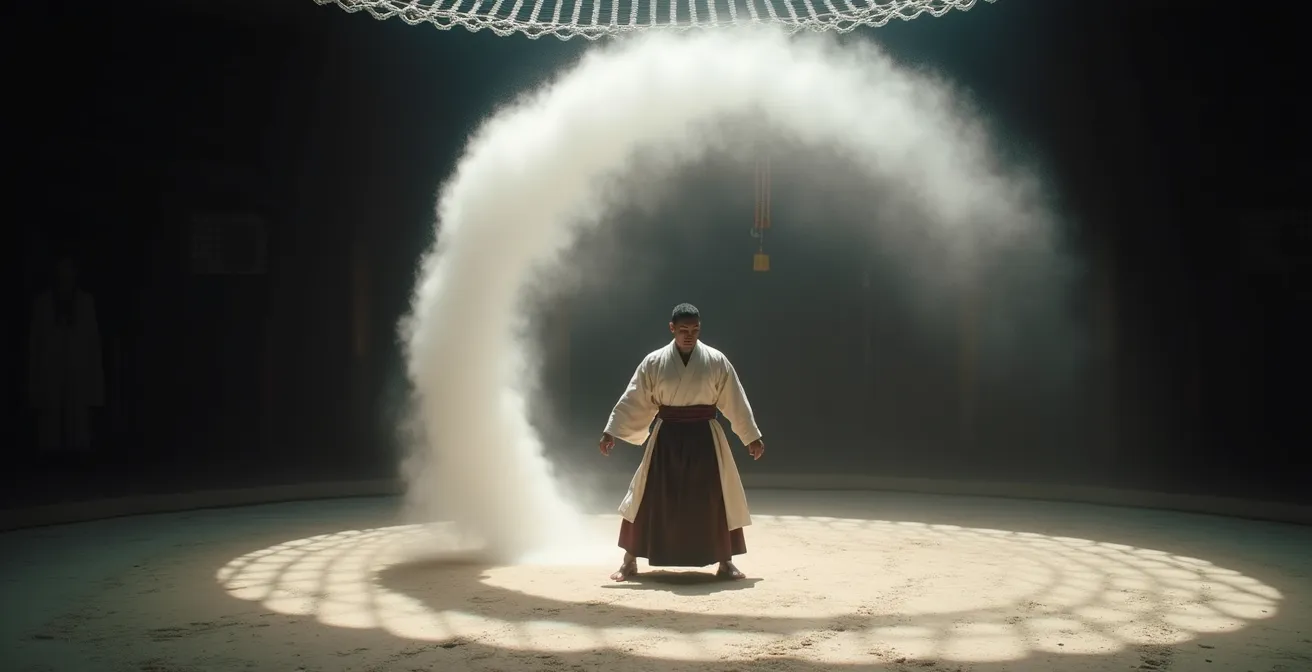
The psychological dimension is just as important. During the *shikiri* phase, wrestlers repeatedly crouch into the starting position, glare at each other, and retreat. This isn’t just a delay; it’s a battle of wills. Each wrestler is trying to find the perfect psychological moment to begin the *tachiai* (the initial charge), attempting to intimidate their opponent through their unwavering gaze. Understanding these layers turns you into a spectator-as-participant, feeling the tension build with the rest of the arena.
The Shinto Origins of Sumo Purification Rituals
The act of throwing salt is more than just a spectacle; it is a direct reflection of Japan’s core cultural and spiritual values. According to an analysis of sumo’s origins, the *shiomaki* ritual is steeped in the Shinto belief in purification (*oharai*). Before any important event or entering a sacred space, purification is essential. By cleansing the *dohyo*, the wrestlers show respect for the space, their opponent, and the gods, preparing themselves spiritually for battle.
When to Join a Line Based on Length and Turnover Speed?
While this question may seem abstract, it’s at the heart of the strategic decisions you’ll make on tournament day. The sumo stadium is an ecosystem of queues, and knowing which ones to join—and when—can define your experience. Two key lines matter most: the line for same-day, unreserved tickets, and the lines for the most popular food stalls.
For those who fail to secure tickets online, the stadium offers a limited number of unreserved arena seats for sale on the day of the event. This creates a line that forms early in the morning. Here, length is your primary indicator. If the line already snakes around the block by 8 a.m., your chances are slim. The “turnover speed” is zero until the ticket window opens, so early arrival is your only strategy. This is a high-risk, high-reward gambit, best suited for weekdays when demand is slightly lower.
The second critical set of lines is for food, particularly for the coveted *chanko nabe*. These stalls often have long but steadily moving queues. The key here is turnover speed. Watch the line for a few minutes. Is it a slow shuffle or a constant flow? The best time to join is not during the peak lunch hour, but rather during the mid-division bouts in the early afternoon. Many casual fans are still arriving, and the die-hards are glued to their seats. This window offers the shortest lines and fastest turnover, allowing you to get your food and return to your seat without missing the top-division action.
How to Throw the Coin and Ring the Bell for a Prayer?
At a Shinto shrine, a visitor throws a coin, rings a bell, and claps to offer a prayer. While you won’t be doing this at a sumo match, the title serves as a powerful metaphor for understanding sumo’s spiritual dimension. The actions on the *dohyo* are a form of ritual performance, and by understanding them, you are metaphorically “ringing the bell” to connect with a deeper cultural frequency.
The wrestlers’ pre-match rituals are, in essence, a prayer in motion. The *shiko* stomp isn’t just a warm-up; it’s a physical act to appease the earth gods. The *shiomaki* salt-throwing is not just for show; it’s a cleansing rite to create a sanctified space, fit for both gods and men. The *yokozuna’s* solo ring-entering ceremony, the *dohyo-iri*, is the most elaborate of all. With its special rope (*tsuna*) and attendants, it is a piece of living Shinto liturgy, demonstrating the grand champion’s connection to the divine.
As a spectator, your “offering” is your attention and understanding. When you appreciate that the *shikiri* staredown is a form of mental warfare, you are no longer just waiting for the match to start; you are participating in the building tension. When you recognize the significance of a *kinboshi* upset, your cheer is not just for the underdog; it is an acknowledgment of a great feat within this sacred context. By investing your focus and learning the symbolic language of the sport, you are engaging in a dialogue with centuries of tradition, making your own silent offering to the spirit of sumo.
Key Takeaways
- Seating is a Strategic Choice: Balance the desire for an authentic, up-close atmosphere in box seats with the physical reality of sitting on the floor for hours.
- Act Fast on Tickets: Tournament tickets, especially for weekends, sell out in minutes. Be online and ready the moment they are released, about a month before the event.
- Embrace the Full Experience: A day at the sumo includes unique food like *chanko nabe* and understanding the dramatic narratives of the bouts, such as the celebrated *kinboshi* upset.
Gion or Awa Odori: Which Summer Festival Is Worth the Crowds?
Just as a traveler might weigh the merits of two different grand festivals, a prospective sumo fan must choose how they want to experience the sport. The two primary ways are attending a Grand Tournament or arranging a visit to a sumo stable. Each offers a profoundly different, yet equally valid, glimpse into the world of sumo, and the “right” choice depends entirely on what you seek.
The Grand Tournament is the “Gion Festival” of the sumo world: a massive, public spectacle filled with color, sound, and energy. It is a full-day event combining top-tier sport, festival food, and electric crowd drama. You witness the entire hierarchy of the sport, from the aspiring novices to the god-like *yokozuna*. The experience is about being part of a huge, collective celebration. The downside is the crowd itself; you are one of thousands, and the connection to the wrestlers is from a distance. It is grand, exciting, and sometimes overwhelming.
In contrast, a stable visit is the “Awa Odori” experience, but in an intimate, disciplined form. It is quiet, intense, and deeply personal. You are not watching a performance; you are witnessing the raw, unfiltered process of creating a warrior. You hear the grunts, the slaps of skin on skin, and the labored breathing of men pushing their bodies to the absolute limit. There is no cheering, no food, no fanfare—only the stark reality of immense effort. It offers an unparalleled sense of proximity and respect for the athletes. The “crowd” is a small, silent group of observers, and the experience is one of reverence rather than excitement.
The ideal approach is to do both. Watch a stable practice in the morning to gain a profound respect for the discipline involved, then attend the tournament in the afternoon to see that discipline unleashed in a glorious public spectacle. This combination provides a complete, holistic understanding of the art, effort, and spirit of Japan’s national sport.
Frequently Asked Questions about Watching Sumo
What is the psychological purpose of the shikiri ritual?
During shikiri, both wrestlers crouch and stare at each other to time the perfect tachiai. The tension during this moment builds anticipation in the crowd, while wrestlers use this time for mental warfare through their gaze and the amount of salt thrown.
Why do wrestlers stomp their feet (shiko)?
The stomping motion called ‘shiko’ serves to drive away evil spirits from the ground according to Shinto tradition, while also serving as a warm-up exercise for the wrestlers’ leg muscles.
What’s the difference between regular and Yokozuna ring-entering ceremonies?
The Yokozuna’s dohyo-iri is more elaborate, featuring a solo performance with two attendants, a special rope (tsuna) worn around the waist, and unique movements that demonstrate their supreme rank in the sport.