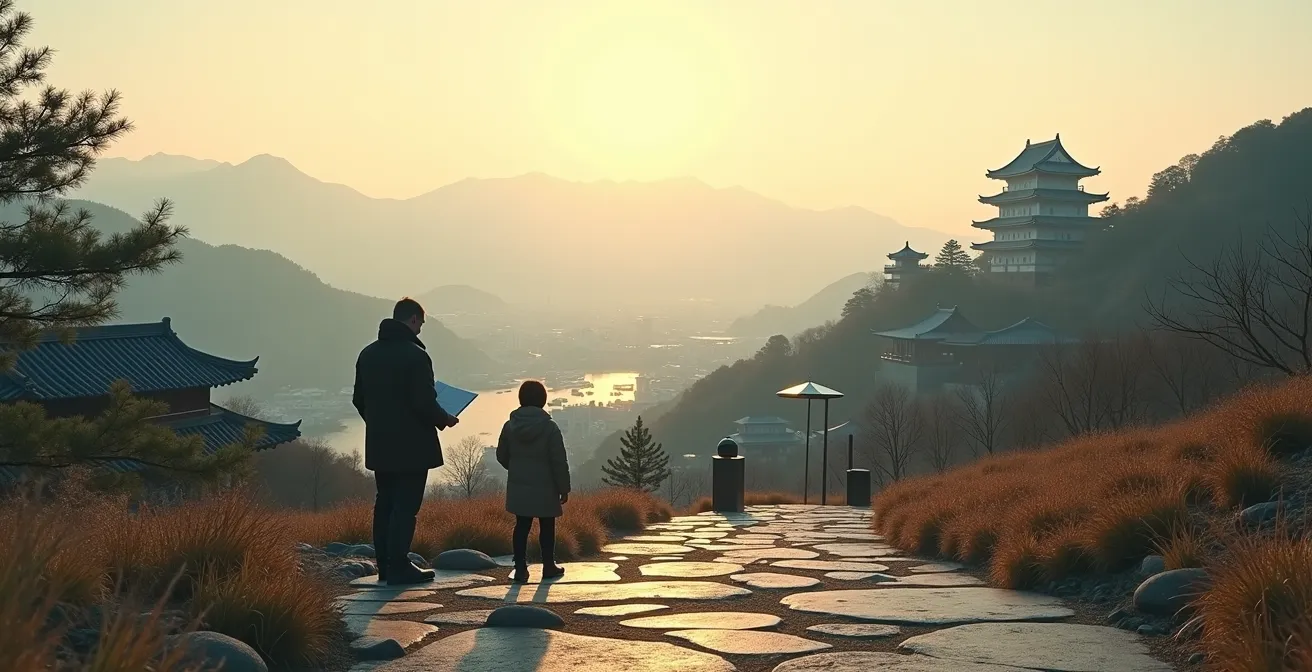
The most meaningful Japan itinerary isn’t about geography; it’s about crafting a narrative that connects each stop thematically.
- Logistical precision is key for complex themes like the art islands, where ferry schedules and museum closures dictate the flow.
- Historical routes require balancing iconic landmarks with the quiet, immersive trails that bring the past to life.
- A powerful theme can even be an abstract philosophy like Wabi-Sabi, guiding you toward experiences that prioritize feeling over sightseeing.
Recommendation: Define your ‘why’ before your ‘where’—choose a theme that resonates personally to transform your trip from a tour into a story.
For the repeat visitor to Japan, the classic Tokyo-Kyoto-Osaka “Golden Route” begins to feel less like a discovery and more like a well-trodden path. You’ve seen the highlights, and now you crave something deeper—a journey with purpose, a story that unfolds with each train ride and temple visit. The common approach is to simply pick a new region, but this often leads to another checklist of disconnected sights. The alternative? Thinking not like a tourist, but like a travel designer.
This shift in perspective is transformative. Instead of asking “Where should I go?”, you start by asking “What story do I want to experience?”. This is the essence of thematic travel. It’s about building a cohesive narrative where every destination, every activity, and every meal serves a central idea. Whether your passion is the stoic grandeur of feudal castles, the cutting-edge creativity of contemporary art, or the quiet philosophy of imperfection, a thematic lens turns a simple trip into a curated, personal pilgrimage.
The real art lies in weaving these thematic threads into a practical, flowing itinerary. It requires a different kind of planning, one that prioritizes narrative cohesion over geographical convenience. This guide will walk you through the design principles for building such a journey, exploring distinct thematic routes and the strategic choices that bring them to life. We’ll delve into how to connect historical landmarks, choreograph an art island hop, and even build a trip around an abstract feeling.
This article explores eight distinct thematic itinerary concepts, providing the strategic framework to help you design your own narrative-driven journey across Japan. Discover how to link castles, plan island hops, walk ancient roads, and choose destinations that add true value to your story.
Contents: Designing Your Thematic Japan Itinerary
- Himeji to Matsumoto: How to Link the Original 12 Castles?
- Naoshima and Teshima: How to Plan the Ultimate Art Island Hop?
- Magome to Tsumago: How to Walk the Old Samurai Road?
- Your Name to Ghibli: How to Visit Real Life Anime Locations?
- Kurokawa to Beppu: How to Plan a Kyushu Onsen Road Trip?
- Hakone or Himeji: Which Stopover Adds the Most Value to the Route?
- Wabi-Sabi: How Imperfection Redefines Beauty for Visitors
- North or South: How to Choose a Region for a 10-Day Trip?
Himeji to Matsumoto: How to Link the Original 12 Castles?
Designing a historical journey around Japan’s 12 original-construction castles is a puzzle of logistics and storytelling. These are the rare fortresses that have survived the fires, wars, and demolitions of the post-feudal era. A thematic trip connecting them isn’t a straight line but a historical detective story. The narrative anchor is often the magnificent Himeji Castle, one of the first of what is now 26 World Heritage Sites in Japan. It’s the protagonist of your story—grand, famous, and unmissable.
The other 11 castles become the supporting cast, each adding a unique chapter. For instance, linking Himeji to Matsumoto Castle (“The Crow Castle”) in the Japanese Alps creates a dramatic contrast between the white heron and the black crow. In between, you can thread in smaller, more intimate castles like Bitchu Matsuyama. This castle, perched at an impressive 430 meters elevation, stands as Japan’s highest original castle, often appearing to float on a sea of clouds. Planning this route requires mastering the Japan Rail network, but also knowing when to branch off onto local lines or even buses to reach these more remote historical gems.
The design challenge is pacing. Don’t try to “collect” all 12 in one trip. A more compelling itinerary might focus on a cluster. For example, a western Japan route could link Himeji with Matsue and Bitchu Matsuyama, while a central Japan theme could connect Matsumoto, Inuyama, and Maruoka. This approach allows for deeper immersion in each region’s local history and culture, turning a castle tour into a rich, regional narrative.
Naoshima and Teshima: How to Plan the Ultimate Art Island Hop?
Planning a trip to the art islands of the Seto Inland Sea is less a vacation and more a logistical ballet. The theme is contemporary art’s dialogue with nature and community, but the reality is a dance of ferry timetables, museum schedules, and limited accommodation. The islands of Naoshima, Teshima, and Inujima are the main stage, hosting world-class art sites like the Chichu Art Museum and the Teshima Art Museum. The immense popularity of these destinations, which saw Naoshima receive over 1 million visitors during the 2019 Setouchi Triennale, means that planning is not just recommended; it’s essential.
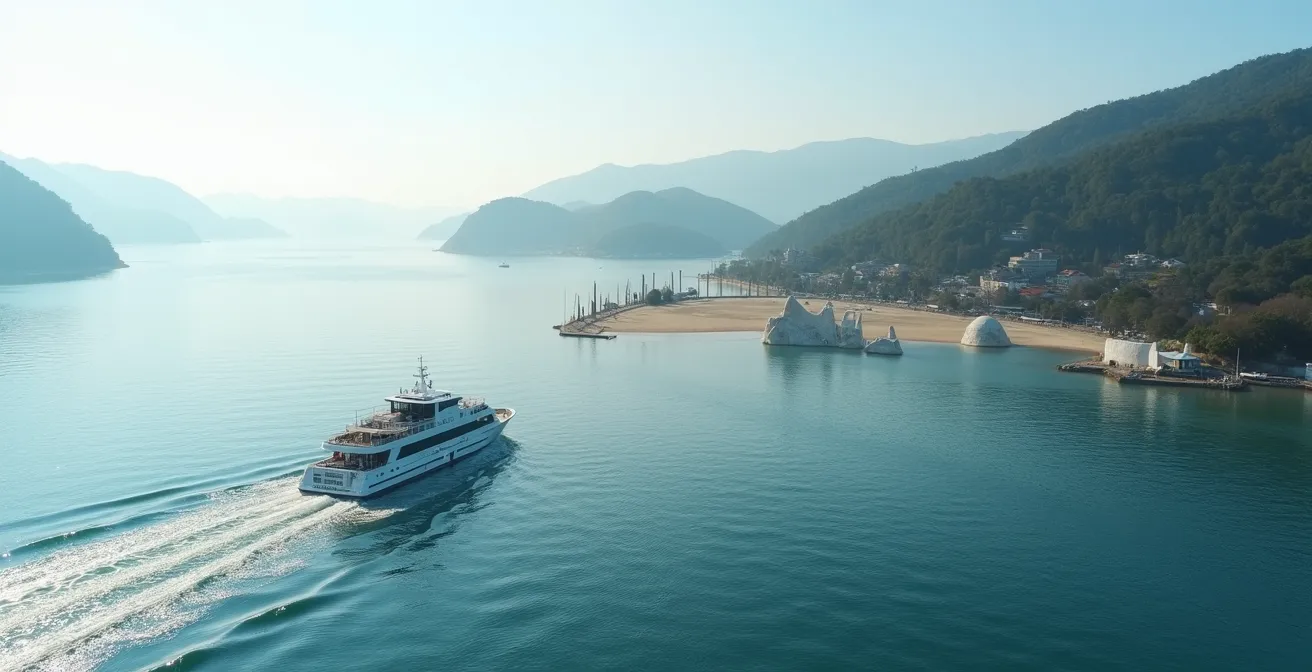
As the ferry glides across the calm sea, you’ll see how art and landscape merge. The key design principle here is rhythm and flow. A day trip is technically possible but artistically criminal; it rushes the experience and breaks the immersive spell. A well-designed itinerary allocates at least two to three days, allowing you to move at the island’s pace. This involves checking the Benesse Art Site calendar meticulously, as museums have different closing days (typically Mondays on Naoshima, Tuesdays on Teshima).
Transportation on the islands is part of the experience itself. You can choose the efficiency of local buses, the convenience of the Benesse House shuttle if you’re a guest, or the freedom of a rented electric bicycle to tackle the surprisingly hilly terrain. Here are the core planning steps:
- Consult the official Benesse Art Site Calendar before booking anything to avoid closed museums.
- Plan for at least one or two nights on one of the islands to fully absorb the atmosphere.
- Decide on your island transport: electric bike rental offers the most freedom.
- Map your ferry routes: Most journeys start from Uno Port (near Okayama) or Takamatsu Port.
Magome to Tsumago: How to Walk the Old Samurai Road?
To walk the Nakasendo is to step into a woodblock print. This ancient highway connected Kyoto and Edo (now Tokyo) during the Edo Period, and sections of it remain beautifully preserved. A thematic journey here is about experiencing time travel, trading bullet trains for cobblestone paths and modern hotels for traditional inns. The most famous and accessible part of this theme is the 8km trail between Magome and Tsumago in the Kiso Valley. These two post towns are immaculately maintained, with dark wooden buildings, water wheels, and a complete absence of modern intrusions like power lines.
However, the true travel designer knows this popular stretch is just the introduction. The real depth of a Nakasendo theme comes from choosing how far you want to venture into the past. While the Magome-Tsumago walk is a perfect half-day immersion, extending the journey offers a more profound experience. This requires a strategic choice based on difficulty and desired authenticity.
The following table helps illustrate the options, allowing you to design your walk based on your own pace and interest. It’s a clear example of how a theme can be scaled from a brief taste to a deep, multi-day immersion.
| Section | Distance | Difficulty | Highlights |
|---|---|---|---|
| Magome-Tsumago | 8km | Easy | Most popular, well-preserved post towns |
| Tsumago-Narai | 40km | Moderate | Less crowded, authentic mountain paths |
| Full Trail | 534km | Challenging | 69 post towns, complete historic experience |
Choosing a longer section like the route to Narai means fewer crowds and more time on authentic mountain trails, but it requires more physical commitment and logistical planning for overnight stays in family-run *minshuku*. The ultimate expression of the theme—walking the entire 534km trail—is a challenging trek for dedicated history buffs, but for most, a well-chosen section provides the perfect narrative arc of a journey back in time.
Your Name to Ghibli: How to Visit Real Life Anime Locations?
A modern form of pilgrimage has taken root in Japan: ‘Seichi Junrei’, or visiting the real-world locations that appear in anime and manga. This thematic journey is a powerful way for fans to connect with their favorite stories, blurring the line between fiction and reality. A trip could follow the iconic Tokyo stairs from *Your Name*, explore the Dogo Onsen that inspired *Spirited Away*, or wander through the forests of Yakushima Island, the muse for *Princess Mononoke*. Designing this type of trip, however, requires more than just a list of GPS coordinates; it’s about understanding the context and etiquette of the pilgrimage.
The key design principle is respectful immersion. Many ‘seichi’ (sacred spots) are quiet residential neighborhoods, local shrines, or schools, not official tourist sites. The goal is to be a respectful fan, not a disruptive tourist. This means being mindful of noise, following any rules about photography (especially near private homes or inside shops), and, where possible, supporting the local economy by purchasing goods from nearby stores. This transforms the visit from a simple photo-op into a genuine gesture of appreciation for the community that inspired the art.
It’s also helpful to understand the different types of anime locations to manage expectations. Some are direct models, where a real place has been almost perfectly replicated in the anime. Others are inspirational atmospheres, where the artists captured the feeling of a place without copying it directly. Finally, visiting the hometowns of creators offers another layer of connection. Recognizing which type of ‘seichi’ you are visiting helps frame the experience and deepens the appreciation for the creative process. It is a unique journey where the narrative has already been written; your role is to walk through its pages respectfully.
Kurokawa to Beppu: How to Plan a Kyushu Onsen Road Trip?
A road trip through Kyushu, Japan’s southernmost main island, offers a theme centered on a powerful sensory experience: the onsen. This is a journey into the heart of volcanic landscapes, where the earth breathes steam and the culture is steeped in the ritual of bathing. Designing this trip is about creating a narrative of water, from the rustic, riverside baths of Kurokawa Onsen to the theatrical, multi-colored “hells” of Beppu. A rental car is the best tool here, providing the freedom to explore remote mountain ryokans and dramatic caldera views at your own pace.
The thematic thread is the diversity of the water itself. The experience changes with the mineral properties of each spring. You can design a route that contrasts the soothing, iron-rich waters of Yufuin with the potent, sulfuric springs of Unzen. This is a journey for the body as much as the eyes. Interspersing onsen soaks with stops at places like the immense Mt. Aso caldera or the mythical Takachiho Gorge adds a sense of scale and adventure, grounding the wellness theme in Kyushu’s raw natural power.
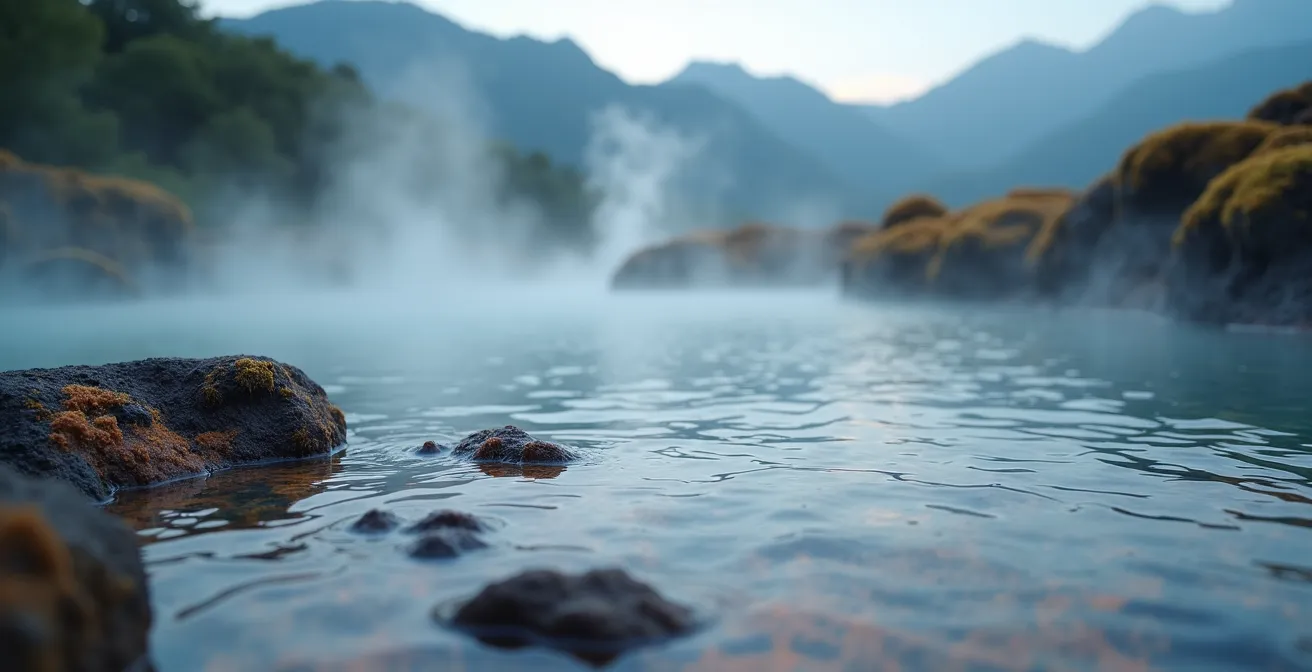
This itinerary demands a balance between planning and flexibility. Popular onsen towns like Kurokawa have a limited number of traditional ryokans, so booking well in advance is crucial. Yet, the weather in the mountains can be unpredictable, potentially affecting access to certain areas. A well-designed plan includes alternate routes and a mindset that embraces spontaneous detours. It’s a theme that teaches you to relax, both in the hot springs and in your travel style.
Action Plan: Designing Your Kyushu Onsen Itinerary
- Research mineral properties: Map out a route that allows you to experience different water types, such as sulfuric in Beppu or alkaline in Kurokawa.
- Book accommodations early: Secure your spot in sought-after ryokans, especially in smaller towns like Kurokawa.
- Integrate non-onsen stops: Plan visits to natural wonders like Mt. Aso or Takachiho Gorge to add variety and adventure to the route.
- Allow for flexibility: Mountain weather can be unpredictable. Have backup plans and be ready to adapt your schedule.
- Pack for both relaxation and exploration: Bring a small towel for onsen hopping and comfortable shoes for walking through towns and on trails.
Hakone or Himeji: Which Stopover Adds the Most Value to the Route?
When designing a Japan itinerary, especially between major hubs like Tokyo and Kyoto, the choice of a stopover is a critical narrative decision. It’s not just about breaking up a long train ride; it’s about adding a new thematic layer to your journey. The choice between Hakone and Himeji is a classic travel designer’s dilemma, as they offer completely different values. There is no “better” option; there is only the option that better serves your story.
Hakone is a point of deceleration. It’s a place to slow down and immerse yourself in a theme of art and nature. Nestled around Mount Fuji, it’s an ecosystem of hot springs, hiking trails, and world-class museums like the Hakone Open-Air Museum. Choosing Hakone adds a chapter of modern creativity and natural wellness to your trip. It’s ideal for a journey focused on contemporary culture, relaxation, or the beauty of the Japanese landscape.
Himeji, in contrast, is a point of concentration. It offers a deep, focused dive into Japan’s feudal history. The stop is built around its magnificent castle, a masterpiece of architecture and a symbol of samurai power. A half-day here is intense and educational, reinforced by the adjacent Koko-en Garden. Choosing Himeji strengthens a historical or architectural theme, providing a powerful, tangible link to the past. The following table breaks down this strategic choice:
| Factor | Hakone | Himeji |
|---|---|---|
| Theme Alignment | Art, nature, modernity | Feudal history, craftsmanship |
| Travel Pace | Deceleration point – slow immersion | Concentration point – focused half-day |
| Supporting Attractions | Museums, trails, hot springs ecosystem | Koko-en Garden, proximity to Kobe/Okayama |
| Best For | Nature & wellness themes | Historical & architectural themes |
Ultimately, the decision rests on your itinerary’s narrative arc. Are you looking to add a moment of quiet reflection amidst nature and art, or a powerful dose of historical grandeur? Answering that question is the essence of intentional travel design.
Wabi-Sabi: How Imperfection Redefines Beauty for Visitors
Perhaps the most profound thematic journey in Japan is one built not around places, but around a philosophy: Wabi-Sabi. This is the uniquely Japanese worldview centered on the acceptance of transience and the appreciation of imperfect, impermanent, and incomplete beauty. Designing a trip around Wabi-Sabi means shifting your focus from the grand and flawless to the subtle and authentic. It’s a theme that teaches you to find beauty in a weathered temple gate, a cracked teacup, or a moss-covered stone.
This is not a checklist itinerary. It’s a sensory and mindful approach to travel. Instead of rushing between famous temples, you might spend an entire afternoon in a single Zen garden, observing the play of light and shadow. You choose a traditional *ryokan* not for its luxury, but for the feel of its tatami floors and the simple elegance of its wooden bath. As one expert on the philosophy notes in *Inside The Wabi Sabi Revival*:
It slows your pace, clears your mind, and helps you notice beauty that usually goes unseen. This ancient philosophy shapes modern travel by guiding you toward natural materials, quiet places, and experiences that feel honest and human.
– Travel Philosophy Expert, Inside The Wabi Sabi Revival
So how do you translate this abstract idea into a concrete plan? By seeking out experiences that embody its principles. Here are some ways to build a Wabi-Sabi itinerary:
- Stay in traditional accommodations like ryokans in Kyoto or machiya townhouses, where natural aging and craftsmanship are celebrated.
- Participate in simple, mindful activities like a tea ceremony or a calligraphy class, which focus on process and presence.
- Seek out nature that reflects the passage of time, such as the ancient trees of Yakushima Island or the moss gardens of Kyoto.
- Prioritize quiet, less-visited shrines and neighborhoods over crowded tourist hubs.
A Wabi-Sabi journey is the ultimate antidote to modern, fast-paced tourism. It doesn’t ask what you want to see, but how you want to feel. It’s a theme that stays with you long after you’ve returned home.
Key Takeaways
- Thematic travel is not about where you go, but the story you create by connecting places with a cohesive idea.
- Effective travel design requires balancing iconic “concentration points” with slower “deceleration points” to create a satisfying rhythm.
- Logistics are part of the narrative; mastering ferry schedules, train lines, and booking windows is essential for complex themes.
North or South: How to Choose a Region for a 10-Day Trip?
For a focused 10-day trip, choosing between Japan’s macro-regions—like the vast north of Hokkaido or the volcanic south of Kyushu—is a foundational design choice. With Japan’s tourism projected to grow significantly, as evidenced by projections of 36.87 million visitors in 2024, picking a region allows for a deeper, less-rushed experience away from the most crowded corridors. This decision shouldn’t be random; it should be aligned with a seasonal theme and a desired travel pace.
Hokkaido (The North) is a theme of wild, open spaces. In winter, it’s a world-renowned destination for snow sports and epic snow festivals. In the summer, it offers a cool escape from the mainland’s humidity, with sprawling lavender fields in Furano and epic wilderness hiking in its numerous national parks. A trip to Hokkaido is about embracing nature on a grand scale, best suited for road trips and outdoor adventures. Its identity is rugged, vast, and distinctly different from the rest of Japan.
Kyushu (The South) presents a theme of history, geothermal energy, and cultural warmth. It has a milder climate, making it a great year-round destination. Its narrative is woven from the tragic history of Nagasaki, the vibrant food scene of Fukuoka, and the onsen-centric culture of towns like Beppu and Kurokawa. A journey here is often a loop, exploring volcanic landscapes, subtropical coastlines, and a rich tapestry of local traditions. The choice between North and South is a choice between two entirely different stories, as this seasonal breakdown illustrates:
| Season | North/Hokkaido Theme | South/Kyushu Theme |
|---|---|---|
| Winter | Snow Festivals & Winter Sports | Mild Weather Exploration |
| Spring | Late Blooms & Wildlife | Island Hopping & Early Blooms |
| Summer | Lavender Fields & Cool Escape | Coastal Diving & Matsuri |
| Autumn | Wilderness hiking & Fall Colors | Cultural Festivals & Harvest |
Choosing North or South is the first brushstroke in your itinerary’s design. It defines the color palette, the mood, and the overall narrative of your 10-day story. Consider what you want to feel—the crisp air of a mountain hike or the warm steam of a volcanic spring—and let that guide your decision.
Your next trip to Japan can be more than a collection of sights; it can be a story that you design from the ground up. By defining a theme—whether it’s historical, artistic, or philosophical—you create a framework that gives every choice meaning and every day a purpose. Start designing your own thematic narrative today and transform your next journey into an unforgettable story.
Frequently Asked Questions on Thematic Travel in Japan
What is ‘Seichi Junrei’ and why is it important?
Seichi Junrei refers to the act of anime pilgrimage—visiting real-world locations that appear in anime series or films. It is an important cultural phenomenon for fans as it allows them to connect more deeply with their favorite stories. It’s crucial for visitors to understand the etiquette involved, especially the need for respect when visiting locations that are residential areas or private properties, to ensure the practice remains welcome.
How should visitors behave at anime locations?
The core principle is respect. Visitors should avoid causing disruptions in residential areas, always follow posted photography rules, and be mindful of local communities. A great way to show appreciation is to support local businesses near the ‘seichi’ (sacred spot). The goal is to position yourself as a respectful fan who contributes positively, rather than a disruptive tourist.
What types of anime locations can be visited?
Anime locations can be categorized to help manage expectations. There are Direct Model Locations, which are nearly exact real-world copies of what’s seen on screen. There are also Inspirational Atmospheres, which are places that inspired the general feel or mood of a scene without being a direct copy. Finally, visiting the Hometowns of Creators offers a different, more personal level of connection to the artist behind the work.