
Omotenashi is not about being friendly; it’s a professional discipline where intentional distance and mutual respect create a flawless guest experience.
- True Omotenashi is proactive, anticipating needs before they are verbalized, rather than just reacting to requests.
- Excellence is driven by an artisan’s pride (Shokunin mindset) and collective responsibility, making cash tips irrelevant and even inappropriate.
Recommendation: To understand it, observe the invisible details and respect the choreographed process, rather than seeking personal connection.
There are moments in luxury travel that feel like magic. A cool towel appears on a humid day before you even realize you’re warm. The lighting in a room is already set to a soothing level upon your return. A driver is waiting, having already tracked your flight’s early arrival. This isn’t just good service; it’s a different category of experience entirely. Many travelers and service professionals encounter this in Japan and label it simply as “excellent hospitality.” They note the lack of a tipping culture and the meticulous attention to detail, often attributing it to a vague notion of politeness.
But this surface-level observation misses the fundamental operating system at work. The common assumption is that superior service must be warm, personal, and friendly. But what if the key to this perfection isn’t emotional warmth, but a calculated, respectful distance? What if Omotenashi is less an act of selfless giving and more a professional discipline of perception? The philosophy is not about becoming the guest’s friend; it’s about creating a seamless environment where the guest’s comfort is the absolute, unwavering focus, achieved through invisible effort and profound respect for the process.
This article moves beyond the simple definition of Omotenashi. We will deconstruct the mechanics behind this anticipatory service, exploring the core principles that distinguish it from Western hospitality models. We will examine the crucial, often overlooked role of the guest in this exchange, debunk the myth that professional distance equals “cold” service, and provide a framework for how service leaders and discerning travelers can adopt its spirit, no matter where they are in the world.
To navigate this deep dive into the philosophy and practice of Japanese hospitality, the following sections will break down its most essential components. This structure will guide you from the foundational concepts to practical applications.
Table of Contents: A Deep Dive into the Discipline of Omotenashi
- Why Omotenashi Is About Anticipation, Not Just Reaction?
- How to Spot the Invisible Details of Hospitality in Your Hotel?
- Guest or God: What Is Your Responsibility in the Omotenashi Exchange?
- The ‘Cold’ Service Myth: Why Professionalism Means Distance?
- How to Bring the Spirit of Omotenashi Back to Your Home Country?
- Why Japanese Service Is High Quality Without Cash Incentives?
- Nakai-san in the Room: How to Behave During a Kaiseki Room Dinner?
- Dinner Times and Curfews: How to Survive Ryokan Schedules?
Why Omotenashi Is About Anticipation, Not Just Reaction?
Standard service culture operates on a reactive loop: a guest makes a request, and the staff fulfills it. Excellence is measured by the speed and efficiency of this reaction. Omotenashi, however, operates on a fundamentally different principle: proactive anticipation. The goal is to identify and meet a need before the guest is even consciously aware of it, creating an experience that feels effortless and intuitive. This isn’t mind-reading; it is a highly developed skill of observation and empathy. As the TOKI Tokyo Editorial Team notes, true Omotenashi is about how hosts “pay attention to detail and anticipate their guests’ needs.”
This anticipatory mindset is built upon several core philosophical pillars:
- Ma (間): This is the concept of negative space or the pause. In service, it’s the interval *before* a guest speaks. A practitioner of Omotenashi uses this quiet moment not to wait for instruction, but to observe—noticing a guest’s slight shiver that suggests the air conditioning is too high, or the way their eyes scan the room, looking for a power outlet. It’s in this “emptiness” that needs are discovered.
- Ichigo Ichie (一期一会): Translating to “one time, one meeting,” this principle treats every interaction as a unique, unrepeatable event. It demands complete presence and attention from the service provider. By seeing each moment as precious, the host is motivated to perfect it, leaving no room for a “good enough” attitude.
- Graceful Recovery: Even the most skilled professional cannot anticipate every need. When a mistake occurs or a need is missed, the Omotenashi response is swift, humble, and discreet. The focus is entirely on restoring the guest’s comfort, not on explaining the error or defending the provider’s ego. The recovery is executed so smoothly that it barely registers as a disruption.
Ultimately, anticipation in Omotenashi is about shifting the focus from the service provider’s actions to the guest’s unspoken state of being. It transforms service from a series of tasks into a continuous, fluid process of care.
How to Spot the Invisible Details of Hospitality in Your Hotel?
Omotenashi often manifests in details so subtle they are felt more than seen. For the untrained eye, a Japanese luxury hotel or ryokan might simply seem clean and well-run. But for the discerning observer, it is a masterclass in environmental design and behavioral psychology. To appreciate it, one must learn to look for the evidence of thoughts that have already been had on your behalf. A useful method is to apply a sensory framework to your observations.
The corridor of a high-end ryokan, for example, is not just a hallway; it’s the first chapter of the room’s story. The subtle alignment of elements is a deliberate act of welcome.
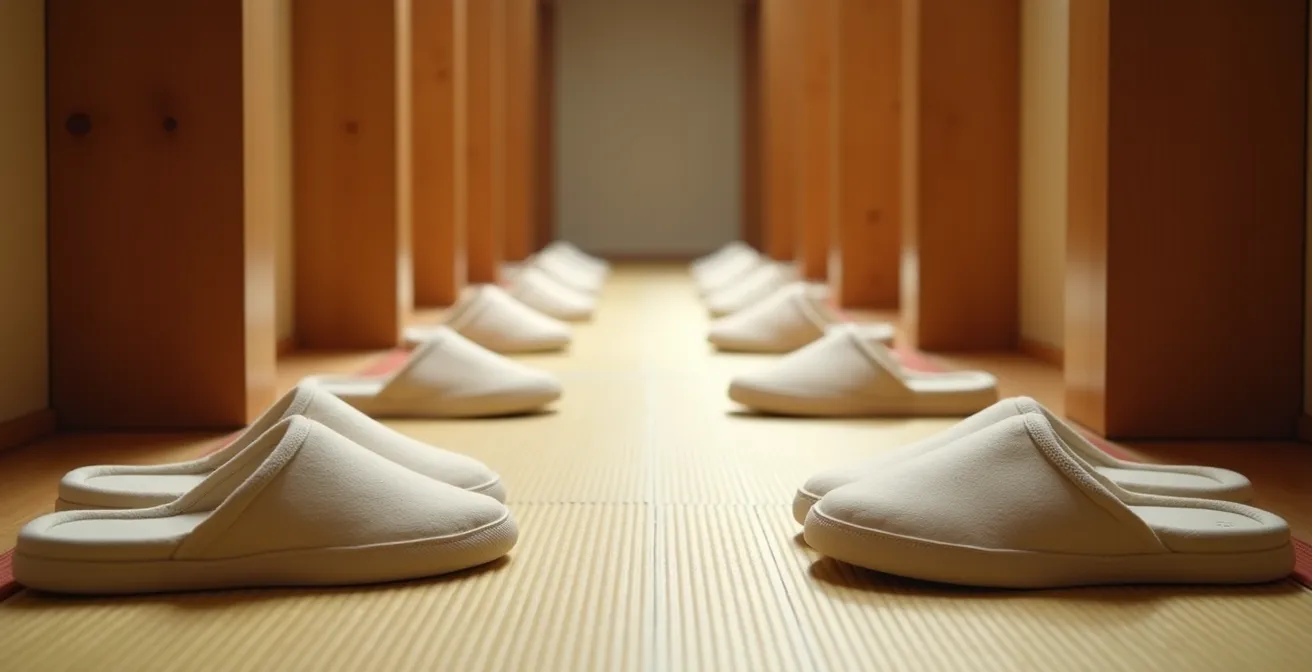
This image captures how precision and order create an immediate sense of peace, signaling that you are entering a space where every detail has been considered for your comfort.
- LOOK for visual cues of preparation. Are guest slippers positioned at the perfect angle for you to slide your feet into without bending over? Are amenities in the bathroom aligned with an almost geometric precision? Notice how lighting is often indirect and pre-adjusted for a calming effect, not a harsh, sterile brightness.
- FEEL the atmospheric adjustments. The room temperature is already comfortable upon entry, anticipating your arrival from the heat or cold outside. The texture of a perfectly warmed and moistened towel (oshibori) is a small but profound gesture of care.
- HEAR the curated soundscape—or lack thereof. True luxury is often silence. Notice the absence of intrusive sounds: the quiet glide of a staff member in the hallway, the lack of rattling carts or loud conversations. When a knock comes, it is gentle and timed appropriately.
- SENSE the ‘Kata’ (型), or the practiced forms. Watch how a staff member performs a task, like pouring tea or setting down a dish. There is an economy of motion, a practiced choreography where each movement has purpose and grace. It’s like observing an artisan whose craft has been honed to the point of becoming second nature.
By actively looking for these invisible gestures, you transform from a passive guest into an active participant in the art of hospitality. You begin to see the thought behind every object and action.
Guest or God: What Is Your Responsibility in the Omotenashi Exchange?
A common Western misconception translates the Japanese phrase “okyakusama wa kamisama desu” as “the customer is God.” This creates a dynamic of subservience, where the guest holds all the power and the provider is expected to be infinitely accommodating. However, the true spirit of Omotenashi is not one of servitude, but of mutual respect. As Chef Masahiro Kakinuma of the three-Michelin-starred Sushi Shikon states, the relationship is a two-way street.
Omotenashi is grounded on mutual respect. While I consider it a privilege to serve, guests should pay respect to us.
– Chef Masahiro Kakinuma, Sushi Shikon Hong Kong, Michelin Guide
This means the guest has a responsibility in the exchange. Your role is not to be a demanding deity, but a “gracious receiver.” By understanding and respecting the process, you enable the service professional to perform their craft at the highest level. This requires a certain level of restraint and awareness, a concept known as ‘Enryo’.
The Gracious Receiver: Guest Etiquette in Japanese Hospitality
Analysis of guest behavior in traditional ryokans shows that practicing ‘Enryo’ (discreet restraint) significantly enhances the service experience. Guests who avoid overfamiliarity and maintain a respectful distance enable staff to perform their choreographed duties without disruption. This creates the necessary ‘Ma’ (space) for professionals to anticipate needs effectively. Simple acts, like accepting a dish with a quiet nod instead of effusive thanks, or refraining from trying to “help” a staff member clear a table, are crucial. Such interruptions can break the flow of a service sequence that has been practiced to perfection, paradoxically making the experience less smooth for everyone.
Therefore, the guest’s responsibility is to trust the process. By being observant, appreciative, and non-intrusive, you become an ideal audience for the performance of hospitality. You provide the space and respect necessary for the “magic” to happen, making you an integral part of the successful Omotenashi experience, not just a passive recipient of it.
The ‘Cold’ Service Myth: Why Professionalism Means Distance?
For visitors accustomed to Western service standards, where friendliness is often expressed through casual conversation and personal connection, the Japanese model can sometimes feel “cold” or “distant.” Staff may not ask about your day, share personal anecdotes, or engage in familiar banter. This is not a sign of indifference; it is a profound sign of respect. This intentional distance is a core feature of Omotenashi, designed to keep the focus entirely on the guest.
As Kyoto-based Tea Master Randy Channell Soei explains, the provider’s role is to be an invisible stagehand, not a co-star.
The goal is for the guest to be the star; the provider’s personal story is irrelevant. The distance ensures the spotlight remains on the guest’s experience.
– Randy Channell Soei, Tea Master and Cultural Expert, Kyoto
This professional boundary is deeply rooted in the Japanese cultural concept of ‘Uchi-soto’ (内 Soto 外), which defines relationships between “insiders” (uchi) and “outsiders” (soto). In a service context, the guest and provider are ‘soto’ to each other, and maintaining a formal, respectful distance is the culturally appropriate way to interact. It is a gesture of honor, not aloofness.
Cultural Framework of Professional Distance in Japanese Service
The ‘Uchi-soto’ dynamic ensures that the service provided is consistent, professional, and free from the emotional variables of personal relationships. This distance acts as a protective barrier for the service provider, preventing the emotional burnout that can come from constantly forming superficial connections. By remaining professional “stagehands,” staff can maintain a high level of flawless execution for every guest, every time. This contrasts sharply with Western ideals that often encourage service staff to “be themselves” and create a personal rapport, which can lead to inconsistent experiences depending on the personalities involved.
In essence, the perceived distance is the very thing that guarantees the quality and purity of the service. It ensures the experience is 100% about the guest’s comfort and needs, uncolored by the provider’s personality or personal life. It’s the ultimate form of selfless service, where the provider’s ego is completely removed from the equation.
How to Bring the Spirit of Omotenashi Back to Your Home Country?
After experiencing Omotenashi firsthand, many travelers and professionals wonder how to replicate it. The key is to understand that Omotenashi is not a set of rituals to be copied, but a mindset to be adopted. Attempting to implement Japanese customs like bowing without understanding their cultural context can appear awkward or insincere. The true goal is to transplant the core principle: a selfless, anticipatory focus on the other person’s needs.
This spirit can be applied in any cultural context, whether at work, at home, or in digital interactions. It is about the thoughtful consideration that precedes an action. The hands holding a tea bowl, for example, demonstrate a mindful, practiced care that can be applied to any task.
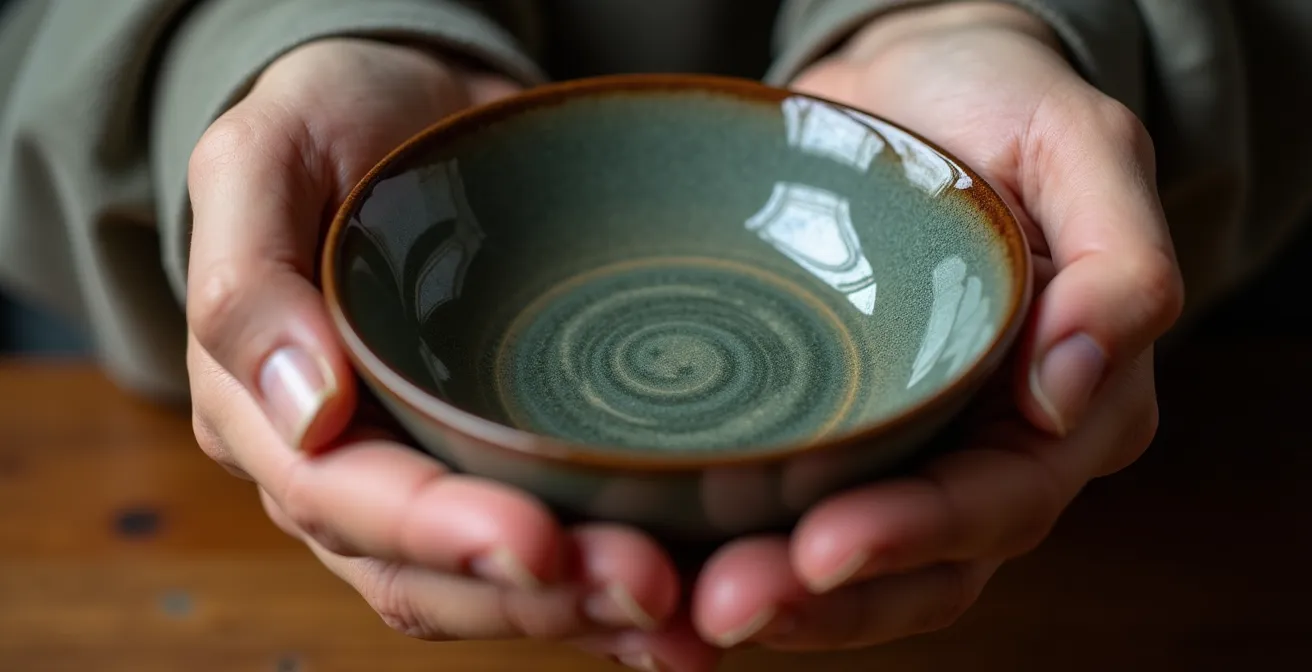
This focus on the craft and the recipient’s experience is the universal element of Omotenashi. You can cultivate this mindset anywhere by shifting your focus from yourself to others.
Here are practical ways to apply the Omotenashi spirit outside of Japan:
- Digital Omotenashi: When sending an email, anticipate the recipient’s next likely question and answer it in advance. When designing a website or application, proactively identify potential points of user frustration and eliminate them before they are encountered. A well-designed user experience is a form of digital anticipation.
- Workplace Application: Observe your colleagues. If you know a team member has a stressful deadline, preparing their favorite coffee before they have to ask is an act of Omotenashi. Setting up a meeting room with the necessary presentation cables, water, and notepads already in place anticipates the needs of the attendees.
- Home Hospitality: For guests staying over, think beyond clean sheets. What items might they need but feel awkward asking for? A phone charger, a bottle of water by the bed, or a note with the Wi-Fi password are all simple acts of anticipation. For your own family, creating a calm, tidy atmosphere before they return home from a stressful day is a way of caring for their unspoken needs.
The most important takeaway is to focus on the mindset, not the mimicry. The essence of Omotenashi lies in the genuine desire to make an experience seamless and comfortable for someone else, without any expectation of reward.
Why Japanese Service Is High Quality Without Cash Incentives?
The absence of tipping in Japan is often a point of confusion for Western visitors, who are conditioned to see tips as a primary motivator for good service. The assumption is that without a direct cash incentive, service quality would decline. Yet, the opposite is true. Japan’s service industry is globally renowned for its excellence, demonstrating that financial rewards are not the only, or even the best, driver of quality. The success of this model is proven by the market itself; a deep dive into industry data reveals a projected market value of USD 47.39 billion by 2025 for Japan’s hospitality industry, all built without a tipping culture.
The motivation is not external and financial, but internal and philosophical. It is rooted in two powerful cultural concepts: personal pride and collective responsibility. At the individual level, the Shokunin (職人) mindset is paramount. A shokunin is an artisan who pursues the mastery of their craft for its own sake. The reward is not a bonus, but the intrinsic satisfaction of performing a skill perfectly.
The Shokunin Mindset in Modern Japanese Hospitality
A prime example can be seen in high-end chefs like Masahiro Kakinuma, who, even after two decades, views his work as an art form to be continuously perfected. This philosophy extends to all roles in the service industry. Pride in one’s work, stable employment, and rigorous company-led training create an environment where service quality is a source of personal and professional honor. The incentive is to uphold the reputation of one’s craft and one’s employer.
At the collective level, service is a team sport. The success of a hotel, restaurant, or shop is seen as a group achievement. An individual’s performance reflects on the entire team, and letting the team down is a powerful social deterrent. In this context, a tip can be seen as an insult. It implies that the service was performed for a transactional reward, not out of genuine care and professional pride. It also creates an unequal dynamic, singling out one individual when the entire “ecosystem” contributed to the experience.
Nakai-san in the Room: How to Behave During a Kaiseki Room Dinner?
One of the most immersive—and potentially intimidating—Omotenashi experiences is a private kaiseki dinner in a ryokan, served by a dedicated room attendant, or Nakai-san. This is not simply a meal; it is a meticulously choreographed performance where the food, the service, and the atmosphere are all part of a unified whole. For the guest, knowing how to behave is key to respecting the art form and fully enjoying the experience. The biggest mistake is to treat the Nakai-san as a conventional waiter.
Instead, your role is that of an appreciative audience member. The Nakai-san is both the director and lead actor, executing a sequence that has been practiced to perfection. Your quiet appreciation and non-interference allow them to perform their craft without disruption. This is the ultimate expression of the “gracious receiver” principle. To ensure a smooth and respectful experience, following a simple set of guidelines is essential.
Checklist for a Graceful Kaiseki Dinner: Your Role as the Guest
- View the Dinner as a Performance: Understand that you are the guest of honor at a carefully staged event. Your quiet engagement allows the “actor” (your Nakai-san) to focus on their complex choreography.
- Maintain Respectful Silence During Service: When the Nakai-san is entering, serving, or clearing, pause your conversation. This allows them to concentrate and demonstrates respect for their skill and the moment.
- Sync with the Service Cadence: Wait for the Nakai-san to complete their service of a course before you begin. Eat at a measured pace that aligns with the rhythm of the meal, and allow them to clear dishes without you trying to “help.”
- Time Your Questions Appropriately: The best time to ask a question about a dish is right after the Nakai-san has finished explaining it and is about to depart the room. Avoid interrupting their explanation or movements.
- Use Polite, Essential Phrases: A simple ‘Sumimasen’ (excuse me) to get attention is appropriate. Use ‘Itadakimasu’ before starting the meal and ‘Gochisousama deshita’ after finishing to express gratitude for the meal and the effort.
By following this etiquette, you are not being passive; you are actively contributing to the success of the performance. You are showing respect for the immense skill and preparation that goes into a kaiseki dinner, thus honoring the spirit of Omotenashi.
Key Takeaways
- Omotenashi is proactive anticipation rooted in observation, not just polite, reactive service.
- Professional distance is a sign of ultimate respect for the guest’s experience, not a mark of coldness.
- The guest’s role as a “gracious receiver” who respects the process is as crucial as the provider’s skill.
Dinner Times and Curfews: How to Survive Ryokan Schedules?
For travelers used to the 24/7 flexibility of modern hotels, the rigid schedules of a traditional Japanese inn can be a shock. A firm dinner time (e.g., 6:00 PM sharp), a curfew for the front door, and set hours for communal baths can feel restrictive. It’s easy to view these rules as inconvenient. However, this perspective misses the point entirely. A ryokan is not a hotel; it is a highly integrated service ecosystem, and its strict schedule is the choreography that allows it to function flawlessly.
Understanding the scale of these operations helps explain this necessity. With an industry comprising over 50,320 ryokans and hotels, many of which are small, family-run establishments, operational efficiency is paramount. Unlike a large hotel with multiple restaurants and round-the-clock staff, a ryokan operates like a finely tuned watch, with each part dependent on the others.
The Interconnected Ecosystem of Ryokan Timing
The strict 6:00 PM dinner time is not arbitrary. It is dictated by the kitchen, where a kaiseki meal is prepared with ingredients at their absolute peak of freshness; delaying the meal would compromise its quality. While you are at dinner, staff must enter your room to prepare the futons for sleeping. After dinner, the onsen (communal baths) may need to be cleaned or switched for gendered use. As analysis from hospitality experts confirms, every scheduled event is linked. A delay in one area creates a cascade of problems throughout the entire system, impacting not just your experience but that of every other guest and staff member.
The key to “surviving” a ryokan schedule is to reframe it. Do not see it as a list of rules to obey, but as a curated itinerary designed for maximum relaxation. Successful guests treat the ryokan’s rhythm as the main event. They plan their day to arrive back early, enjoy a pre-dinner bath, and fully surrender to the pace set by the inn. Punctuality is not about obedience; it’s about showing respect for the intricate ecosystem of staff, chefs, and fellow guests who all contribute to your perfect stay.
Now that you understand the principles behind this intricate system, the next step is to cultivate this discipline of perception in your own professional or travel experiences. Start by observing the invisible, respecting the process, and appreciating the profound elegance of a service designed to be seamless. This is how you move from simply receiving service to truly understanding excellence.