In summary:
- Luggage with total dimensions of 161-250cm requires a mandatory, free reservation for a specific “oversized baggage” seat.
- Failing to reserve results in a 1,000 yen on-the-spot fee and forces you to move your luggage to a conductor-designated area.
- Use the SmartEX app for advance booking, but JR station counters are essential for complex routes or if you hold a Japan Rail Pass.
- Never attempt to bring oversized luggage into a non-reserved car; there is zero designated space.
- Factor in an extra 10-15 minutes for transfers when carrying oversized bags due to elevator queues and platform navigation.
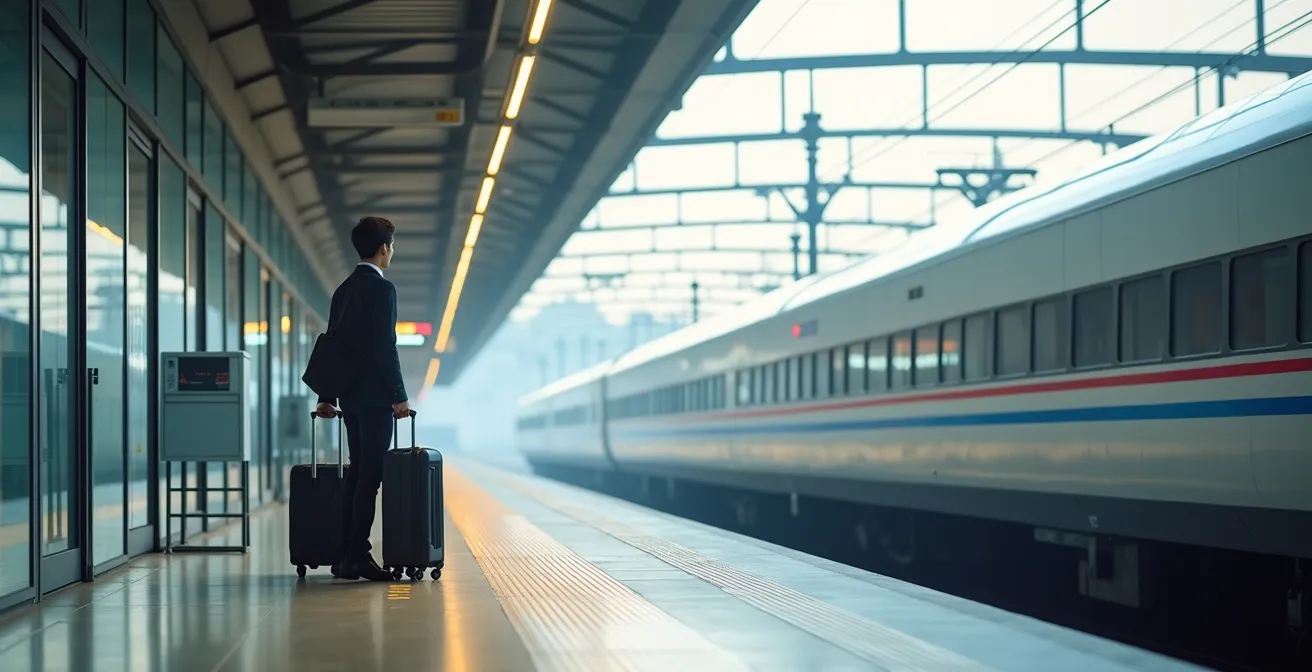
The image is a familiar one for any traveler in Japan: wrestling a large suitcase through a bustling station, only to face the sleek, silent challenge of the Shinkansen. The core anxiety isn’t just about lifting the bag, but about the rules. You’ve likely heard that bringing large luggage aboard requires special planning, but the advice is often fragmented. Common knowledge dictates that any luggage with combined dimensions over 160 cm is considered “oversized” and needs a reservation, but this is only the beginning of the logistical puzzle.
Many guides simply state the rules, leaving travelers to discover the harsh realities of passenger flow dynamics, transfer time constraints, and the critical differences between train types. They tell you *what* to do, but not *why*. The key to a stress-free journey isn’t just memorizing policies; it’s understanding the underlying logistics of Japan’s world-class rail system. This system is a masterpiece of efficiency, and every rule is designed to mitigate bottlenecks and maintain punctuality.
This guide adopts a logistician’s perspective. We will move beyond simply stating regulations to explain the operational logic behind them. You will learn not just how to book a seat, but how to make strategic decisions about your choice of train, your timing on the platform, and even your in-station meal purchase. By understanding the system’s constraints, you can navigate them proactively, transforming a potentially stressful experience into a seamless part of your Japanese adventure. We will dissect each step, from the consequences of failing to reserve a spot to the cost-benefit analysis of the JR Pass in this new era of travel.
This article provides a comprehensive operational breakdown for managing oversized luggage on the Shinkansen. Explore the sections below to master each aspect of your high-speed rail journey.
Summary: A Logistician’s Guide to Shinkansen Luggage Reservation
- What Happens If You Bring Big Bags Without a Reservation?
- SmartEX App or Station Counter: Which Is Faster for Reservating Seats?
- Nozomi, Hikari, or Kodama: Which Train Saves You Time vs Money?
- Ekiben: Why Buying a Bento Box Is Essential for the Ride?
- When to Line Up on the Platform for Non-Reserved Seats?
- 8 Minutes: Is It Enough Time to Transfer Shinkansen Lines?
- How to Handle an Emergency Call While on the Shinkansen?
- Is the JR Pass Still Worth Buying After the Recent Price Hike?
What Happens If You Bring Big Bags Without a Reservation?
Boarding a Shinkansen with unreserved oversized luggage initiates a clear and non-negotiable protocol. The primary consequence is a 1,000 yen “carry-on fee,” which must be paid to the train conductor. This is not a fine in a punitive sense, but a service charge for the logistical disruption caused. Upon payment, the conductor will instruct you to move your luggage to a designated space, which may be at the end of the car or in an entirely different car, away from your seat. This is done to clear aisles and maintain safety and punctuality, the twin pillars of the Shinkansen system.
The real cost, however, is not the yen but the stress and inconvenience. You will have to navigate a moving train with a heavy bag, potentially disrupting other passengers and losing sight of your belongings. This situation is entirely avoidable through proactive reservation. However, if you find yourself in this predicament, a clear damage control protocol can minimize the disruption. The key is to act immediately and communicate clearly with the train staff.
Damage Control Plan: Unreserved Oversized Luggage
- Platform Realization: If you notice your error before boarding, go directly to a ticket counter or machine to modify your booking. This is the best-case scenario.
- Onboard Action: If already on the train, find the conductor immediately. They usually patrol from the front cars to the back after departure. Don’t wait for them to find you.
- Clear Communication: Prepare to say, “Sumimasen, ookina nimotsu no yoyaku o wasuremashita” (Excuse me, I forgot to reserve for oversized luggage).
- Payment Readiness: Have 1,000 yen in cash ready. While cards may be accepted, cash is the most efficient way to handle the on-the-spot transaction.
- Compliance: The conductor will assign a storage spot. Follow their instructions promptly and be prepared to relocate your bag, even if it’s to another car.
SmartEX App or Station Counter: Which Is Faster for Reservating Seats?
Securing your oversized luggage seat involves a choice between digital efficiency and in-person assistance. The SmartEX app and website represent the fastest path for tech-savvy travelers, allowing reservations to be made from anywhere, often up to a month in advance. In contrast, the station counter offers a necessary human interface for complex itineraries or for those using a Japan Rail Pass. Each method has distinct operational advantages and limitations that cater to different traveler profiles and logistical needs.
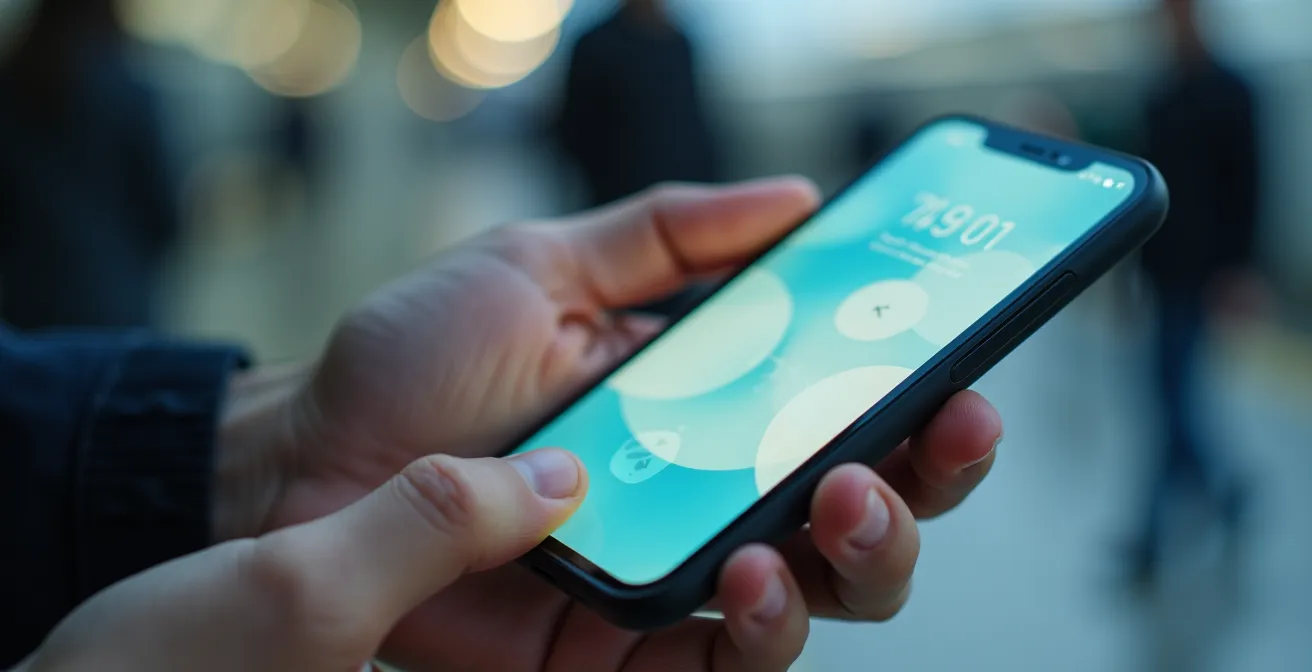
The decision between these methods is a strategic one. For a straightforward trip from Tokyo to Kyoto booked in advance with an international credit card, the app is unparalleled. However, for a JR Pass holder who needs to activate their pass and book multiple legs of a journey, the station counter is the only viable option. The key is to identify your specific constraints—pass holder status, itinerary complexity, and comfort with technology—to choose the most efficient booking channel. As a third option, ticket machines offer a middle ground for simple, point-to-point journeys without a JR Pass, but their interfaces can be challenging for first-time users.
Case Study: The JR Pass Holder’s Luggage Dilemma
Travelers with a Japan Rail Pass face a unique challenge. Even if they’ve made online seat reservations through third-party services, the oversized luggage space cannot be booked without interacting with JR staff in Japan. This creates a two-step process: book a seat online, then visit a JR station counter upon arrival to add the free luggage reservation. To solve this logistical gap, services like Klook now offer an English-first interface that allows travelers to book a seat *and* the associated oversized luggage space for the Tokaido Shinkansen (Tokyo-Osaka route) in a single transaction, effectively bridging the gap for international visitors.
The following table breaks down the time-versus-benefit trade-offs of each method, providing a clear framework for your decision.
This comparison, based on data from JR’s official booking platforms, highlights the distinct use cases for each method.
| Method | Speed | Best For | Limitations |
|---|---|---|---|
| SmartEX App | 3-5 minutes | Tech-savvy travelers, planning from abroad, booking before JR Pass activation | Cannot reserve oversized baggage compartment for transfers, requires Japanese phone number or international credit card |
| Station Counter | 5-10 minutes (plus queue time) | JR Pass holders, complex routes, last-minute changes, language assistance needed | Language barrier possible, queue times during peak hours can exceed 30 minutes |
| Ticket Machine | 2-4 minutes | Simple point-to-point journeys, travelers comfortable with machines | Can be confusing for first-timers, limited to 5 passengers per booking |
Nozomi, Hikari, or Kodama: Which Train Saves You Time vs Money?
The choice between Nozomi, Hikari, and Kodama trains on the Tokaido-Sanyo line is a classic logistical trade-off between speed, cost, and accessibility—especially when traveling with oversized luggage. The Nozomi is the fastest, stopping only at major cities, making the Tokyo to Kyoto journey in about 2 hours and 15 minutes. The Hikari is the next fastest, with a few more stops, while the Kodama stops at every station, extending the same journey to nearly 4 hours. Crucially, the Japan Rail Pass does not cover the Nozomi, making the Hikari the default for most pass holders.
From a luggage perspective, this choice has significant implications. The oversized baggage area, located behind the last row of seats in designated cars, is a finite space. According to JR West’s specifications for the N700 series trains, this space is approximately 42 cm deep. While the number of available seats is the same across all three train types, the passenger turnover rate is not. The slower Kodama trains often have more availability for last-minute oversized luggage reservations simply because they are less popular and serve a more local passenger flow.
Furthermore, the dwell time at stations varies. A Nozomi may stop for only a minute, creating a high-pressure situation for boarding with heavy luggage. A Kodama, however, can wait for several minutes, providing a much safer and less stressful window to get yourself and your belongings aboard. Therefore, the decision framework is as follows:
- Choose Nozomi if: Speed is your absolute priority, you have no JR Pass, and you have successfully reserved your luggage space well in advance.
- Choose Hikari if: You are a JR Pass holder seeking the best balance between speed and accessibility. This is the standard choice.
- Choose Kodama if: You are booking last-minute, prioritize a stress-free boarding experience over speed, or are traveling a short distance.
It is also critical to know that these luggage rules primarily apply to the Tōkaidō, San’yō, Kyūshū, and Nishi Kyūshū Shinkansen lines. Other lines, such as the Tohoku or Joetsu Shinkansen, have different configurations and more relaxed policies.
Ekiben: Why Buying a Bento Box Is Essential for the Ride?
The practice of eating an ekiben (station bento box) on the Shinkansen is more than a charming tradition; it’s a sound logistical strategy, particularly for travelers encumbered with oversized luggage. The core reason is to avoid on-platform bottlenecks. Platform kiosks and onboard food carts have extremely limited selections and are situated in narrow, high-traffic areas. Attempting to navigate these spaces with a large suitcase, or leaving it unattended at your seat to go to the food cart, creates chokepoints and unnecessary stress for you and other passengers.
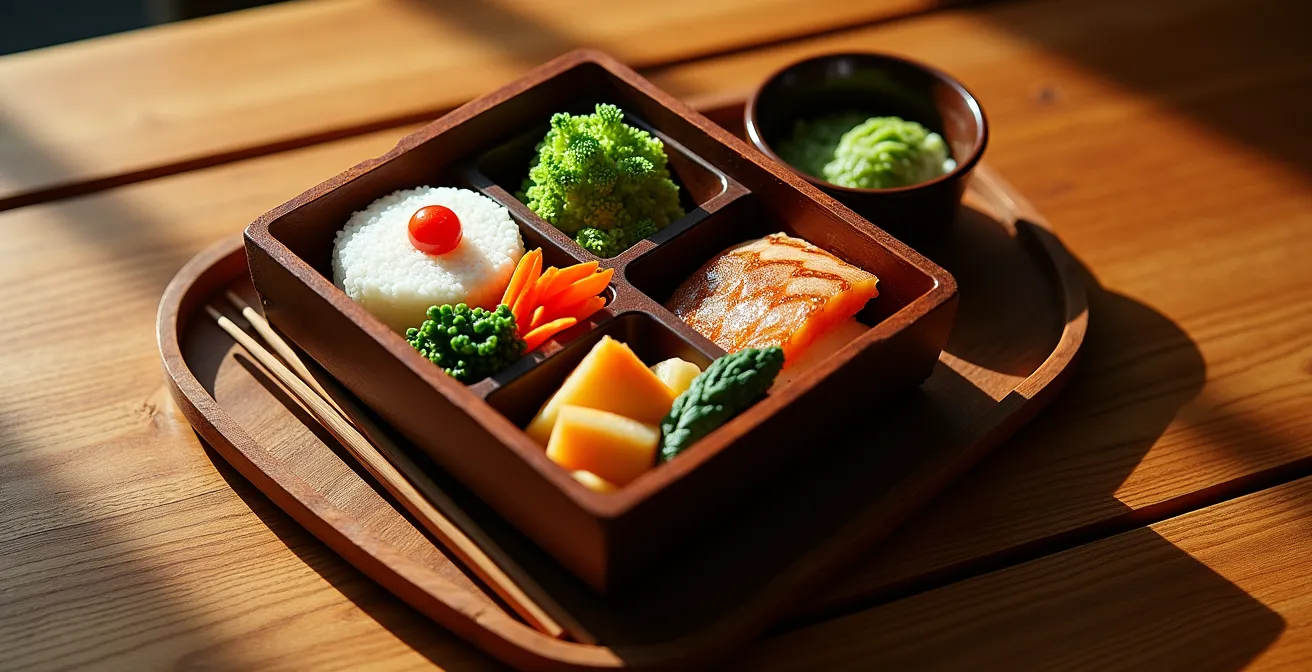
The optimal strategy, as practiced by seasoned travelers, is to acquire your ekiben before passing through the Shinkansen ticket gates. The vast underground food halls (depachika) found in the basements of department stores connected to major stations like Tokyo Station or Shinjuku Station are the prime locations. They offer an incredible variety of bento, from simple 800-yen options to elaborate 2,000-yen multi-course meals, in a much more spacious and navigable environment. By purchasing your meal here, you can proceed directly to your platform and focus on the singular task of boarding smoothly.
Case Study: Strategic Ekiben Acquisition for the Encumbered Traveler
An experienced traveler on the 2.5-hour Tokyo to Osaka route recommends purchasing a lighter bento box from a depachika before entering the station complex. For longer journeys, such as the 4-hour trip to Hiroshima, a more substantial meal is warranted. The key principle remains the same: secure your meal in a low-stress environment before tackling the final leg of your journey to the platform. This pre-planning transforms the meal from a potential source of anxiety into an enjoyable and integral part of the Shinkansen experience, allowing you to settle in and enjoy the view as Japan’s scenery speeds by.
When to Line Up on the Platform for Non-Reserved Seats?
For a traveler with oversized luggage, the answer to this question is unequivocal: never. The Shinkansen’s oversized luggage reservation system is exclusively tied to reserved seats. The non-reserved cars (jiyūseki), typically cars 1-3 on most Tokaido line trains, have no designated area for oversized baggage. The space behind the last row of seats in these cars is not available for this purpose, and attempting to store a large suitcase there will obstruct passengers and draw immediate attention from the conductor.
The official booking systems confirm this operational reality. As noted by the JR’s Smart-EX booking system, there are exactly zero oversized luggage seats available in the non-reserved section. The system is designed to allocate a specific seat (the last row in a reserved car) to a specific piece of luggage. Attempting to circumvent this by using the non-reserved cars is a logistical impossibility and a breach of the rules that will result in the 1,000 yen fee and a forced relocation of your bag.
While lining up early on the platform is a valid strategy for securing a regular seat in a non-reserved car during busy periods, it is a futile effort for those with oversized bags. The platform timing strategy for such travelers is instead focused on arriving at their reserved car’s boarding position with enough time to navigate elevators and position themselves without rushing. The following matrix illustrates why attempting to use non-reserved cars during peak times is operationally unfeasible, reinforcing the need for a reservation.
| Day/Time | Crowd Level | Recommended Arrival Time | Luggage Strategy |
|---|---|---|---|
| Monday Morning (6-9am) | Very High | N/A – Avoid entirely | Use luggage forwarding or book reserved seats only |
| Weekday Midday (11am-2pm) | Low | 20 minutes early | Only feasible for standard luggage |
| Friday Evening (5-8pm) | Extreme | N/A – Avoid entirely | Reserved seats mandatory |
| Weekend Morning (9-11am) | Moderate | 30 minutes early | Position near elevator access points |
| Holiday Periods | Extreme | N/A – Impossible | Book reserved seats weeks in advance |
8 Minutes: Is It Enough Time to Transfer Shinkansen Lines?
An 8-minute transfer time, while standard for a passenger with light luggage, is a significant logistical risk for a traveler with an oversized suitcase. The official transfer time accounts for walking from one platform to another, but it does not factor in the critical bottlenecks created by large bags: elevator queues and maneuvering through crowded concourses. A single crowded elevator can easily consume 3-5 minutes of your transfer window. Therefore, a simple calculation is required to determine a safe transfer time.
To calculate your required transfer time, you should follow a simple additive formula. This turns an optimistic 8-minute window into a more realistic 15-25 minute buffer, depending on the station’s complexity.
- Start with Standard Time: Begin with the official transfer time provided (e.g., 8 minutes).
- Add a Luggage Buffer: Add a minimum of 10 minutes. This accounts for retrieving your bag, navigating more slowly, and securing it on the next train.
- Add an Elevator Surcharge: If your transfer requires changing platform levels, add another 5 minutes specifically for potential elevator queues.
- Add a Station Complexity Fee: For vast, multi-level stations like Tokyo Station, add an additional 10 minutes minimum.
For example, a standard 8-minute cross-platform transfer at Shin-Osaka becomes a more realistic 18 minutes with oversized luggage (8 + 10). A transfer at Tokyo Station involving an elevator could require as much as 33 minutes (8 + 10 + 5 + 10). However, even with the best planning, delays can happen. Fortunately, the JR system has a built-in contingency.
If you miss your connection due to oversized luggage delays, you can use the ‘jiyūseki’ (non-reserved seat) rule to board the next available train on the same route without additional charges
– JR Station Staff Advisory, JR West Official Guidelines
This crucial rule means that your ticket remains valid for the non-reserved section of the next train. While this is a helpful safety net, remember that non-reserved cars have no space for oversized luggage, so this should be considered an emergency option only.
How to Handle an Emergency Call While on the Shinkansen?
Handling an urgent call on the Shinkansen requires adherence to strict etiquette, a protocol made more complex when you are also responsible for oversized luggage. Japanese train etiquette dictates that all non-essential phone calls should be avoided. For urgent matters, the designated area is the deck space between cars. This area is shielded from the main cabin, preventing your conversation from disturbing other passengers. The primary challenge is securing your luggage while you are away from your seat.
The correct protocol involves several steps. Before anything else, ensure your oversized luggage is secured. A simple TSA-approved cable lock, used to attach your suitcase to the luggage bar or an adjacent fixture, provides a deterrent against opportunistic theft. Once your belongings are secure, you can move to the deck area to take your call. For optimal call quality, it’s wise to use the train’s Wi-Fi calling feature, as cellular service can be unreliable in tunnels.
Case Study: Emergency Call Protocol with Oversized Luggage
A business traveler on the Tokyo-Kyoto line shared their experience of handling an urgent work call. Before leaving their seat, they used a small cable lock to secure their large suitcase to the baggage area’s bar. They then moved to the deck area and used the stable “Shinkansen Free Wi-Fi” for their call, avoiding cellular dropouts in tunnels. They noted that in a true emergency where leaving the seat isn’t possible, whispering “Kinkyū desu” (It’s an emergency) to nearby passengers can signal the urgency and garner understanding, though moving to the deck remains the proper procedure.
To be prepared for such a situation, you should configure your phone and have your equipment ready before you board.
- Enable Wi-Fi Calling: Before your trip, go to your phone’s settings and enable Wi-Fi calling.
- Connect Immediately: As soon as you board, connect to the train’s free Wi-Fi network.
- Secure Your Bag: Have a small cable lock accessible to quickly secure your luggage if you need to step away.
- Move to the Deck: For any call lasting more than a few seconds, always move to the deck area between cars.
Key takeaways
- Reservation is Mandatory, Not Optional: Any luggage with combined dimensions of 161-250 cm requires a specific, free reservation. Treating this as optional will result in a fee and logistical hassle.
- Choose Your Booking Tool Strategically: Use the SmartEX app for advance, simple bookings. Rely on station counters for JR Pass-related reservations or complex multi-leg journeys.
- Your Train Choice is a Logistical Decision: The Nozomi offers speed, but the slower Hikari and Kodama trains offer better last-minute luggage seat availability and less stressful boarding times.
Is the JR Pass Still Worth Buying After the Recent Price Hike?
Following the significant price increase in October 2023, the value proposition of the national Japan Rail Pass has shifted. For travelers with oversized luggage, the analysis must go beyond a simple cost-per-trip calculation and factor in the convenience of the reservation process. A key logistical advantage of the JR Pass is the ability to make all your seat and luggage reservations in a single, streamlined process at any JR ticket counter. For instance, a traveler can make up to five separate Shinkansen reservations in one visit, which is a significant time-saver for a multi-city itinerary.
However, the pass’s primary limitation remains: it is not valid on the fastest Nozomi (or Mizuho) trains, restricting holders to the Hikari and Kodama services. This creates a direct trade-off. While individual tickets for a Tokyo-Kyoto round trip on the Nozomi might be cheaper than a 7-day pass, the pass holder benefits from the flexibility of unlimited travel on other JR lines (like the Narita Express and local city loops) and the simplified reservation process for their luggage.
The decision now hinges on the complexity and breadth of your itinerary. A Regional Pass, such as the JR West Kansai WIDE Area Pass, might offer a better value, as some do include access to certain Nozomi trains within their designated area. The following table provides a clear comparison from the perspective of a traveler with oversized luggage.
| Option | 7-Day Cost (approx.) | Luggage Reservation Process | Train Access |
|---|---|---|---|
| JR Pass (National) | ¥50,000 (as of late 2023) | All reservations free and can be made in one visit at a counter. | Hikari/Kodama only (no Nozomi) |
| Individual Tickets | Varies (¥28,000+ for Tokyo-Kyoto round trip) | Must reserve each segment separately via app or machine. | All trains including the faster Nozomi. |
| Regional Pass (e.g., JR West) | Varies (¥12,000+) | Free reservations for the covered area only. | Regional limitations but some include Nozomi access. |
Ultimately, the JR Pass is no longer an automatic purchase. It is best suited for travelers planning extensive, multi-city journeys over 7 or 14 days, for whom the convenience of a single-pass system and consolidated booking process outweighs the premium cost and restriction from Nozomi trains.
To put these principles into practice, your next step should be to draft your potential itinerary and use a fare calculator to compare the cost of individual tickets against the price of the relevant JR Pass. This data-driven approach is the only way to make a truly informed logistical decision.