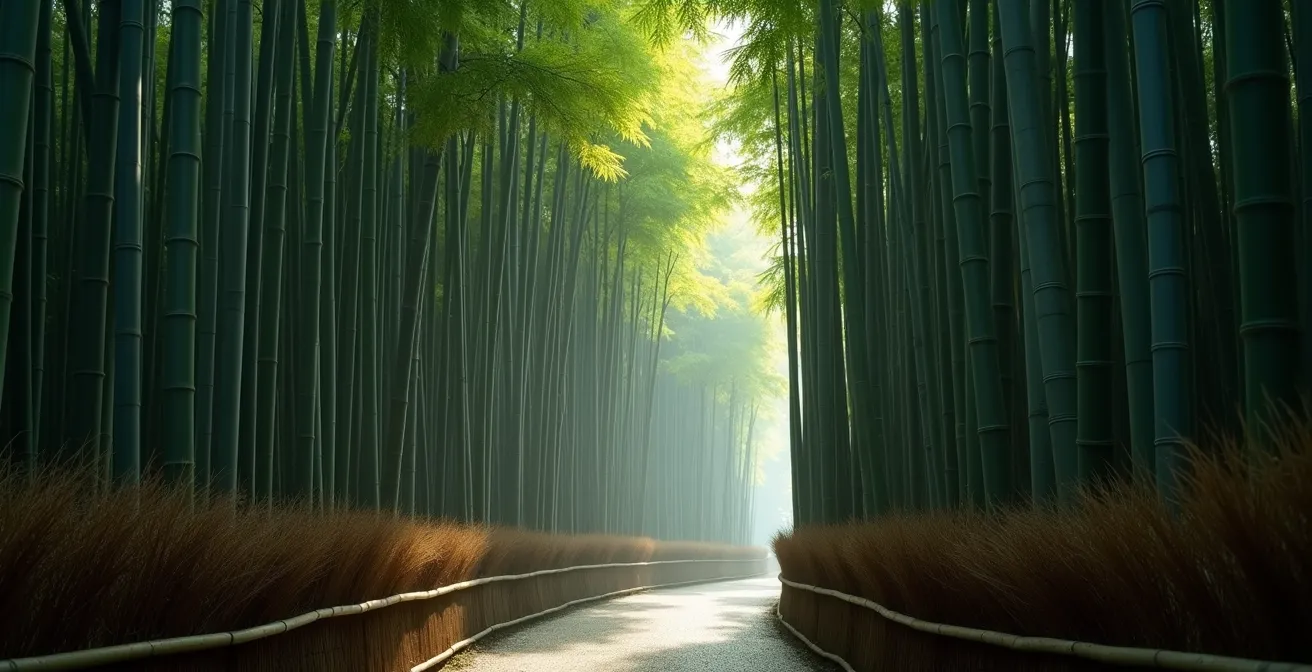
The secret to a crowd-free photo in Arashiyama isn’t a specific time, but a series of strategic decisions made before you even arrive.
- Success comes from navigating crowd flow, not just avoiding peak hours.
- Paying for entry to adjacent sites like Tenryu-ji Temple often provides a tactical advantage by offering less-crowded access points to the main attraction.
Recommendation: Shift your mindset from a tourist’s checklist to a photographer’s mission plan. Analyze each choice—transport, entry point, time of day—for its strategic value in achieving the perfect, serene shot.
Every photographer and nature lover has seen the image: a lone figure walking down a path flanked by towering, ethereal bamboo stalks, the light filtering through the dense canopy. This is the promise of Kyoto’s Arashiyama Bamboo Grove. The reality, however, is often a slow, crowded shuffle amidst a sea of smartphones and selfie sticks, a stark contrast to the zen-like peace you came to capture. The common advice—”go at 6 AM” or “try just before sunset”—is a good starting point, but it’s a platitude that misses the larger strategic picture. It treats the problem as a simple matter of timing, when it is truly a challenge of logistics and crowd dynamics.
The truth is that capturing the grove’s serenity is less about finding a magic, empty hour and more about executing a well-planned mission. For the photographer desperate for that solo shot, success lies in understanding the flow of people and making a series of calculated trade-offs. It’s about seeing the entire Arashiyama district as a chessboard and choosing your moves wisely. Is the physical effort of a steep hike worth the panoramic reward? Is a paid entrance fee a cost or an investment in a strategic shortcut?
This guide abandons the generic advice and adopts the mindset of a photography scout. We will dissect the key decisions you’ll face in Arashiyama and greater Kyoto, framing each choice as a strategic trade-off with a clear visual return on investment. From choosing your mode of transport to deciding which river experience offers the best perspective, you will learn to think not like a tourist checking off a list, but like a strategist on a mission to capture the true spirit of a place, even one as popular as Arashiyama.
To help you plan your photographic mission, this guide breaks down the essential strategic decisions you’ll need to make. Each section analyzes a critical trade-off, providing the intelligence needed to maximize your chances of capturing that perfect, crowd-free image.
Summary: A Strategic Guide to Capturing Kyoto’s Icons
- Hike or Grove: Is the Steep Climb to the Monkey Park Worth the View?
- Train or Boat: What Is the Best Way to See the Hozu River?
- Garden or Forest: Why You Should Pay to Enter Tenryu-ji Temple?
- Ebisuya Rickshaw: What Do You Get for the High Price Tag in Arashiyama?
- Rowing or Guided: How to Rent a Boat on the Arashiyama River?
- 6 AM Starts: Why You Must Beat the Tour Buses to Kiyomizu-dera?
- The ‘Checklist’ Trap: Why Rushing Ruins the Spirit of Japan
- Bus or Bike: What Is the Most Efficient Way to See Kyoto?
Hike or Grove: Is the Steep Climb to the Monkey Park Worth the View?
The first strategic trade-off in Arashiyama is effort versus reward. While most visitors flock directly to the bamboo, a different opportunity awaits across the river: the Iwatayama Monkey Park. Reaching it involves a tangible cost in both energy and time. After crossing the Tsutenkyo Bridge, a winding, 30-minute uphill hike is required. For a fee of around ¥550, the summit offers a unique payoff: not only are you greeted by over 100 free-roaming Japanese macaques, but you also gain a sweeping panoramic view of Kyoto that is inaccessible from the valley floor.
From a photographer’s perspective, this isn’t just a side trip; it’s a strategic maneuver. The climb itself filters out a significant portion of the crowds, offering moments of quiet contemplation and photo opportunities along the trail. The real value, or “visual ROI,” is the elevated perspective. While everyone else is shooting the same upward-looking shots in the bamboo grove, you are capturing a vast, contextual landscape. It’s a chance to tell a different story of Arashiyama—one of scale, nature, and the city in the distance.
To maximize this opportunity, treat the climb as part of the photographic experience, not just transit. Start early when the park opens (around 9 AM) to avoid the midday heat. Bring water and allow for pauses at viewpoints along the path. The physical investment of the climb buys you a perspective and a level of tranquility that those who stay in the crowded grove will miss entirely. It’s a classic trade of physical exertion for photographic exclusivity.
Train or Boat: What Is the Best Way to See the Hozu River?
The Hozu River, which carves the dramatic gorge next to Arashiyama, presents another critical choice: experience it from above by train or from below by boat? The Sagano Scenic Railway offers a stunning journey through the gorge, providing elevated, cinematic views of the river and surrounding landscape. The Hozugawa River Boat Ride, conversely, is a two-hour rafting journey that puts you directly on the water, offering an immersive, eye-level perspective of the rapids and rock formations.
The ultimate strategic play, however, is not to choose one, but to combine both. A highly effective strategy many visitors employ is to take the Sagano Scenic Train up the gorge and then return via the Hozu River boat. This “combined experience strategy” transforms a simple sightseeing choice into a comprehensive photographic mission. According to the railway’s own recommendations, this approach allows you to capture the same stunning landscape from two radically different and complementary viewpoints. For the best photo opportunities on the train, insiders suggest booking even-numbered seats, especially C and D, as they offer the most unobstructed views of the gorge below.
This dual-perspective approach maximizes your visual return. The train provides the grand, sweeping establishing shots, while the boat delivers the intimate, detailed, and action-oriented images. It’s a perfect example of how thinking strategically about your itinerary can yield a much richer and more diverse photographic portfolio of a single location.
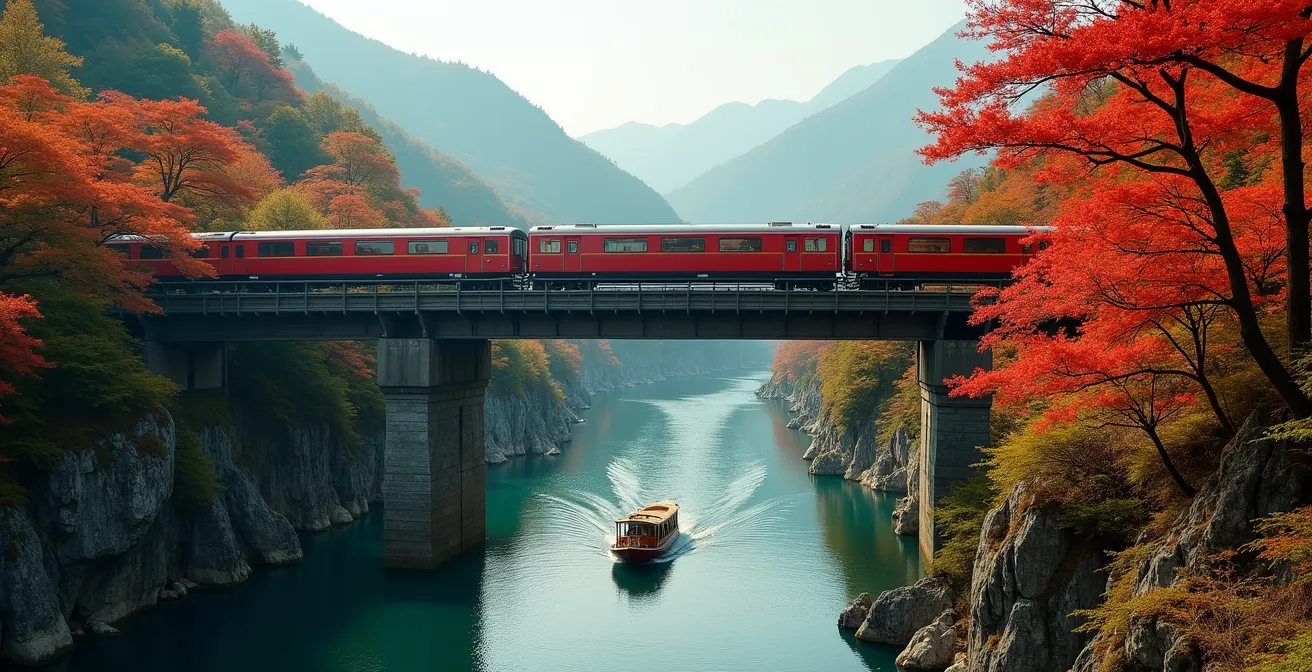
As this image demonstrates, the two experiences are not mutually exclusive but two halves of a whole. The train captures the scale of the engineering within nature, while the boat captures the raw power of the river itself. By combining them, you don’t just see the Hozu River; you document it completely.
Garden or Forest: Why You Should Pay to Enter Tenryu-ji Temple?
Right at the entrance to the main bamboo path lies Tenryu-ji Temple, a UNESCO World Heritage site. Many tourists, eager to get to the grove, walk right past it. This is a tactical error. The temple’s entrance fee— ¥500 for the garden and an additional ¥300 for the buildings—is not just a cost; it’s an investment in a strategic advantage. Paying to enter Tenryu-ji is one of the single most effective maneuvers for outsmarting the crowds heading into the bamboo grove.
The primary benefit is access. The temple’s sprawling Sogenchi Teien garden has a north exit that leads directly into the heart of the bamboo grove. By entering through the temple, you bypass the chaotic, heavily congested main entrance of the public path. You emerge into the grove from a different direction, effectively flanking the main wave of tourists. This allows you to access quieter sections of the path before the bulk of the crowd arrives.
Furthermore, the temple itself opens at 8:30 AM, giving you a head start. You can spend time in the serene, masterfully designed garden, photograph the famous reflective pond, and then proceed to the bamboo path just as the crowds are beginning to build at the main entrance. This turns a potential waiting period into a tranquil and productive photographic session. The fee is a small price to pay for a tactical shortcut that delivers a significant advantage in the mission for a crowd-free shot.
Your Action Plan: Using Tenryu-ji for a Strategic Advantage
- Enter Tenryu-ji at its 8:30 AM opening time to get ahead of the main tour groups.
- First, experience and photograph the UNESCO World Heritage garden and its iconic reflective pond.
- Locate the temple’s north exit, which serves as your private entrance to the bamboo grove.
- Use this access to bypass the most congested first 100 meters of the main public path.
- Explore the less-trafficked western section of the grove, which is more directly accessible from the temple’s exit.
Ebisuya Rickshaw: What Do You Get for the High Price Tag in Arashiyama?
Navigating Arashiyama’s crowded streets presents another trade-off: budget versus access. While walking is free and rental bicycles offer some flexibility, the Ebisuya Rickshaw tour presents a high-cost, high-reward alternative. With prices starting around ¥7,000 for a 30-minute tour, the question is what, exactly, are you paying for? The answer is not just transportation; it’s curated navigation and exclusive access.
A rickshaw driver, or *shafu*, is more than a puller; they are a local guide and a crowd-control strategist. They possess an intricate knowledge of tour bus schedules and the ebb and flow of pedestrian traffic. While cyclists and walkers are stuck in the main arteries, the *shafu* can divert down less-congested side streets, providing a smooth and serene experience even at peak times. Crucially for a photographer, they know the exclusive photo angles that are impossible to access when surrounded by a throng of people. Being elevated in the rickshaw also provides a unique and slightly higher vantage point for your shots.
The high price tag buys you an expert who can choreograph your visit, taking you to quiet spots and hidden gems while narrating the history and culture of the area. It’s a tool for transforming a potentially stressful navigation challenge into a seamless and photographically productive experience. For those with a limited time budget, the financial investment can offer a significant return in terms of quality experiences and unique images.
This comparative analysis breaks down the strategic value of each transportation method in Arashiyama.
| Option | Cost | Crowd Avoidance | Experience Value |
|---|---|---|---|
| Walking | Free | Stuck in crowds | Basic sightseeing |
| Bicycle Rental | ¥1000/day | Some flexibility | Self-guided exploration |
| Rickshaw (30 min) | ¥7000-9000 | Elevated above crowds | Guided storytelling + exclusive routes |
| Rickshaw (60 min) | ¥13000-17000 | Access to hidden spots | Full cultural narrative + photo assistance |
Rowing or Guided: How to Rent a Boat on the Arashiyama River?
The calm waters of the Katsura River (often called the Arashiyama River) offer a final opportunity for serene photography, but here too, a strategic choice must be made. You can rent your own three-person rowboat for a modest fee or opt for a guided tour, especially the evening *Ukai* (cormorant fishing) boats in the summer. The key to success with either choice is understanding how to create your own zone of serenity on the water.
Most visitors who rent rowboats tend to cluster near the main boat dock, creating a miniature traffic jam on the water. The strategic error is staying close. The secret to finding solitude and perfect reflections of the surrounding mountains is to commit to rowing. By heading upstream, under the Togetsukyo Bridge, the river widens and the crowds thin out dramatically. Rowing just a few hundred meters from the dock is enough to leave the congestion behind and find yourself in a peaceful expanse of water, perfect for capturing those tranquil, reflective shots, especially during the golden hour.
The guided boats, particularly the *Ukai* tours, offer a different kind of value. These tours, which demonstrate the traditional art of fishing with cormorant birds, provide a unique cultural spectacle against the backdrop of an evening sky. While less about solitude, they offer a chance for dramatic, low-light photography filled with fire, water, and ancient tradition. The choice is between actively creating your own peace with a rowboat or passively capturing a curated cultural performance.
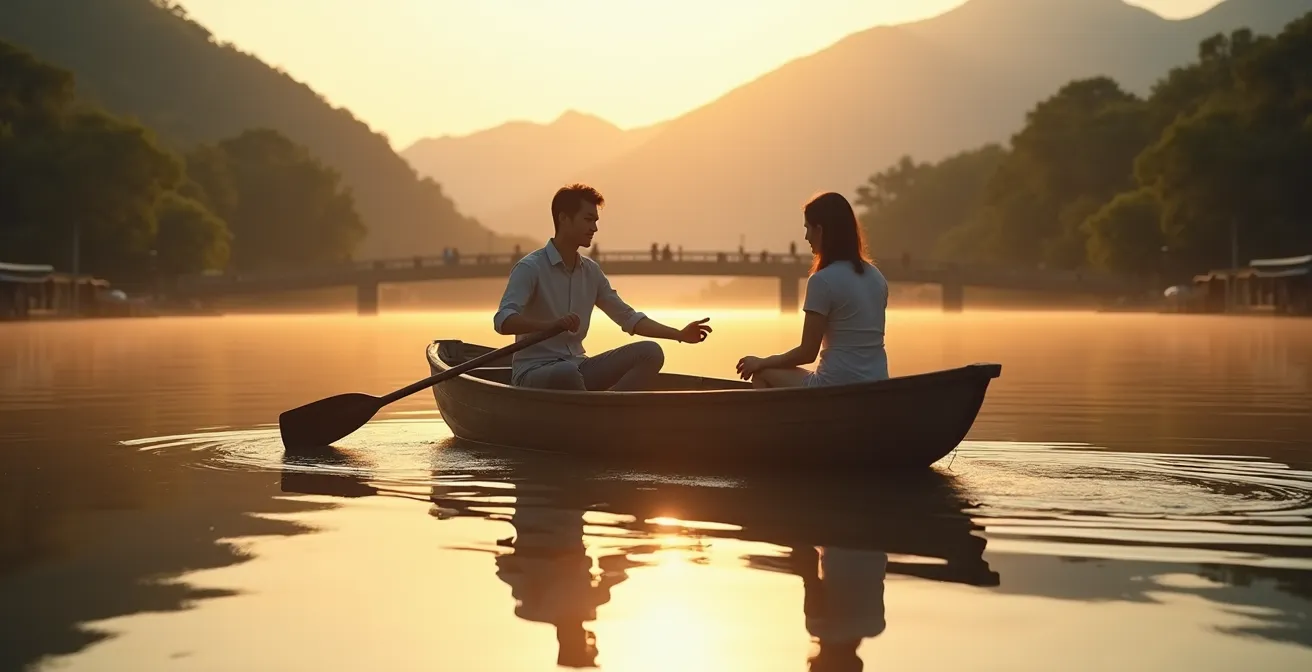
The payoff for rowing away from the crowds is evident. This quiet moment, with the mountains reflected in the still water, is the reward for strategic effort. It’s a scene you must actively create for yourself by literally rowing away from the pack.
6 AM Starts: Why You Must Beat the Tour Buses to Kiyomizu-dera?
The strategic principles honed in Arashiyama are universally applicable across Kyoto’s other major sites. Nowhere is this truer than at Kiyomizu-dera Temple. The question isn’t *if* you should go early, but *how* early. The answer is unequivocal: you must arrive at 6 AM. This isn’t just a suggestion; it is the entire strategy. The temple opens its doors at 6:00 AM, and the window of tranquility is brutally short. Visitor guides confirm that the optimal time is between 6:00 AM and 8:00 AM, before the first wave of tour buses descends.
The difference between arriving at 7:00 AM and 9:00 AM is not incremental; it is absolute. A visitor who arrived at the temple in the early morning reported a transformative experience, noting it was their first time visiting with so few people that they could take photos with no one else in the frame. This magical window slams shut around 9:00 AM when, as one report confirms, ” busloads of people begin arriving.” The experience shifts from a spiritual pilgrimage to a crowded tourist attraction in a matter of minutes.
For a photographer, the 6 AM start is non-negotiable. It is the only way to capture the iconic wooden stage of the main hall without a foreground of hundreds of people. It’s your chance to photograph the temple’s vibrant vermillion pagodas against the morning sky in peace. The early start is a significant investment of effort—requiring discipline and careful transport planning—but the photographic payoff is unparalleled. It is the difference between getting “the shot” and getting a snapshot of a crowd.
Key Takeaways
- Strategic Inefficiency: Sometimes the longer, harder, or more expensive path (a hike, a fee, a rickshaw) is the most efficient way to achieve a better photographic outcome.
- Flank the Crowd: Don’t just follow the main path. Use alternative entry points, like the Tenryu-ji north exit, to bypass the densest parts of the crowd.
- Create Your Zone: In open spaces like the river, you must actively move away from the central cluster of people to find the tranquility and clean shots you’re looking for.
The ‘Checklist’ Trap: Why Rushing Ruins the Spirit of Japan
There is a danger inherent in all this strategic planning: the “checklist trap.” It’s the mindset of rushing from one iconic spot to the next, focused only on capturing a pre-conceived image before moving on. This approach is particularly ruinous in Japan, a culture that prizes mindfulness and quiet observation. When your visit becomes a frantic race to tick boxes, you not only miss the spirit of the place but you also set yourself up for disappointment when reality doesn’t match the curated images on social media.
Despite getting 4.5 out of five stars on TripAdvisor, visitors report that ‘most of the time, you will not enjoy a peaceful stroll in a bamboo grove… Instead, you will be surrounded by Instagram photo-snapping tourists.’
– As reported by CNBC
This experience exemplifies the letdown of checklist tourism. The true strategic masterstroke is to transform your checklist into a “curiosity list.” Instead of a list of places to *see*, create a list of moments to *experience*. This simple mental shift changes your entire approach. You stop hunting for a specific shot and start becoming receptive to the unique moments that unfold in front of you. This is where the truly original and soulful photographs are born.
Instead of “See the bamboo grove,” your goal becomes “Experience the sound of bamboo swaying in the morning wind.” Instead of “Visit Kiyomizu-dera,” it’s “Listen to the monks’ morning chants at 6 AM.” This approach encourages you to slow down, observe, and connect with your surroundings on a deeper level. The resulting photographs will be more authentic and meaningful than any replicated Instagram shot, because they will be born from a genuine moment of presence, not a rushed item on a checklist.
Bus or Bike: What Is the Most Efficient Way to See Kyoto?
The final layer of your strategic plan is choosing your primary mode of transport for Kyoto. This choice between the city bus network and a rental bicycle is not about convenience; it’s about defining the nature of your photographic mission for the day. There is no single “best” way; there is only the most efficient tool for the specific job at hand. The bus and the bike offer fundamentally different operational advantages.
The Kyoto city bus network is your tool for macro-level exploration. It is highly efficient for covering the large distances between districts—for example, getting from Kyoto Station to Kinkaku-ji (the Golden Pavilion) or from Gion to Arashiyama. If your plan is to capture 2-3 major, geographically disparate landmarks in a single day, the bus is your strategic asset. However, you are tied to its fixed routes and schedules, sacrificing spontaneity for reach.
Conversely, the rental bicycle is your tool for micro-level discovery. It is unparalleled for a deep-dive exploration of a single, dense district like Higashiyama or Gion. A bike allows you to duck into quiet residential alleys, follow a stream, or stop instantly when a perfect composition of light and shadow appears. It offers maximum flexibility and spontaneity, which are often the ingredients for the most unique and personal photographs. Its limitation is range and the challenge of navigating Kyoto’s few but significant hills.
The most efficient way to see Kyoto, therefore, is to decide on your mission first. Is it a “highlights reel” day, jumping between icons? Take the bus. Is it a “deep immersion” day, exploring every corner of a single neighborhood? The bike is your best ally. A truly advanced strategy might even involve using both: taking a bus to a target district, then renting a bike to explore it in depth.
By adopting this strategic, mission-oriented mindset for every decision, you transform your trip from a passive tour into an active photographic pursuit. Start planning your Kyoto mission not with a list of places, but with a series of strategic choices that will lead you to the extraordinary images that lie beyond the reach of the casual tourist.