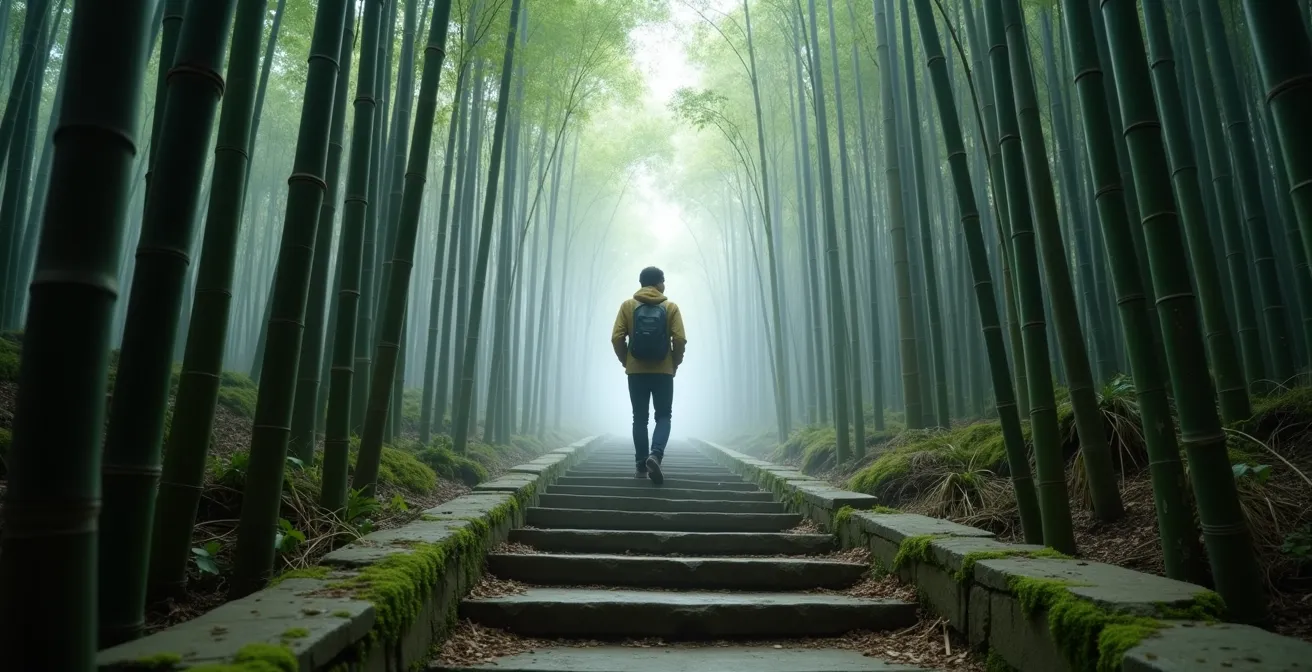
The primary cause of Japan travel burnout is not an overly ambitious checklist, but a failure to account for the hidden ‘time taxes’ of inefficient transit, sensory overload, and poor pacing.
- Most itineraries underestimate the 6-7 hours consumed by a single ‘3-hour’ Shinkansen journey between cities.
- Failing to group neighborhood activities in hubs like Tokyo can waste up to three hours per day on redundant travel.
Recommendation: Shift from an ‘attraction-adder’ to a ‘time-auditor’ mindset. Prioritize depth over breadth by implementing strategic clustering and a ‘hub-and-spoke’ city base to minimize transit waste and maximize enjoyment.
The promise of a 10-day trip to Japan is intoxicating: a whirlwind of ancient temples, neon-drenched skyscrapers, and sublime cuisine. The resulting itinerary, meticulously crafted from countless blog posts and guides, often looks perfect on paper. Yet, for many, the reality is a frantic race against the clock that culminates in exhaustion. The pressure to “see it all” creates a travel plan so dense that the joy of discovery is suffocated by the logistics of transit and queueing.
Conventional wisdom offers simple solutions: “skip the Golden Pavilion for the Silver Pavilion” or “don’t try to do too much.” This advice, while well-intentioned, fails to address the systemic flaws in most travel plans. It treats the symptom—a long checklist—rather than the disease: an inefficient use of your most limited resource, time. The problem isn’t just about the places you choose, but the hidden costs associated with getting to them.
What if the key to a successful trip wasn’t a better list of attractions, but a more ruthless audit of your schedule? This guide approaches your 10-day itinerary from the perspective of an efficiency auditor. We will dissect the hidden “time taxes”—the unaccounted-for hours lost to travel, transitions, and decision fatigue. We will analyze your “visual diet” to prevent sensory burnout and introduce frameworks that build in space for the spontaneous moments that make a trip memorable. This isn’t about seeing less; it’s about experiencing more by being smarter with your time.
This article provides a systematic audit of your Japan travel plan. We will move from high-level strategic decisions, like choosing your destinations, down to the granular tactics that can save you hours each day. The following sections are designed to help you identify and eliminate the most common sources of wasted time and energy in your itinerary.
Summary: A Ruthless Auditor’s Guide to Crafting an Efficient Japan Itinerary
- Why Some ‘Top Spots’ Might Not Be Worth Your Limited Time?
- How to Group Tokyo Neighborhoods to Save 3 Hours Daily?
- Temples vs. Skyscrapers: How to Balance Your Daily Visual Diet?
- The Exhaustion Mistake: Why 3 Cities in 7 Days Fails
- When to Leave Flexibility for Serendipitous Discoveries?
- East to West or West to East: Does It Matter Where You Start?
- 7 AM to 9 AM: Why You Must Avoid Tokyo Trains During Commute Hours?
- 7 Days or 14:How Queueing Like a Local Saves You Time at Train Stations
Why Some ‘Top Spots’ Might Not Be Worth Your Limited Time?
The allure of a “Top 10” list is powerful, but it’s a primary driver of inefficient travel. From an auditor’s perspective, the value of an attraction is not its fame, but its return on investment in terms of time and energy. A famous site that requires two hours of transit and another hour in a queue offers a poor return for a traveler on a 10-day schedule. The real cost isn’t just the time spent, but the subsequent fatigue that compromises the rest of your day. A survey has shown that by day three, travelers were fried from following popular, packed itineraries.
The goal is to replace low-return attractions with high-return alternatives. This doesn’t necessarily mean skipping a famous landmark, but it does require a conscious evaluation. For example, instead of joining the massive crowds at Kinkaku-ji (Golden Pavilion), consider visiting Ginkaku-ji (Silver Pavilion) for a more contemplative experience with fewer people. The audit question is simple: does this activity energize me or drain me? Choosing a lesser-known but more authentic local shotengai (shopping arcade) over a crowded tourist market can provide a richer, more relaxed cultural immersion.
Case Study: The Overpacking Regret
An analysis of over 670 Reddit comments about Japan travel mistakes revealed a clear pattern: the number one regret was overpacking the itinerary. Travelers who attempted to visit numerous cities and sights in a short period consistently reported exhaustion and a sense of having “missed” the real Japan. Many wished they had chosen depth over breadth, spending more quality time in fewer locations rather than sprinting through a checklist.
This principle of substitution is the first step in your itinerary audit. For every “must-see” on your list, question its true value to your specific trip. The objective is to build a plan that is rich in experience, not just in famous names. Sometimes the most memorable part of a trip isn’t the landmark, but the quiet neighborhood you discovered on the way.
How to Group Tokyo Neighborhoods to Save 3 Hours Daily?
Tokyo is not a single city; it’s a constellation of distinct districts, each with its own character and cluster of attractions. The single biggest time-wasting mistake visitors make is crisscrossing the metropolis multiple times a day. An efficient itinerary treats Tokyo as a series of walkable hubs. By dedicating a morning or afternoon to a specific “cluster,” you can eliminate hours of redundant subway travel and reclaim that time for exploration.
The strategy is called geographic clustering. Instead of planning your day by a list of sights (e.g., Senso-ji Temple, then Shibuya Crossing, then Shinjuku Gyoen), you plan it by neighborhood. For example, you would group Harajuku’s Takeshita Street, the Meiji Jingu shrine, and the high-fashion district of Omotesando into a single, seamless walking tour. They are all part of the same geographic cluster and can be explored on foot. This minimizes your interaction with the complex train system and maximizes your time on the ground.
This comparative table breaks down logical neighborhood groupings to form the backbone of an efficient Tokyo plan. Using this as a template allows you to build daily schedules that flow logically from one point to the next, drastically reducing the “time tax” of transit.
| Cluster | Neighborhoods | Walking Time | Key Connection |
|---|---|---|---|
| Shibuya-Harajuku | Shibuya, Harajuku, Omotesando, Daikanyama | 15-20 min radius | All within walking distance |
| East Tokyo | Asakusa, Ueno, Tokyo Station | 10-15 min by train | Connected by Yamanote/Ginza lines |
| Central Luxury | Ginza, Marunouchi, Imperial Palace | 10-15 min walk | Adjacent areas |
| West Hub | Shinjuku, Kabukicho, Yoyogi | 10-20 min radius | Centered around Shinjuku Station |
Adopting this mindset transforms your itinerary from a chaotic checklist into a series of focused, immersive experiences. You’ll spend less time staring at a subway map and more time discovering the hidden alleyways and local shops that define each neighborhood’s unique atmosphere.
Temples vs. Skyscrapers: How to Balance Your Daily Visual Diet?
Travel burnout isn’t just physical; it’s also sensory. A day spent pinballing between the frenetic energy of Shibuya Crossing, the digital overload of an Akihabara arcade, and the dazzling lights of Shinjuku can leave your brain as tired as your feet. An effective itinerary auditor manages the “visual diet” by intentionally balancing high-stimulation activities with periods of calm and quiet reflection. This deliberate pacing prevents sensory overload and enhances your appreciation for both extremes of the Japanese experience.
Think of your day in terms of an A-B-A rhythm. Start with a high-energy “A” activity (e.g., a bustling market or modern art installation), then follow it with a low-stimulation “B” activity (e.g., a quiet temple garden, a peaceful park, or a traditional tea house). This gives your mind a chance to process and reset. After this period of calm, you can decide if you have the energy for another “A” activity or if it’s time to wind down. This approach is far more sustainable than stacking multiple high-intensity experiences back-to-back.
Some of the best memories from a trip to Japan won’t come from the checklist items. They’ll sneak up on you in the quiet corners
– Japan Travel Pros Editorial Team, How to Pace Your Japan Travel Itinerary
Balancing your visual diet also means diversifying your sensory input. After a visually-heavy experience like teamLab Borderless, plan an activity focused on another sense, such as a food tour to engage your sense of taste or a craft workshop to engage your sense of touch. This creates a richer, more varied travel experience and prevents the feeling of being overwhelmed.
Your Action Plan: The A-B-A Pacing Framework
- Start with an ‘A’ activity: A high-stimulation, modern site like Shibuya Crossing or a teamLab exhibit.
- Follow with a ‘B’ activity: A low-stimulation, traditional space such as a temple garden, a quiet café, or a park.
- Schedule a 90-minute ‘negative space’ block: Intentionally leave this time unplanned for rest or spontaneous discovery.
- Balance sensory experiences: After a visually intense activity, plan something focused on taste (food tour) or touch (craft workshop).
- Conclude with an optional ‘A’ activity: Only if energy levels permit, return to a more active form of urban exploration in the evening.
The Exhaustion Mistake: Why 3 Cities in 7 Days Fails
On paper, the Shinkansen (bullet train) makes Japan seem deceptively small. A “three-hour ride” from Tokyo to Kyoto sounds like a simple morning trip. In reality, this is a critical miscalculation. From an auditor’s perspective, a city change is the single most expensive activity in your time budget. A travel efficiency analysis reveals that what looks like a 3-hour journey actually consumes 6 to 7 hours of your day. This “time tax” includes packing, checking out, navigating to the station, the train ride itself, navigating the arrival station, traveling to your new hotel, and checking in. This process effectively wipes out an entire day of exploration.

Trying to squeeze three or more cities into a 7 or 10-day trip is a recipe for burnout. You spend a disproportionate amount of your precious time in transit and in a constant state of packing and unpacking, rather than immersing yourself in a location. The more efficient alternative is the “hub-and-spoke” strategy. Instead of moving hotels every two days, you establish a base in a major city (the hub) for 4-5 days and use it to launch day trips (the spokes) to nearby destinations.
Case Study: The Hub-and-Spoke Success
A study of traveler experiences showed that those using Kyoto as a 4-5 day base for day trips to Nara, Osaka, and Himeji reported significantly less fatigue. Compared to travelers who changed hotels for each city, the hub strategy eliminated the packing/unpacking cycle and saved an average of 3-4 hours per city transition. This allowed for the same variety of exploration but with a massive reduction in logistical stress and wasted time, leading to higher overall trip satisfaction.
For a 10-day trip, a ruthless audit would suggest a maximum of two base cities—for instance, five days in Tokyo and five days in the Kansai region (based in Kyoto or Osaka). This minimizes the heavy “time tax” of inter-city travel and maximizes your time for actual discovery.
When to Leave Flexibility for Serendipitous Discoveries?
An itinerary packed to the minute is a fragile one. A single delayed train or a longer-than-expected queue can cause the entire day’s plan to collapse, inducing stress and frustration. The most robust and enjoyable itineraries are not the ones that are most detailed, but the ones that strategically build in flexibility. Serendipity—the magic of stumbling upon a hidden temple, a charming café, or a local festival—cannot be scheduled. It can only happen when you leave space for it.
The “Itinerary Auditor” approach advocates for the 80/20 planning rule. Plan 80% of your day with clear, high-priority destinations, but leave 20% intentionally blank. This “negative space” is not wasted time; it’s your budget for spontaneity. It’s the freedom to wander down an interesting-looking alleyway, to spend an extra hour in a museum you love, or simply to sit in a park and watch the world go by. This unstructured time is often where the most cherished memories are made.
This doesn’t mean being unprepared. A key part of the 80/20 rule is to create pre-vetted lists of 3-4 backup options (cafes, shops, smaller temples) for each neighborhood you plan to visit. If you find yourself with a free hour, you’re not scrambling to find something to do; you’re choosing from a curated list of high-quality options. This combines the efficiency of planning with the freedom of spontaneity. It’s also crucial to distinguish between activities that require rigid scheduling (like booking the Ghibli Museum) and zones that are perfect for aimless wandering (like the backstreets of Gion in Kyoto).
Ultimately, a successful trip is a balance between structure and freedom. By intentionally leaving gaps in your schedule, you give yourself permission to follow your curiosity, turning a rigid checklist into a dynamic adventure.
East to West or West to East: Does It Matter Where You Start?
When planning a multi-city trip in Japan, a common question arises: is it better to start in the bustling metropolis of Tokyo (East) or the cultural heartland of Kyoto (West)? From an efficiency auditor’s perspective, the answer is not a matter of preference but of energy management. The sequence of your trip can significantly impact your pace, cultural adjustment, and ability to cope with jet lag. While there is no single right answer for everyone, analyzing the factors can lead to a more logical and less stressful journey.
Starting in Tokyo throws you directly into the high-energy, 24/7 rhythm of modern Japan. For many, this is an advantage. The constant activity helps to combat jet lag by keeping you engaged, and you tackle the most intense and potentially overwhelming city while your energy reserves are at their peak. You can then taper down to the more relaxed, traditional pace of Kyoto, using the second half of your trip to rest and reflect. This “fast-to-slow” progression is often cited as a highly satisfying arc for a first-time visitor.
| Factor | Start in Tokyo (East) | Start in Kyoto (West) |
|---|---|---|
| Jet Lag Management | 24/7 activity helps adjustment | Earlier closing times may worsen jet lag |
| Energy Level | Tackle most intense city while fresh | Gentler cultural immersion first |
| Pace Progression | Start fast, taper to relaxed | Build up energy gradually |
| Cultural Adjustment | Immediate urban immersion | Traditional focus eases transition |
Case Study: The Energy Tapering Strategy
An analysis of traveler reports indicates that first-time visitors who started their journey in Tokyo and concluded in Kyoto reported better overall trip satisfaction. The logic is that the intense pace of Tokyo was easier to handle when travelers were fresh off the plane. Kyoto’s calmer atmosphere then provided a restorative and culturally rich conclusion to their journey, preventing the feeling of burnout at the end of the trip.
Conversely, starting in Kyoto offers a gentler immersion into Japanese culture. It allows for a slower adjustment period before diving into the organized chaos of Tokyo. The choice ultimately depends on your travel style, but auditing your own energy levels and preference for pacing is a critical step in designing a logical itinerary.
7 AM to 9 AM: Why You Must Avoid Tokyo Trains During Commute Hours?
The efficiency of Japan’s train system is legendary, but there is one time it becomes a traveler’s worst enemy: the morning rush hour. Between roughly 7:00 AM and 9:00 AM on weekdays, Tokyo’s train lines are pushed to, and often beyond, their capacity. For a tourist, especially one with luggage or unfamiliar with the station layout, attempting to navigate this period is not just unpleasant—it’s a critical strategic error that wastes time and starts the day with immense stress. An analysis of tourist experiences shows that travelers trying to use trains during rush hour are three times less efficient, particularly when carrying bags.
The “time tax” of rush hour is severe. You’ll face longer waits just to get onto a platform, impossibly crowded carriages where movement is restricted, and a high likelihood of missing connections due to the sheer volume of people. It’s a high-stress, low-efficiency environment that offers zero positive return for a visitor. The auditor’s recommendation is unequivocal: do not plan any train travel across the city during these hours.
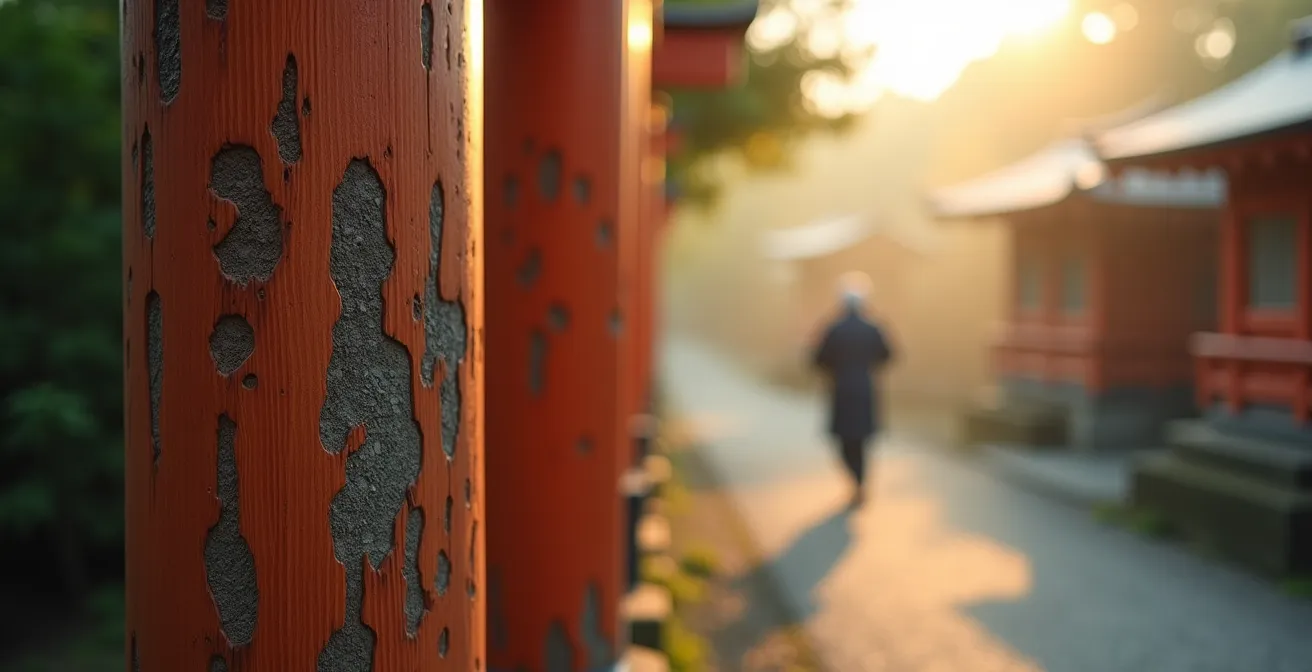
Instead of fighting the commute, use this “golden hour” for activities in the immediate vicinity of your hotel. This is the perfect time for a peaceful and crowd-free experience. Consider these alternatives:
- Explore your hotel’s neighborhood as it wakes up, observing local life unfold.
- Visit a nearby shrine or temple for serene morning photography before anyone else arrives.
- Enjoy a leisurely, unhurried breakfast at a local café, planning your day’s strategy.
- Use the time for practical errands, like visiting a convenience store to reload an IC card.
By simply waiting until after 9:00 AM to start your cross-town journey, you trade a stressful, inefficient ordeal for a calm, pleasant start to your day and a much faster, more comfortable train ride.
Key Takeaways
- Audit for ‘time taxes,’ not just sights. The real cost of an activity includes transit, queues, and recovery time.
- Implement the ‘hub-and-spoke’ model and neighborhood clustering to slash hours of wasted transit time.
- Actively manage your ‘visual diet’ by alternating high-stimulation and low-stimulation activities to prevent sensory burnout.
7 Days or 14:How Queueing Like a Local Saves You Time at Train Stations
Regardless of your trip’s duration, the cumulative minutes saved at Japan’s train stations can add up to hours of reclaimed exploration time. Tourists often waste significant time in queues or through inefficient platform navigation, mistakes that locals instinctively avoid. Adopting a few simple habits can transform your station experience from a point of friction into a seamless transition. The key is preparation and observation.
One of the biggest time sinks is buying tickets. Instead of lining up at station machines during peak times, a smarter approach is to purchase next-day Shinkansen tickets during off-peak hours, like mid-afternoon. Furthermore, reload your IC card (like Suica or Pasmo) at a convenience store, where there is rarely a queue, instead of at the station’s busy machines. Travel efficiency experts estimate that you can save up to 30 minutes per long-distance ticket purchase by avoiding peak morning queues.
Platform efficiency is another critical area. Before you even descend to the Shinkansen platform, check your ticket for your assigned car number. On the platform, look for the markings on the ground that indicate exactly where each car will stop. By positioning yourself correctly before the train arrives, you avoid the last-minute scramble and can board smoothly and without stress. For local trains, observe how commuters line up in orderly queues at designated points on the platform and follow their lead. These small acts of preparation are the difference between a frantic and a fluid travel experience.
Finally, use station lockers strategically. They are an invaluable resource for day trips, but they fill up quickly. If you plan to use one, make it your first stop upon arriving at a station in the morning when availability is highest. These seemingly minor hacks are the foundation of efficient travel in Japan, allowing you to move with the same purpose and ease as a local.
Stop adding to your itinerary. Start auditing it. Apply these principles of time taxes, clustering, and pacing to your plan now, and you will reclaim your trip from the threat of burnout, ensuring your 10 days in Japan are as rewarding in reality as they are on paper.